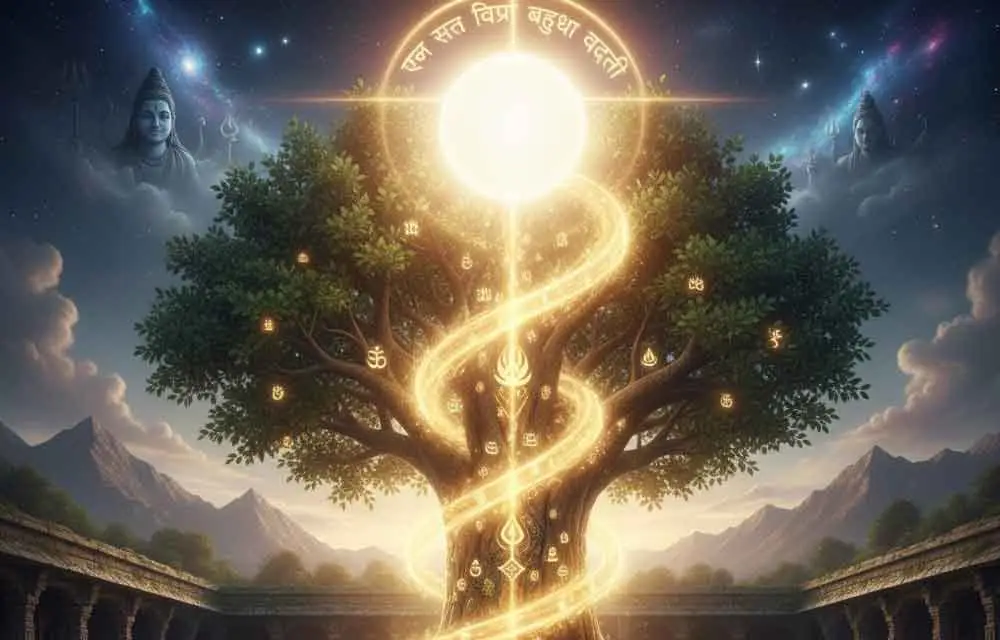
From Upanishads to Quantum Physics: Schrödinger’s Vision
Erwin Schrödinger and Vedanta: How the Upanishads Shaped Quantum Physics In the turbulent world of 20th-century physics, where reality seemed to dissolve into…

Erwin Schrödinger and Vedanta: How the Upanishads Shaped Quantum Physics
In the turbulent world of 20th-century physics, where reality seemed to dissolve into probabilities and waves, one brilliant mind found profound solace—and inspiration—in ancient Indian wisdom. Erwin Schrödinger, the Nobel Prize-winning physicist behind the famous Schrödinger's equation, once declared:
“Vedanta teaches that consciousness is singular, all happenings are played out in one universal consciousness and there is no multiplicity of selves.”
This wasn't a passing fancy. Schrödinger's deep immersion in Vedanta and the Upanishads didn't just comfort him amid the paradoxes of quantum mechanics; it profoundly influenced how he interpreted the universe. The ancient Hindu philosophy of non-duality bridged the gap between Eastern mysticism and Western science, revealing timeless truths about reality, consciousness, and unity.
A Physicist's Journey into Ancient Wisdom
Born in 1887 in Vienna, Erwin Schrödinger was exposed to Indian philosophy early through the works of Arthur Schopenhauer, who himself drew heavily from the Upanishads. By the 1920s, as Schrödinger revolutionized physics with his wave mechanics formulation of quantum theory, he was already grappling with Vedantic ideas.
Schrödinger kept copies of the Upanishads and Bhagavad Gita by his bedside. He named his dog Atman—a nod to the individual soul in Hindu thought. In his personal essays and books like My View of the World (1961), he openly embraced Vedanta's core teaching: the unity of all existence. He saw in Advaita Vedanta (non-dualistic philosophy) a framework that resolved the bewildering implications of quantum physics, where particles exist in superpositions and the act of observation seems to shape reality.
His biographer Walter Moore noted a "clear continuity" between Schrödinger's understanding of Vedanta and his scientific breakthroughs. The physicist even remarked that the "unity and continuity of Vedanta are reflected in the unity and continuity of wave mechanics."
Key Parallels: Quantum Mysteries and Vedantic Truths
The resonances between quantum physics and Vedanta are strikingly profound, especially in concepts of consciousness, unity, and the role of the observer.
1. The Singular Consciousness: No Multiplicity of Selves
Schrödinger was troubled by quantum mechanics' implication of multiple realities (as in his famous cat paradox). How could the world be consistent for all observers? He found the answer in Vedanta:
“The multiplicity is only apparent. This is the doctrine of the Upanishads... Vedanta teaches that consciousness is singular.”
In Advaita Vedanta, there is only one universal consciousness—Brahman—manifesting as the many. The perceived separation of individual selves (Atman) is an illusion (Maya). Schrödinger saw this mirroring quantum theory's wave function, where all possibilities coexist in a unified field until "collapsed" by observation.
2. Tat Tvam Asi: "Thou Art That" and the Observer Effect
One of the most iconic Upanishadic mahavakyas (great sayings) is Tat Tvam Asi—"That Thou Art." It declares the identity of the individual self (Atman) with the ultimate reality (Brahman). Schrödinger frequently referenced this:
“This life of yours... is not merely a piece of this entire existence, but in a certain sense the whole... tat tvam asi, this is you.”
In quantum mechanics, the observer effect shows that measuring a particle alters its state—reality isn't independent of observation. Vedanta parallels this: the world of multiplicity arises from consciousness. The observer and observed are not separate; they are one. As Schrödinger noted, quantum physics eliminates the gap between subject and object, echoing the Upanishads' assertion that "the observer and the observed are the same."
3. Unity in Wave Mechanics and Brahman
Schrödinger's equation describes particles as waves in a unified field. He explicitly linked this to Vedanta:
“The unity and continuity of Vedanta are reflected in the unity and continuity of wave mechanics. This is entirely consistent with the Vedanta concept of All in One.”
Just as Brahman is the unchanging substratum behind the illusory world of forms, the quantum wave function underlies all apparent particles and events.
Eternal Wisdom: Bridging East and West
Schrödinger's fascination wasn't unique—fellow quantum pioneers like Niels Bohr and Werner Heisenberg also drew from Eastern thought. But Schrödinger went deepest, calling for a "blood transfusion from the East to the West" to revitalize science.
Today, as quantum physics probes consciousness and reality's foundations, Vedanta's insights feel more relevant than ever. The Upanishads, composed millennia ago, anticipated a universe of interconnected oneness—a vision Schrödinger helped bring into modern science.
In the words of this quantum visionary: The ancient wisdom of the Upanishads offers the "only solution" to the paradoxes of multiplicity and consciousness. Perhaps, in uniting Atman and Brahman, we find not just the secret of the quantum world, but the eternal truth of existence itself.
Explore more on Hindu philosophy, quantum insights, and spiritual science at www.hindutone.com.
Keywords: Schrödinger Vedanta, Schrödinger Upanishads, Quantum Physics Hinduism, Tat Tvam Asi quantum, Vedanta consciousness
Also read: quantum computing explained for Hindus.
Frequently Asked Questions
How did Erwin Schrödinger connect Vedanta with quantum physics?
Schrödinger saw Advaita Vedanta's non-duality as a framework for quantum paradoxes. He said the unity and continuity of Vedanta are reflected in the unity and continuity of wave mechanics.
What did Schrödinger mean by 'consciousness is singular'?
He held that all happenings play out in one universal consciousness, with no multiplicity of selves. In Advaita this is Brahman appearing as the many, and the separate self is Maya.
What does Tat Tvam Asi mean and why did Schrödinger quote it?
Tat Tvam Asi means 'That Thou Art', the Upanishadic mahavakya declaring the individual self (Atman) identical with Brahman. Schrödinger quoted it to say a single life is, in a sense, the whole of existence.
Did Schrödinger really study Indian philosophy?
Yes. He was introduced to it early through Schopenhauer, kept the Upanishads and Bhagavad Gita by his bedside, and named his dog Atman. He wrote about Vedanta in My View of the World (1961).
What is the 'blood transfusion from the East' Schrödinger asked for?
Schrödinger called for a 'blood transfusion from the East to the West' to revitalize Western science with Eastern thought. Niels Bohr and Werner Heisenberg also drew on Eastern ideas, though he went deepest.
Share this with family and friends
Send it on WhatsApp, post it, or copy the link.
More from Hindutone
- What Does Sarva Mangala Mean? | Significance and Spiritual Meaning in Lalita Sahasranama
- Vat Savitri Vrat & Snana Yatra June 29 2026 – Complete Devotional Guide: Savitri’s Story, Rituals & Jagannath Significance
- Nirjala Ekadashi June 25 2026 – The King of Ekadashis: Complete Guide with Bhima’s Story, Rituals, Mantras & Benefits
- Masik Shivaratri June 13 2026 – Complete Devotional Guide: Date, Story, Rituals, Mantras & Benefits
- Parama Ekadashi June 11 2026 – Complete Devotional Guide: Date, Story, Rituals, Mantras & Benefits