Shocking Seizure of 1.89 Lakh Kg Cow Meat in Andhra Pradesh: Alleged Political Links Ignite Outrage Among Hindu Groups
Visakhapatnam/Bapatla | November 10, 2025 In a dramatic operation that has sent shockwaves across Andhra Pradesh, the Directorate of Revenue Intelligence (DRI)…
Visakhapatnam/Bapatla | November 10, 2025 In a dramatic operation that has sent shockwaves across Andhra Pradesh, the Directorate of Revenue Intelligence (DRI)…
Visakhapatnam/Bapatla | November 10, 2025
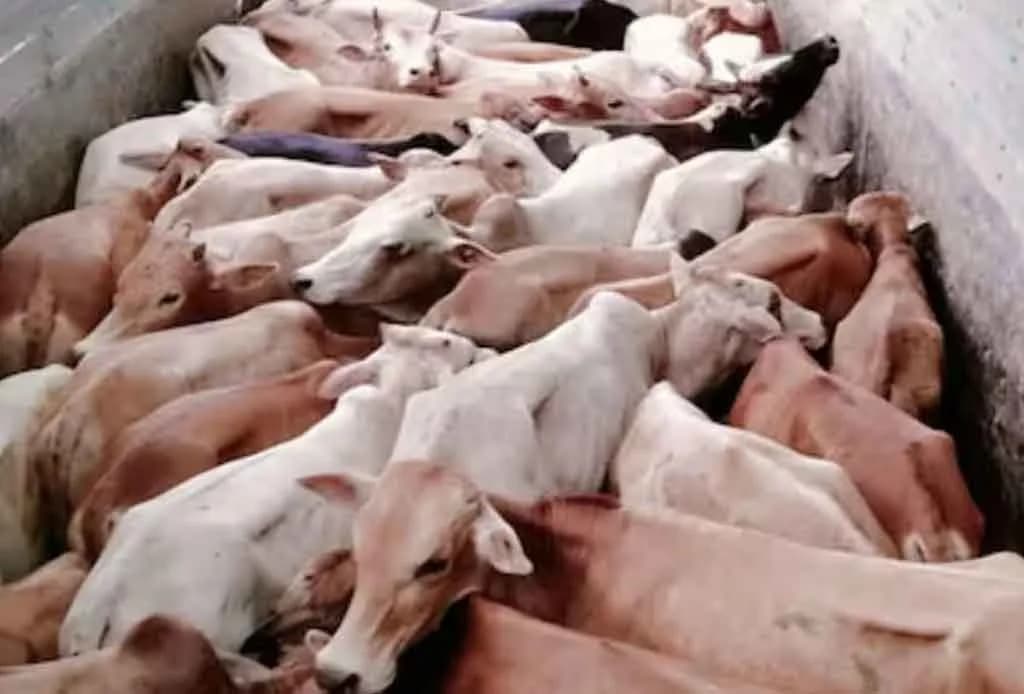
In a dramatic operation that has sent shockwaves across Andhra Pradesh, the Directorate of Revenue Intelligence (DRI) has uncovered a massive cow meat smuggling racket, seizing an astonishing 1.89 lakh kilograms of illegal meat from a cold storage facility in Visakhapatnam’s Anandapuram region near Shontyam.
The discovery has sparked a storm of outrage among Hindu religious organizations and local communities, who have condemned the desecration of the sacred cow — revered as Gomata, the embodiment of motherhood and purity in Sanatana Dharma.
The Raid and Revelations
The seizure took place at Mitra Cold Storage, where officials found vast quantities of illegally stored and transported cow meat, allegedly meant for smuggling across state borders. The Anandapuram Police have registered a case and initiated a full-scale investigation to trace the network behind this operation.
Preliminary findings suggest the existence of a well-organized interstate syndicate, exposing deep-rooted challenges in enforcing cow protection laws.
Adding fuel to the fire, several viral reports circulating on social media have alleged links between the operation and Subrahmanya Gupta, said to be a close associate of a Bapatla TDP MLA. Though these claims remain unverified, they have triggered intense public debate and condemnation, with netizens demanding transparency and accountability from political leaders.
Fury from Religious and Local Communities
Prominent Hindu groups, including local Dharma Raksha Samitis, have denounced the incident in the strongest terms. Peaceful protests and candlelight vigils have been organized across Bapatla and Visakhapatnam, urging authorities to take swift and uncompromising action against those involved.
“The cow is not just an animal but a divine mother in our scriptures. From the Vedas to the Puranas, her sanctity is absolute,”
— said a spokesperson for a Bapatla-based Hindu organization.
Residents have also raised serious concerns over alleged administrative negligence, questioning how such a massive illegal stockpile went unnoticed for so long.
“This is not just a crime—it’s a betrayal of our cultural values and faith,” lamented one community leader.
Gomata: The Eternal Symbol of Dharma
In the heart of Hindu philosophy, the cow represents Ahimsa (non-violence), motherhood, and sustenance. Ancient scriptures like the Rig Veda and Manusmriti extol her as the nourisher of life — providing milk, fuel, and even medicine.
This shocking incident serves as a sobering reminder of the continued need to protect Gomata and uphold the values of Dharma amid modern challenges.
A Call to Action
Hindutone appeals to all devotees and Dharma followers to unite in strengthening cow protection initiatives and supporting sanctuaries dedicated to their welfare.
As the auspicious season unfolds, let us reaffirm our collective resolve to preserve compassion, sanctity, and reverence for the sacred mother — Gomata.
Why is the Cow Sacred in Sanatana Dharma? The Scriptural Foundation
The veneration of the cow in Hindu tradition is not a matter of custom alone but is grounded in some of the oldest layers of Vedic and Puranic literature. The Rigveda (6.28) dedicates an entire sukta — the Gavishthira — to the cow, describing her as Aditi, the boundless mother, and as Aghnya, literally 'that which must not be slain.' The Atharvaveda (12.4) reinforces this prohibition explicitly, listing the cow among beings whose killing invites severe karmic consequence.
In the Mahabharata's Anushasana Parva, Bhishma Pitamaha enumerates to Yudhishthira the immeasurable merits of Go-seva — service to the cow — and equates her body with the entire cosmos, with thirty-three crore devatas said to reside within her. The Srimad Bhagavatam similarly portrays Surabhi, the divine wish-fulfilling cow, as an eternal companion of Lord Krishna in Goloka Vrindavana, underscoring that her sanctity is inseparable from devotion to the Supreme.
The title Gomata — cow as mother — captures a central theological idea: just as a mother nourishes her children, the cow sustains civilization through her five gifts collectively called Panchagavya (milk, curd, ghee, urine, and dung), each of which has both ritual and practical applications described in the Charaka Samhita and Sushruta Samhita of Ayurveda.
Cow Protection Laws in India: What the Legal Framework Says
Article 48 of the Constitution of India, under the Directive Principles of State Policy, explicitly directs the State to 'take steps for preserving and improving the breeds of cattle and prohibit the slaughter of cows and calves and other milch and draught cattle.' While Directive Principles are not directly enforceable in court, they form the moral and legislative basis on which multiple states have enacted stringent cow-slaughter prevention acts.
Andhra Pradesh operates under the Andhra Pradesh Prevention of Cow Slaughter and Animal Preservation Act, 1977, which prohibits the slaughter of cows, calves of cows, and calves of she-buffaloes. Violations can attract imprisonment and heavy fines. The seizure at Mitra Cold Storage in Anandapuram — involving nearly 1.89 lakh kilograms — indicates a large-scale and systematic flouting of these provisions, which investigators must now trace back through the supply and transport chain.
Interstate smuggling of cow meat adds a further layer of legal complexity, typically invoking provisions of the Prevention of Cruelty to Animals Act, 1960, the Food Safety and Standards Act, 2006, and potentially the Foreign Trade (Development and Regulation) Act if export is involved. The role of the Directorate of Revenue Intelligence (DRI) — a central agency that usually monitors customs and smuggling at the national level — suggests investigators suspect cross-border or export dimensions to this racket.
Historical Context of Cow-Smuggling Crackdowns in Andhra Pradesh and Telangana
Seizures of illegally transported cattle and beef have been reported periodically across the combined Andhra region over the past two decades, but operations of the scale uncovered in Visakhapatnam's Anandapuram are rare. Earlier crackdowns along the National Highways connecting Andhra Pradesh to Odisha and Tamil Nadu have revealed the use of refrigerated trucks under falsified permits, a modus operandi consistent with the cold-storage facility model found at Mitra Cold Storage.
Religious organizations such as the Vishwa Hindu Parishad (VHP) and various state-level Gau Raksha Dals have repeatedly submitted memoranda to successive Andhra Pradesh governments highlighting gaps in inspection mechanisms at checkposts and cold-storage licensing. The current seizure, if the alleged political links are substantiated by investigation, would represent precisely the kind of systemic failure these groups have warned against.
Historically, cities like Visakhapatnam, with their major port infrastructure, have been flagged as potential transit hubs for illegally processed animal products destined for overseas markets. The DRI's involvement lends credibility to concerns that this is not an isolated local violation but part of a broader network requiring coordinated central and state response.
What is Gau Raksha and How Have Hindu Organizations Responded Across India?
Gau Raksha — literally 'protection of the cow' — is regarded in Dharmic tradition as a form of dharmic duty (dharma-kartavya) inseparable from broader ecological and spiritual well-being. The tradition traces directly to Lord Krishna's identity as Govinda and Gopala, names meaning 'protector and nourisher of cows,' and to the importance given to Go-daan (gifting a cow) as among the highest acts of charity in texts such as the Dharmasindhu and Smriti Chandrika.
In contemporary India, Gau Raksha Samitis and Dharma Raksha Dals operate across virtually every state, functioning as community-level watchdog organizations that file complaints, organize protests, and sometimes coordinate with law enforcement. The groups in Bapatla and Visakhapatnam who held candlelight vigils following this seizure are part of this wider network, whose legitimacy derives from centuries of tradition even as their activities are now mediated through modern civic and legal channels.
Notable precedents for Hindu organizational response to similar incidents include large-scale dharnas (sit-in protests) at district collectorates and representations to state Governors demanding FIRs under cow-slaughter acts. Religious leaders from the Shankaracharya tradition and various Vaishnava Peethas have in the past issued statements reminding political parties that Go-hatya (cow-slaughter) is not merely a legal infraction but a spiritual transgression with societal consequences according to Dharmashastra.
The Panchagavya Tradition: Why Cow Products Hold Cultural and Ritual Significance
Central to understanding the depth of Hindu outrage over incidents like the Anandapuram seizure is the concept of Panchagavya — the five products of the cow: milk (ksheera), curd (dadhi), ghee (ghrita), cow urine (gomutra), and cow dung (gomaya). The Sushruta Samhita and various Grihyasutras prescribe Panchagavya in purificatory rituals (prayaschitta), temple consecrations (pratishtha), and medicinal formulations, making the cow central not just to worship but to everyday sacred life.
Ghee offered into the Vedic homa (fire ritual) is considered the medium through which prayers reach the devatas; the Taittiriya Samhita specifies Go-ghrita as the preferred oblation. In many South Indian temples, including those managed by the Tirumala Tirupati Devasthanams (TTD), the daily Abhisheka of the presiding deity incorporates cow's milk and Panchagavya as non-negotiable liturgical elements. Any disruption to the ethically and religiously sanctioned supply of these products is therefore felt as an injury to living religious practice, not merely a sentimental concern.
This layered cultural reality explains why the discovery of nearly 1.89 lakh kilograms of cow meat in a single cold storage facility generates a response that goes far beyond a standard law-enforcement story — it strikes at the heart of a living tradition that has been continuously practiced from the time of the Vedas to the present day.
Frequently Asked Questions
What is Shocking Seizure of 1.89 Lakh Kg Cow Meat in Andhra?
Visakhapatnam/Bapatla | November 10, 2025 In a dramatic operation that has sent shockwaves across Andhra Pradesh, the Directorate of Revenue Intelligence (DRI) has uncovered a massive cow meat smuggling racket, seizing an astonishing 1.89 lakh kilograms of illegal meat from a cold storage facility in Visakhapatnam’s Anandapuram region near Shontyam. The disc
What are the key points about Shocking Seizure of 1.89 Lakh Kg Cow Meat in Andhra?
The Raid and Revelations The seizure took place at Mitra Cold Storage , where officials found vast quantities of illegally stored and transported cow meat, allegedly meant for smuggling across state borders. The Anandapuram Police have registered a case and initiated a full-scale investigation to trace the network behind this operation.
Why does Shocking Seizure of 1.89 Lakh Kg Cow Meat in Andhra matter in Hinduism?
It reflects core values of Sanatana Dharma and offers practical and spiritual guidance that remains relevant across generations.
How can devotees apply Shocking Seizure of 1.89 Lakh Kg Cow Meat in Andhra in daily life?
By reflecting on its teaching, incorporating the related practices or observances into daily routine, and approaching it with sincere devotion and understanding.
You might also like

Purushottam Maas 2026: Lord Vishnu's Sacred Gift of Spiritual Multiplication & Divine Grace
Hindu Priest Jobs New Zealand 2026 — Auckland, Wellington, Christchurch Vacancies & NZ Religious Worker Visa Guide

Hindu Priest Jobs Malaysia 2026 — Batu Caves, KL, Penang Vacancies & Tamil Hindu Career Guide