The Sacred Tulasi: A Divine Herb in Hinduism and Ayurveda
🌺 Spiritual Significance in Hinduism 1️⃣ Symbol of Devotion: Tulasi (Holy Basil) is revered as the earthly manifestation of Goddess Lakshmi and a consort of…
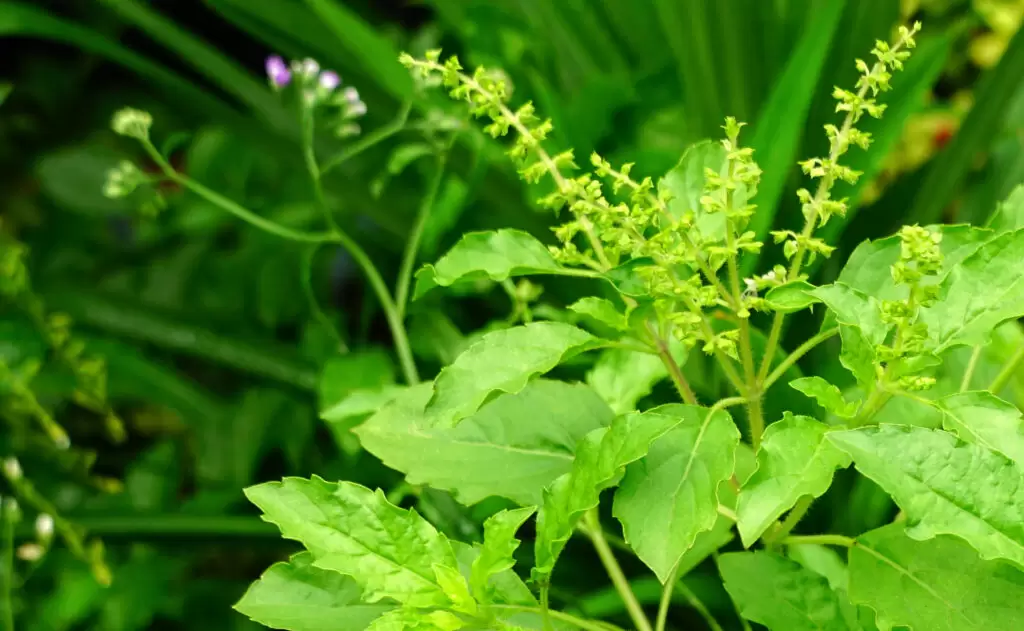
🌺 Spiritual Significance in Hinduism
1️⃣ Symbol of Devotion: Tulasi (Holy Basil) is revered as the earthly manifestation of Goddess Lakshmi and a consort of Lord Vishnu. Worshiping Tulasi brings peace, prosperity, and spiritual harmony.
2️⃣ Essential in Rituals: Tulasi leaves are indispensable in Hindu pujas, offered to deities like Vishnu and Krishna, signifying purity and devotion.
3️⃣ Sacred Protector: A Tulasi plant at home is believed to dispel negative energy and attract positive vibrations.
🌿 Tulasi in Ayurveda
1️⃣ Immunity Booster: Tulasi is packed with antioxidants and essential oils that strengthen the immune system and combat infections.
2️⃣ Stress Reliever: Known as an adaptogen, Tulasi helps reduce stress and promote mental well-being. 3️⃣ Natural Detoxifier: It purifies the blood, supports liver health, and promotes detoxification.
4️⃣ Respiratory Health: Tulasi is a natural remedy for cough, cold, asthma, and other respiratory issues.
5️⃣ Skin and Hair Benefits: Its antibacterial properties help clear skin and promote healthy hair growth.
🌼 Tulasi at Home
Planting Tulasi: A Tulasi plant in the courtyard is a mark of purity and is said to bring good fortune. Daily Rituals: Lighting a diya near the Tulasi plant and offering water strengthens spiritual and physical health.
💡 Tulasi bridges the realms of spirituality and science, embodying health, prosperity, and divine blessings. Let the sacred Tulasi enrich your life! 🌟
What does the Skanda Purana reveal about the origin of Tulasi?
The Skanda Purana contains the most detailed account of Tulasi's divine origin. According to this scripture, Tulasi was born from the churning of the cosmic ocean — the Samudra Manthan — and was immediately accepted by Lord Vishnu as supremely dear to him. The text declares: 'Tulasi is auspicious in all parts — root, branch, leaf, flower, and fruit — and the soil where Tulasi grows is holy ground.'
The Padma Purana further narrates the story of Vrinda, a devoted wife whose unwavering piety made her husband Jalandhara nearly invincible. Vishnu, to restore cosmic order, assumed a disguise that broke her chastity; grief-stricken, Vrinda cursed Vishnu before merging into the divine. Out of her body grew the Tulasi plant, and Vishnu, honoring her devotion, declared that no offering to him would ever be complete without her leaves. This origin myth explains why Tulasi is considered both a form of Lakshmi and a sacred widow-consort, worshipped with equal reverence.
How is Tulasi Vivah observed and what is its deeper meaning?
Tulasi Vivah is the ceremonial marriage of the Tulasi plant to Lord Vishnu — typically represented by a shaligrama stone or an image of Krishna — celebrated on the eleventh or twelfth day of the bright fortnight of Kartika (October–November). The ritual formally marks the end of Chaturmas, the four-month period during which auspicious events like marriages are traditionally paused. By performing this vivah, devotees symbolically 'reopen' the cosmic calendar for weddings and new beginnings.
The ceremony follows full wedding rites: the Tulasi plant is decorated with a sari, sugarcane stalks are placed around the Vrindavana (the masonry planter), and priests chant Vedic mantras. In many households, especially across Maharashtra, Gujarat, and Karnataka, the event is celebrated with the same festivity as a family wedding. Theologically, the ritual affirms that Tulasi is not merely a plant but a nitya-suhari — an eternal companion of Vishnu — and that tending to her is an act of direct service to the Lord himself.
Which specific Sanskrit names for Tulasi carry layered devotional meanings?
Classical texts assign Tulasi more than twenty Sanskrit names, each encoding a specific quality. 'Vishnu-priya' means 'beloved of Vishnu'; 'Haripriya' carries the same meaning with emphasis on the liberating aspect of the divine. 'Vrindavani' ties her identity to Vrindavana, the forest of Krishna's childhood, while 'Surasa' — meaning 'rich in essence or juice' — bridges her spiritual and medicinal identities in a single syllable.
The name 'Apamarga' (one who removes obstacles) is less commonly cited but appears in several Ayurvedic nighantus (botanical lexicons). Perhaps most theologically rich is the name 'Tulasi' itself: the root 'tula' means comparison or balance, and the suffix suggests that nothing is comparable to her — she is beyond measure. Chanting these names during the morning water-offering (jalaabhisheka) is considered equivalent to reciting the Vishnu Sahasranama by some devotional commentaries.
What does Charaka Samhita and classical Ayurveda say about Tulasi's healing properties?
The Charaka Samhita, one of the foundational texts of Ayurveda, classifies Tulasi (Ocimum tenuiflorum) under the category of herbs that balance Vata and Kapha doshas while generating mild heat (ushna virya). It is particularly commended for Kasa (cough), Shwasa (asthma), and Jwara (fever). The herb's essential oils — primarily eugenol, rosmarinic acid, and ursolic acid — are responsible for these classical actions and have been subjects of modern phytochemical study as well.
Sushruta Samhita recommends Tulasi leaves processed with honey and ginger as a first-response treatment for early-stage respiratory infections, a preparation still common in Indian households. Ayurvedic practitioners distinguish between two primary varieties: Krishna Tulasi (dark-purple leaves, considered more potent medicinally) and Rama Tulasi (green leaves, preferred for daily worship and culinary use). A third variety, Vana Tulasi, grows wild and is used in tribal herbal medicine across central India. Each variety is considered a distinct dravya (medicinal substance) with overlapping but not identical therapeutic profiles.
Which famous Tulasi shrines and Vrindavanas hold pan-Hindu pilgrimage significance?
The most celebrated Tulasi-related sacred site is Vrindavana in Mathura district, Uttar Pradesh, where the entire town derives its name from the Tulasi groves (vrinda means Tulasi, vana means forest) that once surrounded Krishna's childhood pastimes. The Banke Bihari Temple and the ISKCON Sri Krishna-Balarama Mandir in Vrindavana both maintain large Tulasi gardens where pilgrims circumambulate the plants as a devotional practice called Tulasi pradakshina.
In South India, the Srirangam Ranganathaswamy Temple in Tamil Nadu — one of the 108 Divya Desams sung by the Alvars — maintains a dedicated Tulasi garden whose leaves are used exclusively for the daily abhisheka and naivedya of Lord Ranganatha. The Tirupati Venkateswara Temple in Andhra Pradesh similarly uses Tulasi garlands (Tulasi mala) in every formal alankara (decoration) of the deity, and devotees purchase these garlands as prasadam. These living traditions underscore that Tulasi worship is not symbolic alone but forms the material backbone of daily temple liturgy across India.
Are there any scriptural guidelines on when Tulasi leaves should not be plucked?
Hindu scriptural tradition — particularly the Skanda Purana and various Dharmashastra texts — specifies several occasions when plucking Tulasi leaves is prohibited: on Dvadashi (the twelfth lunar day), on Sundays, during solar and lunar eclipses, at twilight (sandhya kala), and at night. The reasoning given is that Tulasi, being a living form of the goddess, enters a state of rest or heightened sanctity at these times, and disturbing her would be an act of adharma.
A practical workaround observed in many Vaishnava households is to pluck leaves in advance on an auspicious day and preserve them in water or with a tulasi-manjari (flowering top) to be offered on restricted days. Temple priests at large Vishnu shrines such as the Udupi Sri Krishna Matha in Karnataka follow a strict daily schedule for leaf-plucking, performed only during the brahma muhurta (roughly 90 minutes before sunrise). This careful stewardship reflects the broader Hindu understanding that even in devotional service, the means of worship must honor the sanctity of the object being offered.
Frequently Asked Questions
Why is Tulasi worshipped in Hinduism?
Tulasi (holy basil) is revered as the earthly manifestation of Goddess Lakshmi and a consort of Lord Vishnu. Worshipping her is believed to bring peace, prosperity and spiritual harmony.
What is Tulasi Vivah and when is it celebrated?
Tulasi Vivah is the ceremonial marriage of the Tulasi plant to Lord Vishnu, represented by a shaligrama stone or an image of Krishna. It is held on the eleventh or twelfth day of the bright fortnight of Kartika (October-November) and marks the end of Chaturmas.
How is the origin of Tulasi commonly told?
As commonly told, the Padma Purana narrates that Vrinda, a devoted wife, cursed Vishnu and merged into the divine, and the Tulasi plant grew from her body. Vishnu then declared that no offering to him is complete without Tulasi leaves.
When should Tulasi leaves not be plucked?
Scriptural tradition prohibits plucking Tulasi on Dvadashi, on Sundays, during solar and lunar eclipses, at twilight and at night. Many Vaishnava households pluck leaves in advance on an auspicious day and keep them in water.
What is the difference between Krishna Tulasi and Rama Tulasi?
Krishna Tulasi has dark-purple leaves and is considered more potent medicinally, while Rama Tulasi has green leaves and is preferred for daily worship and culinary use. A third variety, Vana Tulasi, grows wild.
What daily ritual can be done at a Tulasi plant at home?
Lighting a diya near the Tulasi plant and offering water is the daily ritual described. A Tulasi plant in the courtyard is seen as a mark of purity and good fortune, and offering water is also done as the morning jalaabhisheka.
Share this with family and friends
Send it on WhatsApp, post it, or copy the link.
More from Hinduism
- AI and the Sanskrit Revival in 2026: Language Models, Manuscript OCR, Translation Tools and What AI Still Gets Wrong
- Can a Robot Perform Puja? Robot Aarti, AI in Rituals and What Hindu Tradition Says
- GitaGPT and AI Bhagavad Gita Chatbots: How Accurate Are They, and What Does Hindu Tradition Say?
- Robotic Elephants and AI in Hindu Temples: Kerala's Mechanical Tuskers, Tirumala's AI Command Centre and the Debate
- Quantum Computing Explained for Hindus: Qubits, Superposition and Entanglement, with Vedanta Analogies (Not Equivalences)
You might also like

Sacred Hindu Numbers: The Complete Story of 108 and Its Divine Significance

Ravivar — The Sacred Sunday: Complete Guide to Rituals, Surya Dev Worship, Arghya & Fasting for Hindus in India and Across the World
Shanivar — The Sacred Saturday: Complete Guide to Rituals, Shani Dev Worship, Peepal Tree Puja & Fasting for Hindus in India and Across the World