Why the World Is Turning to Hinduism Today
Why the World Is Turning to Hinduism Today : The Eternal Appeal of Sanatan Dharma In an era of rapid change, stress, and spiritual seeking, millions across the…

Why the World Is Turning to Hinduism Today : The Eternal Appeal of Sanatan Dharma
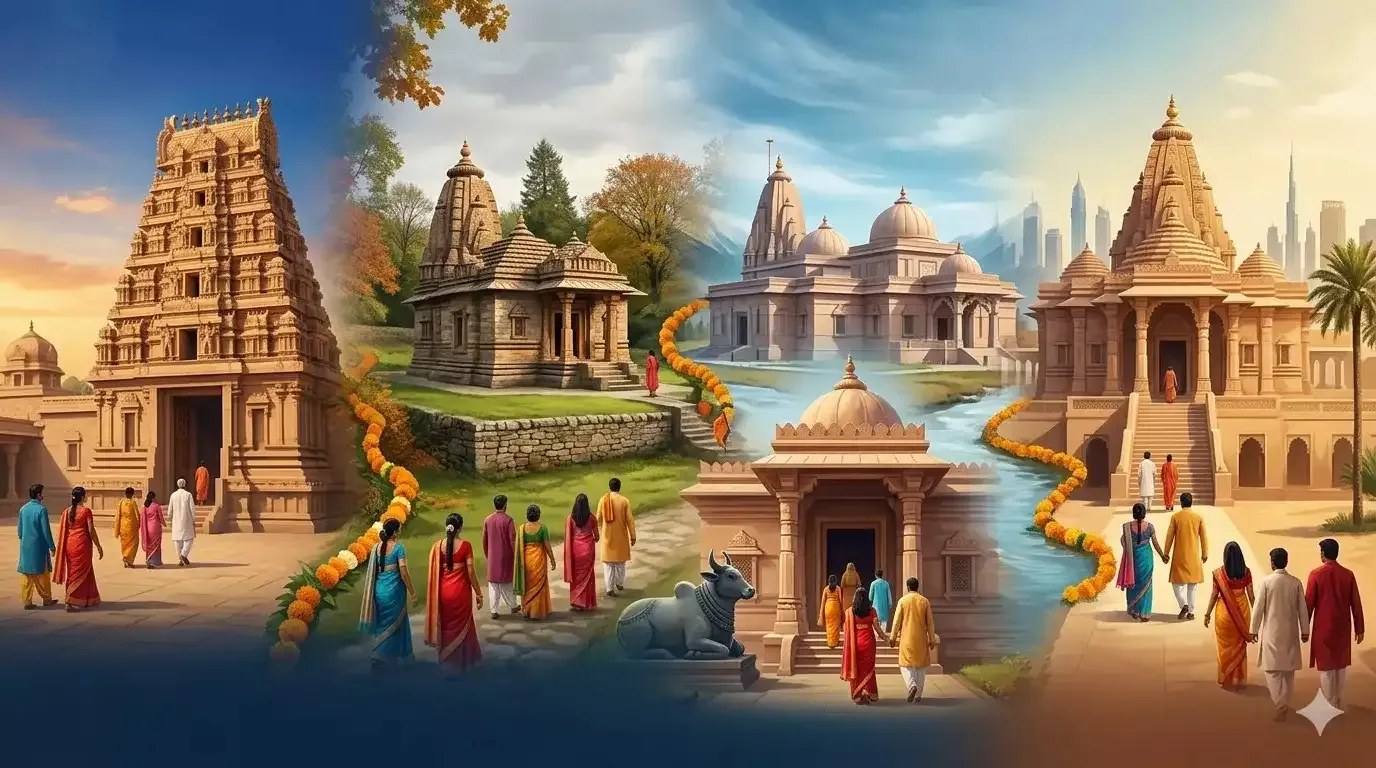
In an era of rapid change, stress, and spiritual seeking, millions across the globe are discovering the profound wisdom of Hinduism, also known as Sanatan Dharma – the eternal way of life. From bustling cities in the West to ancient ashrams in India, people from diverse backgrounds are embracing Hindu principles. But why this growing fascination? What draws celebrities, scientists, and everyday seekers to Hinduism when other religions exist?
Hinduism stands out for its unparalleled inclusivity and flexibility. Unlike many faiths, it declares: "Ekam Sat Vipra Bahudha Vadanti" – Truth is one, the wise call it by many names (Rig Veda). This philosophy welcomes all paths to the divine, without claiming exclusivity. It teaches that God manifests in countless forms – from the formless Brahman to personal deities like Shiva, Vishnu, Krishna, and Devi – allowing individuals to connect in ways that resonate personally.
The global surge in yoga and meditation, both rooted deeply in Hindu scriptures like the Yoga Sutras of Patanjali and the Upanishads, has been a gateway. Over 300 million people worldwide practice yoga today, seeking not just physical health but mental peace and spiritual awakening. Icons like Julia Roberts, who converted to Hinduism after filming Eat Pray Love, Russell Brand, and Hugh Jackman have openly shared how Hindu practices transformed their lives. Even The Beatles' pilgrimage to Rishikesh in the 1960s introduced Transcendental Meditation to the West, sparking a revolution in mindfulness.
Hinduism's emphasis on karma, dharma, and reincarnation offers logical answers to life's deepest questions: Why suffering? What is the purpose of existence? Its scientific alignment – concepts like cyclic time (yugas), vast cosmic scales in Puranas predating modern astronomy, and holistic wellness in Ayurveda – appeals to rational minds. In a world grappling with mental health crises, Hinduism's tools for inner peace are timeless remedies.
Even adherents of other religions find inspiration here. Christianity and Islam have drawn from Hindu ideas of non-violence (ahimsa) and universal brotherhood. Interfaith dialogues highlight how Hinduism's tolerance – revering Jesus and Prophet Muhammad as enlightened souls – fosters harmony. As Swami Vivekananda proclaimed at the 1893 Parliament of Religions, Hinduism teaches not just tolerance but universal acceptance.
Today, as materialism leaves many empty, Hinduism's focus on self-realization, devotion (bhakti), and service attracts seekers. It's not about conversion but realization – anyone can follow Sanatan Dharma while respecting their roots.
This growing global embrace reminds us of Hinduism's eternal relevance. To dive deeper, let's explore a timeless devotional legend that embodies its essence: the profound story of Prahlada and Narasimha, a tale of unwavering faith, divine protection, and triumph of devotion over evil.
The Divine Protection: The Complete Devotional Story of Prahlada and Lord Narasimha
Dear devotees, welcome to this sacred narration on Hindutone.com, your trusted companion in exploring the glorious depths of Sanatan Dharma. Today, we delve into one of the most inspiring and miraculous avatars of Lord Vishnu – the story of Narasimha, the half-man, half-lion incarnation, and his devoted young bhakta, Prahlada. This legend from the Bhagavata Purana teaches unbreakable faith, the power of devotion, and how the Lord rushes to protect His devotees, no matter the obstacles.
In the ancient times of Satya Yuga, there ruled a powerful asura king named Hiranyakashipu. He was the brother of Hiranyaksha, whom Lord Vishnu had slain in His Varaha (boar) avatar. Burning with revenge, Hiranyakashipu performed severe tapasya (austerities) to Lord Brahma for thousands of years. Pleased, Brahma granted him a boon: "You shall not be killed by man or beast, neither indoors nor outdoors, neither during day nor night, neither on land nor in sky nor water, and by no weapon."
Emboldened, Hiranyakashipu declared himself god, conquering the three worlds. He banned worship of Vishnu, demanding all bow to him alone. But destiny had other plans. His wife, Kayadhu, was pregnant during his penance. The devas, fearing his tyranny, abducted her briefly, but sage Narada sheltered her in his ashram.
There, Narada chanted Vishnu's glories daily. The unborn child absorbed these divine vibrations. Thus was born Prahlada, a soul eternally devoted to Lord Vishnu from the womb.
As a child, Prahlada's devotion shone brightly. While other children played, he sang Hari's names. Sent to guru Shukracharya's school (for asura children), Prahlada taught classmates: "O friends, human life is rare – chant Narayana's name, for He is the ultimate refuge."
Hiranyakashipu was furious. "Who taught you this Vishnu nonsense?" he roared.
Prahlada calmly replied, "Father, Vishnu is everywhere – in you, in me, in all creation. He is the Supreme Lord."
Enraged, the king tried to kill his son. First, he ordered elephants to trample him – but Prahlada chanted "Om Namo Narayanaya," and the beasts bowed gently.
Next, poisonous snakes were unleashed – yet they became garlands around his neck.
Thrown into fire, Prahlada emerged unscathed, praising Hari.
Cast from mountains, he landed softly, protected by Vishnu's grace.
Even Holika, his aunt with a fireproof boon, sat with him in blazing pyre – but her shawl flew to Prahlada, burning her instead while he remained cool.
Each attempt failed. Prahlada's faith grew stronger: "Father, surrender to Vishnu. Ego and anger lead to destruction."
Finally, Hiranyakashipu challenged: "Where is your Vishnu? Show him!"
Prahlada said, "He is in this pillar."
Mocking, the king struck the pillar with his mace. Lo! It burst open with a thunderous roar. Out emerged Lord Narasimha – neither fully man nor beast, with a lion's head and mane, human-like body, blazing eyes, and sharp claws.
It was twilight – neither day nor night.
Narasimha seized Hiranyakashipu at the threshold – neither indoors nor outdoors.
Placed him on His lap – neither land, sky, nor water.
With claws – no weapon – He tore open the demon's chest at dusk.
Thus, every condition of the boon was cleverly bypassed. The Lord protected His devotee while upholding Brahma's word.
Roaring victoriously, Narasimha's fury terrified even the devas. Only Prahlada approached fearlessly. "O Lord, calm Your anger. You are the protector of all."
Touched by pure bhakti, Narasimha placed Prahlada on His lap, blessed him: "Ask any boon."
Prahlada replied, "I seek nothing but eternal devotion to You. Liberate my father, for he was Your gatekeeper Jaya, cursed to be born as asura."
The Lord granted salvation to Hiranyakashipu and crowned Prahlada king, who ruled with dharma, spreading Vishnu bhakti.
This miraculous avatar teaches profound lessons:
- Unshakable Faith: Like Prahlada, true devotion overcomes all trials. Chant Narayana's name in adversity – protection comes.
- Divine Ingenuity: The Lord finds ways to save devotees, transcending logic.
- Bhakti Above All: Even a child’s pure love surpasses rituals or power.
- Non-Violence and Forgiveness: Prahlada prayed for his father's salvation, embodying ahimsa.
- Vishnu's Avatars: Narasimha, the fourth dashavatar, reminds us God incarnates to restore dharma.
Devotees worldwide celebrate Narasimha Jayanti (in Vaishakha month) with fasting, puja, and reciting Narasimha Kavacham for fear removal and protection.
Mantra for Protection: Ugram Veeram Mahavishnum Jvalantam Vishvato Mukham Nrisimham Bhishanam Bhadram Mrityur Mrityum Namamyaham
Chant this daily for courage and divine shield.
This story inspires millions, showing why Hinduism captivates hearts – its tales are not mere myths but living guides to devotion, resilience, and union with the Divine.
On Hindutone.com, we bring such eternal stories to nurture your spiritual journey. Explore more on Vishnu avatars, Prahlada bhajans, and Narasimha temples. Embrace Sanatan Dharma – the path of eternal bliss.
Jai Narasimha! Jai Prahlada! Om Namo Narayanaya!
Frequently Asked Questions
Why are people around the world embracing Hinduism?
Seekers are drawn to its inclusivity, its view that truth is one and called by many names, and its tools for inner peace. Yoga, meditation, karma, dharma and devotion offer answers to deep questions.
What role has yoga played in Hinduism's global appeal?
Yoga and meditation are rooted in the Yoga Sutras of Patanjali and the Upanishads, and over 300 million people worldwide practice yoga today. For many, it has been a gateway to Hindu thought.
Do you have to convert to follow Sanatan Dharma?
No. It is about realization, not conversion, and anyone can follow Sanatan Dharma while respecting their own roots.
What does "Ekam Sat Vipra Bahudha Vadanti" mean?
It is a Rig Veda declaration meaning "Truth is one, the wise call it by many names." It welcomes all paths to the divine without claiming exclusivity.
What is the story of Prahlada and Narasimha?
As commonly told in the Bhagavata Purana, the child devotee Prahlada survived every attempt by his father Hiranyakashipu to kill him. Vishnu then emerged from a pillar as Narasimha, half-man and half-lion, and defeated Hiranyakashipu at twilight.
When is Narasimha Jayanti observed and how?
It is observed in Vaishakha month. Devotees fast, perform puja and recite the Narasimha Kavacham for fear removal and protection.
Share this with family and friends
Send it on WhatsApp, post it, or copy the link.
More from Hinduism
- AI and the Sanskrit Revival in 2026: Language Models, Manuscript OCR, Translation Tools and What AI Still Gets Wrong
- Can a Robot Perform Puja? Robot Aarti, AI in Rituals and What Hindu Tradition Says
- GitaGPT and AI Bhagavad Gita Chatbots: How Accurate Are They, and What Does Hindu Tradition Say?
- Robotic Elephants and AI in Hindu Temples: Kerala's Mechanical Tuskers, Tirumala's AI Command Centre and the Debate
- Quantum Computing Explained for Hindus: Qubits, Superposition and Entanglement, with Vedanta Analogies (Not Equivalences)