
What Is Moksha? The Four Paths to Liberation in Hinduism — A Complete Devotional Guide
Table of Contents A Devotional Invocation Introduction: The One Thing Worth Wanting What Is Moksha?
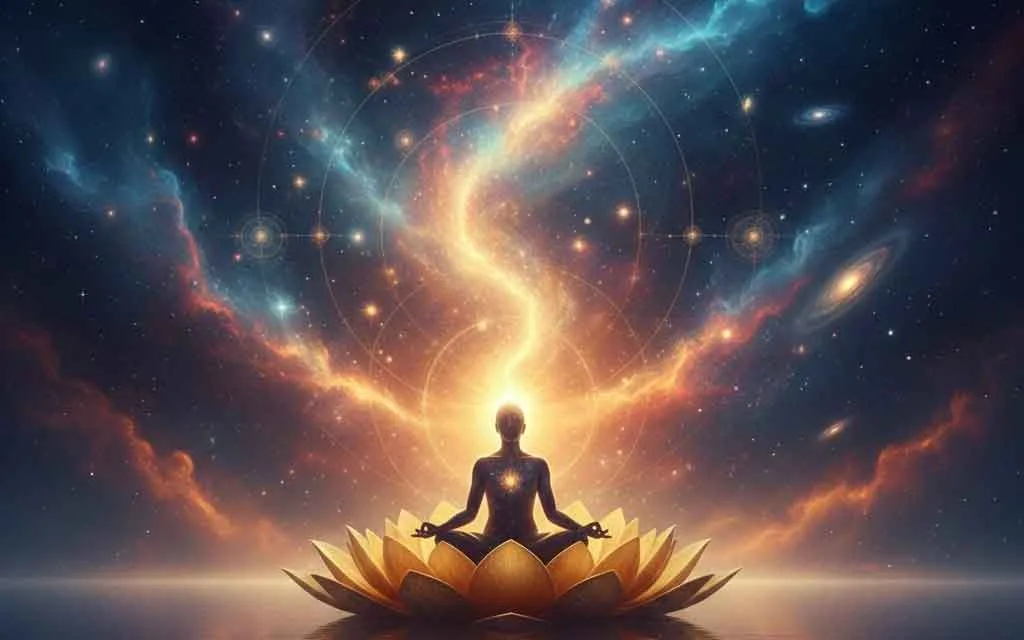
Table of Contents A Devotional Invocation Introduction: The One Thing Worth Wanting What Is Moksha?
Table of Contents
- A Devotional Invocation
- Introduction: The One Thing Worth Wanting
- What Is Moksha? The Meaning of Liberation
- What Moksha Is Not: Clearing the Misconceptions
- What Moksha Truly Is: The Vision of the Sages
- Moksha Across Hindu Traditions
- The Obstacles to Moksha: Avidya, Maya, and Ego
- Jivanmukti: Liberation While Still Alive
- Videhamukti: Liberation After Death
- The First Path — Jnana Yoga: The Liberation of Knowing
- The Second Path — Bhakti Yoga: The Liberation of Loving
- The Third Path — Karma Yoga: The Liberation of Serving
- The Fourth Path — Raja Yoga: The Liberation of Stillness
- Are the Four Paths Separate or One?
- Moksha in the Bhagavad Gita
- Moksha in the Upanishads
- The Role of the Guru on the Path to Moksha
- Grace and Self-Effort: The Two Wings of Liberation
- Signs of One Who Has Attained Moksha
- Frequently Asked Questions
- A Devotional Closing: The Homecoming
1. A Devotional Invocation {#invocation}
Aum. Sarve bhavantu sukhinah. Sarve santu niramayah. Sarve bhadrani pashyantu. Ma kashchid-duhkha-bhag-bhavet.
May all beings be happy. May all beings be free from disease. May all beings behold what is auspicious. May none suffer.
Aum Shanti. Shanti. Shanti. — Brihadaranyaka Upanishad
This prayer does not ask for victory. It does not ask for wealth, fame, or even personal salvation. It asks for the liberation of all beings — because the sage who has truly tasted freedom cannot bear that any soul should remain in the darkness of suffering and ignorance.
This is the spirit in which we approach the sacred subject of Moksha — not as a selfish escape from the world, but as the soul's great homecoming, the fulfillment of existence itself.
Namo namah. We bow. We begin.
2. Introduction: The One Thing Worth Wanting {#introduction}
There is a story told of the great sage Narada — the divine wanderer who moves freely between the worlds, his veena singing the names of God. One day, Narada comes before Lord Vishnu and asks a question that burns in every sincere human heart:
"Lord, what do all beings truly want? Beneath every prayer, every desire, every act of worship — what is the one longing at the root of all longing?"
Vishnu smiles — the smile of infinite compassion — and says simply:
"Freedom. Every soul wants to be free."
The beggar wants freedom from poverty. The king wants freedom from fear. The lover wants freedom from loneliness. The philosopher wants freedom from doubt. The dying person wants freedom from death. The grieving person wants freedom from sorrow.
Every desire, at its deepest root, is a disguised longing for Moksha — the final, complete, irreversible freedom of the soul from all limitation, all suffering, all death.
Hinduism is, at its heart, a civilization built around this one supreme aspiration. Every scripture, every ritual, every festival, every sacred image, every mantra and meditation — all of it exists to serve this single purpose: to help the soul find its way home.
This is the story of Moksha. And it is, ultimately, your story.
3. What Is Moksha? The Meaning of Liberation {#meaning}
The Word Itself
Moksha (Sanskrit: mokṣa) comes from the root muc — meaning to release, to free, to let go. It is also known by several other sacred names across Hindu traditions:
- Mukti — freedom, release
- Nirvana — the blowing out of the flame of desire (used in both Hindu and Buddhist traditions)
- Kaivalya — absolute aloneness, self-sufficiency of pure consciousness (Yoga philosophy)
- Apavarga — the cessation of the cycle of suffering (Nyaya-Vaisheshika tradition)
- Paramapada — the Supreme abode (Vaishnava tradition)
- Sayujya — merger with the Divine
- Videhamukti — liberation after the death of the body
- Jivanmukti — liberation while still living in the body
All these words point to the same essential truth: the soul's complete and final freedom from samsara — the cycle of birth, death, and rebirth driven by karma and desire.
The Four Goals of Human Life
To understand Moksha fully, we must place it within Hinduism's framework of the four goals (Purusharthas) of human existence:
Dharma, Artha, and Kama are the three worldly goals — all valid, all necessary for a full and dignified human life. But they are incomplete in themselves. No amount of righteous action, material security, or sensory pleasure can permanently satisfy the soul's deepest longing.
Only Moksha — the fourth and supreme goal — addresses the root cause of all suffering: the soul's ignorance of its own true, infinite, eternally free nature.
Moksha does not negate the other three goals. Rather, it reveals the luminous ground from which all genuine dharma, artha, and kama can flower without the distortion of ego and fear.
4. What Moksha Is Not: Clearing the Misconceptions {#what-moksha-is-not}
Before we can grasp what Moksha truly is, we must clear away some common misunderstandings — many of which arise from projecting Western theological categories onto a profoundly different tradition.
Moksha Is Not Heaven
Heaven (svarga) in Hinduism is a beautiful but temporary realm where souls enjoy the fruits of meritorious karma before taking their next birth. It is a rest stop on the journey — not the destination. Moksha is categorically different: it is the end of the journey itself, the permanent dissolution of the very conditions that make rebirth possible.
Moksha Is Not the Annihilation of the Self
Moksha is not the extinction of consciousness or the disappearance of the soul into nothingness. It is not a spiritual death. It is, in fact, the fullest possible awakening of consciousness — the discovery that what you truly are has always been infinite, whole, and free.
The wave does not "die" when it returns to the ocean. It discovers what it always was.
Moksha Is Not Only for Monks and Renunciants
One of Hinduism's most revolutionary teachings — delivered by Lord Krishna in the Bhagavad Gita — is that Moksha is available to anyone, in any station of life: a warrior on a battlefield, a mother in her kitchen, a merchant in his shop. What determines one's progress toward liberation is not the outer form of one's life but the inner quality of one's consciousness.
Moksha Is Not a Future Reward
Moksha is not something you receive later — after a long life of good deeds and spiritual practice. In the deepest Hindu understanding, Moksha is already your nature. You are already free. The spiritual path does not create liberation; it removes the ignorance that prevents you from recognizing the liberation that was never lost.
"You are already that which you seek." — Ramana Maharshi
Moksha Is Not Selfish Escape
The liberated soul does not abandon the world in cold indifference. The great sages and saints — Shankaracharya, Ramakrishna, Vivekananda, Ramana Maharshi — achieved liberation and then gave their entire lives in service to humanity. In the light of Moksha, compassion becomes natural and effortless, because the boundary between "self" and "other" has dissolved.
5. What Moksha Truly Is: The Vision of the Sages {#what-moksha-is}
After clearing away what Moksha is not, we approach — with trembling reverence — what it truly is.
Moksha is the soul's direct, living, unshakeable recognition of its own nature as Sat-Chit-Ananda — Pure Being, Pure Consciousness, Pure Bliss.
It is the moment — if moment it can be called — when the wave turns and sees it is the ocean. When the ray of sunlight recognizes it is inseparable from the sun. When the apparently separate soul, having sought God in every temple and every scripture and every teacher, finally becomes still enough to hear the ancient truth whispered from within:
"I am that which I have been seeking. The seeker and the Sought are One."
In that recognition:
- All fear dissolves — because what is infinite cannot be threatened
- All longing dissolves — because what is complete lacks nothing
- All sorrow dissolves — because what is pure awareness is untouched by any experience
- All death dissolves — because what was never born can never die
The Mandukya Upanishad points to this as the Fourth State (Turiya) — the ground of pure awareness that underlies and pervades waking, dreaming, and deep sleep, yet is itself none of these. It is the silence in which all sounds arise. The stillness in which all movement dances.
Moksha is this — not as a philosophical concept, but as a living reality, as immediate and intimate as your next breath.
6. Moksha Across Hindu Traditions {#across-traditions}
While all Hindu traditions agree that Moksha is the supreme goal, they differ beautifully in how they understand its nature:
Advaita Vedanta: Moksha as Recognition
For Adi Shankaracharya's Advaita Vedanta, Moksha is the direct recognition (anubhava) that the individual Atman and the universal Brahman are one and the same — that there never was, is, or will be any actual separation.
"Brahma satyam, jagan mithya, jivo brahmaiva naparah." "Brahman alone is real. The world is appearance. The individual self is none other than Brahman."
Liberation in Advaita is not the soul "going to" God. It is the disappearance of the illusion that the soul was ever separate from God.
Vishishtadvaita: Moksha as Eternal Service
For Ramanujacharya, Moksha means the soul attaining its natural, perfected state — eternally present in Vaikuntha, the divine realm of Lord Vishnu, experiencing infinite bliss in loving service and contemplation of the Supreme.
The soul retains its individual identity but is now purified of all karma and ignorance, shining in the full beauty of its divine nature. Liberation is not the end of relationship — it is the beginning of the eternal relationship.
Dvaita: Moksha as Blissful Proximity
For Madhvacharya, Moksha is the soul's eternal residence in the presence of Lord Vishnu — distinct from God, never merging with God, but bathed in the infinite bliss of divine love. The soul in Moksha experiences the Lord directly, fully, and forever.
Even among liberated souls, Madhva teaches, there are gradations of bliss according to the soul's nature and devotion — an eternally dynamic, living world of divine relationship.
Shaiva Siddhanta: Moksha as Shiva-consciousness
In Shaiva Siddhanta, Moksha is the soul's recognition of its essential nature as pure Shiva-consciousness — freed from the three bonds (pashas) of ego (anava), karma (karma), and illusion (maya) through the grace of Lord Shiva himself.
Kashmir Shaivism: Moksha as Recognition of Shiva's Nature
In Kashmir Shaivism, liberation (mukti) is the sudden or gradual recognition (pratyabhijna) that the individual consciousness was always, only, completely Paramashiva — the Supreme Shiva — temporarily contracted into the appearance of a limited self. This recognition is not achieved; it is given by Shiva's grace.
7. The Obstacles to Moksha: Avidya, Maya, and Ego {#obstacles}
If Moksha is our natural state, why don't we experience it right now? What stands between the soul and its own infinite freedom?
Hindu philosophy identifies three deeply interlocked obstacles:
Avidya: The Root Ignorance
Avidya (Sanskrit: a = not, vidya = knowledge) is the fundamental ignorance of one's true nature — the primal error of mistaking the finite for the infinite, the temporary for the eternal, the body-mind for the Atman.
Avidya is not ordinary ignorance — it is not merely not knowing a fact. It is the soul's deep, habitual, beginningless tendency to identify with what it is not. This root ignorance generates all other suffering, desire, fear, and karma.
The entire spiritual path, in one sense, is simply the gradual or sudden dissolution of this one fundamental error.
Maya: The Cosmic Veil
Maya is the divine creative power (shakti) of the Supreme that makes the one appear as many, the infinite appear as finite, and the eternal appear as changing. Maya is not "evil" — it is the creative magic of existence itself. But it is the veil that prevents the soul from recognizing its own true nature.
Maya operates through two powers:
- Avarana Shakti — the power of concealment, which hides the true nature of the Self
- Vikshepa Shakti — the power of projection, which throws up the appearance of a false, separate self in its place
Spiritual practice progressively dissolves maya's concealing and projecting powers, allowing the light of the Atman to shine clearly.
Ahamkara: The Ego
Ahamkara (literally "I-maker") is the faculty of the mind that creates and maintains the sense of being a separate, individual self — distinct from the world and from God. The ego is not "bad" in itself — it is a necessary functional tool for navigating life. But when mistaken for the ultimate self, it becomes the primary prison of the soul.
The ego's survival strategy is to constantly generate desire and fear — reaching for what it does not have, recoiling from what it does not want — thus generating karma, perpetuating samsara, and keeping the wheel of rebirth turning.
All four paths to Moksha are, in different ways, strategies for the ego's transformation and ultimate dissolution.
8. Jivanmukti: Liberation While Still Alive {#jivanmukti}
One of Hinduism's most radical and beautiful teachings is the concept of Jivanmukti — liberation attained while still living in the human body.
In most traditions, one imagines that freedom must wait until death — until the body is left behind and the soul is released. But the Hindu sages insist that the Supreme Truth can be recognized here, now, in this body, in this lifetime.
The Jivanmukta: A Living Liberated Being
A Jivanmukta — one who is liberated while alive — continues to walk, eat, breathe, and interact with the world, but from an utterly different interior ground. The body and mind continue to function, driven by the momentum of prarabdha karma (the karma already in motion for this life). But the false identification with the body-mind has been permanently dissolved.
The Jivanmukta lives like an actor who knows they are acting — fully present in the play, responsive and alive, yet inwardly untouched by any of the drama.
Characteristics of the Jivanmukta
The Jivanmukti Viveka of Swami Vidyaranya and the Ashtavakra Gita describe the liberated sage:
- Completely free from desire and fear
- Equanimous in pleasure and pain, praise and blame, gain and loss
- Naturally compassionate toward all beings without effort or strategy
- Abiding in constant, effortless awareness of the Self
- Neither attached to life nor afraid of death
- Acting in the world spontaneously, as a river flows — without self-conscious effort
Ramana Maharshi of Tiruvannamalai is perhaps the most luminous modern example of a Jivanmukta — a being in whom the absolute peace and freedom of Moksha was so palpably present that thousands of people experienced profound inner transformation simply by sitting in his presence.
9. Videhamukti: Liberation After Death {#videhamukti}
When the Jivanmukta's body finally falls away — when the prarabdha karma that sustained this final embodiment is fully exhausted — the soul attains Videhamukti: liberation without body.
In Advaita Vedanta, Videhamukti means the complete dissolution of the individual soul back into Brahman — like a flame that has burned down to nothing, or like a river finally surrendering to the sea. There is no "person" left to go anywhere. Only Brahman remains — as it always was.
In devotional traditions, Videhamukti means the soul's entry into the eternal divine realm — Vaikuntha, Goloka Vrindavan, Kailasha — never to be reborn, dwelling forever in the luminous presence of the Supreme.
Either way, the result is the same: the wheel of samsara stops. The soul never takes birth again. The journey that began in the mists of beginningless time arrives at its timeless completion.
10. The First Path — Jnana Yoga: The Liberation of Knowing {#jnana-yoga}
"Jnanad eva tu kaivalyam." "Liberation comes only through knowledge." — Sankhya Karika
What Is Jnana Yoga?
Jnana Yoga — the path of wisdom and self-inquiry — is the most direct and intellectually demanding of the four paths to Moksha. It is the path of the sage, the philosopher, the one whose soul demands to know — not merely to believe, not merely to feel, but to see the Truth directly and unmistakably.
Jnana is not ordinary intellectual knowledge — not the accumulation of information, nor the mastery of theological arguments. It is Brahma-jnana — the direct, living knowledge of the Self as Brahman, which transforms the knower at the deepest level and dissolves the root ignorance of avidya once and for all.
The Three Steps of Jnana Yoga
The Vedantic tradition outlines three progressive stages of Jnana practice, known as Shravana, Manana, and Nididhyasana:
1. Shravana — Sacred Listening
The first step is shravana — listening to the teachings of the Upanishads and Vedanta from a qualified teacher (sadguru). This is not passive hearing but deep, whole-hearted reception of the Truth.
The great Mahavakyas — "Tat Tvam Asi" (That Thou Art), "Aham Brahmasmi" (I am Brahman), "Prajnanam Brahma" (Consciousness is Brahman) — are absorbed again and again, not as philosophical slogans but as living transmissions of the Supreme Reality.
2. Manana — Sustained Reflection
The second step is manana — sustained intellectual reflection on what has been heard, until every doubt and confusion is resolved. The seeker rigorously examines every argument, every objection, every apparent contradiction, until the intellect is fully convinced of the Truth and no longer generates doubt.
This is the philosopher's path in its most intense form — the mind examining itself until it finds what lies beyond the mind.
3. Nididhyasana — Continuous Contemplation
The third and deepest step is nididhyasana — the continuous, unbroken contemplation of the Self. Even when intellectual conviction has been achieved, the old habits of identifying with the body-mind (vasanas) may continue to arise by sheer momentum. Nididhyasana is the sustained, patient, devoted abiding in the recognition of the Self, until those old habits dissolve completely and the recognition becomes permanent.
This stage merges seamlessly with the deepest meditation — the mind resting effortlessly in its own source, no longer generating the restlessness of seeking because the Sought has been found.
The Self-Inquiry Method: Ramana Maharshi
The great 20th-century sage Ramana Maharshi distilled Jnana Yoga into its most direct and powerful form: the practice of Self-inquiry (Atma Vichara).
The practice is devastatingly simple: In the midst of any thought, feeling, or experience, ask: "Who am I?" or "To whom does this thought arise?"
Follow every thought, feeling, and sensation back to the "I" that is aware of it. And then ask: "Who is this I? What is this awareness that is aware?"
The mind that sincerely pursues this inquiry will eventually exhaust itself — will find that it cannot locate any separate, independent "I" as an object of awareness. What remains — the awareness that was always doing the looking — is the Atman. Is Brahman. Is the Supreme.
"The thought 'who am I?' will destroy all other thoughts, and like the stick used for stirring the burning pyre, it will itself in the end get destroyed. Then there will arise Self-realization." — Ramana Maharshi
Great Jnana Yoga Masters
- Adi Shankaracharya — the 8th-century philosopher-monk who wrote the definitive commentaries on the Upanishads, Bhagavad Gita, and Brahma Sutras
- Ramana Maharshi — the sage of Tiruvannamalai whose silence and Self-inquiry teachings transformed thousands
- Nisargadatta Maharaj — the Mumbai shopkeeper-sage whose teachings (recorded in I Am That) are among the most direct pointers to liberation in modern spiritual literature
- Swami Vivekananda — who brought Jnana Vedanta to the world's stage at the 1893 Parliament of Religions
11. The Second Path — Bhakti Yoga: The Liberation of Loving {#bhakti-yoga}
"Bhaktir bhagavato seva." "Devotion is service to the Supreme." — Narada Bhakti Sutras
What Is Bhakti Yoga?
Bhakti Yoga — the path of love and devotion — is the most widely practiced of all Hindu spiritual paths and, for most devoted Hindus, the most natural and accessible route to Moksha.
Bhakti is not sentimental religious feeling. It is the total, unconditional surrender of the human heart to the Divine — a love so complete, so consuming, so selfless that in its fire, the ego that separates the soul from God is gradually, beautifully burned away.
Where Jnana approaches the Supreme through the intellect, Bhakti approaches through the heart. Where Jnana says "I am Brahman," Bhakti says "I love You, Lord." And yet both paths, when followed to their completion, arrive at the same destination — the dissolution of the false self and the recognition of one's true nature in the Divine.
The Nine Forms of Bhakti
The Bhagavata Purana describes nine forms of devotional practice (Navavidha Bhakti) — nine rivers flowing toward the one ocean of divine love:
The highest of these nine is Atma-nivedana — complete, unconditional self-surrender — which the Bhagavad Gita calls the supreme teaching:
"Abandon all varieties of dharma and simply surrender unto Me alone. I shall liberate you from all sinful reactions. Do not fear." — Bhagavad Gita 18.66
Para Bhakti: The Supreme Devotion
Narada's Bhakti Sutras describe the highest form of devotion — Para Bhakti — as a state in which the devotee no longer asks anything of God, no longer even seeks liberation for themselves, but loves the Divine purely, completely, for its own sake.
In Para Bhakti, the devotee is not separate from God. The lover and the Beloved merge — not through the dissolution of consciousness, but through the complete consummation of love. The soul becomes, as the mystics say, drunk with God — beyond reason, beyond doctrine, beyond the need for any further seeking.
The Great Bhakti Saints
The Bhakti tradition has produced some of the most radiant human beings who have ever lived:
Mirabai (15th–16th century) — the Rajput princess who gave up royalty, endured persecution, and poured her entire life into her love for Lord Krishna. Her bhajans — still sung in temples and homes across India today — are among the most beautiful love poetry in all of human history.
"I have found my Guru, the beautiful dark one. He has entered my eyes and become the light within me."
Tukaram (17th century) — the Maharashtrian farmer-saint whose abhangas (devotional poems) to Lord Vitthal of Pandharpur burn with a love so intense and honest that scholars consider them among the great spiritual literature of the world.
Chaitanya Mahaprabhu (15th–16th century) — the Bengali saint who is considered by Vaishnavas to be an avatar of Krishna and Radha combined, who danced and sang the names of God with such ecstatic abandon that entire cities were swept into the current of divine love. He taught that in this age (Kali Yuga), the chanting of God's names is the supreme path to liberation.
Andal (8th century) — the Tamil Vaishnava saint-poetess who from childhood refused any husband but Vishnu himself, composing the Tiruppavai — thirty sacred verses still chanted in temples at dawn across South India every December.
Ramakrishna Paramahamsa (19th century) — the priest of the Dakshineswar Kali temple near Kolkata who experienced the Divine Mother not as an image of stone but as the living, breathing, supremely real presence of the Supreme. His spiritual ecstasies, his direct experience of all the major world religions as paths to the one God, and his teachings on the unity of all religions have made him one of the most beloved figures in modern Hinduism.
The Power of the Divine Name
Central to Bhakti Yoga is Nama Japa — the repetition of God's name. The Hindu sages teach that the name of God is not merely a symbol for God — it is God, present in the vibration of sound. To chant God's name with love and sincerity is to be in the actual presence of the Divine.
"Hare Krishna, Hare Krishna, Krishna Krishna, Hare Hare. Hare Rama, Hare Rama, Rama Rama, Hare Hare."
"Om Namah Shivaya."
"Om Namo Narayanaya."
"Jai Mata Di."
These are not words. They are living bridges between the human heart and the heart of the Infinite.
12. The Third Path — Karma Yoga: The Liberation of Serving {#karma-yoga}
"Yoga-sthah kuru karmani." "Established in yoga, perform your actions." — Bhagavad Gita 2.48
What Is Karma Yoga?
Karma Yoga — the yoga of action — is the path of liberation through how one acts in the world rather than through withdrawal from it. It is the path for those who are fully engaged in the world — raising families, running businesses, serving communities, fighting battles — and who wish to transform every act of daily life into a spiritual practice.
The fundamental teaching of Karma Yoga is elegant and radical: it is not what you do that binds you to samsara. It is the attitude with which you do it — specifically, the attitude of self-centered attachment to results.
When you act expecting certain outcomes, when you grasp at success and recoil from failure, when you do good things in order to get good things — your actions generate karma, which perpetuates the cycle of rebirth. But when you act righteously, fully, and without attachment to results — offering the fruits of every action to God — your actions generate no new karma. The karmic account is gradually cleared. The soul moves toward liberation through the very activities of daily life.
The Three Principles of Karma Yoga
1. Right Action (Dharmic Action) Act in accordance with your svadharma — your own nature, duty, and station in life. Do not copy others' paths; walk your own with integrity and courage.
2. Non-Attachment to Results (Nishkama Karma) Do your duty fully and sincerely, but release attachment to outcomes. Success and failure are not in your hands. Your responsibility is the quality of your effort and intention — not the result.
"You have a right to perform your prescribed duties, but you are not entitled to the fruits of your actions. Never consider yourself the cause of the results of your activities, and never be attached to not doing your duty." — Bhagavad Gita 2.47
3. Offering All Action to God (Ishvara Arpana) Transform every act — from the grandest sacrifice to the simplest meal preparation — into an offering to the Divine. Work not for personal gain or recognition, but as service (seva) to God in all beings.
Karma Yoga in Daily Life
This is the beauty of Karma Yoga: it requires no monastery, no special costume, no retirement from the world. A mother bathing her child with complete, selfless love is practicing Karma Yoga. A surgeon operating with total focus and no thought of personal credit is practicing Karma Yoga. A farmer tending his fields as an offering to the earth is practicing Karma Yoga.
Any action, however humble, offered with a pure heart and free from self-centered attachment, is an act of worship — and progressively purifies the mind until it becomes transparent to the light of the Atman.
Great Karma Yogis
Mahatma Gandhi saw his entire life — his political activism, his fasting, his spinning of cloth, his campaigns for justice — as an act of Karma Yoga, a service to God in the form of humanity. He kept the Bhagavad Gita at his bedside and called the chapter on Karma Yoga his greatest source of strength.
Swami Vivekananda thundered: "He who sees Shiva in the poor, in the weak, and in the diseased, really worships Shiva. He who only sees Shiva in the image, his worship is but the beginning."
Mother Teresa, while not Hindu, embodied the spirit of Karma Yoga — seeing the face of the Divine in every suffering person she served, acting with total selflessness, and finding in that selfless service the deepest possible contact with God.
13. The Fourth Path — Raja Yoga: The Liberation of Stillness {#raja-yoga}
"Yogas chitta-vritti-nirodhah." "Yoga is the cessation of the modifications of the mind." — Patanjali, Yoga Sutras 1.2
What Is Raja Yoga?
Raja Yoga — the "royal yoga" or "king of yogas" — is the systematic science of the mind: the direct training of consciousness itself through progressive stages of discipline, meditation, and absorption that lead ultimately to the direct experience of the Atman and liberation.
While Jnana Yoga works primarily through the intellect, Bhakti through the heart, and Karma Yoga through action, Raja Yoga works through the direct discipline of awareness itself — the careful, systematic training of the most powerful and most elusive instrument we possess: the human mind.
The foundational text of Raja Yoga is the Yoga Sutras of Patanjali — 196 terse, brilliant aphorisms composed around the 4th century BCE, presenting the complete science of yoga with extraordinary precision and depth.
The Eight Limbs of Raja Yoga (Ashtanga Yoga)
Patanjali describes the path of Raja Yoga as having eight limbs (ashtanga) — not sequential steps but mutually supporting dimensions of an integrated spiritual life:
1. Yama — Ethical Restraints The five ethical foundations without which no genuine spiritual progress is possible:
- Ahimsa — Non-violence in thought, word, and deed
- Satya — Truthfulness
- Asteya — Non-stealing
- Brahmacharya — Celibacy or wise use of vital energy
- Aparigraha — Non-possessiveness
2. Niyama — Personal Observances Five disciplines of personal life and character:
- Saucha — Purity of body and mind
- Santosha — Contentment
- Tapas — Disciplined effort and austerity
- Svadhyaya — Self-study and study of scripture
- Ishvara Pranidhana — Surrender to God
3. Asana — Steady Posture The ability to sit still and comfortably for extended meditation. In Patanjali's original context, asana referred not to the hundreds of physical yoga postures known today, but to the capacity for stable, relaxed physical stillness that allows the mind to turn inward.
4. Pranayama — Breath Control The conscious regulation of the life-force (prana) through the breath. When the breath is rhythmic and still, the mind naturally becomes calmer and more focused. Pranayama is the gateway between the body and the deeper dimensions of mind and consciousness.
5. Pratyahara — Sense Withdrawal The withdrawal of the senses from their objects — like a tortoise drawing its limbs into its shell. The attention, ordinarily pulled outward by sensory stimulation, is gently but firmly drawn inward, toward its own source.
6. Dharana — Concentration The sustained focusing of attention on a single point — a divine name, a sacred image, the breath, the space of the heart, the light between the eyebrows. The mind is trained, gradually and patiently, to remain steady rather than scattering in all directions.
7. Dhyana — Meditation When concentration (dharana) becomes continuous and effortless — when the flow of attention toward its object is unbroken, like the uninterrupted flow of oil from a vessel — it deepens into dhyana: true meditation. The distinction between the meditator and the act of meditation begins to thin.
8. Samadhi — Absorption The culmination of the path. In samadhi, the final boundary between the meditator, the act of meditation, and the object of meditation dissolves entirely. The separate sense of "I" that was doing the meditating is absorbed into pure awareness. What remains is not nothing — it is everything: the shining, boundless, perfectly still ocean of consciousness that is the Atman-Brahman.
Patanjali distinguishes between sabija samadhi (samadhi with a seed — still containing subtle impressions) and nirbija samadhi (seedless samadhi — perfectly pure, without any residual karmic impressions). Only nirbija samadhi leads to permanent, irreversible liberation — Kaivalya.
Modern Raja Yoga
Swami Vivekananda brought Raja Yoga to global audiences with his landmark 1896 book Raja Yoga — the first systematic presentation of Patanjali's Yoga Sutras in English. He presented yoga not as a exotic Oriental curiosity but as a rigorous science of consciousness, available to any serious seeker regardless of nationality or religious background.
14. Are the Four Paths Separate or One? {#four-paths-one}
A sincere question arises: are these four paths truly separate? Does one have to choose between the way of wisdom, the way of love, the way of action, and the way of meditation?
The great teachers answer with a unanimous, resounding: No.
The four paths are not four different destinations — they are four different doors into the same house. And the house itself has only one room: the pure, infinite, self-luminous consciousness of the Atman.
Swami Vivekananda taught that a complete spiritual life integrates all four yogas:
- Jnana purifies and illuminates the intellect
- Bhakti purifies and opens the heart
- Karma purifies the will and habits of action
- Raja directly trains and stills the mind
A mature spiritual practitioner will naturally draw from all four — thinking deeply, loving fully, serving selflessly, and meditating steadily. Different temperaments may lead with different paths, but the full flowering of the human soul requires all four dimensions.
Lord Krishna himself, in the Bhagavad Gita, teaches all four paths in an integrated vision — presenting them not as alternatives but as complementary facets of the one complete spiritual life.
15. Moksha in the Bhagavad Gita {#bhagavad-gita}
The Bhagavad Gita is Hinduism's most comprehensive and beloved guide to Moksha. Across its eighteen chapters, Lord Krishna addresses every possible human temperament — the doubter, the fighter, the lover, the philosopher, the mystic — and offers each one a path suited to their nature.
The Gita's teaching on liberation builds across three movements:
Chapters 1–6: The Path of Action and Knowledge Krishna establishes the nature of the Self, the unreality of death, and the practice of nishkama karma (desireless action). He presents Karma Yoga and the foundations of Jnana Yoga as the essential starting points.
Chapters 7–12: The Path of Devotion Krishna reveals his divine nature and the path of Bhakti — culminating in Chapter 11's cosmic vision (Vishvarupa) and Chapter 12's identification of Bhakti Yoga as the most accessible and complete path to liberation.
Chapters 13–18: The Synthesis Krishna integrates all paths into a complete vision of liberation — the discriminative knowledge of Purusha (consciousness) and Prakriti (nature), the three gunas and how to transcend them, and the supreme teaching of total surrender (saranagatya) in 18.66.
The Gita's final word on Moksha is not a technique. It is not a philosophy. It is a relationship:
"Always think of Me, be devoted to Me, worship Me, bow down to Me. So shall you come to Me. I promise you truly, for you are dear to Me." — Bhagavad Gita 18.65
16. Moksha in the Upanishads {#upanishads}
The Upanishads are the philosophical wellspring from which all Hindu understanding of Moksha flows. Their approach is direct, experiential, and utterly uncompromising in their insistence on the truth of the soul's infinite nature.
The Mundaka Upanishad: The Two Birds
One of the Upanishads' most beautiful metaphors for liberation is found in the Mundaka Upanishad: two birds sit on the same tree. One bird (the ego-self) eats the tree's fruits — sometimes sweet, sometimes bitter — experiencing joy and sorrow. The other bird (the Atman) simply watches, never eating, never moved, in perfect, serene freedom.
Liberation is the moment the eating bird ceases its frantic consumption and turns to look at its companion — and recognizes, in the watching bird's still gaze, its own true nature.
The Taittiriya Upanishad: The Bliss of Liberation
The Taittiriya Upanishad attempts to describe what liberation feels like — comparing the bliss of liberation to the greatest human joy multiplied to infinite proportions. It concludes with the liberated sage's cry of supreme recognition:
"Aham Annam! Aham Annam! Aham Annam!" — "I am the food! I am the eater! I am the One who connects them!"
In liberation, the sage recognizes themselves not as a limited individual but as the totality of existence itself — the One in whom all eating and all being-eaten occurs.
17. The Role of the Guru on the Path to Moksha {#guru}
In Hindu tradition, the Guru (literally "dispeller of darkness") occupies a uniquely sacred and irreplaceable role on the path to Moksha.
"Gurur Brahma, Gurur Vishnu, Gurur Devo Maheshwara. Gurur Sakshat Para Brahma, Tasmai Shri Gurave Namah."
"The Guru is Brahma, the Guru is Vishnu, the Guru is the great Lord Shiva. The Guru is verily the Supreme Brahman itself. To that blessed Guru, I bow."
The Guru is not merely a teacher of concepts. The Guru is one who has themselves realized the Truth and whose very presence, by the grace of the lineage and the Divine, can awaken that same recognition in the sincere disciple.
The great texts — Mundaka Upanishad, Bhagavad Gita, and many others — emphasize that Moksha cannot be fully attained from books alone. The transmission of wisdom from a realized Guru to a receptive disciple is considered an essential element of the path — a living link in the chain of grace that extends back to the original divine revelation.
The relationship between Guru and disciple is perhaps the most sacred relationship in Hindu life — built on trust, surrender, service, and the disciple's gradual opening to the truth that the Guru embodies and transmits.
18. Grace and Self-Effort: The Two Wings of Liberation {#grace}
A great and ancient debate in Hindu philosophy: Is Moksha achieved through one's own effort? Or is it given by divine grace?
The answer — as with so much in Hinduism's infinite wisdom — is: Both. And neither. And their relationship is a mystery.
The school of self-effort (purusha-vyapara) teaches that the seeker must apply sustained, sincere, courageous effort — through study, meditation, ethical living, and devotional practice. Grace does not fall on the passive. The divine door opens to those who knock.
The school of grace (anugraha) — most powerfully expressed in the Shaiva traditions and in devotional Vaishnavism — teaches that ultimately, no amount of personal effort can produce the final leap to liberation. Liberation is a gift of divine grace — given freely, not earned. The role of spiritual practice is to purify the seeker and make them receptive to grace, but grace itself is the supreme, sovereign, irreducible act of the Divine.
The Tamil Shaiva saint Manikkavacakar expressed this with heartbreaking beauty:
"I did not seek You. You came seeking me. You melted my stone heart with Your compassion and entered it as Your home. This grace — what words can describe it?"
The wisest teachers hold both truths simultaneously: practice as if everything depends on your effort; pray and surrender as if everything depends on grace. For in the mystery of liberation, the seeker's sincere effort and the Divine's boundless grace meet — and in that meeting, the seeker disappears, and only the Divine remains.
19. Signs of One Who Has Attained Moksha {#signs}
How do we recognize a liberated soul? The scriptures offer vivid, consistent descriptions. The Bhagavad Gita, the Vivekachudamani of Shankaracharya, and the Ashtavakra Gita all describe the liberated being — the sthitaprajna (one of steady wisdom) — in terms that are simultaneously otherworldly and entirely human:
Equanimity in All Circumstances The liberated soul is not blown about by the winds of pleasure and pain, gain and loss, praise and blame, birth and death. They remain inwardly still in the midst of all external change — like the deep ocean that is unaffected by waves on its surface.
"One who is not disturbed in mind even amidst the threefold miseries or elated when there is happiness, and who is free from attachment, fear, and anger, is called a sage of steady mind." — Bhagavad Gita 2.56
Freedom from Desire and Fear All personal desire — for pleasure, power, recognition, even for liberation itself — has been dissolved. All fear — including the primal fear of death — has been seen through. The liberated soul neither grasps nor flees.
Spontaneous Compassion Having recognized the one Atman in all beings, the liberated soul naturally and effortlessly overflows with love for every creature — not as a moral duty but as the natural expression of their own nature.
Lightness and Joy The burden of the ego — with all its anxieties, strategies, and defenses — having been laid down, the liberated soul moves through the world with an extraordinary lightness, simplicity, and natural joy that is unmistakable to those who encounter it.
Transparency The great sages — Ramana Maharshi, Ramakrishna, Nisargadatta Maharaj, Anandamayi Ma — were remarkable not for extraordinary personalities but for a kind of transparency: the sense that in their presence, one was encountering not a person but the Supreme itself looking through human eyes.
20. Frequently Asked Questions {#faq}
Q: What is moksha in simple terms? Moksha is the Hindu concept of spiritual liberation — the soul's permanent freedom from the cycle of birth, death, and rebirth (samsara). It is the highest goal of human life in Hinduism, representing the soul's direct recognition of its true, infinite, eternal nature as one with or intimately related to the Supreme.
Q: Can anyone attain moksha, or only holy people? The Hindu tradition is clear that Moksha is the birthright of every soul — regardless of caste, gender, background, or religious tradition. It may take many lifetimes, but every soul is moving — however slowly — toward this ultimate homecoming. What differs is the readiness and urgency of the seeker.
Q: How long does it take to attain moksha? This varies entirely with the individual soul's karmic situation, spiritual readiness, intensity of practice, and divine grace. Some rare souls are liberated in a single lifetime. Others may take many lifetimes of spiritual development. The Hindu tradition teaches patience and perseverance — the journey, however long, is purposeful and ultimately inevitable for every soul.
Q: What is the difference between moksha and nirvana? Both terms refer to liberation from the cycle of rebirth. Moksha is the Hindu term; nirvana is primarily Buddhist. The concepts share the idea of liberation from suffering and rebirth. However, they differ in metaphysical detail: Hindu Moksha generally involves the recognition or union of the individual soul with the Supreme Consciousness, while Buddhist nirvana emphasizes the extinguishing of the illusion of a permanent self without positing an eternal soul or Supreme Being.
Q: Can women attain moksha in Hinduism? Yes, unequivocally. The Upanishads record female sages (rishikas) such as Gargi and Maitreyi as seekers and teachers of the highest wisdom. The Bhakti tradition — with its female saints like Mirabai, Andal, Akkamadevi, and Lalleshwari — makes absolutely clear that the path of liberation is equally open to women. In the non-dual Advaita view, gender belongs to the body, not the Atman, which is beyond all distinctions.
Q: Is moksha the same as death? No. Death is simply the departure of the soul from one body before taking another — a change of garments. Moksha is the end of the entire cycle of death and rebirth. The liberated soul (jivanmukta) can attain Moksha while still alive in the body, and at death (videhamukti) does not take another birth.
Q: Do you need a guru to attain moksha? Most Hindu traditions strongly recommend a realized Guru for the deepest stages of the spiritual path, as the direct transmission of wisdom from teacher to student is considered essential. However, God's grace can work through many channels, and the sincere, devoted seeker who lacks a human Guru may find their Guru in the form of scripture, nature, inner guidance, or even life's experiences.
Q: What role does devotion play in attaining moksha? In devotional traditions, devotion (bhakti) is not merely a preparation for Moksha — it IS Moksha. Para Bhakti, the supreme love for God that asks nothing in return, is itself the state of liberation. When the heart is completely surrendered in love to the Divine, the ego — the primary obstacle to liberation — dissolves naturally in the fire of that love.
21. A Devotional Closing: The Homecoming {#closing}
We have journeyed together through the vast and luminous landscape of Moksha — through the caverns of philosophy and the sunlit meadows of devotion, through the fierce discipline of Raja Yoga and the tender surrender of Bhakti, through the intellectual fire of Jnana and the selfless service of Karma.
And perhaps this is what we have learned:
Liberation is not the end of the story. It is the recognition that there never was a story — only the storyteller. Only the awareness. Only the One, dreaming the dream of the many, and slowly, tenderly, lifetime after lifetime, waking up to itself.
Every prayer you have ever prayed was answered the moment it was prayed — because the God you were praying to was the same as the awareness you were praying from. Every act of kindness you have ever offered was an act of the Supreme giving to itself. Every moment of genuine love was the Infinite recognizing its own face in the beloved.
You have never been lost. You have been on the most extraordinary journey — the journey of the Infinite exploring its own nature through the beautiful, broken, luminous vehicle of human experience.
And Moksha — liberation — is simply this:
Coming home.
Coming home to the truth that was always here, always real, always waiting — patient as the sky, vast as the sea, intimate as your next breath.
"That which you are seeking is causing you to seek." — Ramana Maharshi
Tat Tvam Asi. That Thou Art.
Aum Shanti. Shanti. Shanti.
This article is offered with devotion by HinduTone — a sacred space for seekers on the eternal path.
Tags: what is moksha in Hinduism, four paths to liberation Hinduism, Jnana Yoga moksha, Bhakti Yoga liberation, Karma Yoga spiritual path, Raja Yoga Patanjali, jivanmukti, videhamukti, Hindu concept of liberation, moksha meaning Sanskrit, samsara and moksha, Advaita Vedanta moksha, Bhagavad Gita liberation, Upanishads moksha, mukti Hinduism, spiritual freedom Hinduism, Ramana Maharshi self-inquiry, Shankaracharya moksha
Related Articles on HinduTone:
- Hindu Beliefs on Soul and Rebirth: Atman, Karma & Samsara Explained
- Hindu Beliefs on the Supreme God: Brahman, Ishvara & the Divine
- Karma Explained: The Hindu Law of Cause and Effect
- The Bhagavad Gita: A Complete Chapter-by-Chapter Guide
- Who Was Adi Shankaracharya? Life, Teachings & Legacy
- Ramana Maharshi: The Sage of Self-Inquiry
Published on HinduTone.com — Your devotional home for Hindu spirituality, culture, and sacred wisdom. © HinduTone | www.hindutone.com
You might also like
Purushottam Maas 2026: Lord Vishnu's Sacred Gift of Spiritual Multiplication & Divine Grace
Shani Jayanti 2026: Date, Significance, Rituals & Powerful Mantras
Hindu Priest Jobs New Zealand 2026 — Auckland, Wellington, Christchurch Vacancies & NZ Religious Worker Visa Guide