
Ekantika
Ekantika (एकान्तिका) is a Sanskrit-origin Hindu girl-name meaning “Singularly devoted”. Find pronunciation, origin, deity association, popularity and similar Hindu baby names.
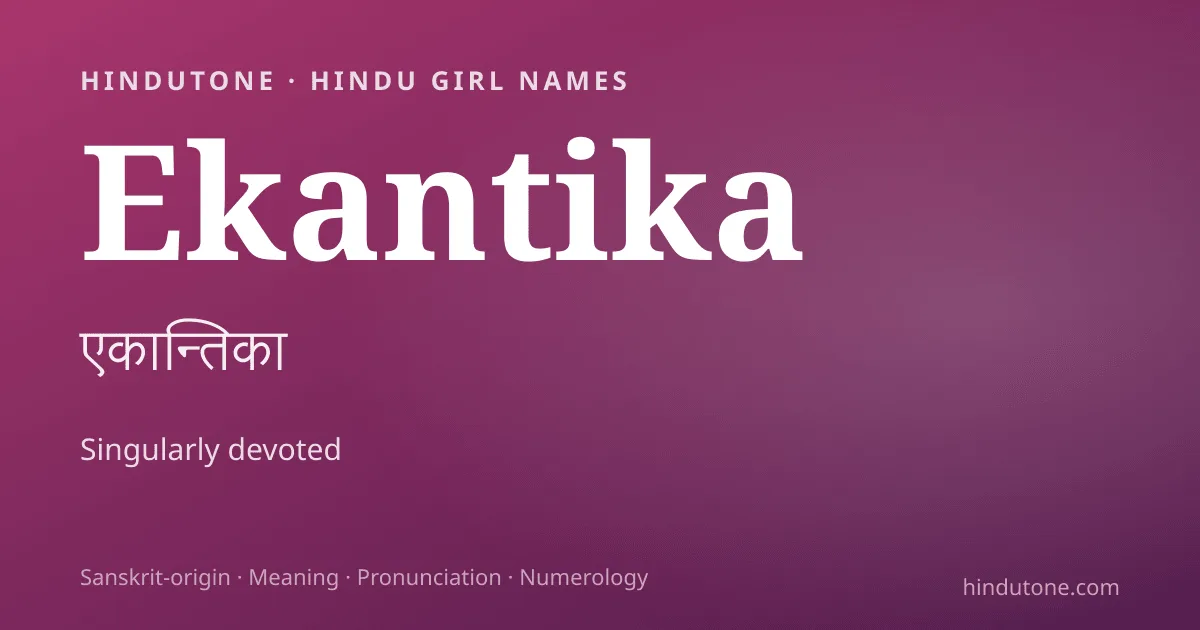
Ekantika (एकान्तिका) is a Sanskrit-origin Hindu girl-name meaning “Singularly devoted”. Find pronunciation, origin, deity association, popularity and similar Hindu baby names.
Ekantika (एकान्तिका) is a Sanskrit-origin Hindu girl-name meaning “Singularly devoted”. This guide covers Ekantika’s meaning, origin, pronunciation, deity association, popularity and similar names.
What does Ekantika mean?
Ekantika means Singularly devoted in Sanskrit. The name carries a serene devotional resonance — every Hindu name encodes a virtue, a deity or a cosmic principle.
Origin and Sanskrit script
Ekantika is written एकान्तिका in Devanagari. The Sanskrit mātṛkā (mother-syllables) preserve the sacred sound — important during the Namakarana Samskara.
Pronunciation of Ekantika
Ekantika is pronounced as it is spelled in standard Hindi/Sanskrit and travels well across school registers, government forms and social settings in the USA, UK, Canada and Australia.
Why parents choose Ekantika
Ekantika carries the timeless feel of classical Sanskrit and has been used in Hindu families for generations. It remains a comparatively distinctive Hindu girl-name.
Quick facts about the name Ekantika
- Gender: Hindu girl-name
- Sanskrit: एकान्तिका
- Meaning: Singularly devoted
- Origin: Sanskrit
- Popularity: 60/100 in 2026
Quick Facts
Attribute: Detail
Gender: Girl
Origin: Sanskrit
AdvertisementMeaning: Singularly devoted, exclusively focused
Pronunciation: Eh-kahn-tee-kah
Syllables: 4
Lucky Number: 7
Rashi: Mesha (Aries)
Nakshatra: Krittika
Advertisement
Sanskrit Etymology & Devanagari
The name Ekantika (एकान्तिका) derives from the Sanskrit compound eka-anta (एकान्त), where eka means "one" or "singular" and anta signifies "end," "goal," or "ultimate purpose." The suffix -ika (इका) forms a feminine adjective or noun, denoting a quality or characteristic belonging to someone. In classical Sanskrit literature, ekānta (IAST: ekānta) refers to solitude, exclusivity, or absolute devotion to a single path or deity.
Within Vedantic and bhakti traditions, ekāntika describes a devotee who follows the path of ekānta-bhakti—unwavering, single-pointed devotion to one form of the Divine, typically Vishnu or Krishna in Vaishnava schools. The Bhagavata Purana and commentaries by Acharyas such as Ramanuja use the term to distinguish devotees who seek liberation (moksha) through exclusive surrender, rejecting all other goals including worldly pleasures, heavenly rewards, and even yogic siddhis. The name thus carries connotations of spiritual focus, purity of intent, and the renunciation of distractions in favor of a singular divine relationship.
Culturally, naming a daughter Ekantika signals the parents' aspiration that she embody steadfastness, clarity of purpose, and inner tranquility—qualities highly valued in Hindu philosophy. The name evokes the image of a soul undistracted by maya (illusion), anchored in devotion and truth.
Mythological & Historical Figures
While no prominent mythological character bears the exact name Ekantika in the Ramayana, Mahabharata, or major Puranas, the concept of ekānta-bhakti is embodied by several celebrated devotees. Prahlada, the child-devotee of Vishnu, demonstrated singular devotion despite his father's persecution. The Gopis of Vrindavan, especially Radha, are often described in Vaishnava theology as ekāntika devotees whose love for Krishna was absolute and exclusive. Andal, the Tamil saint-poetess, composed the Tiruppavai with the fervor of one wholly devoted to Vishnu, exemplifying the ekāntika ideal. Meerabai's life and poetry similarly reflect unwavering focus on Krishna, forsaking worldly ties. Though these figures are not named Ekantika, they personify the spiritual essence the name represents, making it resonate deeply within devotional Hindu culture.
Regional Popularity in India
Ekantika is most commonly chosen in North Indian states such as Uttar Pradesh, Madhya Pradesh, Rajasthan, and Delhi, where classical Sanskrit names retain strong appeal among upper-caste Hindu families and those with Brahmin or Kshatriya heritage. The name also enjoys modest popularity in Maharashtra and Gujarat, particularly among Vaishnava communities who value names reflecting devotional virtues.
In South India—Tamil Nadu, Karnataka, Andhra Pradesh, and Telangana—Ekantika is less common but appreciated among families seeking pan-Indian, Sanskritized names that transcend regional linguistic boundaries. Bengali and Odia parents occasionally select it for its literary and philosophical depth. Among the diaspora in the USA, UK, Canada, and Australia, Ekantika appeals to parents seeking a name that is distinctly Hindu, easy to pronounce in English-speaking contexts, and carries spiritual gravitas without being overly religious or difficult to spell.
Numerology & Astrology
According to Vedic numerology, Ekantika is commonly associated with the lucky number 7, which signifies introspection, spiritual wisdom, and analytical thinking. Individuals with this number are believed to be seekers of truth, drawn to philosophy, meditation, and solitary contemplation—traits harmonizing perfectly with the name's meaning of singular devotion.
Astrologically, Ekantika falls under the Mesha (Aries) rashi and the Krittika nakshatra, ruled by the Sun. Krittika is symbolized by a razor or flame, representing sharpness of intellect, purification, and the cutting away of illusions. Those born under Krittika are often courageous, determined, and possess strong leadership qualities. The combination of the name's devotional meaning and the nakshatra's fiery energy suggests a personality that is both spiritually focused and dynamically purposeful.
Personality Traits
Deeply Spiritual: Ekantika is often associated with a contemplative nature and an early inclination toward prayer, meditation, or philosophical inquiry.
Focused and Determined: The name's meaning of singular devotion translates into strong goal-orientation and the ability to pursue objectives without distraction.
Introspective and Thoughtful: Girls named Ekantika are believed to prefer meaningful conversations and solitary reflection over superficial social engagements.
Loyal and Trustworthy: Just as the name implies unwavering devotion, Ekantika bearers are thought to be steadfast friends and family members.
Independent Thinkers: The emphasis on "one path" suggests a personality that values authenticity and is unswayed by peer pressure or fleeting trends.
Compassionate and Serene: The devotional undertone fosters a gentle, empathetic demeanor and a calming presence in social settings.
Variants & Similar Names
Spelling Variants: Ekanthika, Ekaantika, Ekantikaa
Similar Names: Ekanta, Ekaangi, Ananya, Advika, Eka, Ekansha, Ekagra, Ekisha, Ekalya, Ananyaa, Bhakti, Shraddha, Nishtha
FAQ
How do you pronounce Ekantika correctly?
Ekantika is pronounced Eh-kahn-tee-kah, with four syllables. The stress falls naturally on the second syllable ("kahn"). In English-speaking countries, it is straightforward to say and spell, making it suitable for diaspora families. The "E" is pronounced as in "bed," "ka" as in "car," "ti" as in "tea," and the final "ka" again as in "car."
Is Ekantika appropriate for modern, urban, or diaspora families?
Yes, Ekantika is well-suited for contemporary Hindu families, including NRIs in the USA, UK, Canada, and Australia. It balances traditional Sanskrit roots with a modern, elegant sound. The name is easy to pronounce in English, unlikely to be mispronounced or mocked, and carries a dignified, spiritual meaning that appeals to parents seeking depth without overt religiosity. It works seamlessly in professional, academic, and multicultural settings.
Does Ekantika have any religious restrictions or denominational associations?
Ekantika is rooted in Hindu Vaishnava devotional theology but is not restricted to any single sect or caste. It is appropriate for families of all Hindu denominations—Vaishnavism, Shaivism, Shaktism, and Smartism—as the concept of singular devotion is universally respected across Hindu traditions. The name carries no caste-specific connotations and is chosen by Brahmins, Kshatriyas, Vaishyas, and others. It is a spiritually inclusive name celebrating devotion and focus, making it suitable for any Hindu family valuing these virtues.
Frequently Asked Questions
What does the name Ekantika mean?
Ekantika ( एकान्तिका ) is a Sanskrit-origin Hindu girl-name meaning “Singularly devoted” . This guide covers Ekantika’s meaning, origin, pronunciation, deity association, popularity and similar names.
Is Ekantika a good Hindu baby name?
Yes — it is a traditional Hindu name with an auspicious meaning, suitable for a baby and rooted in Sanatana Dharma values.
What is the origin of the name Ekantika?
It has Sanskrit/Hindu origins; its roots, deity association and significance are detailed above.
Are there variations or similar names to Ekantika?
Related and similarly-themed Hindu names, along with their meanings, are listed in the guide above to help you choose.
Ekantika — Name Facts
- Meaning
- Singularly devoted
- Gender
- Hindu girl name
- Nakshatra
- Krittika
- Rashi
- Vrishabha (Taurus)
- Numerology
- 3
Frequently asked questions
What does the name Ekantika mean?
Ekantika is a Sanskrit-origin Hindu girl name meaning “Singularly devoted”.
Is Ekantika a boy or girl name?
Ekantika is traditionally a Hindu girl name.
Which nakshatra and rashi suit the name Ekantika?
By the first-syllable rule of Vedic naming, Ekantika aligns with the Krittika nakshatra, under the Vrishabha (Taurus) rashi.
What is the numerology number of Ekantika?
The Chaldean name number of Ekantika is 3.
Explore more: Krittika nakshatra names · Vrishabha rashi names · Hindu girl names with E · All Hindu names A–Z