Dhanvantari Mantra: The Sacred Vedic Chant for Healing and Health
In times of physical and mental distress, turning to the divine is a centuries-old practice in Sanatan Dharma.
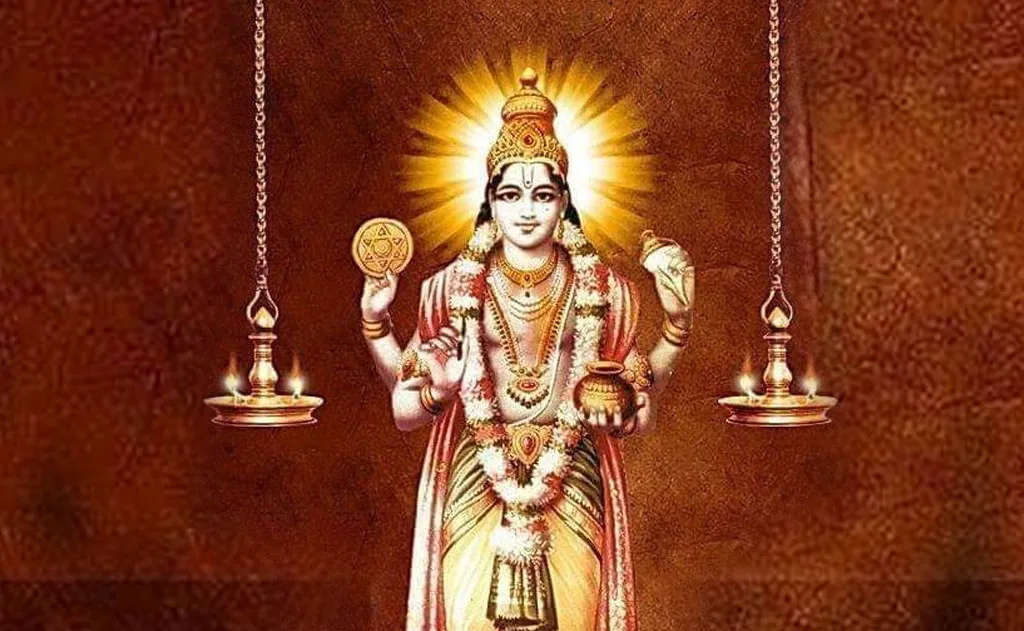
In times of physical and mental distress, turning to the divine is a centuries-old practice in Sanatan Dharma. Among the pantheon of healing deities, Lord Dhanvantari shines as the divine physician of the gods—the incarnation of Lord Vishnu who emerged during the Samudra Manthan holding a pot of Amrit (nectar of immortality). The Dhanvantari mantra is a sacred invocation that brings health, vitality, and relief from all illness. At www.hindutone.com, we delve into the meaning, significance, and benefits of this powerful healing mantra.
The Dhanvantari Mantra
ॐ नमो भगवते वासुदेवाय धन्वंतरये अमृतकलशहस्ताय
सर्वामयविनाशनाय त्रैलोक्यनाथाय श्रीमहाविष्णवे नमः॥
Meaning of the Mantra
- Om Namo Bhagavate Vasudevaya – Salutations to the Supreme Lord Vasudeva (Vishnu)
- Dhanvantaraye – To Lord Dhanvantari, the divine healer
- Amrit Kalasha Hastaya – Who holds the pot of nectar (Amrit) in his hands
- Sarva Amaya Vinashanaya – The destroyer of all diseases
- Trailokya Nathaya – Lord of the three worlds
- Sri Maha Vishnave Namah – Salutations to the Supreme Lord Vishnu
Spiritual Significance
This mantra is more than a prayer; it is a vibrational medicine. It invites the healing energies of Lord Dhanvantari into the body, mind, and spirit, helping:
- Eradicate physical diseases and ailments
- Balance internal energies and doshas (as per Ayurveda)
- Cleanse mental toxicity and emotional suffering
- Empower doctors, healers, and medical practitioners
When and How to Chant
- Ideal Time: Early morning or before medical treatments
- Repetitions: 11, 21, or 108 times with a tulsi or rudraksha mala
- Best Days: Thursdays or on Dhanteras, a day dedicated to Dhanvantari
- Complementary Practices: Light a ghee lamp and keep an image or idol of Dhanvantari Murthy while chanting
Scientific and Ayurvedic Relevance
While the mantra is rooted in spirituality, its effect on calming the nervous system, reducing anxiety, and aligning internal rhythms is being studied in integrative medicine. The deity’s symbolism—Amrit, medicinal herbs, and divine wisdom—aligns with holistic healing.
Symbolism of Dhanvantari Murthy
Lord Dhanvantari is usually depicted with:
- A pot of Amrit representing eternal health
- Shankha and Chakra symbolizing divine protection and spiritual evolution
- A leech (in some depictions), referencing Ayurvedic practices
- A scripture or medicinal herbs, reflecting sacred medical knowledge
Mantra for Healers and Practitioners
This mantra is often chanted by:
- Ayurvedic doctors before treatments
- Spiritual healers before energy sessions
- Patients before surgeries or healing journeys
- Families as a daily health prayer
Conclusion
In a world filled with stress, disease, and imbalance, the Dhanvantari mantra is a sacred tool of restoration and divine medicine. It reminds us that true healing transcends the body and reaches into the soul. At Hindutone, we honor this healing vibration and invite all to experience its transformative power.
Who Is Lord Dhanvantari? His Origin in the Puranas
Lord Dhanvantari is celebrated in the Srimad Bhagavatam (Canto 8, Chapter 8) as the twelfth gem to emerge from the Samudra Manthan—the great churning of the cosmic ocean by the Devas and Asuras using Mount Mandara as the churning rod and the serpent Vasuki as the rope. He arose bearing the Amrit Kalasha in one hand and is described as wearing yellow robes, adorned with earrings of gleaming gems, holding medicinal herbs, a shankha (conch), chakra, and leech—the last symbol representing the clinical practice of Ayurveda. He is identified as an avatar of Lord Vishnu, specifically tasked with preserving life and eradicating suffering caused by disease.
The Agni Purana and Vishnu Purana both record that Dhanvantari was later reborn in the lineage of King Dirghatamas of Kashi (Varanasi) in response to prayers, taking human birth as the physician-prince Divodasa Dhanvantari. In this birth he established the formal lineage of Ayurveda, teaching students such as Sushruta, whose surgical treatise—the Sushruta Samhita—remains one of Ayurveda's foundational texts. This dual existence—cosmic deity and historical teacher—makes Dhanvantari unique among Vedic healing figures.
The Scriptural Roots of the Dhanvantari Mantra
The core salutation 'Om Namo Bhagavate Vasudevaya' originates from the Vishnu Purana and is called the Dwadasakshara Mantra—the twelve-syllable mantra of Vishnu. Appending 'Dhanvantaraye' and the subsequent epithets constitutes the full healing invocation found in several later Tantric and Vaishnava ritual compilations. The phrase 'Amrit Kalasha Hastaya' is directly linked to the iconographic description found in the Bhagavata Purana, ensuring that the mantra itself mirrors the deity's scriptural form.
The epithet 'Sarva Amaya Vinashanaya'—destroyer of all diseases—resonates with the Rigvedic understanding of disease as caused by both physical imbalance (dosha dushti) and spiritual transgression. Vedic hymns addressed to the Ashwini Kumars, the twin divine physicians of the Rigveda, share a similar vocabulary of cure and restoration, placing Dhanvantari within a continuous healing tradition stretching from the oldest Vedic texts to the Puranic age.
Principal Temples of Lord Dhanvantari Across India
The most renowned temple dedicated to Lord Dhanvantari is the Thrikkannamangal Dhanvanthari Temple in Thrissur district, Kerala, believed to be one of the oldest in India. Another significant shrine is the Sree Dhanvanthari Temple at Nelluvai, also in Kerala, where elaborate Ayurvedic rituals accompany daily worship. Pilgrims visit these shrines not only for prayers but to receive blessings before undergoing medical treatments.
In Varanasi (Kashi), the ancient Dhanvantari Ghat and associated shrines honour the deity's connection to the city through the legend of Divodasa Dhanvantari. The Guruvayur Sri Krishna Temple in Kerala also features a Dhanvantari shrine within its complex, where sick devotees offer specific puja. In Tamil Nadu, the Devarajaswami Temple at Kanchipuram includes a Dhanvantari icon revered for healing, and physicians from the region traditionally seek blessings here before beginning medical practice.
Dhanteras—the first day of the Diwali festival, observed on Trayodashi of Kartik Krishna Paksha—is officially designated as Dhanvantari Jayanti in the national calendar of India, recognising his role as the father of Ayurveda. Hospitals, Ayurvedic institutions, and medical schools across the country mark this day with prayers, underlining the living continuity of this tradition.
How the Mantra Aligns with Ayurvedic Healing Principles
Ayurveda, the science attributed to Lord Dhanvantari, teaches that disease arises from the imbalance of the three doshas—Vata, Pitta, and Kapha—and from the accumulation of Ama (metabolic toxins). The Dhanvantari mantra is traditionally considered a complement to Ayurvedic treatment because sound (shabda) is itself classified as a tanmatra—a subtle sensory element—in Samkhya philosophy, capable of influencing the body's pranic channels (nadis) and vital energy centres (chakras).
Practitioners in the classical Ayurvedic tradition often recommend chanting this mantra while preparing medicinal formulations, believing the vibrational quality of the sound purifies both the preparer's intention and the medicine itself. The Charaka Samhita, Ayurveda's seminal diagnostic text, acknowledges the role of daivavyapashraya chikitsa—divine or spiritual therapy—as one of three valid categories of medical treatment, placing mantra recitation on a formal therapeutic footing alongside herbal and surgical interventions.
Step-by-Step Ritual Protocol for Dhanvantari Mantra Japa
A dedicated japa session begins with Achamana—three sips of water while reciting 'Om Achyutaya Namah, Om Anantaya Namah, Om Govindaya Namah'—to purify the body and mind. The worshipper then seats themselves facing east or north, lights a ghee lamp (deepa) and an incense stick, and places before them an image or idol of Dhanvantari holding the Amrit Kalasha. Offering yellow flowers such as chrysanthemum or marigold is considered especially auspicious.
The mantra is chanted using a tulsi mala (108 beads) or a rudraksha mala, completing 1, 3, or 7 rounds of 108 repetitions depending on the severity of the illness being addressed. Each round may be accompanied by a silent mental visualisation of blue-hued divine light entering the afflicted part of the body. Concluding the japa with a short Vishnu Sahasranama recitation or a simple prayer of surrender—saranagati—is recommended in Vaishnava practice. Consistency over 21 or 40 consecutive days, known as an anushthana, is traditionally considered more efficacious than sporadic practice.
Dhanvantari's Iconography and Its Deeper Symbolism
Classical texts describe Lord Dhanvantari as four-armed (chaturbhuja), holding the Amrit Kalasha (pot of immortal nectar) in the upper right hand, a shankha (conch representing the primordial sound of creation) in the upper left, a chakra (discus, symbol of the cosmic wheel of time and destruction of disease) in the lower right, and a set of medicinal herbs or a leech in the lower left. His complexion is described as shyama—a dark azure-blue—identifying him unmistakably as Vishnu.
The Amrit Kalasha is not merely a mythological prop; it symbolises the body of Ayurvedic knowledge itself—preserved, protected, and offered to humanity. The leech (jaloka) is significant because Sushruta's surgical tradition used leeches in Jalaukavacharana therapy, a classical blood-purification technique still practised in certain Ayurvedic hospitals today. Every element of the iconography thus encodes a medical or philosophical teaching, making the image of Dhanvantari a visual textbook as much as an object of devotion.
Frequently Asked Questions
What is the Dhanvantari Mantra?
In times of physical and mental distress, turning to the divine is a centuries-old practice in Sanatan Dharma . Among the pantheon of healing deities, Lord Dhanvantari shines as the divine physician of the gods—the incarnation of Lord Vishnu who emerged during the Samudra Manthan holding a pot of Amrit (nectar of immortality).
How many times should the Dhanvantari Mantra be chanted?
It is traditionally chanted 108 times using a rudraksha or tulsi mala. Even 11 or 21 sincere repetitions daily are considered beneficial — steady, focused practice matters more than the count.
What is the best time to chant the Dhanvantari Mantra?
Dawn (Brahma Muhurta) after a bath is considered ideal, though it may be chanted any time with a calm, focused mind. Many devotees keep a fixed daily time to build consistency.
Who can chant the Dhanvantari Mantra?
Anyone may chant it with faith and a pure mind, regardless of age, gender or background. Beginners benefit from first hearing the correct pronunciation and understanding its meaning.
What are the benefits of chanting the Dhanvantari Mantra?
It is believed to calm the mind, dissolve negativity, and draw divine grace, protection and clarity to the devotee.
Share this with family and friends
Send it on WhatsApp, post it, or copy the link.