Mantra Recitation in a Diaspora Apartment: A Beginner's Guide for 2026
Four mantras worth starting with, the daily rhythm that fits an NRI apartment, and the common mistakes that derail beginners. A practical 2026 starting point.
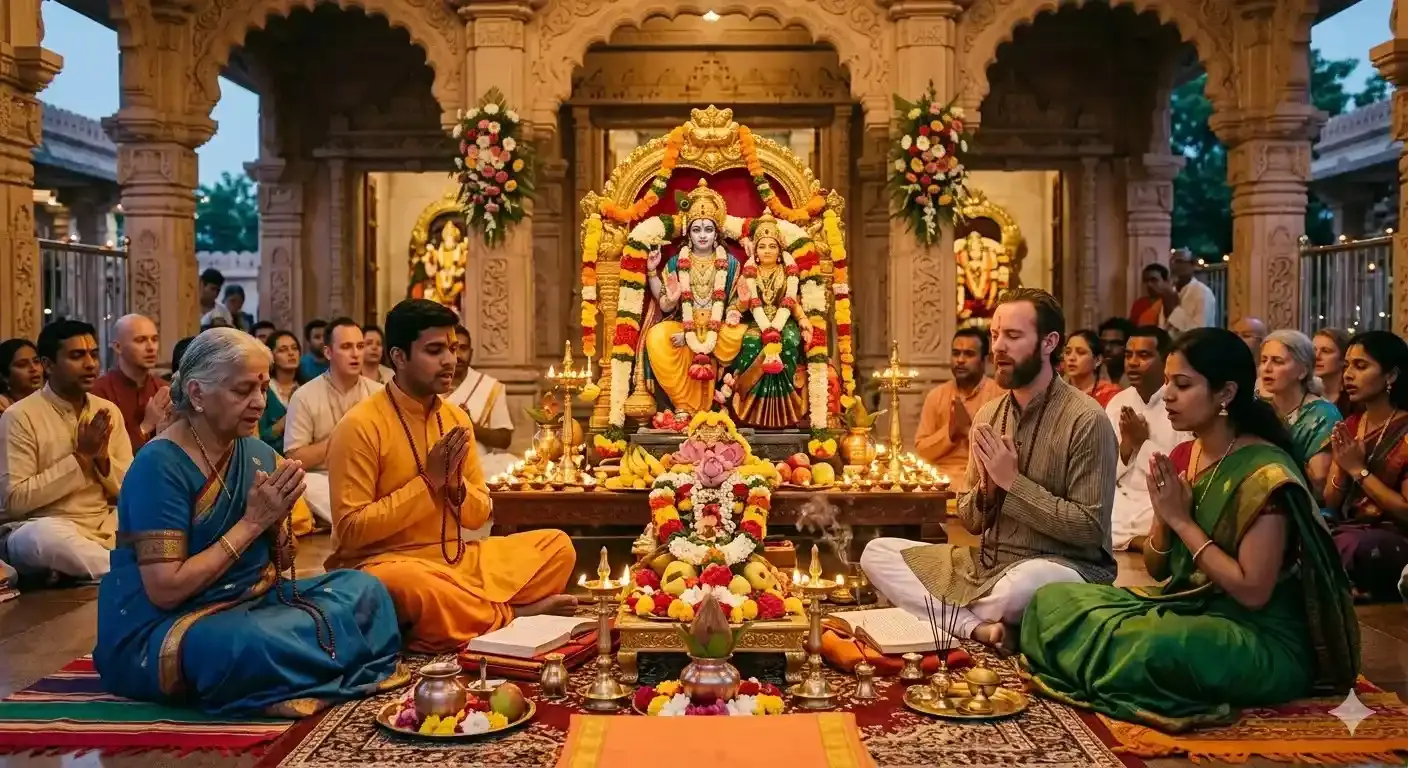
Most NRI adults who want to start a mantra practice have run into the same two obstacles. The first is information overload — the internet has thousands of mantras catalogued, each with claimed benefits, recommended counts, specific timings and ritual prerequisites, and the would-be practitioner has no obvious starting point. The second is the apartment context — the practice as commonly taught assumes a quiet puja room, a fixed daily schedule and a household that can accommodate the recitation. The 1,200-square-foot urban apartment with a working spouse, two children and shared walls is a different context.
What follows is a practical starting point for an adult beginner in a 2026 diaspora apartment. It is not the only approach, but it is one that has produced sustained practice in NRI households over multiple years rather than the burst-and-abandon pattern that ambitious starting points often produce.
Four mantras worth starting with
Begin with no more than four mantras. The selection below covers the essential bases without overwhelming the beginner.
First, the Gayatri Mantra. The most universally recommended Hindu mantra, present across regional and sectarian traditions, traditionally recited at sandhya (dawn, midday and dusk). The mantra is twenty-four syllables long, takes about eight seconds at a comfortable pace, and is the practice that most NRI households inherit if they inherit any mantra practice at all. The basic recommended count is three repetitions at each sandhya, eleven for a fuller practice, twenty-one or 108 for sustained practice.
Second, Om Namah Shivaya. The five-syllable Shiva mantra, short, easy to learn, accommodates any pace and any household configuration. The standard count is 108 repetitions; in practice, even ten or twenty during a short break is a meaningful practice. The mantra travels well — it can be recited mentally on a commute, during a walk, before sleep.
Third, the Mahamrityunjaya Mantra. A longer Shiva mantra invoking healing and protection from untimely circumstances. The standard count is 108; the mantra is approximately twelve seconds long at a steady pace, so a 108-count session takes about twenty minutes. The mantra is particularly recommended during family illness or stress, and many practitioners use it as their primary mantra during difficult periods.
Fourth, a chosen Ishta-Devata mantra. The Ishta-Devata is the deity the practitioner feels most personally drawn to — Vishnu (Om Namo Narayanaya), Krishna (Om Namo Bhagavate Vasudevaya), Hanuman (the Hanuman Chalisa or the Sankat Mochan mantra), Lakshmi (the Mahalakshmi Ashtakam), Durga (the Durga Saptashloki). The Ishta-Devata mantra is the one that becomes the practitioner's anchor practice over time.
These four mantras together cover the essentials. The practitioner does not need additional mantras for a long time; depth in these four is more useful than breadth across many.
The daily rhythm that works
The starting daily rhythm should be modest. The pattern that produces sustained practice in NRI apartments is roughly: a brief morning recitation (three to five minutes — the Gayatri Mantra and a short Ishta-Devata invocation) before the workday begins, and a longer evening recitation (fifteen to twenty minutes — a complete cycle of one chosen mantra) before dinner or before sleep.
Total daily time investment is twenty to thirty minutes. This is sustainable across years; the more ambitious schedules that demand an hour or more daily are not sustainable for working households and tend to collapse after a few weeks. The sustained twenty-minute practice produces more cumulative benefit than the burst hour-long practice that lasts a month.
Where in the apartment
A dedicated puja space is ideal but not essential. The practical approach in most NRI apartments is to designate a small corner — a shelf, a side table, a wall area — as the practice space. A small image of the practitioner's Ishta-Devata, a ghee lamp or a small electric lamp that can substitute when fire is impractical, a cushion or a low seat, a place to keep the rudraksha or tulsi mala if the practitioner uses one — these elements transform any corner into a practice space.
The fixed location matters. A practice that happens in the same place every day builds momentum that a roving practice does not. The brain begins to associate the location with the disposition the practice requires, and the practitioner finds it easier to settle into the practice over time.
The mala question
A mala — a string of 108 beads used to count recitations — is a useful tool but not a requirement. The traditional rudraksha mala (for Shiva mantras), tulsi mala (for Vaishnava mantras) and crystal mala (for general use) each have their associations, but any 108-bead mala works for counting. The practical question is whether the practitioner finds counting helpful as a focus aid or distracting from the recitation itself.
Many beginners benefit from using a mala during the early weeks to learn the rhythm of a 108-count cycle. Once the cycle is internalised, the mala becomes optional. Many sustained practitioners eventually drop the mala and count cycles informally; others find the mala remains useful indefinitely as a tactile anchor.
Common mistakes that derail beginners
Three mistakes consistently derail beginner practice in NRI households.
The first is starting too ambitiously. A beginner who commits to a 108-count Mahamrityunjaya recitation at 5 AM daily is setting up a practice that will collapse within two weeks. The discipline is to start at half the intended pace, sustain it, and increase only when the lower intensity has become reliable.
The second is treating mantra recitation as performance rather than practice. The beginner who is monitoring their pronunciation, comparing themselves to recorded recitations, worrying about whether they are "doing it right" — these meta-concerns interrupt the practice itself. Pronunciation matters and improves with practice, but the meta-monitoring is more counter-productive than imperfect pronunciation.
The third is breaking the rhythm at the first travel disruption. Most beginners do well at home and lose the practice during their first work trip or vacation. The discipline that works is to plan a reduced version of the practice for travel — even ten Om Namah Shivayas mentally before sleep maintains the thread — and pick up the full practice on return. The break-and-resume pattern is what kills the practice; the reduced-but-continuous pattern preserves it.
A six-month evaluation point
A useful checkpoint for a beginning practitioner is the six-month mark. At this point, the practice has either consolidated into a habit or revealed which elements were not sustainable. The honest review covers three questions. Has the morning rhythm survived? Has the evening rhythm survived? Has the practice produced any noticeable shift in the practitioner's daily disposition — calmer mornings, better sleep, clearer mind at the start of difficult conversations?
Positive answers to any of these justify continuing as is. Negative answers in specific areas point to specific adjustments — shorter sessions, different timing, different mantras, the same mantras with closer attention. The practice is meant to be adjusted across years, not held rigid. The 2026 beginner who is still practising at this level of intentionality six months in has cleared the hurdle that most beginners do not. The next year of practice builds on that foundation, and from there the practice takes its own shape over the practitioner's lifetime.
Frequently asked questions
Which mantras should a beginner start with?
Start with no more than four: the Gayatri Mantra, Om Namah Shivaya, the Mahamrityunjaya Mantra, and a mantra for your chosen Ishta-Devata. Depth in these four is more useful than breadth across many.
How much time should a beginner spend on mantra practice each day?
Twenty to thirty minutes in total: three to five minutes in the morning and fifteen to twenty minutes in the evening. Schedules of an hour or more tend to collapse after a few weeks.
Do I need a puja room to recite mantras in an apartment?
No. A small corner, shelf or side table with an image of your Ishta-Devata, a lamp (electric if fire is impractical) and a low seat is enough. Using the same spot daily builds momentum.
Is a mala necessary for mantra recitation?
No. A 108-bead mala is useful for learning the rhythm of a 108-count cycle, and any 108-bead mala works. Once the cycle is internalised it becomes optional.
What are common mistakes that derail beginners?
Starting too ambitiously, treating recitation as a performance by worrying about pronunciation, and dropping the practice at the first trip. Begin at half the intended pace and plan a reduced version for travel.
How can I keep my mantra practice going while travelling?
Plan a reduced version, such as ten mental Om Namah Shivayas before sleep, and resume the full practice on return. Reduced but continuous practice preserves the habit better than breaking and restarting.
Share this with family and friends
Send it on WhatsApp, post it, or copy the link.
More from Pooja, Slokas and Mantras
- Narmadashtakam (Sabindu Sindhu) by Adi Shankaracharya: Full Text in Sanskrit with Meaning
- Hari Stotram (Jagajjalapalam) by Swami Brahmananda: Full Text in Sanskrit with Meaning
- Ganeshashtakam (Yato Anantashakteh) from the Ganesha Purana: Full Text with Meaning
- Kashi Vishwanath Ashtakam (Gangataranga Ramaniya Jatakalapam): Full Text with Meaning
- Shivashtakam (Prabhum Prananatham Vibhum Vishvanatham): Full Text with Meaning
You might also like
Masik Shivaratri June 13 2026 – Complete Devotional Guide: Date, Story, Rituals, Mantras & Benefits

Maha Shivaratri Four Prahar Puja — The Complete Night-by-Night Ritual Guide
Shivaratri 2026 Special Shiva Devotional Songs