The Power of Dattatreya Japa and Homa – The Redemption of Srinivasan, a South Indian Priest
1. Introduction: The Silent Power of Avadhuta DattaThe mystic path of Lord Dattatreya often begins where all else fails.
1. Introduction: The Silent Power of Avadhuta DattaThe mystic path of Lord Dattatreya often begins where all else fails.
1. Introduction: The Silent Power of Avadhuta Datta
The mystic path of Lord Dattatreya often begins where all else fails. Unlike conventional prayers, His path is one of fire, silence, and unshakable surrender. This is the story of Srinivasan, a Telugu Brahmin priest from Kurnool, whose life transformed through the unorthodox path of Dattatreya japa and homa.
2. The Fall of a Lineage
Srinivasan belonged to a proud lineage of Shiva worshippers. Once caretakers of a powerful temple, his family had fallen into karmic decline. The temple was demolished, ancestral property lost, and the family entered a long phase of obscurity and hardship. Though well-versed in rituals, Srinivasan battled ego, financial instability, and inner restlessness.
3. The Turning Point: Mahalaya Amavasya
During Mahalaya Amavasya, he saw a mysterious beggar whisper near a cremation ground: “When nothing works, only Avadhuta Datta will burn the karmic threads... do His japa with fire. Fire. Fire.” This cryptic message pierced his soul.
4. The Upadesha and Initiation
Srinivasan discovered an old palm-leaf manuscript bearing the mantra:
Om Shri Guru Dattatreyaya Namah
He later received diksha from a wandering avadhuta in Srisailam. The only instruction was: “Do 108x108 japa and offer tilahuti in fire for 41 days. Then visit Narasobawadi.”
5. The Sadhana Begins
- Duration: 41 days
- Japa: 108 x 108 = 11,664 daily repetitions
- Homa: 108 sesame, bilva, and ghee ahutis nightly
He experienced intense heat, tremors, and visions. Crows gathered outside. His wife grew frightened. He calmly said: “Let the karma burn. Datta is here.”
6. The Miracles Unfold
- Day 24: A 20-year land dispute resolved miraculously.
- Day 33: A sick neighbor dreamt of a 3-headed yogi healing her with ashes.
- Day 41: During the final homa, a dog entered, circled the fire, licked the ash, and sat in padmasana. It then left. Srinivasan wept in recognition—Datta’s leela as Shvanavahana (His dog companion).
7. Darshan at Narasobawadi
Carrying sacred ash from his last homa, Srinivasan visited Narasobawadi. A tall man in torn clothes appeared, saying, “Why did you delay so long? I was waiting for 5 janmas.” That night, Lord Dattatreya appeared in his dream surrounded by siddhas and said:
“Your tapas has reversed your next 3 janmas of suffering. Now serve others. I live in fire and in silence.”
8. The Sacred Aftermath
Today, Srinivasan conducts Datta japa and homa retreats every Amavasya. He charges no fee, saying:
“Give ghee. Give sesame. And give your ego.”
His house has become a healing space where miracles are common:
- Scorpion bites healed by vibhuti
- Black magic dispelled through homa
- Childless couples blessed after sankalpa japa
9. Spiritual Insights from the Sadhana
- Dattatreya Japa with fire (homa) is a karmic purifier.
- Dogs, crows, and silent wanderers may be Datta’s forms.
- True grace arises when ego burns in tapas.
- Datta’s blessings come not from perfection, but from surrender.
10. Conclusion: Call Him with Fire and Faith
This story is not just Srinivasan’s redemption—it is a reminder. When mantras, rituals, and remedies fail, and the soul cries from its core, Dattatreya listens. Call Him with fire. Call Him with silence. And He shall walk into your life.
Who Is Avadhuta Datta — The Theology Behind the Three Heads and Six Arms
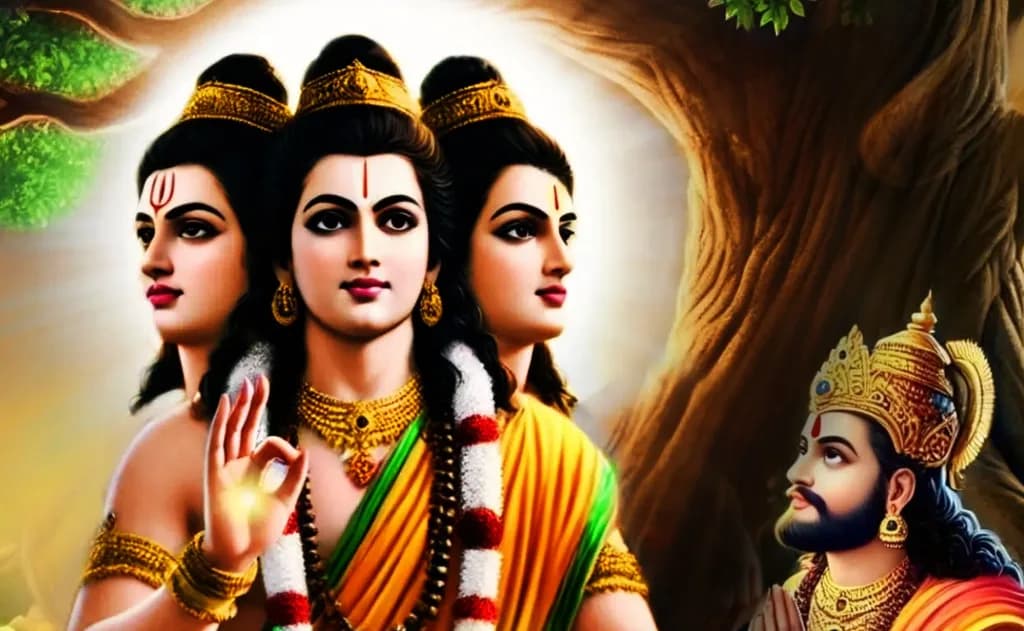
Lord Dattatreya is celebrated in the Markandeya Purana, the Devi Bhagavata Purana, and the Guru Charitra — the sacred biography composed in Marathi that remains the primary scriptural authority at Shri Kshetra Narasobawadi and Gangapur. He is the combined avatara of the Trimurtis — Brahma, Vishnu, and Shiva — whose three heads represent creation, sustenance, and dissolution respectively. His six arms carry the kamandalu, rosary, trishula, damaru, conch, and sudarshana chakra, signifying that all spiritual powers converge in Him.
The title Avadhuta is not merely an honorific. In the Avadhuta Gita, attributed to Dattatreya Himself and preserved in 8 chapters of deeply non-dual Vedantic verse, He declares: 'I am neither born nor do I die; I have no duty, no ritual, no caste.' This makes His path radically different from temple-bound worship — He is the guru who teaches through nature, silence, and the shock of grace. The twenty-four gurus He names in the Bhagavata Purana's eleventh skanda — including the python, the ocean, the moth, and the prostitute Pingala — underscore that wisdom is embedded in all of creation for the one who has eyes to see.
The Significance of Tilahuti — Why Sesame Seeds and Ghee Are Central to Dattatreya Homa
The instruction Srinivasan received — to offer tila (sesame), bilva leaves, and ghee into the sacred fire — is rooted firmly in Vedic homa vidhi. Sesame seeds, called tila in Sanskrit, are specifically prescribed in the Pitru Tarpana and Shraddha rites described in the Dharmashastra tradition because they are believed to possess the power to dissolve accumulated karmic debt across multiple generations. The Vishnu Dharma Surana explicitly states that tila purifies the field of pitru-rina, the ancestral debt that can silently suppress a lineage for generations.
Bilva — the bael leaf sacred to Shiva — brings the Shaiva dimension into the homa, honoring Srinivasan's own ancestral lineage of Shiva worshippers even while approaching Lord Datta. Ghee, known as sarva-devata-priya or 'beloved of all gods,' carries the mantra-sound into subtler planes when it ignites. The combination of these three substances in 108 nightly ahutis therefore works simultaneously on the pitru plane (sesame), the Shaiva plane (bilva), and the universal devic plane (ghee), making the homa unusually comprehensive in its field of purification.
The number 108 is not arbitrary. It corresponds to the 108 Upanishads, to the 108 sacred kshetras in the sub-continent, and mathematically to the ratio of the Sun's distance from Earth to the Sun's diameter — a proportion ancient astronomers recognized as sacred. Each ahuti offered with focused consciousness is understood in the Taittiriya Aranyaka tradition as a micro-yajna that mirrors the cosmic Mahayajna of creation itself.
Narasobawadi — The Living Heart of Dattatreya Worship on the Banks of the Krishna
After completing his 41-day sadhana, Srinivasan was instructed to visit Narasobawadi, situated at the confluence of the Krishna and Panchaganga rivers in Kolhapur district, Maharashtra. This kshetra is considered the most ancient among the four principal Dattatreya padhams, the others being Gangapur (Karnataka), Pithapur (Andhra Pradesh), and Audumbar (Maharashtra). The Guru Charitra records that Shripad Shrivallabha — the first avatara of Dattatreya in human form — performed tapas at Narasobawadi and granted a boon that anyone who reads the Guru Charitra there across seven consecutive days would be freed from the afflictions of the navagrahas.
The presiding deity at Narasobawadi is worshipped in the form of Shri Narasimha Saraswati, the second avatara of Dattatreya, whose paduka (sacred sandals) are installed at the garbhagriha. Pilgrims from Karnataka, Telangana, and Andhra Pradesh — particularly those from priestly families carrying generational karmic burdens — traditionally undertake parikrama of the ashwattha (sacred fig) tree adjacent to the temple as part of their vow. The presence of dogs in the temple precincts is not discouraged; they are regarded as Datta's own companions, embodiments of the Shvana-vahana principle, and are fed as a devotional act.
The Shvana-Vahana Leela — Why a Dog Sitting in Padmasana Is a Recognized Sign of Datta's Grace
The appearance of the dog during Srinivasan's final homa — its circling the fire, consuming the ash, and sitting in padmasana — belongs to a recognized category of Dattatreya leela documented across the Guru Charitra and in the devotional literature of the Datta Sampradaya. Lord Dattatreya is almost always depicted accompanied by four dogs, said to represent the four Vedas — Rigveda, Yajurveda, Samaveda, and Atharvaveda — following Him loyally as the Avadhuta wanders without attachment. The dog also symbolizes a devotee who has been completely emptied of ego and follows the guru's will alone.
In the folk theology of Karnataka and Maharashtra, a dog's unexpected and calm presence near a homa or at a threshold is interpreted as Datta's reconnaissance — His way of 'checking in' on a sincere sadhaka before manifesting more fully. The Datta Mahatmya, a devotional text popular in Karnatic and Deccani traditions, narrates at least three instances where an anonymous dog sat between a distressed devotee and an active fire as a sign that the karmic thread had been cut. Srinivasan's weeping at this moment reflects a recognition (pratyabhijna) — not sentiment — that the leela had reached its completion.
How to Begin Dattatreya Japa — Practical Guidance Grounded in Tradition
For a householder wishing to undertake Dattatreya japa, the Shaiva-Vaishnava synthesis at the heart of Datta worship means no elaborate sectarian preparation is required. The most widely practiced mula mantra is 'Om Shri Guru Dattatreyaya Namah,' with a minimum traditionally set at 108 repetitions daily using a rudraksha mala. Those undertaking a formal 40-or-41-day vrata should begin on a Thursday — Guruvar — which is Datta's sacred day, at dawn or dusk, facing either East or North.
Physical cleanliness and a fixed asana (seat) placed on a natural fiber mat are the only material prerequisites stressed in the Datta Sampradaya guidelines. The deeper prerequisite is what the tradition calls guru-bhava — approaching the mantra not as a mechanical recitation but as a living conversation with the Avadhuta who is already present. Offerings of bilva, tulasi, or flowers of the aghada plant (Achyranthes aspera), which is considered especially dear to Dattatreya, may accompany the japa. A small deepa (oil lamp) kept burning during the recitation connects the sadhaka to the homa principle even without a full fire ritual.
Those drawn to a more intensive path, including homa, are advised by traditional acharyas to first read or listen to the Guru Charitra in its entirety — ideally across seven days as prescribed — before commencing the agni-based sadhana. This is because the Guru Charitra functions as a preparatory purification of the manomaya kosha (mental sheath), making the subsequent fire ritual significantly more effective in burning through accumulated samskaric residue.
Frequently Asked Questions
What is the The Power of Dattatreya Japa and Homa –?
Introduction: The Silent Power of Avadhuta Datta The mystic path of Lord Dattatreya often begins where all else fails. Unlike conventional prayers, His path is one of fire, silence, and unshakable surrender.
How many times should the The Power of Dattatreya Japa and Homa – be chanted?
It is traditionally chanted 108 times using a rudraksha or tulsi mala. Even 11 or 21 sincere repetitions daily are considered beneficial — steady, focused practice matters more than the count.
What is the best time to chant the The Power of Dattatreya Japa and Homa –?
Dawn (Brahma Muhurta) after a bath is considered ideal, though it may be chanted any time with a calm, focused mind. Many devotees keep a fixed daily time to build consistency.
Who can chant the The Power of Dattatreya Japa and Homa –?
Anyone may chant it with faith and a pure mind, regardless of age, gender or background. Beginners benefit from first hearing the correct pronunciation and understanding its meaning.
What are the benefits of chanting the The Power of Dattatreya Japa and Homa –?
It is believed to calm the mind, dissolve negativity, and draw divine grace, protection and clarity to the devotee.
You might also like
Nirjala Ekadashi June 25 2026 – The King of Ekadashis: Complete Guide with Bhima’s Story, Rituals, Mantras & Benefits
Anant Ambani Donates 25 Electric Buses to Tirumala TTD | ₹27.5 Crore Mahā Kānuka
The Resolve of a Monk – A Divine Incident Showcasing Kanchi Paramacharya’s Compassion