The Mystery of 108: Why This Sacred Number Resonates Across Traditions
IntroductionFrom the beads of a japa mala to the distance between Earth and the Sun, the number 108 appears across spiritual, scientific, and cosmic…
Introduction
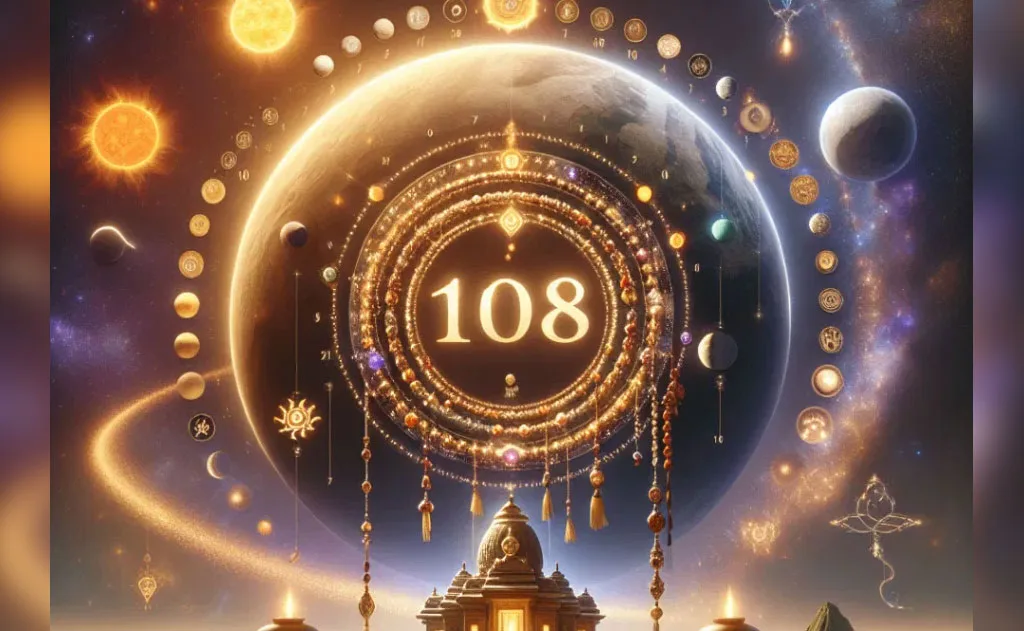
From the beads of a japa mala to the distance between Earth and the Sun, the number 108 appears across spiritual, scientific, and cosmic dimensions. It’s a number that has intrigued seekers, saints, and scientists alike. But is it just a coincidence? Or did our ancient sages encode a deeper truth into this sacred number? At www.hindutone.com, we explore the mystical significance of 108 and its relevance across Hinduism, Buddhism, Jainism, and even Japanese traditions.
Why 108 Beads in a Japa Mala?
In Hindu and Buddhist spiritual practice, a mala (prayer rosary) typically contains 108 beads. Each bead represents one repetition of a mantra, helping practitioners enter a state of focus and mindfulness. The number 108 symbolizes spiritual completion, aligning with the subtle anatomy of the body and the cosmos.
108 Marma Points in the Human Body
Ayurveda, India’s ancient medical science, identifies 108 vital energy points or marma sthanas in the body. These points are gateways to healing and energy circulation. Stimulating or meditating on these points helps maintain pranic flow, aligning physical health with spiritual energy.
Cosmic Connection: Earth, Sun & Moon
Ancient seers were also astronomers. Did you know:
- The distance between the Earth and the Sun is approximately 108 times the Sun’s diameter.
- The distance between the Earth and the Moon is about 108 times the Moon’s diameter.
These cosmic proportions are not random—they reflect a harmony that suggests an intrinsic balance in the universe.
Mathematical and Philosophical Significance
- 1 stands for unity or the higher truth
- 0 represents completeness or the void
- 8 symbolizes infinity or eternity
Together, 108 becomes a number that reflects the journey from individuality to wholeness.
108 in Global Spiritual Traditions
- Hinduism: 108 names of deities, 108 Upanishads
- Buddhism: 108 earthly desires to overcome, 108 defilements
- Jainism: 108 virtues of the soul
- Japan: On New Year’s Eve, Buddhist temples ring their bells 108 times to purify the soul from sin
108 in Yoga and Meditation
There are 108 sacred sites (pithas) in India. Yogic texts speak of 108 energy lines (nadis) converging at the heart chakra. Surya Namaskar (Sun Salutation) is often practiced in cycles of 108 on special occasions.
Is It Scientific, Symbolic… or Both?
Whether you look at it as a mystical code or a scientific proportion, the number 108 bridges the inner and outer universe. It symbolizes spiritual ascent, universal harmony, and meditative focus. The ancients didn’t just believe in numbers—they experienced them.
Conclusion
108 is not just a number. It is a sacred symbol—of unity, infinity, and cosmic design. From mantra recitations and bodily energy points to astronomical measurements and global rituals, 108 is a powerful reminder of the interconnectedness of all life. At Hindutone, we honor this ancient wisdom and invite you to embrace the power of 108 in your spiritual practice.
How does 108 appear in the Vedic scriptures and Upanishads?
The traditional count of Upanishads is given as 108, a figure referenced in the Muktika Upanishad, where Rama himself instructs Hanuman on the complete canon of Upanishadic wisdom. These 108 texts span all four Vedas — Rigveda, Yajurveda, Samaveda, and Atharvaveda — and collectively map every dimension of self-inquiry, from the nature of Brahman to the liberation of the individual soul (jiva). The Muktika enumeration treats 108 not as an arbitrary editorial decision but as a spiritually complete corpus: nothing essential is missing, nothing superfluous is added.
The Rigveda itself is organized into ten mandalas containing 1,028 hymns, and several Vedic recitation traditions divide their daily practice into cycles that total 108 repetitions of key invocations such as the Gayatri Mantra. The Shatapatha Brahmana, one of the most detailed Vedic prose texts, describes fire-altar (agni-chayana) constructions using brick counts rooted in multiples of 108, linking the physical ritual structure to cosmic proportions. This integration of number into liturgy shows that 108 was not merely symbolic but functionally embedded in Vedic sacred science.
Which major Shaiva and Vaishnava traditions give 108 a central role in worship?
In Vaishnavism, the Divya Prabandham — the collected devotional hymns of the 12 Alvars — celebrates exactly 108 Divya Desams, the sacred Vishnu temples recognized as the holiest pilgrimage sites across India and one in Nepal. The Nalayira Divya Prabandham (4,000 Tamil verses) was itself compiled and arranged by Nathamuni in the 9th century CE as a spiritual itinerary through these 108 abodes of Vishnu, from Srirangam on the banks of the Kaveri river to Badrinath in the Himalayas. Completing a pilgrimage to all 108 Divya Desams is considered by Sri Vaishnava tradition to be equivalent to liberating multiple generations of one's lineage.
Shaiva tradition mirrors this with the 108 Shiva temples known as Paadal Petra Sthalams celebrated in the Tevaram hymns of the Nayanmars. These Tamil Shaiva saints — Thirugnana Sambandhar, Thirunavukkarasar (Appar), and Sundarar — composed verses on 276 of these shrines, but the canonically recognized count of the most sacred sites totals 108, embedded along the sacred geography of Tamil Nadu. Additionally, the Shiva Purana enumerates 108 names (ashtottara shatanamavali) of Shiva that together constitute a complete portrait of his cosmic attributes, from Mahadeva to Nataraja to Bhairava, and recitation of these names is a standard daily practice in Shaiva households.
What is the mathematical structure behind 108 that fascinated Vedic thinkers?
Vedic mathematicians and philosopher-astronomers recognized 108 as the product of 4 × 27, connecting the four directions of space with the 27 Nakshatras (lunar mansions) that form the backbone of Jyotisha, the Vedic science of time and astronomy. The 27 Nakshatras divide the ecliptic into equal segments, and the Moon traverses all 27 in approximately one sidereal month. Multiplying the Nakshatras by the four cardinal directions yields 108, embedding both spatial and temporal completeness in a single number.
Alternatively expressed, 108 = 1² × 2² × 3³, which means it is built from the first three integers raised to their own powers — a pattern that Vedic thinkers read as reflecting the three-fold structure of existence: creation (Brahma), preservation (Vishnu), and dissolution (Shiva), each elevated to its own essential nature. This numerical elegance made 108 uniquely suited for encoding cosmic order. It is also a Harshad number — divisible by the sum of its own digits (1+0+8 = 9, and 108 ÷ 9 = 12) — a property that connects it to the 12 Adityas, the 12 months of the solar year, and the 12 signs of the zodiac used in Vedic astrology.
How is 108 woven into the daily and festival rhythms of Hindu practice?
Abhisheka rituals performed at major temples — such as the daily panchamrita abhisheka at the Brihadeeswara Temple in Thanjavur and the elaborate tirumanjanam at Tirupati Balaji — often prescribe exactly 108 pots (kalashas) of sanctified water, milk, or panchamrita poured over the deity. Temple priests trained in Agama Shastra (the ritual science governing temple worship) count these offerings with a mala, ensuring the count of 108 is maintained as a non-negotiable liturgical requirement, not a rough approximation. The logic is that 108 rounds of an offering constitute a spiritually complete act of surrender (samarpanam).
During the festival of Karthigai Deepam, observed across Tamil Nadu and particularly at Thiruvannamalai around the sacred hill Arunachala, 108 lamps are lit in specific sequences as part of the pradakshina (circumambulation) ritual. The Bhagavata Purana prescribes 108 circumambulations of the tulasi plant as a meritorious daily practice for Vaishnava householders. Even in classical Indian dance — Bharatanatyam — the foundational text Natya Shastra describes 108 karanas (unit combinations of hand gesture and foot position), meaning the number simultaneously organizes sacred geometry, devotional ritual, and performing arts within a single numerical key.
Why does 108 carry such weight in Tantric and Kundalini traditions?
In Tantric cosmology, the human body is understood as a microcosm of the universe, mapped through a network of 72,000 nadis (subtle energy channels). Of these, the three principal nadis — Ida, Pingala, and Sushumna — meet at key chakra points, and the total number of significant nadi intersections most relevant to sadhana practice is traditionally counted as 108. The Tantraloka of Abhinavagupta, the 10th-century Kashmiri Shaiva master, treats 108 as the number that bridges the individual body-mind system (anu) with the universal Shakti, making it the structurally ideal count for mantra japa intended to awaken Kundalini.
The Sri Yantra, considered the queen of all yantras in Shakta Tantra, contains 43 smaller triangles formed by the intersection of nine interlocking triangles. When scholars of sacred geometry trace all the intersection points and the lines defining the yantra's outer boundary together, the count of significant geometric points reaches 108 — a fact noted in commentaries on the Saundarya Lahari of Adi Shankaracharya. This convergence suggests that 108 is not externally imposed on spiritual practice but emerges organically from the geometry of Shakti's own self-expression, reinforcing the conviction of the ancient sages that the number is discovered, not invented.
How has 108 travelled beyond India into other world traditions, and what does that suggest?
In Tibetan Buddhism, the canonical Kangyur — the collection of Buddha's translated teachings — is organized into 108 volumes, mirroring the Hindu count of 108 Upanishads as a marker of complete spiritual knowledge. Japanese Zen Buddhist temples ring their temple bells exactly 108 times on New Year's Eve (Joya no Kane) to dispel the 108 earthly desires (bonno in Japanese, klesha in Sanskrit) that Buddhist psychology identifies as the roots of human suffering. This shared count across two geographically and linguistically separate traditions points to a common Indo-Buddhist inheritance rather than independent invention.
In ancient Greece, the mathematician and mystic Pythagoras is said to have been deeply influenced by Indian and Egyptian number philosophy during his travels, and the Pythagorean emphasis on numbers as the foundation of cosmic order resonates strongly with the Vedic treatment of 108. While no direct textual link can be established without speculation, the widespread appearance of 108 — in Mayan calendar cycles, in the 108 stitches on a standard baseball (a modern curiosity frequently cited), and in the architectural proportions of certain ancient structures — invites the possibility that some numerical truths were intuited across cultures independently because they reflect genuine patterns in nature. The Vedic tradition's answer is straightforward: the rishis did not create 108; they perceived it through deep meditative insight (prajna) as the number woven into the fabric of existence itself.
Frequently Asked Questions
Why does a japa mala have 108 beads?
Each bead stands for one repetition of a mantra, so a full round of the mala is 108 repetitions. The number symbolizes spiritual completion and helps the practitioner stay focused.
What are the 108 marma points in Ayurveda?
Ayurveda identifies 108 vital energy points, called marma sthanas, in the body. They are described as gateways to healing and pranic flow.
How is 108 linked to the Earth, Sun and Moon?
The Earth-Sun distance is approximately 108 times the Sun's diameter, and the Earth-Moon distance is about 108 times the Moon's diameter. Ancient seers saw this as a sign of cosmic harmony.
What is the mathematical meaning of 108 in Vedic thought?
As commonly explained, 108 is 4 × 27, joining the four directions with the 27 Nakshatras. It is also 1² × 2² × 3³, and it divides evenly by the sum of its digits, 9.
Why do Japanese Buddhist temples ring bells 108 times?
On New Year's Eve, Buddhist temples in Japan ring their bells 108 times to purify the soul from sin. Buddhism also speaks of 108 earthly desires to overcome.
Which Hindu pilgrimage and worship traditions use the number 108?
Vaishnavism celebrates 108 Divya Desams, and Shaiva tradition honors 108 Shiva temples called Paadal Petra Sthalams. Shiva's 108 names (ashtottara shatanamavali) are recited daily in Shaiva households.
Share this with family and friends
Send it on WhatsApp, post it, or copy the link.
More from Spirituality
- Ahankara, the Wall Before Self-Knowledge | True Knowledge Dawns When the Ego Goes
- Daiva Sankalpam (Divine Will): The Story of the Sadhu on the Sinking Boat
- Deeparadhana: Significance of Lighting the Lamp, Deepam Jyoti Parabrahma Meaning, Oil and Wicks
- Chilkur Balaji 'Visa Balaji' Temple: The 11 and 108 Pradakshina Custom Explained for NRIs
- Ekagrata (One-Pointedness): Yoga Concentration and Samyama Glossary
You might also like
108 Shakti Peethas: The Divine Geography of the Goddess — Complete Guide
Mandukya Upanishad: The Shortest Path to Liberation (Moksha) in Advaita Vedanta | HinduTone
Purushottam Maas 2026: Lord Vishnu's Sacred Gift of Spiritual Multiplication & Divine Grace