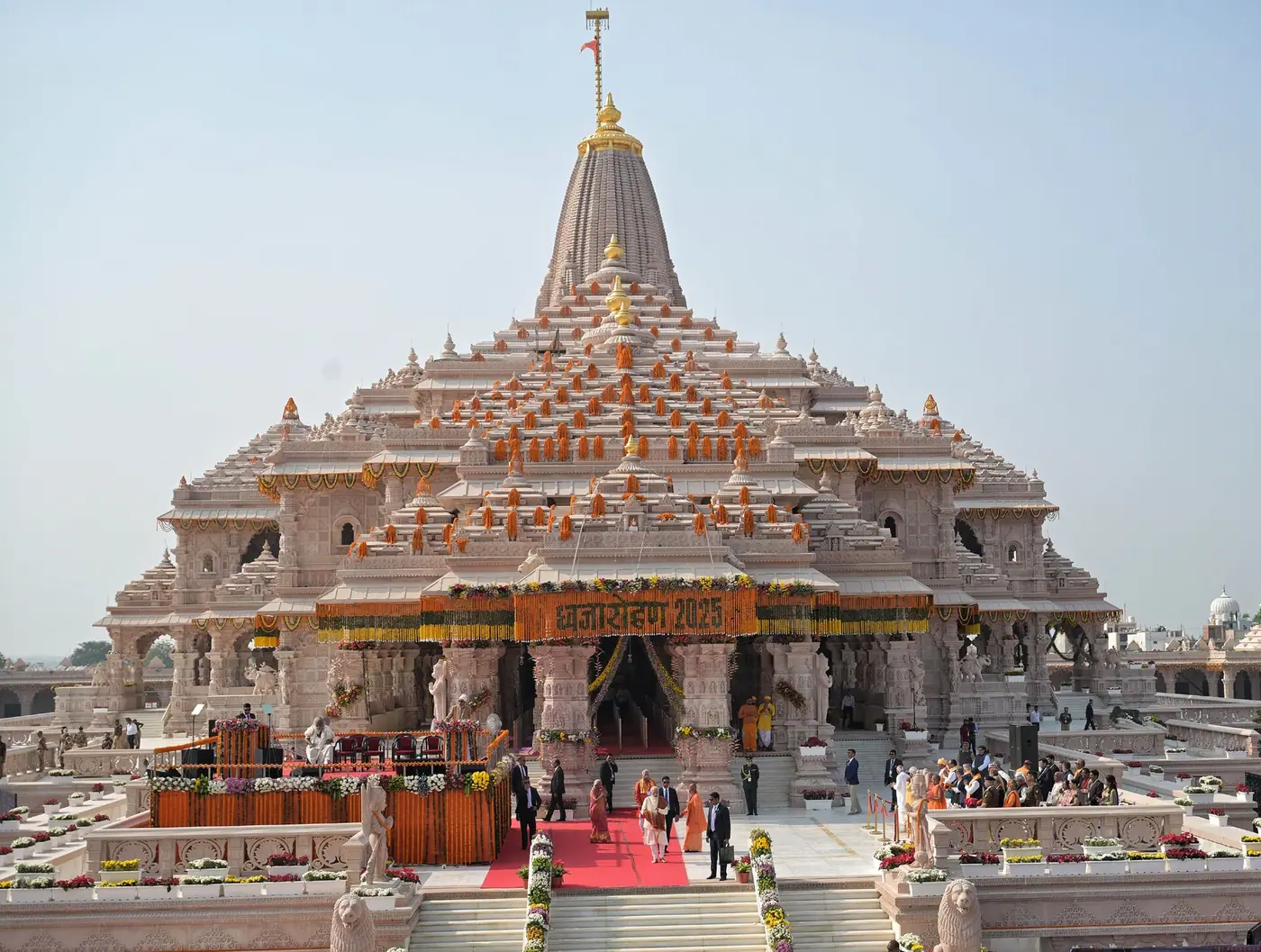
The Ranakpur Jain Temple in Rajasthan
The Ranakpur Jain Temple in Rajasthan, India was built in the 15th century by a merchant who was inspired by a dream.
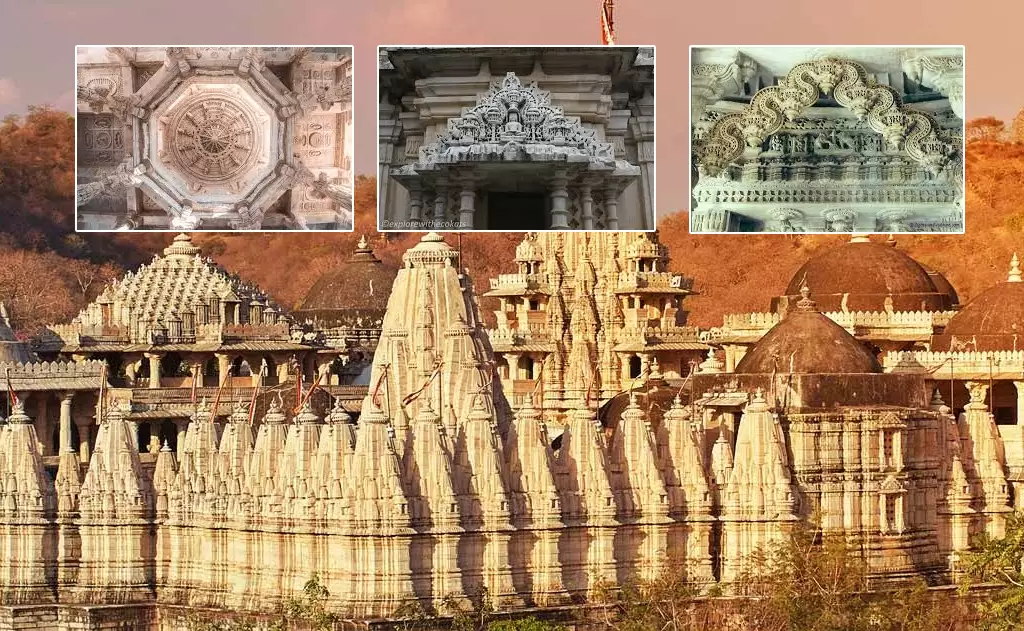
The Ranakpur Jain Temple in Rajasthan, India was built in the 15th century by a merchant who was inspired by a dream. The temple is dedicated to Adinatha, the first Jain Tirthankara.
History
The temple was commissioned by Dhanna Shah, a prosperous merchant and minister to Rana Kumbha, the ruler of Mewar.
Shah had a dream of building a temple in the shape of a celestial vehicle.
He shared his dream with the king, who agreed to help on the condition that the temple be named after him.
The temple's construction began in 1446 and took over 50 years to complete.
The temple was built from light-colored marble by thousands of skilled artisans.
Features
The temple is considered one of the most spectacular examples of Jain architecture in the world.
The temple's main shrine is the Chaumukha Temple, which features a four-faced idol of Adinatha.
The temple has many intricately carved pillars, domes, and ceilings.
The temple is made entirely of white marble.
Significance
The temple is one of the five most sacred pilgrimage sites in Jainism.
What is the architectural significance of the 1,444 pillars inside Ranakpur?
The Ranakpur temple complex, formally known as Chaturmukha Dharana Vihara, contains 1,444 intricately carved marble pillars spread across 29 halls, called navaranga mandapas. Remarkably, no two pillars bear identical carvings — each is a unique composition of celestial beings (apsaras and vidyadharas), scrolling foliage, and geometric patterns drawn from the Jain cosmological vision of the heavens.
Structurally, the pillars serve a precise load-distribution function, supporting 80 domed ceilings of varying heights without the use of a single beam in the traditional sense. The columns are arranged so that a viewer standing at any point inside the temple can see the central four-faced (chaumukha) icon of Adinatha, a deliberate design choice meant to remind the devotee that the Tirthankara's omniscience — kevala jnana — extends in all directions simultaneously.
The sheer quantity of pillars gave rise to a local tradition that the builders lost count during construction and had to begin counting afresh several times, which is why some accounts list slightly different totals. Whether legend or fact, this story underscores the temple's reputation for overwhelming visual complexity.
Who was Adinatha, the presiding deity of the Ranakpur temple?
Adinatha, also called Rishabhadeva or Rishabha, is the first of the twenty-four Tirthankaras — the 'ford-makers' who, in Jain theology, have crossed the ocean of worldly existence and shown others the path to liberation (moksha). Jain canonical texts such as the Acaranga Sutra and the Kalpa Sutra describe Rishabha as having lived in an almost incalculably ancient cosmic era, long before recorded human history, and as the progenitor of civilised arts including writing, agriculture, and governance.
The Chaumukha (four-faced) form of Adinatha enshrined at Ranakpur is particularly significant because it symbolises the Tirthankara's all-directional compassion and vision. Devotees circumambulate the sanctum in pradakshina so that each face of the icon is venerated in turn, representing the four cardinal points and, by extension, the entirety of the universe.
How does Ranakpur fit within the broader landscape of Jain pilgrimage in Rajasthan?
Ranakpur is located in the Pali district of Rajasthan, nestled in a forest valley of the Aravalli range near the town of Sadri. This geographical seclusion was intentional — Jain doctrine values vana (forest) settings for temples because the tranquillity aids the meditative detachment that the faith calls vairagya. The site is sometimes referred to as Ranpur in older inscriptions, and it lies roughly midway between the sacred city of Jodhpur and the famous hilltop pilgrimage complex of Dilwara on Mount Abu.
Within the five most sacred Jain tirthas (pilgrimage sites), Ranakpur is grouped alongside Shatrunjaya (Palitana, Gujarat), Girnar (Junagadh, Gujarat), Sammeta Shikhara (Jharkhand), and Pawapuri (Bihar). Each site is associated with a specific Tirthankara's spiritual milestone — at Ranakpur, the primary association remains Adinatha, though subsidiary shrines within the complex also honour Parsvanatha (the twenty-third Tirthankara) and Neminatha (the twenty-second).
Pilgrims typically combine Ranakpur with a visit to the Kumbhalgarh Fort, located only about 35 kilometres away, since both sites owe their founding-era patronage to the Mewar court of Rana Kumbha in the mid-15th century.
What was the role of Rana Kumbha and the Mewar kingdom in the temple's construction?
Rana Kumbha, who ruled Mewar from approximately 1433 to 1468 CE, was one of the most celebrated builder-kings of medieval Rajputana. His reign produced not only Ranakpur but also the Kumbhalgarh Fort and the Vijay Stambha (Tower of Victory) at Chittorgarh. Granting land and royal patronage to Dhanna Shah for the temple project was consistent with Rana Kumbha's broader policy of supporting diverse religious communities within his kingdom as a means of consolidating political goodwill.
The condition that the temple complex be named after him — hence 'Ranakpur,' a compound of 'Rana' and 'pur' (city or settlement) — reflected the medieval practice of immortalising royal names through architectural endowments, a custom visible across both Hindu and Jain traditions of the period. Dhanna Shah, in turn, is recorded in temple inscriptions as the sthapati-dana-pati, the patron-donor who bore primary religious merit (punya) for the commission.
The architect credited with translating Dhanna Shah's dream-vision into structural reality is named in local tradition as Deepaka (sometimes spelled Deepa), a master shilpin (craftsman-architect) whose genius is said to have reconciled the symbolic celestial vehicle (vimana) concept from Dhanna Shah's dream with the practical demands of the terraced mountain terrain.
What rituals and practices do devotees observe when visiting Ranakpur today?
Visitors entering the Ranakpur temple are required to remove footwear and leather articles — including belts and wallets — before the threshold, in accordance with the Jain principle of ahimsa (non-violence) toward all living beings. Menstruating women are traditionally asked to refrain from entering the inner sanctum, a practice common to many Jain and Hindu sacred spaces in India.
The principal worship at Ranakpur follows the Shvetambara tradition of Jainism, under whose auspices the temple has been managed for centuries. Morning rituals include abhisheka — the ceremonial bathing of the Adinatha idol with water, milk, and sandalwood paste — followed by the offering of fresh flowers, incense, and lamps in the eight-fold puja (ashtaprakari puja) described in Shvetambara texts. Monks and nuns of the order, who observe strict non-possession (aparigraha), may be present to offer pravachana (spiritual discourse) to pilgrims.
The temple is open to non-Jain visitors during designated hours, and the Archaeological Survey of India maintains certain conservation responsibilities for the complex, reflecting its status as a monument of national architectural importance.
Frequently Asked Questions
Where is The Ranakpur Jain Temple in Rajasthan located?
The Ranakpur Jain Temple in Rajasthan, India was built in the 15th century by a merchant who was inspired by a dream. The temple is dedicated to Adinatha, the first Jain Tirthankara.
Who is the presiding deity of The Ranakpur Jain Temple in Rajasthan?
The temple's presiding deity and its significance are described in the guide above.
What are the timings and how do I reach The Ranakpur Jain Temple in Rajasthan?
Temples typically open early morning and evening; confirm current darshan timings before visiting. The nearest airport, railway station and road routes are covered in the guide above.
What is the best time to visit The Ranakpur Jain Temple in Rajasthan?
Major festival days and the cooler months are popular, though weekday mornings offer a calmer darshan. Plan around the temple's key festivals for the most vibrant experience.
Share this with family and friends
Send it on WhatsApp, post it, or copy the link.
More from Temples
- Famous Temples in Gujarat: A Source-Checked Guide to Somnath, Dwarka, Dakor, Ambaji, Modhera and More
- Famous Temples in Madhya Pradesh: A Source-Checked Guide to Mahakaleshwar, Omkareshwar, Khajuraho, Orchha and Datia
- Famous Temples in Kerala: A Source-Checked Guide to Guruvayur, Padmanabhaswamy, Vadakkunnathan, Attukal, Sabarimala and 70 More
- Famous Temples in Andhra Pradesh: A Source-Checked Guide from Tirumala and Simhachalam to Srikurmam, Lepakshi and Kanipakam
- Famous Temples in Karnataka: A Source-Checked Guide to Kukke, Kollur, Mysuru, Melukote, Hampi and More
You might also like
Famous Temples in Uttarakhand: A Source-Checked Guide to Kedarnath, Badrinath, Tungnath, Haridwar, Almora and More
Famous Temples in Odisha: A Source-Checked Guide to Puri, Bhubaneswar, Biraja, Tara Tarini and Western Odisha
Famous Temples in West Bengal: A Source-Checked Guide to Kalighat, Dakshineswar, Tarapith, Bansberia, Bishnupur and More