Shanivar — The Sacred Saturday: Complete Guide to Rituals, Shani Dev Worship, Peepal Tree Puja & Fasting for Hindus in India and Across the World
Published by HinduTone.com | Dharma · Devotion · Daily Practice "Nilanjana Samabhasam Raviputram Yamagrajam, Chhaya Martanda Sambhutam Tam Namami…
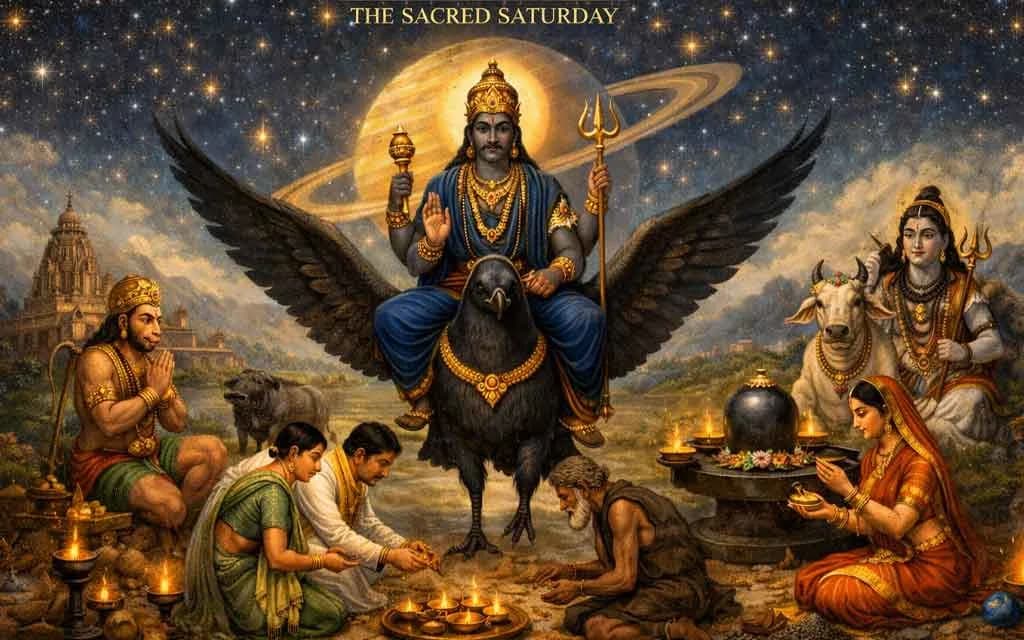
Published by HinduTone.com | Dharma · Devotion · Daily Practice "Nilanjana Samabhasam Raviputram Yamagrajam, Chhaya Martanda Sambhutam Tam Namami…
Published by HinduTone.com | Dharma · Devotion · Daily Practice
"Nilanjana Samabhasam Raviputram Yamagrajam, Chhaya Martanda Sambhutam Tam Namami Shaneshcharam."
I bow to Shanishchara (Saturn) — dark-blue in appearance, son of Surya (the Sun), elder brother of Yama, born of Chhaya and Martanda. I salute the slow-moving one.
Introduction — Why Saturday Belongs to Lord Shani Dev
In the sacred architecture of the Hindu week — where each day pulses with a specific divine energy — Saturday, Shanivar, stands utterly apart. It is simultaneously the most feared and the most liberating day of the week. It is the day of Lord Shani Dev — the son of Surya (the Sun God) and Chhaya (Shadow), the elder brother of Yama (the God of Death), the presiding deity of the planet Saturn, the most powerful and most uncompromising of all the nine Navagrahas.
Shanivar is not a day of comfort — it is a day of truth. It is the day when the universe holds up a mirror and says: here is your karma. Here is what your actions have built. Here is what must change. And in that unflinching honesty — in that absolute refusal to flatter or deceive — lies Saturday's greatest gift. For Shani Dev is not the god of punishment. He is the god of justice. He is the god of karma. He is the god of discipline, perseverance, and the long arc of righteous consequence. And when honoured sincerely on his own day, he becomes one of the most generous, most protective, most transformative divine forces in the entire Hindu pantheon.
The name Shanivar comes from Shani — derived from the Sanskrit root "Shanaye Kramati Sah" — he who moves slowly. Saturn is the slowest-moving planet visible to the naked eye, and its slow, grinding movement through the zodiac mirrors the nature of karmic consequence: slow, thorough, inescapable, and ultimately perfectly just. Saturn takes approximately 30 years to complete one orbit of the Sun — meaning it spends about 2.5 years in each zodiac sign, and its long transits bring sustained periods of testing, transformation, and ultimate strengthening.
At HinduTone.com, we bring you the most complete, most devotion-rich guide to Saturday worship — every ritual, every mantra, every fast rule, the Shanivar Vrat Katha, the Peepal tree tradition, the mustard oil lamp, Sade Sati remedies, and complete guidance for NRI Hindus in the USA, UK, Australia, and Canada to observe Shanivar with full devotion, wherever in the world they may be.
"Om Sham Shanaischaraya Namah." — The primary mantra of Lord Shani Dev. 108 repetitions every Saturday.
Understanding Shani Dev — Who Is He Really?
Before learning how to worship Shani Dev, it is essential to understand who he truly is — because most people approach Saturday worship from a place of fear, and fear is not the right foundation for any relationship with the divine.
Shani Dev is the son of Surya Dev (the Sun) and Chhaya (Shadow). His dark complexion — in contrast to his father's golden radiance — is the first indication of his nature: where Surya is direct, visible, immediate light, Shani is the indirect, hidden, slow-working consequence of light. He is a great Shiva devotee — indeed, Lord Shiva himself blessed Shani Dev with extraordinary powers. He carries a sword, a trident, and an arrow — the instruments of justice. He rides a crow or a vulture — birds associated with the inevitable processes of nature (death and transformation). He wears iron and dark blue.
Shani Dev is Jeevana Karaka — the lord of vital aspects of existence like livelihood and longevity. He controls career, employment, discipline, service, the elderly and the poor, iron and oil, the lower limbs of the body (legs, feet, knees), the bones and teeth, and the entire principle of karma: action and its consequence.
Shani Dev is the God of Justice, not of Anger. Even those who remain successful all through their lives may suffer for their wrongdoings under Shani's watch. Conversely, those who serve others, give charity, remain honest, and live with discipline — regardless of their birth or wealth — receive Shani's special protection and blessings. Saturday is therefore uniquely the day of the poor, the labourer, the servant, the disabled, the marginalized — and seva (selfless service) to these groups on Saturday is the most powerful act of Shani worship possible.
The Spiritual Significance of Shanivar — Nine Sacred Dimensions
1. Karma and Justice — The Cosmic Accountant
Shani Dev maintains the universe's karmic ledger with absolute impartiality. He does not differentiate between king and beggar — only between righteous action and unrighteous action. This makes him simultaneously the most feared and the most just deity in Hinduism. Saturday worship is an act of karmic accountability — a weekly reckoning, a weekly clearing of the slate, a weekly resolve to live more righteously.
2. Sade Sati — The Seven-and-a-Half-Year Saturn Period
Sade Sati (literally "seven and a half") is the most discussed and most feared astrological period in Hindu astrology. It occurs when Saturn transits through three zodiac signs consecutively — from the sign immediately preceding your natal Moon sign, through your Moon sign, to the sign immediately following. Each sign takes approximately 2.5 years, giving a total of 7.5 years. During Sade Sati, individuals often experience: career setbacks, relationship challenges, health issues, financial pressure, and profound life restructuring. Saturday fasting and worship is the most powerful ongoing remedy for Sade Sati. Sharing food to the needy and performing yajna on this day reduces the adverse effects of Sade Sati.
3. Shani Dhaiya — The Two-and-a-Half-Year Saturn Transit
Shani Dhaiya (also called Shani ki Dhaiya or Panoti) is a 2.5-year period when Saturn transits through either the 4th house or the 8th house from your natal Moon sign. Like a milder version of Sade Sati, Dhaiya brings challenges in specific life domains — particularly home, property, and career (4th house Dhaiya) or sudden changes, legal matters, and the occult (8th house Dhaiya). Saturday worship with the specific remedies described in this guide provides sustained relief during both Sade Sati and Dhaiya.
4. Hanuman's Protection — The Divine Shield Against Shani
The most celebrated Saturday mythology involves the relationship between Lord Hanuman and Lord Shani. When Hanuman arrived in Lanka searching for Sita, he heard cries from a dark room. Upon investigation, he found Lord Shani imprisoned there by Ravana — who had captured and confined Shani to prevent the planet's unfavourable gaze from affecting his own chart. Hanuman freed Shani from captivity, carrying the planet on his mighty shoulders. Though Shani's gaze momentarily fell upon Hanuman (creating a brief karmic effect), Shani — deeply grateful to Hanuman — declared: "Those who worship Lord Hanuman on Saturday will be liberated from my painful effects." This is why Hanuman worship on Saturday is considered the most direct and powerful means of Shani pacification.
5. The Peepal Tree — Saturn's Sacred Living Shrine
The Peepal tree (Ficus religiosa — the sacred fig) is one of the most revered trees in Hindu tradition — worshipped as the dwelling of the Trimurti, associated with Lord Vishnu (who is said to dwell in its roots), and uniquely connected to Shani Dev. Offering water and mustard oil to a Peepal tree on Saturday morning, circumambulating it seven times, and lighting a sesame-oil lamp beneath it are among the most powerful Saturday rituals for Shani's pacification. The Peepal tree produces oxygen even at night — and is perhaps the only tree in India around which the ancient practice of night worship developed.
6. Seva and Charity — The Highest Saturday Practice
Saturn rules service, labour, the poor, the elderly, the disabled, and all who suffer unjustly. Shani Dev is most deeply pleased not by elaborate puja but by genuine acts of compassion and service to those whom society marginalises. Feeding crows (Saturn's vehicle), feeding the poor, donating to the disabled, giving black sesame, black cloth, and iron to Brahmins — these acts of dana on Saturday carry merit a hundredfold greater than on any other day.
7. Bhairav Dev — The Fierce Form of Shiva on Saturday
Along with Shani Dev and Hanuman, Kaal Bhairav (the fierce, time-devouring form of Lord Shiva) is deeply associated with Saturday. Bhairav is the guardian of time and the destroyer of all that impedes spiritual evolution. His worship on Saturdays — with offerings of flowers, mustard oil lamps, and the Bhairav Ashtakam — is particularly powerful for dissolving deep-seated fears, cutting through karmic obstacles, and invoking Shiva's protective grace on the day most associated with karmic consequence.
8. Lord Narasimha on Saturday
As noted in the Hindu Panchanga, Hindu devotees not only worship Lord Shanidev but also Lord Narasimha (the fourth incarnation of Lord Vishnu — the Man-Lion who appeared to protect Prahlada) on Saturday. Narasimha is the supreme protector — the one who erupts from any surface to defend the sincere devotee. His Saturday worship is particularly observed in South India and by Vaishnava communities.
9. The Black and Dark Blue of Saturday — Colours of Cosmic Truth
Black and dark blue are Saturn's colours — not the colours of negativity but of the cosmos itself. The night sky is blue-black. The deep ocean is blue-black. The farthest reaches of space are blue-black. Saturn's colours represent depth, introspection, the infinite, and the ultimate truth that lies beyond the superficial. On Saturday, wear black or dark blue with pride — as a statement of alignment with cosmic law, karmic accountability, and the profound dignity of the dark.
The Deities of Saturday
Primary Deity — Shani Dev (Lord Saturn)
Shani Dev is depicted as a dark-complexioned, lean figure — standing or seated — with four arms holding a sword, a trident (Trishul), an arrow, and making the Varada Mudra (giving gesture). He wears dark blue or black clothing and is adorned with an iron crown. His vehicle (vahana) is a crow (or sometimes a vulture) — both birds of deep cosmic significance. He is associated with iron, black sesame seeds (Kala Til), mustard oil (Sarson ka Tel), and the Shami tree (Prosopis cineraria — the tree most sacred to Shani).
Secondary Deity — Lord Hanuman
On Saturday, Hanuman is not merely worshipped as a side figure — he is the primary protective force against Shani's more difficult effects. The Hanuman Chalisa recited on Saturday carries the specific energy of Saturn-pacification. Many Shani temples have prominent Hanuman shrines, and many Hanuman temples observe special Saturday Shani-Hanuman puja. The colour of Hanuman's sindoor-red is a counterpoint to Shani's black — fire and darkness, energy and stillness.
Tertiary Deities — Kaal Bhairav and Lord Narasimha
Kaal Bhairav: Worshipped with mustard oil lamps, black flowers, and the Bhairav Ashtakam on Saturday evenings. His fierce energy cuts through karmic blockages that ordinary worship cannot reach. Lord Narasimha: The Man-Lion avatar of Vishnu — worshipped on Saturday in South India particularly, with Panchamrit Abhishekam and the Narasimha Kavacham recitation for protection.
Complete Shanivar Puja Vidhi — Step by Step
Preparation the Night Before
- Gather all puja materials: Shani Dev picture or iron murti (ideally an iron Shani Dev idol in iron vessel with oil), mustard oil (Sarson ka Tel), black sesame seeds (Kala Til), blue or purple flowers (Aparajita — blue clitoria, blue lotus), Shami leaves, black cloth, iron object (nail, iron ring), urad dal (black gram), incense, sesame-oil lamp.
- Black and dark blue are Saturday's sacred colours — lay out black or dark blue clothing.
- Resolve mentally the previous evening to observe the day with particular mindfulness, truthful speech, and service to others.
Morning Routine — The Sacred Beginning
Step 1 — Rise Before Sunrise Wake before sunrise. Brahma Muhurta is particularly important on Saturday — Saturn's most malefic influence operates in the mid-morning; the devotee who is already awake, bathed, and in prayer at dawn gains Saturn's morning protection for the day.
Step 2 — Ritual Bath Bathe with clean water. Add a pinch of black sesame seeds to the bath water — Kala Til is Shani's most sacred grain. Wear black or dark blue clothing after the bath. These colours align with Saturn's energy and demonstrate the devotee's voluntary alignment with the day's karmic force.
Step 3 — Peepal Tree Worship (The First Act of Saturday) If a Peepal tree (sacred fig) is accessible near your home, this is the first act of Saturday: offer water to the Peepal tree roots, light a sesame-oil (Til) lamp at its base, offer black sesame seeds, and circumambulate the tree seven times in clockwise direction (or 108 times for deeper practice), chanting "Om Sham Shanaischaraya Namah" at each circumambulation. This single act is said to be among the most powerful Saturday practices for Shani pacification.
Step 4 — Set Up the Puja Space Arrange the puja space with:
- Shani Dev picture or iron murti (ideally kept in an iron vessel filled with mustard oil)
- Hanuman murti or picture (placed beside Shani)
- Kaal Bhairav picture (optional)
- Blue or purple flowers — Aparajita (blue butterfly pea), blue lotus, or blue flowers
- Shami leaves — small branches or sprigs of the Shami tree (most sacred to Shani)
- Black sesame seeds (Kala Til) — in a small bowl or plate
- Mustard oil (Sarson ka Tel) — for the lamp and for Abhishekam
- Black urad dal (whole black gram)
- Iron object — a small iron nail or iron ring
- Black cloth piece
- Incense — cedar, pine, or dark wood varieties
- Sesame-oil lamp (diya — with sesame oil, not ghee, on Saturday)
Step 5 — Sankalpa (Sacred Vow) Sit facing south or west (Shani's directions). Sprinkle clean water. Join palms and declare:
"Om Sham Shanaischaraya Namah. Om Namo Hanumate Rudratmakaya. Adya Shanivaré, Shri Shanidev tatha Hanuman prasadartham, , aham Shanivar Vrat karishye."
(O Shanidev, O Hanuman born of Rudra. Today, Saturday, for the grace of Shani Dev and Hanuman and for , I observe this Shanivar Vrat.)
The Heart of the Puja — Tailabhishekam (Oil Bath)
The Tailabhishekam — the ritual bathing of Shani Dev with sesame oil (Til oil) or mustard oil — is the supreme and most distinctive act of Saturday worship. It is said that Shani Dev, after his release from Ravana's captivity by Hanuman, was soothed by the cooling application of oil — and declared that those who offer him oil on Saturdays would be freed from his malefic influence.
How to perform Tailabhishekam:
- Hold the bottle of mustard oil or sesame oil in both hands.
- Pour slowly and steadily over the Shani Dev iron murti — from crown to feet.
- Chant "Om Sham Shanaischaraya Namah" continuously throughout.
- Visualise all karmic burdens, delays, obstacles, and suffering dissolving into the oil and flowing away from your life.
- If performing at home without an iron murti, pour oil into an iron vessel and offer it as a symbolic bath.
- After the oil bath, offer black sesame seeds, Shami leaves, and black flowers.
Shami Patra (Shami Leaf Offering) — Shani's Most Beloved Leaf: The Shami tree (Prosopis cineraria) is the tree most sacred to Lord Shani. Offering Shami leaves to Shani Dev on Saturday — particularly while chanting "Shami Shamithe Papam Shami Shatruvineshanam, Arjunasya Dhanurdhare Ramasya Priyakarini" — is said to dissolve accumulated sins and remove the root causes of Saturn's difficult influence in one's horoscope.
What to Offer on Saturday
What NOT to offer or do on Saturday:
- Do NOT offer ghee lamp on Saturday — use sesame oil for the lamp
- Non-vegetarian food
- Do NOT buy iron or new iron items on Saturday — considered inauspicious in traditional belief
- Do NOT cut hair or nails on Saturday (a traditional rule, particularly observed in Maharashtra and South India)
- Do NOT argue, lie, or engage in injustice on Saturday — Shani is watching
- Avoid tamasic speech — harsh words, gossip, and deception are particularly harmful on Shani's day
- Do NOT ignore beggars or the poor on Saturday — turning away someone in need on Shani's day invites his displeasure
Mantra Recitation — The Sacred Sounds of Saturday
The Primary Shani Mantra
ॐ शं शनैश्चराय नमः Om Sham Shanaischaraya Namah
The most universally chanted Shani mantra. "Sham" is Shani's seed syllable. Chanting "Om Sham Shanaischaraya Namah" 108 times on Saturday mornings using an iron or black Rudraksha mala is the primary act of Saturn worship. This mantra pacifies Shani's malefic influence, dissolves karmic obstacles, and brings the planet's disciplining force into alignment with the devotee's highest good.
The Shani Beeja Mantra (Seed Syllable of Saturn)
ॐ प्रां प्रीं प्रौं सः शनैश्चराय नमः Om Praam Preem Praum Sah Shanaischaraya Namah
The seed-syllable mantra of Saturn — the most potent single Shani mantra in Vedic astrology. Particularly recommended by astrologers for those undergoing Sade Sati, Shani Dhaiya, or Shani Mahadasha. Chant 108 times every Saturday. Reduces obstacles and ensures protection from adversities.
The Shani Gayatri Mantra
ॐ काल ध्वजाय विद्महे खड्गहस्ताय धीमहि। तन्नो मन्दः प्रचोदयात्॥
Om Kaladwajaya Vidmahe Khadgahastaya Dhimahi, Tanno Mandah Prachodayat.
Meaning: We meditate upon the one who carries the flag of time (Kala), who holds the sword in his hand. May the slow-moving one (Manda — Saturn) inspire and illuminate our intellect. Invokes Shani's blessings for wisdom, patience, and endurance. Chant 108 times on Saturday.
The Dasharatha Shani Stotram
King Dasharatha (father of Lord Rama) is said to have composed this powerful Shani Stotram when Saturn threatened to enter Rohini Nakshatra — an event that would have brought devastating drought and famine to the world. Dasharatha appealed to Shani with such love and surrender that Saturn was moved, and agreed to spare Rohini. The Dasharatha Shani Stotram remains one of the most potent Shani pacification texts in the entire tradition:
Konastha Pingalo Babhru, Krishno Raudrantako Yama, Souri Shanaishcharo Manda, Pippaladen Sansthutah.
Reciting the complete Dasharatha Shani Stotram (10 verses) on Saturday is said to provide the same protection that Dasharatha obtained — turning Saturn's most difficult transits into periods of ultimate growth.
The Shani Chalisa — Forty Verses of Saturn
The Shani Chalisa is a 40-verse devotional hymn in Hindi dedicated to Lord Shani — describing his birth, his qualities, his tests of devotees, and his profound blessings upon those who approach him with humility and genuine devotion. Many devotees recite the Shani Chalisa every Saturday as their primary act of worship:
Opening Doha:
Jai Ganesh Giri Var Rani, Shiva Siv Anupam Bakhani, Kahi Mathurai Das Karori, Ab Aur Tori.
The Hanuman Chalisa on Saturday
Given the divine compact between Hanuman and Shani — that Hanuman's devotees will be protected from Shani's harmful effects — reciting the Hanuman Chalisa on Saturday carries a dual power: it invokes Hanuman's protection AND pacifies Shani simultaneously. Many devotees who find Shani Dev's direct worship intimidating approach Saturday worship entirely through Hanuman, reciting the Hanuman Chalisa 7 or 11 times on Saturday for Shani pacification.
"Bhoot pisaach nikat nahin aave, Mahaveer jab naam sunaave." (No evil spirit or karmic affliction dare come near the one who chants Mahaveer Hanuman's name.)
Shani Ashtakam — Eight Verses of Saturn
The Shani Ashtakam (eight verses in praise of Shani) is a Sanskrit stotra that systematically addresses all of Saturn's qualities — his power over karma, his justice, his compassion toward humble devotees, and his blessings upon those who approach him with truth. Reciting the Shani Ashtakam on Saturday evenings after the aarti completes the day's worship beautifully.
Shani Stotra from the Brahma Purana
Surya Putro Deergha Deh, Vishalaaksha Shiva Priyah, Mandachara, Prasanna Stha, Peedam Haratu Me Shani.
Meaning: Son of the Sun, long-bodied, wide-eyed, beloved of Shiva, slow-moving, in a state of peace — may Shani remove my suffering. Chant 108 times on Saturday for direct Shani pacification.
The 108 Names of Lord Shani (Shani Ashtottara Shatanamavali)
Reciting the 108 names of Shani Dev on Saturday — offering black sesame seeds or blue flowers with each name — is the most complete form of Saturday Archana:
Om Shanaischaraya Namah · Om Shantaya Namah · Om Sarvabhistapradayine Namah · Om Sharanyaya Namah · Om Varaghanaya Namah · Om Sarveshaya Namah · Om Saumyaya Namah · Om Suravandhyaya Namah · Om Suralokaviharine Namah · Om Sukhasonopavisthaya Namah · Om Sundaraya Namah · Om Ghanaaya Namah · Om Ghanaghanaya Namah · Om Ni-thyana Pushkarekshanaya Namah · Om Kruraya Namah · Om Kruracheshtaya Namah · Om Kaamakreedaparayanaya Namah · Om Kaladharaaya Namah · Om Kaakavahaya Namah · Om Khadgadhaarine Namah...
Saturday Evening — Shani Aarti and Bhairav Puja
Shani Aarti: The Saturday evening Shani aarti — performed at dusk with a sesame-oil lamp — is the most important moment of the entire day's practice. Circle the lamp seven times before Shani Dev's image while reciting the aarti. The sesame-oil lamp flame is Shani's most beloved light.
Kaal Bhairav Evening Worship: After the Shani aarti, perform a brief Kaal Bhairav worship with mustard oil lamp, blue flowers, and the Bhairav Ashtakam. This completes Saturday's worship by invoking Shiva's fierce protective energy alongside Shani's karmic justice.
Fasting Rules — Shanivar Upavasa
Complete Fast (Nirahara / Nirjala)
No food or water from sunrise to sunset. This is the strictest form — practised particularly during Sade Sati or for the fulfilment of a very specific Sankalpa. Break the fast after sunset with simple food.
Partial Fast (Phal-Ahar)
Permitted throughout the day: fresh fruits (banana, black grapes — particularly auspicious on Saturday), coconut water, milk, curd, dry fruits, sabudana, and rock salt preparations. Black-coloured foods are particularly auspicious on Saturday: black grapes, black plum (Jamun), blackberries.
The Traditional Saturday Meal
Devotees consume a single meal after fasting and offering prayers to Shani. Black is the colour for Saturn and Saturday — and even the food consists usually of sesame (til) or black gram or any other dark-coloured items. The traditional Saturday single-meal consists of:
- Urad dal preparation (black gram) — Shani's most sacred grain; offered first to a beggar and then eaten
- Black sesame rice or sesame roti
- Black gram khichdi (urad dal + rice, simply prepared)
- No regular salt in strict observance — use rock salt only
- No onion or garlic
Saturday Vrat Food Specialities
- Urad dal khichdi — the quintessential Saturday vrat dish
- Til (sesame) laddoo with jaggery — Saturday's iconic sweet
- Black gram dal (urad) with rock salt and cumin
- Black grape and banana fruit plate
- Coconut-jaggery sweet (without sour)
- Sabudana vada or khichdi (no sour tamarind)
- Jamun (black plum) during season
- Sesame chikki (sesame-jaggery brittle)
- Makhana with black sesame (fox nut and sesame snack)
What to Strictly Avoid on Saturday
- Non-vegetarian food
- Onion and garlic
- Regular table salt (use rock salt / sendha namak)
- Cutting hair or nails
- Purchasing iron objects or new iron items
- Ignoring anyone who asks for help or charity
- Arguments, lies, injustice, and harsh speech
- Starting new ventures or signing important documents (traditional Saturday rule — favours contemplation over action)
The Shanivar Vrat — 11 or 51 Saturdays
The Two Standard Forms
11-Saturday Vrat: The most accessible form. Begin on the first Saturday of Shukla Paksha in any month. Observe 11 consecutive Saturdays with the complete puja vidhi, fasting, and charity. On the 12th Saturday (Udyapan), conclude with an elaborate puja and generous dana.
51-Saturday Vrat: For those with severe Shani afflictions — deep Sade Sati challenges, court cases, serious health issues, or entrenched career blockages — the 51-Saturday Vrat is prescribed. This extended commitment demonstrates to Shani Dev the depth of the devotee's sincerity and Saturn's principle of sustained, long-term effort.
Best Time to Begin
Begin on the first Saturday of Shukla Paksha in any month. The most auspicious beginning days are: the first Saturday of Shravan month (July–August), any Saturday that falls on Amavasya (new moon), and Shani Jayanti (Saturn's birthday — Amavasya of Jyeshtha month). Initiating vows of discipline, starting a long-term fasting routine, or making a solemn resolution to abandon a bad habit on Shani Jayanti carries the immense backing of the universe.
Who Should Observe the Shanivar Vrat?
- Those currently in Sade Sati (7.5-year Saturn transit) or Shani Dhaiya (2.5-year transit)
- Those with Saturn Mahadasha or Antardasha in their Vimshottari Dasha period
- Those with a debilitated, retrograde, or afflicted Saturn in their birth chart
- Those facing persistent career setbacks, job loss, or stalled professional growth
- Those experiencing legal troubles, court cases, or prolonged disputes
- Those with chronic conditions affecting the bones, joints, teeth, or lower limbs (Saturn's body domain)
- Those who feel stuck in life — unable to progress despite genuine effort
- Those seeking relief from the karma of past lives (deeply accumulated negative karma)
- Workers, servants, employees, farmers, and all those whose livelihood involves physical labour — Saturday worship specifically blesses these groups
- Unmarried individuals facing unexplained delays in finding a life partner
Rules of the Shanivar Vrat
- Begin on the first Saturday of Shukla Paksha.
- Fast from sunrise to sunset on each of the 11 or 51 Saturdays.
- Wear black or dark blue on each Saturday.
- On each Saturday: bathe, perform Tailabhishekam (oil bath of Shani murti), offer sesame seeds, Shami leaves, and black flowers, recite the Shani Chalisa or Dasharatha Shani Stotram, recite the Hanuman Chalisa, light the sesame-oil lamp, read the Shanivar Vrat Katha.
- Feed crows on each Saturday — offering black sesame balls, boiled rice with sesame, or grain.
- Donate to the poor — give black sesame seeds, black urad dal, black cloth, iron, oil, or food to those in need on each Saturday. This is non-negotiable.
- Observe truthful speech, patient conduct, and service to others throughout each Saturday.
- Maintain brahmacharya (mental purity) on each Saturday.
Udyapan — The Concluding Ceremony
After completing 11 or 51 Saturdays:
- Perform a grand Shani Puja with Tailabhishekam and full Archana.
- Recite the Shani Chalisa 7 times and the Dasharatha Shani Stotram.
- Offer 108 Shami leaves with the Shani Ashtottara (108 names).
- Donate generously — black cloth, sesame oil, iron, black gram, and food to Brahmins, the poor, and the disabled.
- Feed 11 or 51 poor people (matching the number of Saturdays observed) with a meal that includes urad dal.
- Feed crows with sesame-rice balls.
- Express gratitude to Shani Dev and Hanuman for the weeks of grace and the karmic clearing received.
The Shanivar Vrat Katha — Sacred Saturday Stories
King Vikramaditya and the Seven-and-a-Half-Year Lesson
The most famous Shanivar Vrat Katha tells the story of the legendary Emperor Vikramaditya of Ujjain — celebrated throughout ancient India for his wisdom, justice, and generosity. One day, the nine planets (Navagrahas) gathered and fell into an argument about which of them was the most powerful and influential. They decided to put the question to King Vikramaditya, trusting his impartial judgment.
Vikramaditya, recognising the diplomatic difficulty of the situation, tried to find a neutral resolution — but his approach inadvertently slighted Shanidev by placing him last in the order of consideration. Shani, offended by what he perceived as disrespect, declared: "You shall feel my influence for seven-and-a-half years and judge my power for yourself."
Shani's influence descended upon Vikramaditya's life. The great king who had everything began to lose everything. He was sent on a hunting expedition, became separated from his retinue, wandered into an unknown kingdom, and was falsely accused of theft. As punishment, the local king had Vikramaditya's hands and feet amputated. Even so, the dethroned emperor bore his suffering with extraordinary patience — he found work as an oil-seed crusher, using his teeth to operate the press, and continued to live with dignity and prayer.
As Shani's period drew to a close, the planet's energy softened. The merchant's daughter in whose house Vikramaditya worked heard his singing one night — recognising the quality of his voice as that of a great soul. She told her father. Word spread. The king of the land learned the truth about his prisoner, restored his limbs (miraculously, through divine grace), and his daughter married Vikramaditya. The great king was restored to Ujjain with wealth and honour — greater than before.
Vikramaditya, having experienced Shani's full power, emerged with a transformation of character and became the most devoted Shanidev worshipper in his kingdom. He acknowledged: "Shani did not destroy me. He revealed me. He stripped away everything false and left only what was real and true."
The Katha's teaching: Shani does not punish — he reveals. He removes what is temporary to reveal what is eternal. The person who survives Sade Sati with patience, service, and surrender emerges stronger, wiser, and more genuinely themselves than before.
Hanuman and Shani in Lanka — The Divine Compact
During his mission to Lanka, Hanuman heard faint cries from a dark, locked chamber within Ravana's fortress. Upon investigation, he found Lord Shanidev imprisoned there — Ravana having captured Saturn to prevent the planet from moving into an unfavourable position in his horoscope. Shani had been kept in complete darkness, with no food, no light, and no freedom.
Hanuman, recognising a divine being in suffering, immediately broke open the prison and freed Shani. Shani, grateful and humbled, asked Hanuman how he could repay his liberation. Hanuman replied that he wanted nothing for himself — but requested that those who worship Shani on Saturdays might be protected from suffering. Shani agreed, and declared: "Those who worship Lord Hanuman on Saturday will be liberated from the painful effects of my influence." This is the divine compact that makes Saturday the day of Hanuman AND Shani — inseparable in their protection.
The Story of Shani and Surya — The Father-Son Relationship
Shani Dev is the son of Surya (the Sun) and Chhaya (Shadow). His mother Chhaya — a shadow-form of Surya's first wife Sangya — was a deeply meditative, patient woman. When Shani was conceived and born, he was so deeply imbued with his mother's meditative Shiva-devotion that when he first opened his eyes as an infant, his gaze fell upon his father Surya Dev — and Surya momentarily lost his radiance. This is the origin of the Vedic saying that Shani's gaze (Shani ki Nazar) is powerful enough to affect even the Sun himself.
Surya, not understanding his son's Shiva-devotion and ascetic nature, was initially distant. This created a deep father-son tension that is encoded in astrology as the natural opposition between Sun and Saturn. But the deeper teaching of this story is: even the most powerful beings are subject to karmic consequence. Even the Sun must reckon with the justice of Saturn. And Shani's gaze — though it can humble the mighty — is never malicious. It is the gaze of absolute truth.
Key Shanivar Timings in India
India city-wise approximate sunrise on a representative Saturday: Delhi ~7:01 AM · Mumbai ~7:11 AM · Chennai ~6:24 AM · Kolkata ~6:14 AM · Hyderabad ~6:31 AM · Bengaluru ~6:38 AM
Major Shani Temples Across India — Where Shanivar Shines
The Supreme Shani Shrines
Shani Shingnapur — The Most Extraordinary Shani Shrine
Shani Shingnapur in Ahmednagar district, Maharashtra, is unlike any other temple in India. Lord Shani here is a self-manifested (Swayambhu) black stone standing under the open sky — no roof, no enclosure, no idol, no building. The entire village of Shingnapur is said to be under Shani's direct protection: traditionally, no house in the village has locks on its doors, believing that Shani himself guards all residents against theft and harm. Every Saturday, hundreds of thousands of devotees gather at Shani Shingnapur — pouring mustard oil over the black stone, circling it, and offering black sesame seeds in one of the most extraordinary mass acts of worship in all of India.
Saturday Rituals for NRI Hindus — Complete Country-Wise Guide
For the global Hindu diaspora, Shani Dev's justice and Hanuman's protection are as available in New Jersey as they are in Shani Shingnapur. The Peepal tree is native to many parts of the world, and where it is not available, the sesame-oil lamp, the Hanuman Chalisa, and the feeding of crows carry the complete power of Saturday worship to any corner of the globe.
[image: 🇮🇳] India — Regional Traditions
North India (UP, Bihar, Delhi, Rajasthan, MP, Haryana, Punjab): Saturday is perhaps the most intensely observed weekday vrat in North India. Shani temples — from Delhi's Shani Mandir at Connaught Place to the famous Shanidham in Noida — are packed at dawn. The mustard-oil lamp at the Peepal tree, crow-feeding with sesame balls, and the Hanuman Chalisa recited specifically for Shani pacification are near-universal Saturday practices. The Shani Chalisa is read in homes, neighbourhoods, and temples throughout the day. Sade Sati remedies — performed at Shani Shingnapur or through local temple priests — are among the most commonly sought ritual services in the Jyotish tradition.
Maharashtra: Shani Shingnapur is Maharashtra's most visited pilgrimage site after Shirdi and Pandharpur. Saturday pilgrimages to Shingnapur are made by lakhs of Maharashtrians annually. The Kaal Bhairav tradition is also strong in Maharashtra — Bhairav worship on Saturday evenings at Khandoba temples and Bhairav shrines is a distinctive Maharashtrian Saturday practice. Many Maharashtrian families observe the Saturday sesame-oil fast (no ghee lamp in the home on Saturday — only sesame oil lamps).
Tamil Nadu: Tirunallar Shanishwara temple — one of the nine Navagraha temples of Tamil Nadu — is the supreme Tamil Saturday pilgrimage. The full Navagraha circuit (visiting all nine planetary temples) ideally ends at Tirunallar on a Saturday. Tamil Shani worship is particularly devotional and elaborate: Abhishekam with sesame oil, black sesame seeds, urad dal, and the recitation of the Shani Ashtottara. Tamil families observe the Saturday sesame-oil lamp as a household sacred duty.
Andhra Pradesh & Telangana: Narasimha worship on Saturday is deeply embedded in Telugu tradition — combining Vaishnava protection (Narasimha) with Shaiva justice (Shani) in a uniquely complete Saturday worship. Telugu families light sesame-oil lamps at the Peepal tree and at Shani and Narasimha shrines every Saturday morning.
Karnataka: Saturday is observed with Kaal Bhairav worship (strong in Karnataka's Shaiva tradition), sesame-oil lamps at Peepal trees, and Shani Abhishekam at Navagraha sections of Shiva temples. The Dharmasthala temple complex — one of Karnataka's most beloved pilgrimage centres — has a prominent Shanidev shrine.
[image: 🇺🇸] United States of America
Setting Up Saturday Worship at Home: All essential Shanivar puja items are available across the USA. Indian grocery stores carry sesame oil (Til oil), mustard oil, black sesame seeds, urad dal (black gram), blue flowers (sometimes), and Shani Dev pictures. Many stores also carry sesame laddoo (til ki laddoo) as a ready-made Saturday prasad. Crows are native across all of North America — feeding crows on Saturday morning with black sesame-rice balls is a fully transferable practice.
The Peepal Tree Outside India: The Peepal tree (Ficus religiosa) is not native to North America. However, many Hindu temples in the USA have planted sacred Peepal trees on their grounds — making temples the NRI's Peepal circumambulation destination on Saturdays. Alternatively, worshipping under any large, ancient-looking tree with the Shani mantras carries the essential energy of the practice.
Major Shani and Hanuman Temples in the USA:
NRI Saturday Tip — USA: Nearly all major Hindu temples in the USA have Navagraha (nine planetary) shrines — and most perform special Saturday Shani Abhishekam with sesame oil. Many NRI devotees who cannot visit a temple pour sesame oil over a Shani picture at home while chanting "Om Sham Shanaischaraya Namah" — this home Tailabhishekam is equally valid when done with sincere intention.
Crow Feeding in the USA: Crows (Corvus brachyrhynchos) are abundant throughout North America — in cities, suburbs, and rural areas alike. Saturday morning crow-feeding with black sesame seeds, cooked rice, or bread pieces is a completely transferable Saturday practice for NRI Hindus in the USA.
[image: 🇬🇧] United Kingdom
Home Worship: Sesame oil, mustard oil, black sesame seeds, urad dal, and Shani Dev pictures are available at Indian grocery stores in Leicester, Southall, Wembley, Harrow, and Birmingham. Many UK Indian stores also sell til laddoo (sesame sweet) and black gram preparations. The crow (Corvus corone — the carrion crow and hooded crow) is one of the most common birds in the UK — making crow-feeding an easily practiced UK Saturday tradition.
Major Shani and Navagraha Temples in the UK:
Shirdi Sai Baba and Saturday in the UK: Many Indian Hindus in the UK observe Saturday as Shirdi Sai Baba's special day — a practice deeply aligned with Shani Dev's energy (Sai Baba, like Shani, is associated with justice, service to the poor, and the transcendence of caste). Sai Baba temples in London, Leicester, and Birmingham observe particularly vibrant Saturday worship.
[image: 🇦🇺] Australia
Home Worship: Sesame oil, black sesame seeds, mustard oil, and urad dal are available at Indian grocery stores in Sydney, Melbourne, Brisbane, and Perth. Australian crows and ravens (Corvus spp.) are among the most intelligent and widespread birds in Australia — a fully valid Saturday feeding offering. The large South Indian Tamil and Telugu communities in Sydney and Melbourne are particularly devoted to Navagraha worship, including Shani.
Major Shani and Navagraha Temples in Australia:
Navagraha Worship in Australia: The South Indian Tamil and Telugu communities in Sydney and Melbourne are among the most dedicated Navagraha worshippers in the Australian Hindu diaspora. Many observe a monthly or weekly rotation of Navagraha worship — with Saturday as the specific Shani day. The Sri Venkateswara Temple at Helensburgh performs full Navagraha Abhishekam on Saturdays, attracting devotees from across the Sydney region.
[image: 🇨🇦] Canada
Home Worship: The Greater Toronto Area, Greater Vancouver, and Calgary all have excellent access to Saturday puja materials. South Asian grocery stores in Brampton, Mississauga, and Scarborough carry sesame oil, mustard oil, black sesame seeds, urad dal, and Shani Dev pictures. The common crow (American crow — Corvus brachyrhynchos) is abundant across Canada — making crow-feeding a fully transferable Saturday practice.
Major Shani and Navagraha Temples in Canada:
Shirdi Sai Baba and Saturday in Canada: The Shirdi Sai Mandir in Toronto is one of the most vibrant Saturday worship centres in Canada's Hindu community. Sai Baba's message of service to the poor — deeply aligned with Shani's principle of karma through seva — resonates powerfully with the diaspora. Saturday at the Shirdi Sai Mandir features community langar (free meal for all), which is itself one of the most potent Shani pacification acts: feeding the hungry on Saturn's day.
Practical NRI Tips — Adapting Saturday Rituals Abroad
Item Substitutions for Saturday Worship
The Peepal Tree — Finding One Abroad
Many Hindu temples in the USA, UK, Australia, and Canada have planted Peepal trees (Ficus religiosa) on their grounds — making these the primary Peepal circumambulation sites for NRI devotees. In warmer climates (Southern USA, parts of Australia), Peepal trees may grow in botanical gardens or South Asian community centres. If no Peepal tree is accessible, perform the circumambulation and water-offering at any large, ancient-feeling tree with full Shani mantra recitation — Shani Dev accepts the intention.
The Most Powerful NRI Saturday — Sesame Oil Lamp
If no other Saturday practice is possible, light a sesame-oil lamp (or any oil lamp — sesame oil specifically if available) before a Shani Dev picture or image at sunset, and chant "Om Sham Shanaischaraya Namah" 108 times. This single act is considered the most essential Saturday practice and carries the full energy of Shanivar worship to any location on earth.
Sade Sati and Dhaiya — Online Resources for NRIs
- Sade Sati Calculator: Multiple Hindu astrology websites offer free Sade Sati status checkers — input your Moon sign and birth date to determine if you are currently in Sade Sati or Dhaiya.
- Online Shani Puja Booking: Shani Shingnapur temple, Tirunallar Shanishwara temple, and multiple Varanasi pandits offer online Saturday Shani puja performed on your behalf, with prasad sent by post.
- Live Temple Streams: Shani Shingnapur, Tirunallar, and major Shani temples across India stream Saturday Abhishekam live — watch and chant along for the complete darshan experience.
- Hanuman Chalisa Apps: Given Hanuman's supreme protective role on Saturday, the Hanuman Chalisa app (with audio) is an essential Saturday NRI resource — chant along 7 or 11 times every Saturday for Shani's pacification.
Benefits of Shanivar Vrat — Worldly and Spiritual
Worldly (Prakritic) Benefits
- Reduction or removal of the negative effects of Sade Sati and Shani Dhaiya
- Career stability, professional progress, and relief from workplace obstacles
- Resolution of long-standing legal matters and court cases
- Financial stability and relief from debt
- Improvement in health — particularly conditions related to bones, joints, knees, teeth, and the nervous system (all Saturn's domains)
- Protection from enemies, theft, and sudden losses
- Removal of delays in marriage for unmarried devotees
- Harmony in the household — particularly resolving disputes and tensions
- Improved discipline, time-management, and long-term planning (all Saturn gifts when properly propitiated)
Spiritual (Adhyatmic) Benefits
- Deep karmic cleansing — Saturday worship addresses accumulated karma from multiple lifetimes
- Development of patience, perseverance, and equanimity — Saturn's highest gifts to the sincere devotee
- Cultivation of humility and genuine service (seva) — the virtues that most please Shani Dev
- Increased capacity for sustained, long-term spiritual practice
- Alignment with karmic law — living in conscious, ethical awareness of one's actions and their consequences
- Gradual dissolution of the ego's attachment to comfort and convenience — the highest gift of Saturn's discipline
- Progress toward moksha through the transformation of karma — Shani Dev, properly honoured, becomes a great liberator
Health Benefits
- Fasting on Saturdays rests the digestive system and gives the body's elimination organs (colon, kidneys) a weekly cleanse
- Urad dal — the Saturday fasting staple — is rich in protein, iron, and B vitamins; genuinely beneficial for bone and joint health
- Black sesame seeds (offered and consumed on Saturday) are among the highest plant sources of calcium, magnesium, and zinc — directly beneficial for Saturn's body domains (bones, teeth)
- Mustard oil — used for the Tailabhishekam and the sesame-oil lamp — has demonstrated anti-inflammatory properties particularly relevant to joint pain
- The conscious cultivation of patience and equanimity on Saturdays reduces cortisol and promotes parasympathetic nervous system activation
- Recitation of Shani mantras and the Hanuman Chalisa — with rhythmic, sustained Sanskrit chanting — deepens breathing and activates the vagus nerve
Closing Blessing — From HinduTone.com
ॐ शं शनैश्चराय नमः
O Shanidev — son of Surya, born of Chhaya, the one who moves slowly and sees everything, the one whose gaze no living being can escape — we do not approach you with fear today. We approach you with respect. With honesty. With the willingness to face what you show us.
Show us our karma. Show us where we have been unjust. Show us where we have looked away from suffering we could have alleviated. Show us the places in ourselves that need the discipline of your refining fire. And then, Shanidev — transform us. As you transformed Vikramaditya. As you transform every honest soul who submits to your teaching.
O Hanuman — Mahaveer, Vayuputra, Ramadoot — stand between us and Saturn's harshest lessons. Not to spare us from growth, but to give us the courage to grow without breaking. Your red is the fire of courage in a blue-black universe. Your strength is the exact strength we need on Saturday.
May every sesame-oil lamp lit on Shanivar across the world — from Shani Shingnapur to Southall, from Tirunallar to Toronto, from Hyderabad to Houston — send its light upward to the great planet that governs all our karma. May Shani Dev receive it. May he be pleased. May he turn from judge to guide, from burden to blessing, from the weight of karma to the wings of transformation.
Om Sham Shanaischaraya Namah! Jai Shanidev! Jai Bajrang Bali!
© 2026 HinduTone.com — The Voice of Hindus Worldwide: Unity in Diversity
Note: Shani Hora timings and Sade Sati / Dhaiya calculations vary by individual birth chart. Always consult a qualified Vedic astrologer for personalised guidance on your Saturn-related astrological challenges. Shanivar Vrat is most effective when observed with complete sincerity, sustained consistency, genuine service to others, and a willing embrace of Saturn's teachings of discipline and karmic accountability.
Tags: Shanivar Vrat · Saturday fast Hindu · Shani Dev puja · Saturn worship Hindu · Sade Sati remedies · Shani Dhaiya relief · Tailabhishekam Saturday · Mustard oil Shani · Black sesame Saturday · Hanuman Saturday protection · Shani Shingnapur · Tirunallar Shanishwara · Om Sham Shanaischaraya Namah · Shani Beeja Mantra · Shani Chalisa · Dasharatha Shani Stotram · Peepal tree Saturday · Crow feeding Saturday Hindu · NRI Shani puja · Saturday worship USA UK Australia Canada · Hindu NRI rituals Saturday · Kaal Bhairav Saturday · Shani Dhaiya · Narasimha Saturday · Shani Jayanti 2026 · urad dal Saturday vrat
Frequently Asked Questions
When is Shanivar?
Shanivar is observed on its traditional tithi in the Hindu lunar calendar; refer to the year's panchang for the exact date in your region.
What is the significance of Shanivar?
Published by HinduTone.com | Dharma · Devotion · Daily Practice "Nilanjana Samabhasam Raviputram Yamagrajam, Chhaya Martanda Sambhutam Tam Namami Shaneshcharam." I bow to Shanishchara (Saturn) — dark-blue in appearance, son of Surya (the Sun), elder brother of Yama, born of Chhaya and Martanda. I salute the slow-moving one.
How is Shanivar celebrated?
Devotees observe it with puja, fasting or special offerings, visiting temples, chanting mantras, and gathering with family. Customs vary by region and tradition.
What should devotees do on Shanivar?
Take a sacred bath, perform the day's puja and charity (dana), observe any prescribed fast, and chant mantras with sincere devotion.
You might also like
Top 15 Most Powerful Hanuman Temples in India 2026: Complete Guide with History, Darshan Timings, Hanuman Chalisa Benefits & Pilgrim
Sri Rama Navami 2026: Date, Muhurat, Puja Vidhi, Fasting Rules & Complete Celebration Guide

Safe Holi Celebrations in the USA 2026: Practical Tips for the Hindu Community Amid Global Uncertainties