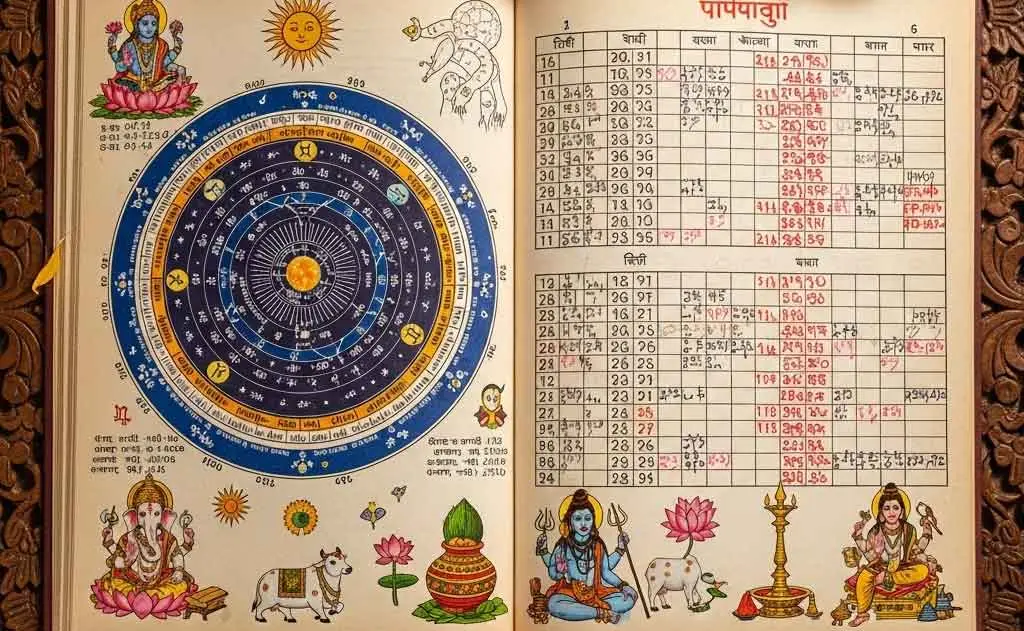
Lagna (Ascendant) and the 12 Houses in Vedic Astrology, Explained Simply
The lagna, or ascendant, is the sign rising in the east at the moment of birth, and it decides how the twelve houses of a Vedic birth chart are numbered. Here is what the lagna is, why a few minutes of birth time matter, a table of the twelve bhavas and their traditional significations, the kendra, trikona, dusthana and upachaya groups, and how to read North and South Indian charts.

The lagna, or ascendant, is the sign rising in the east at the moment of birth, and it decides how the twelve houses of a Vedic birth chart are numbered. Here is what the lagna is, why a few minutes of birth time matter, a table of the twelve bhavas and their traditional significations, the kendra, trikona, dusthana and upachaya groups, and how to read North and South Indian charts.
Quick answer: The lagna (ascendant) is the zodiac sign rising on the eastern horizon at the exact time and place of birth. In Vedic astrology it becomes the 1st house, and the other eleven signs follow in order as houses 2 to 12 (bhavas), each traditionally governing an area of life: self, wealth, siblings, home, children, health, partner, longevity, fortune, career, gains and losses. Because the lagna changes about every two hours, an accurate birth time and place are essential.
What the lagna is
As the Earth turns, all twelve signs of the zodiac rise one after another over the eastern horizon in a day, about two hours each on average. The sign rising at the moment you were born is your lagna (also called the ascendant, or Udaya Lagna). The precise degree rising is the lagna degree, or lagna sphuta.
In Jyotisha the lagna is treated as the most personal point in the chart. It represents the native: body, temperament and the overall course of life, and it is the anchor from which every house is counted. Two babies born on the same day in the same hospital can share a Moon sign but have different lagnas if they were born a few hours apart; two born at the same minute in Delhi and in Toronto will have different lagnas too.
Why birth time and place matter
- Time: with the lagna changing roughly every two hours, and its degree moving about a degree every four minutes on average, a wrong time can change the lagna and therefore every house. Signs do not all take the same time to rise; depending on latitude, some rise in about an hour and a half and others take closer to two and a half hours.
- Place: the rising sign depends on where the horizon is, so latitude and longitude of the birthplace are needed. Always use the place of birth, not where you live now.
- Time zone and daylight saving: for births abroad, make sure the software applied the correct historical time zone and daylight saving; this is a common source of error.
Lagna vs Moon sign vs Sun sign
| Lagna (ascendant) | Rashi (Moon sign) | Sun sign | |
|---|---|---|---|
| What it is | Sign rising in the east at birth | Sign the Moon occupied at birth | Sign the Sun occupied at birth |
| Changes about every | 2 hours | 2.25 days | 30 days |
| Needs birth time? | Yes, precisely | Usually only near a sign change | Rarely |
| Main use in Indian practice | Basis of houses and chart reading | Horoscopes, matching, nakshatra, transits such as Sade Sati | Less emphasised; Sankrantis mark its sign changes |
| Zodiac | Sidereal | Sidereal | Sidereal in Jyotisha; tropical in Western astrology |
HinduTone's monthly horoscopes, such as Mesha rashi October 2026, are written by Moon sign, the convention most Indian readers follow. Some readers also read the horoscope for their lagna as a second view.
Whole-sign houses: how houses are counted
Most traditional Indian charts use whole-sign houses: the entire lagna sign is the 1st house, the next sign the 2nd, and so on. A worked example with an invented chart:
- Lagna in Simha. The 1st house is Simha, ruled by the Sun, so the Sun is the lagna lord.The 2nd house is Kanya, the 4th Vrishchika, the 7th Kumbha and the 10th Vrishabha.If the Moon is in Dhanu, the Moon sits in the 5th house (Simha 1, Kanya 2, Tula 3, Vrishchika 4, Dhanu 5).The 7th house lord is Saturn (ruler of Kumbha), and the 10th house lord is Venus (ruler of Vrishabha).
The sign lords used for this counting are: Mesha and Vrishchika, Mars; Vrishabha and Tula, Venus; Mithuna and Kanya, Mercury; Karka, Moon; Simha, Sun; Dhanu and Meena, Jupiter; Makara and Kumbha, Saturn. Rahu and Ketu do not rule signs in the classical scheme.
Some astrologers also draw a bhava chalit chart, in which houses are measured from the lagna degree and their boundaries fall mid-sign, and others use house systems such as Sripati or KP (Krishnamurti Paddhati) cusps. These can move a planet into the neighbouring house, which is one reason two astrologers sometimes describe the same chart differently.
The 12 houses and their traditional significations
| House | Sanskrit name(s) | Traditionally signifies |
|---|---|---|
| 1st | Tanu, Lagna | Self, body, personality, health in general, the overall direction of life |
| 2nd | Dhana, Kutumba | Wealth, family, speech, food, early education, accumulated resources |
| 3rd | Sahaja, Parakrama | Younger siblings, courage, effort, communication, short journeys, skills |
| 4th | Sukha, Bandhu, Matru | Mother, home, land and property, vehicles, comfort, inner peace, schooling |
| 5th | Putra, Buddhi | Children, intelligence, creativity, devotion and mantra, merit from past lives (purva punya) |
| 6th | Ari, Ripu, Roga | Enemies and competition, illness, debts, service, daily work, obstacles overcome |
| 7th | Kalatra, Yuvati | Spouse, marriage, partnerships, business dealings, public interaction |
| 8th | Ayu, Randhra | Longevity, sudden events, transformation, inheritance, hidden matters, research, the occult |
| 9th | Dharma, Bhagya | Fortune, dharma, guru, father (in many traditions), higher learning, pilgrimage |
| 10th | Karma | Career, profession, actions, status, authority, reputation |
| 11th | Labha | Gains, income, elder siblings, friends and networks, fulfilment of desires |
| 12th | Vyaya | Expenses and losses, sleep, foreign lands, retreat, charity, moksha (liberation) |
Significations overlap and differ between texts. For example, some South Indian astrologers read the father mainly from the 10th house and others from the 9th; education is read from the 2nd, 4th and 5th in different ways. Each house is judged with its lord, the planets in it and aspecting it, and the natural significator (karaka), such as Venus for marriage or Jupiter for children.
House groups: kendra, trikona, dusthana, upachaya
| Group | Houses | Traditional meaning |
|---|---|---|
| Kendra (angles) | 1, 4, 7, 10 | Pillars of the chart; planets here are considered strong and visible in life |
| Trikona (trines) | 1, 5, 9 | Houses of dharma, merit and fortune; considered the most auspicious |
| Dusthana | 6, 8, 12 | Houses of difficulty, also of service, transformation and release |
| Upachaya (growing) | 3, 6, 10, 11 | Houses that improve with time and effort; natural malefics are said to do well here |
| Panaphara (succeedent) | 2, 5, 8, 11 | Houses following the kendras |
| Apoklima (cadent) | 3, 6, 9, 12 | Houses before the kendras |
| Maraka | 2, 7 | Traditionally examined in questions of longevity; not to be read in isolation |
The lagna is both a kendra and a trikona, which is why the lagna and its lord are given such importance. The lords of kendras and trikonas joining together is traditionally described as a Raja yoga, a combination for success, though classical texts list many conditions before such yogas are said to give their full results.
North Indian and South Indian charts, in words
North Indian (diamond) chart
A square divided by its two diagonals and by lines joining the midpoints of its sides, forming twelve compartments. The houses are fixed: the top-centre diamond is always the 1st house (lagna), and the houses run counter-clockwise from there. The signs move: a number in each house shows which sign occupies it (1 for Mesha through 12 for Meena). So a 5 in the top diamond means a Simha lagna.
South Indian (square) chart
A square grid with twelve boxes around the edge and an empty centre. Here the signs are fixed: Meena is in the top-left box, Mesha next to it, and the signs run clockwise around the square, ending with Kumbha below Meena. The lagna is marked in whichever box it falls, usually with a diagonal line or the abbreviation "La" or "Asc", and houses are counted clockwise from that box.
East Indian (Bengali and Odia) charts use a third layout with fixed signs. All three show the same information; it is simply a matter of which format you learned. The same styles are used for divisional charts such as the navamsa (D9).
How the lagna fits with the rest of the chart
A reading in the Parashari tradition typically starts with the lagna and its lord, then looks at the Moon (the chart is often also read with the Moon as the 1st house, called Chandra lagna), the planets' signs and houses, the Moon's nakshatra, the divisional charts, and the timing given by the Vimshottari dasha and transits. No single house or placement is meant to predict a fixed outcome, and many practitioners stress that the chart describes tendencies, not destiny.
Families who want a devotional practice connected with the nine planets often recite the Navagraha Stotram. That is a matter of faith and is never a substitute for medical, legal or financial advice.
Frequently asked questions
What is the difference between lagna and rashi?
Your lagna is the sign rising on the eastern horizon at the moment and place of your birth; it changes roughly every two hours. Your rashi, or Moon sign, is the sign the Moon occupied at birth; it changes roughly every two and a quarter days. Indian monthly horoscopes are usually written by rashi, while a full chart reading starts from the lagna.
Why is my Vedic sign different from my Western sun sign?
Western astrology mostly uses the tropical zodiac, tied to the seasons. Vedic astrology uses the sidereal zodiac, tied to the stars, which today is offset by about 24 degrees (by the commonly used Lahiri ayanamsa). So most people's Vedic Sun sign is one sign earlier than their Western sign, and Western astrology also emphasises the Sun sign, whereas Indian practice emphasises the lagna and Moon sign.
How accurate does my birth time need to be?
The lagna changes about every two hours on average, so a time accurate to within a few minutes usually fixes it, unless you were born close to a sign change. Divisional charts such as the navamsa are far more sensitive. If your recorded time is uncertain, astrologers may try birth time rectification, but that is itself an interpretive process.
Which house is for marriage, career and money?
Traditionally the 7th house is read for marriage and partnership, the 10th for career and public life, the 2nd for wealth and family, and the 11th for income and gains. Astrologers always combine these with the house lords, the planets placed there, the navamsa and the running dasha, so a single house never gives a verdict on its own.
Are the 6th, 8th and 12th houses bad?
They are called dusthanas and are traditionally linked with challenges such as debts, illness, sudden change and expense. But they also signify service, research, transformation, spirituality and liberation, and the 6th is an upachaya house where malefic planets are said to do well. Practitioners caution against reading them in a fearful way.
Do Vedic astrologers use whole-sign houses?
Most traditional Indian practice treats each sign as one house, counted from the lagna sign (whole-sign houses). Some astrologers also use bhava chalit charts or Sripati and Placidus-like cusps, which can shift a planet into a neighbouring house. Ask which method your astrologer is using.
Editor's note (9 October 2026)
This explainer describes the lagna and the twelve bhavas as traditionally taught in Parashari Jyotisha, with whole-sign houses and the sidereal zodiac (commonly calculated with the Lahiri ayanamsa, about 24 degrees from the tropical zodiac in 2026). House significations are summarised from widely used traditional lists and differ between texts and schools, as noted. The worked example uses an invented chart. This is general information, not a personal reading.
Related guides
You might also like
Mangal Dosha (Manglik, Kuja Dosha) Explained: Houses, Cancellations and a Balanced View for Marriage Matching
Navamsa Chart (D9) Explained: How It Is Calculated, Vargottama and Why It Matters
Choghadiya Muhurat Explained: How to Read the Day and Night Choghadiya Table