
Rahu Kalam, Yamagandam and Gulika Kalam Explained: Weekday Tables and How to Calculate Them
Rahu Kalam, Yamagandam and Gulika Kalam are daily periods that many South Indian families avoid for new beginnings. Here is how the daytime is split into eight parts, which part each falls in on every weekday, the familiar 6 AM clock table, and how to work out the real times from your own city's sunrise and sunset.
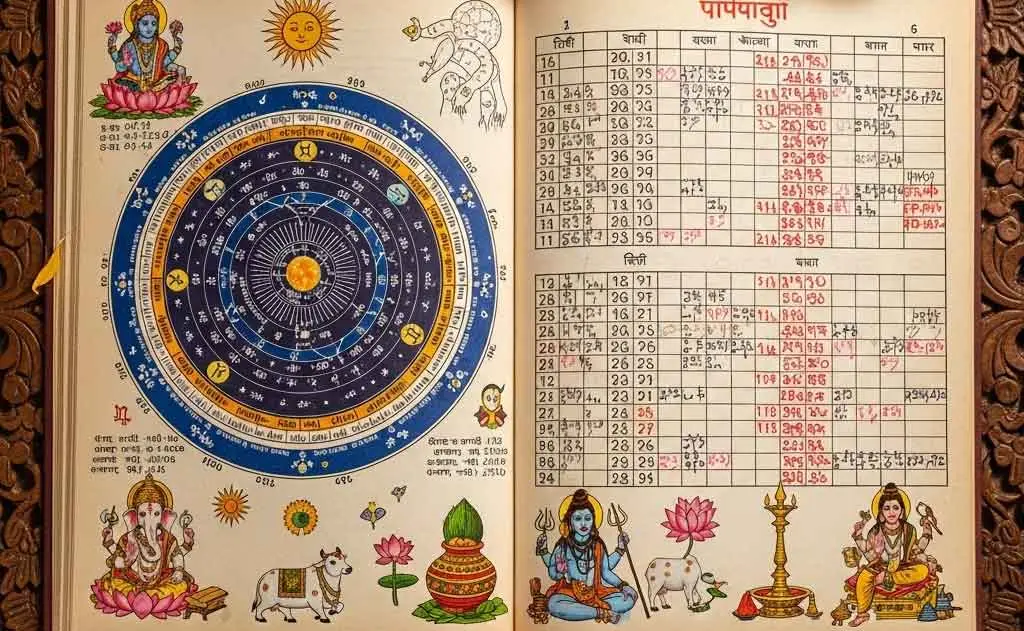
Rahu Kalam, Yamagandam and Gulika Kalam are daily periods that many South Indian families avoid for new beginnings. Here is how the daytime is split into eight parts, which part each falls in on every weekday, the familiar 6 AM clock table, and how to work out the real times from your own city's sunrise and sunset.
Quick answer: Divide the time from local sunrise to local sunset into eight equal parts. Rahu Kalam is the 2nd part on Monday, 3rd on Saturday, 4th on Friday, 5th on Wednesday, 6th on Thursday, 7th on Tuesday and 8th on Sunday. Yamagandam and Gulika Kalam follow their own weekday sequences (tables below). Each lasts about 90 minutes on a 12-hour day. The familiar clock times assume a 6 AM sunrise, so always recalculate from your own city's sunrise and sunset.
What these periods are
In South Indian panchangs, especially in Tamil Nadu, Andhra Pradesh, Telangana, Karnataka and Kerala, three daily periods are printed alongside the tithi and nakshatra:
- Rahu Kalam (Rahu Kalam, Raahu Kaalam): the portion of the day traditionally associated with Rahu, the shadow planet. It is the period most widely avoided for new beginnings.
- Yamagandam (Yamaganda Kalam): a period associated with Yama, also traditionally considered unsuitable for auspicious starts.
- Gulika Kalam (Kuligai, Mandi): associated with Gulika, described as a son of Saturn. It is treated with caution, with the belief that actions begun then tend to repeat.
They are part of the wider muhurta tradition of Vedic astrology, which chooses favourable times for important actions. They are not omens or punishments; they are simply windows that families who follow the tradition prefer not to use for starting something important. For how they fit with tithi, nakshatra, yoga and karana, see our panchang guide.
The rule: eight parts of the day
The calculation is the same for all three periods:
- Step 1: find local sunrise and sunset for the date.
- Step 2: subtract sunrise from sunset to get the length of the day, then divide by 8. That is the length of one part.
- Step 3: count parts from sunrise and pick the one given for that weekday in the table below.
| Weekday | Rahu Kalam (part of day) | Yamagandam (part) | Gulika Kalam (part) |
|---|---|---|---|
| Sunday | 8th | 5th | 7th |
| Monday | 2nd | 4th | 6th |
| Tuesday | 7th | 3rd | 5th |
| Wednesday | 5th | 2nd | 4th |
| Thursday | 6th | 1st | 3rd |
| Friday | 4th | 7th | 2nd |
| Saturday | 3rd | 6th | 1st |
Two patterns help you remember. Yamagandam and Gulika each move one part earlier every day of the week (Gulika runs 7th, 6th, 5th, 4th, 3rd, 2nd, 1st from Sunday to Saturday; Yamagandam runs 5th, 4th, 3rd, 2nd, 1st, then 7th and 6th). For Rahu Kalam, a popular English mnemonic lists the weekdays in the order of the 2nd to the 8th part: "Mother Saw Father Wearing The Turban Suddenly": Monday, Saturday, Friday, Wednesday, Thursday, Tuesday, Sunday.
The familiar clock table (assumes 6 AM sunrise, 6 PM sunset)
When the day is exactly 12 hours, each part is 90 minutes, and you get the times printed on many calendars:
| Weekday | Rahu Kalam | Yamagandam | Gulika Kalam |
|---|---|---|---|
| Sunday | 4:30 PM to 6:00 PM | 12:00 PM to 1:30 PM | 3:00 PM to 4:30 PM |
| Monday | 7:30 AM to 9:00 AM | 10:30 AM to 12:00 PM | 1:30 PM to 3:00 PM |
| Tuesday | 3:00 PM to 4:30 PM | 9:00 AM to 10:30 AM | 12:00 PM to 1:30 PM |
| Wednesday | 12:00 PM to 1:30 PM | 7:30 AM to 9:00 AM | 10:30 AM to 12:00 PM |
| Thursday | 1:30 PM to 3:00 PM | 6:00 AM to 7:30 AM | 9:00 AM to 10:30 AM |
| Friday | 10:30 AM to 12:00 PM | 3:00 PM to 4:30 PM | 7:30 AM to 9:00 AM |
| Saturday | 9:00 AM to 10:30 AM | 1:30 PM to 3:00 PM | 6:00 AM to 7:30 AM |
Treat this as a memory aid, not a timetable. Real sunrise is rarely at 6:00 AM. Even in Chennai or Hyderabad the actual times drift by several minutes over the year, and in North India, and even more so in North America, Europe or Australia, the difference can be large.
Worked example with real-world numbers
Suppose that on a Monday in your city, sunrise is at 6:20 AM and sunset at 6:12 PM. (These are example figures; use your own.)
- Day length: 6:12 PM minus 6:20 AM = 11 hours 52 minutes = 712 minutes.
- One part: 712 divided by 8 = 89 minutes.
- Part 1: 6:20 to 7:49 AM. Part 2: 7:49 to 9:18 AM. Part 4: 10:47 AM to 12:16 PM. Part 6: 1:45 to 3:14 PM.
- On Monday, Rahu Kalam is part 2 (7:49 to 9:18 AM), Yamagandam is part 4 (10:47 AM to 12:16 PM) and Gulika Kalam is part 6 (1:45 to 3:14 PM).
Compare that with the 6 AM table, which would say 7:30 to 9:00 AM for Rahu Kalam: almost 20 minutes off at both ends. In a northern city in midsummer, with a 15-hour day, each part becomes nearly two hours; in midwinter it can shrink to about an hour.
Why the times vary by city and season
- Latitude: the further from the equator, the more day length changes through the year, so the parts stretch in summer and shrink in winter.
- Longitude within a time zone: sunrise is later in the west of a time zone than in the east, so two cities on the same clock can have different Rahu Kalam.
- Daylight saving time: clocks move but the sun does not; the period simply shifts on the clock along with sunrise.
- Panchang conventions: almanacs differ slightly in how they define sunrise (the sun's upper edge or the centre of its disc), which can move times by a minute or two.
How families use them
In many South Indian homes, checking the day's Rahu Kalam is as routine as checking the weather. Common practice, as traditionally followed:
- Avoid starting a journey, a new job, a business, a house-warming, a vehicle purchase or an engagement during Rahu Kalam and Yamagandam.
- Leave a little before Rahu Kalam begins if travel cannot wait, or start the journey symbolically by stepping out earlier.
- Continue work already in progress; the periods concern beginnings, not routine tasks.
- Use the time for prayer. Some devotees perform Rahu Kalam worship of Goddess Durga, a well-known practice in Tamil Nadu, especially on Tuesdays and Fridays.
- For major events such as weddings, families do not rely on Rahu Kalam alone but ask an astrologer for a full muhurta.
In Gujarat, Rajasthan and much of North and West India, people more often consult the Choghadiya instead. The two systems are independent, so a favourable choghadiya can overlap with Rahu Kalam; families follow the system of their own tradition.
These are practices of faith and habit. Nothing bad is guaranteed to happen if something unavoidable, such as a flight time, a hospital appointment or an exam, falls in Rahu Kalam. Many people simply say a short prayer, such as the Navagraha Stotram, and go ahead.
For NRI families: always use local sunrise
If you live in the USA, Canada, the UK, Australia or the Gulf, calculate from your own city's sunrise and sunset, or use a panchang that lets you set your location. Do not take India's Rahu Kalam and convert the clock time; the period belongs to the local sun, not to Indian Standard Time. Save your city in your panchang app and check it in the morning, and remember that the times move noticeably over a few weeks around the daylight-saving changes and the solstices.
Frequently asked questions
Is Rahu Kalam the same every day?
No. It falls in a different eighth of the day on each weekday (Monday the 2nd, Saturday the 3rd, Friday the 4th, Wednesday the 5th, Thursday the 6th, Tuesday the 7th and Sunday the 8th), and its clock time also shifts with the season because sunrise and sunset change.
Is 7:30 to 9:00 AM always Rahu Kalam on Monday?
Only when sunrise is at 6:00 AM and sunset at 6:00 PM. Those familiar times assume a 12-hour day. On any real day the period is one eighth of the actual sunrise-to-sunset time, starting from actual local sunrise, so it can be several minutes or, in winter or summer abroad, more than an hour different.
How do I find Rahu Kalam in the USA, UK or Canada?
Use your own city's sunrise and sunset for that date, divide the daylight into eight equal parts and pick the part for the weekday, or use a panchang set to your city. Never take India's Rahu Kalam and convert it to your time zone; the period depends on the local sun.
Is there a Rahu Kalam at night?
The widely used Rahu Kalam, Yamagandam and Gulika Kalam are daytime periods. Some detailed panchangs also calculate night-time portions by dividing sunset to next sunrise into eight parts, but most families follow only the daytime periods.
What should not be done during Rahu Kalam?
Traditionally, people avoid starting something new: a journey, a business, signing an important agreement, a griha pravesham or an engagement. Ongoing work, daily routines and emergencies are not affected, and many families use the time for prayer instead.
Is Gulika Kalam bad?
Views differ. Gulika (Mandi) is associated with Saturn, and a common belief is that whatever starts in Gulika Kalam tends to repeat. So it is avoided for funerals, borrowing or anything you would not want repeated, while some families consider it acceptable for things they would like to recur.
Editor's note (9 October 2026)
This guide gives the standard weekday sequences for Rahu Kalam, Yamagandam and Gulika Kalam used by South Indian panchangs, and the eight-part rule from sunrise to sunset. The clock table is the conventional illustration for a 6 AM sunrise and is labelled as such; the worked example uses invented sunrise and sunset figures. Beliefs about these periods are described as traditionally held. Always check a panchang set to your own location for actual times.
Related guides
You might also like

Navamsa Chart (D9) Explained: How It Is Calculated, Vargottama and Why It Matters

Choghadiya Muhurat Explained: How to Read the Day and Night Choghadiya Table

Lagna (Ascendant) and the 12 Houses in Vedic Astrology, Explained Simply