What Is a Panchang? The Five Limbs Explained: Tithi, Vara, Nakshatra, Yoga and Karana
The panchang is the Hindu almanac, built on five limbs: tithi, vara, nakshatra, yoga and karana. This guide explains each one simply, lists all 27 yogas and 11 karanas, covers Rahu kalam, Abhijit muhurta and amrit kaal, the amanta and purnimanta month systems, and walks through how to read a daily panchang.
The panchang is the Hindu almanac, built on five limbs: tithi, vara, nakshatra, yoga and karana. This guide explains each one simply, lists all 27 yogas and 11 karanas, covers Rahu kalam, Abhijit muhurta and amrit kaal, the amanta and purnimanta month systems, and walks through how to read a daily panchang.
Quick answer: A panchang (panchanga, "five limbs") is the traditional Hindu almanac. For each day it gives five elements: tithi (lunar day), vara (weekday), nakshatra (the Moon's lunar mansion), yoga (one of 27 combinations of the Sun's and Moon's longitudes) and karana (half a tithi). Panchangs also list sunrise, sunset, Rahu kalam and auspicious windows. Families use it to set festival dates, keep vrats and choose times for ceremonies.
The five limbs at a glance
| Limb | What it measures | How many | Changes roughly every |
|---|---|---|---|
| Tithi | Each 12 degrees the Moon moves ahead of the Sun | 30 per lunar month | About a day (20 to 27 hours) |
| Vara | Weekday, from sunrise to sunrise | 7 | Each sunrise |
| Nakshatra | Moon's position in 27 sidereal segments of 13 degrees 20 minutes | 27 | About a day |
| Yoga | Sun's longitude plus Moon's longitude, in 27 segments of 13 degrees 20 minutes | 27 | About a day |
| Karana | Half a tithi (6 degrees of Moon-Sun separation) | 11 kinds, 60 per month | About half a day |
Four of the five are calculated from the positions of the Sun and Moon; only the vara is fixed by the weekly cycle. Because the Sun and Moon move at different and varying speeds, the limbs change at different times of day and need to be read with their ending times.
1. Tithi: the lunar day
The tithi is the heart of the panchang and decides most festival dates. Each tithi is a 12-degree step in the gap between Moon and Sun, giving 15 tithis in Shukla paksha (waxing, ending at Purnima) and 15 in Krishna paksha (waning, ending at Amavasya). The tithi at local sunrise generally names the day, though festivals have their own rules (pradosh, nishita, aparahna). Full names table and the 2026 Navratri example are in what is a tithi: the 30 tithis explained.
2. Vara: the weekday and its planetary lord
The seven-day week is named after seven grahas, and the Hindu day runs from sunrise to sunrise. Each vara is traditionally linked with a deity, which is why many families fast or visit particular temples on particular days.
| Vara | English | Planetary lord | Commonly associated worship |
|---|---|---|---|
| Ravivara (Bhanuvara) | Sunday | Sun (Surya) | Surya; Aditya Hridayam |
| Somavara | Monday | Moon (Chandra) | Shiva (Somavara vrat) |
| Mangalavara | Tuesday | Mars (Mangala) | Hanuman; Durga; Subrahmanya in the South |
| Budhavara | Wednesday | Mercury (Budha) | Ganesha; Vishnu (varies by region) |
| Guruvara (Brihaspativara) | Thursday | Jupiter (Guru) | Vishnu, Dattatreya, Sai Baba, Guru worship |
| Shukravara | Friday | Venus (Shukra) | Lakshmi; Devi; Santoshi Mata |
| Shanivara | Saturday | Saturn (Shani) | Shani; Hanuman; Venkateswara |
Saturdays, for example, are when many devotees recite the Shani Chalisa or the Sankat Mochan Hanuman Ashtak.
3. Nakshatra: the Moon's lunar mansion
The nakshatra is the segment of the sidereal zodiac the Moon occupies. There are 27, each 13 degrees 20 minutes wide, from Ashwini to Revati, and the Moon spends about a day in each. The day's nakshatra is used in muhurta (choosing times), in temple archana, in nakshatra birthdays and in naming. Your birth nakshatra is the one the Moon held when you were born. See the 27 nakshatras with deities and lords.
4. Yoga: the Sun-Moon sum
The panchang yoga (also called nitya yoga) is the least intuitive limb. Add the sidereal longitudes of the Sun and the Moon, divide the total into 27 segments of 13 degrees 20 minutes, and the segment you land in is the yoga. Because both bodies move eastward, the sum advances about 14 degrees a day, so each yoga lasts about a day.
Worked example: if the Sun is at 180 degrees and the Moon at 50 degrees, the sum is 230 degrees. 230 divided by 13.333 is 17.25, so 17 yogas are complete and the 18th, Variyan, is running. (If the sum exceeds 360 degrees, subtract 360 first.)
These panchang yogas are different from the planetary yogas in a birth chart (such as Gajakesari or Raja yoga), even though the word is the same. The 27 panchang yogas in order:
| No. | Yoga | No. | Yoga | No. | Yoga |
|---|---|---|---|---|---|
| 1 | Vishkambha | 10 | Ganda | 19 | Parigha |
| 2 | Priti | 11 | Vriddhi | 20 | Shiva |
| 3 | Ayushman | 12 | Dhruva | 21 | Siddha |
| 4 | Saubhagya | 13 | Vyaghata | 22 | Sadhya |
| 5 | Shobhana | 14 | Harshana | 23 | Shubha |
| 6 | Atiganda | 15 | Vajra | 24 | Shukla |
| 7 | Sukarma | 16 | Siddhi | 25 | Brahma |
| 8 | Dhriti | 17 | Vyatipata | 26 | Indra |
| 9 | Shula | 18 | Variyan | 27 | Vaidhriti |
In traditional muhurta practice, Vyatipata and Vaidhriti are the yogas most often avoided for new beginnings. Several others (Vishkambha, Atiganda, Shula, Ganda, Vyaghata, Vajra and Parigha) are also flagged in many panchangs, sometimes only for their first few ghatis. Yogas such as Siddhi, Siddha, Shubha, Saubhagya and Shobhana are considered favourable. Traditions differ on the details.
5. Karana: half a tithi
A karana is half a tithi, the time the Moon takes to gain 6 degrees on the Sun. A lunar month has 60 karana slots but only 11 karanas:
- Seven movable (chara) karanas: Bava, Balava, Kaulava, Taitila, Gara (Garaja), Vanija and Vishti (Bhadra). They repeat in this order eight times, filling 56 slots from the second half of Shukla Pratipada to the first half of Krishna Chaturdashi.
- Four fixed (sthira) karanas: Shakuni (second half of Krishna Chaturdashi), Chatushpada (first half of Amavasya), Naga (second half of Amavasya) and Kimstughna (first half of Shukla Pratipada). Each occurs once a month.
The check: 56 movable plus 4 fixed slots makes 60, two per tithi. Vishti, better known as Bhadra, is the karana traditionally avoided for auspicious beginnings, and some festivals, such as Holika Dahan and Raksha Bandhan, are timed specifically to avoid Bhadra.
Beyond the five limbs: what else a daily panchang shows
- Sunrise and sunset: the frame for the whole day. Local, so your city matters.
- Moonrise and moonset: needed for vrats such as Karva Chauth and Sankashti Chaturthi.
- Rahu kalam, Yamagandam and Gulika kalam: the daytime (sunrise to sunset) is divided into eight equal parts, and a fixed part on each weekday is Rahu kalam. With a 6 AM sunrise and 6 PM sunset, Rahu kalam is 7:30 to 9:00 AM on Monday, 3:00 to 4:30 PM on Tuesday, 12:00 to 1:30 PM on Wednesday, 1:30 to 3:00 PM on Thursday, 10:30 AM to 12:00 PM on Friday, 9:00 to 10:30 AM on Saturday and 4:30 to 6:00 PM on Sunday. Real times shift with local sunrise; see Rahu kalam, Yamagandam and Gulika explained.
- Abhijit muhurta: the eighth of fifteen daytime muhurtas, a window of about 48 minutes centred on local noon, widely treated as auspicious (traditionally not used on Wednesdays).
- Amrit kaal and varjyam: windows calculated from the running nakshatra. Each nakshatra has a traditional offset at which a short auspicious (amrit kaal) or inauspicious (varjyam, also called tyajyam) period begins.
- Durmuhurtam: one or two short periods each day traditionally avoided.
- Choghadiya: popular in Gujarat and North India, dividing day and night into eight parts each. See how to read the choghadiya.
- Month, paksha, samvat and ritu: the lunar month, fortnight, era year (Vikram or Shaka samvat) and season.
Amanta vs purnimanta months
Indian calendars name lunar months in two ways. In the amanta system, used in Maharashtra, Gujarat, Karnataka, Andhra Pradesh, Telangana and much of the South and West, a month runs from the day after Amavasya to the next Amavasya. In the purnimanta system, used across most of North India, it runs from the day after Purnima to the next Purnima.
The bright fortnight (Shukla paksha) has the same month name in both systems. The dark fortnight (Krishna paksha) is named after the next month in purnimanta. So Krishna Janmashtami is Shravana Krishna Ashtami in amanta but Bhadrapada Krishna Ashtami in purnimanta, and Diwali's new moon is Ashvin Amavasya in amanta but Kartika Amavasya in purnimanta. The festival day is the same; only the label changes. Tamil Nadu, Kerala, Odisha, Bengal and Assam also use solar months for their civil calendars.
How to read a daily panchang: a worked layout
Here is the typical layout of one day's entry, with placeholders rather than real data. Read it top to bottom:
| Field | Example entry (illustrative) | How to read it |
|---|---|---|
| Place | Your city | Every time below is local to this place |
| Sunrise / Sunset | 6:20 AM / 5:55 PM | The day's frame; tithi at sunrise names the day |
| Vara | Somavara (Monday) | Weekday, sunrise to sunrise |
| Tithi | Shukla Dashami up to 10:15 AM, then Ekadashi | Day is Dashami; Ekadashi begins mid-morning |
| Nakshatra | Shravana up to 4:40 PM, then Dhanishta | Moon changes nakshatra in the afternoon |
| Yoga | Dhriti up to 11:05 PM, then Shula | Dhriti is considered favourable; Shula, from late night, is one many panchangs flag |
| Karana | Gara up to 10:15 AM, Vanija up to 9:30 PM, then Vishti | Bhadra begins late at night |
| Rahu kalam | 7:47 AM to 9:14 AM | Monday's second eighth of the 11 h 35 min daytime |
| Month / Paksha | Ashvin, Shukla paksha (amanta) | Check whether your calendar is amanta or purnimanta |
Note how the karana changes with the tithi: the end of Dashami at 10:15 AM is also the end of its second karana. That kind of internal consistency is a quick check that you are reading the entries correctly.
Getting a reliable panchang abroad
For NRI families the key point is location. Tithis and nakshatras change at the same instant worldwide, but the day they are assigned to depends on local sunrise, and muhurats are entirely local. An Indian panchang can put a vrat on the wrong day for North America or Europe, and an IST muhurat should never be simply converted into your time zone. Use a panchang calculated for your city, or your local temple's calendar, which usually follows the traditions of its community. Also note that most panchangs use the Lahiri ayanamsa, and that North and South Indian almanacs can differ on festival rules.
Also read: what a panchang is.
Frequently asked questions
What does panchang mean?
Panchang (panchanga) means "five limbs" in Sanskrit: pancha (five) and anga (limb). The five limbs are tithi (lunar day), vara (weekday), nakshatra (lunar mansion), yoga (a Sun-Moon combination) and karana (half a tithi).
Is a panchang the same everywhere?
No. Tithi, nakshatra, yoga and karana change at the same instant worldwide, but sunrise, sunset, Rahu kalam and muhurats depend on your location, and the day's tithi is the one at local sunrise. A panchang must be calculated for your city. Nakshatra and yoga also depend on the ayanamsa used; Lahiri is the common standard.
What is Bhadra or Vishti karana?
Vishti, also called Bhadra, is the seventh of the movable karanas. It recurs about eight times a month, and traditionally auspicious new beginnings are avoided during it. Some festivals, such as Holika Dahan and Raksha Bandhan, have specific rules about avoiding Bhadra.
Which yogas are considered inauspicious?
Vyatipata and Vaidhriti are the two most widely avoided for important beginnings. Many panchangs also flag Vishkambha, Atiganda, Shula, Ganda, Vyaghata, Vajra and Parigha, often only for part of their duration. Lists and rules vary between traditions.
When does the Hindu day begin?
Traditionally the Hindu day (vara) runs from sunrise to the next sunrise, not from midnight. So a time like 3 AM on a Tuesday by the clock still belongs to Monday's vara in panchang terms.
Do I need to check the panchang every day?
Not at all. Many families use it only for festivals, vrats such as Ekadashi, and important events like a griha pravesh or a naming ceremony. Others glance at the tithi and nakshatra each morning as part of their prayers. Both are common.
Editor's note (9 October 2026)
This guide was written in October 2026 to explain the panchang as it is traditionally used. The names and order of the 27 yogas and 11 karanas, the vara lords and the Rahu kalam sequence are standard across Indian almanacs; which yogas and periods are flagged as unfavourable varies by tradition. The daily layout table is illustrative and does not describe any real date. For actual dates and times, use a panchang calculated for your location.
Related guides
You might also like
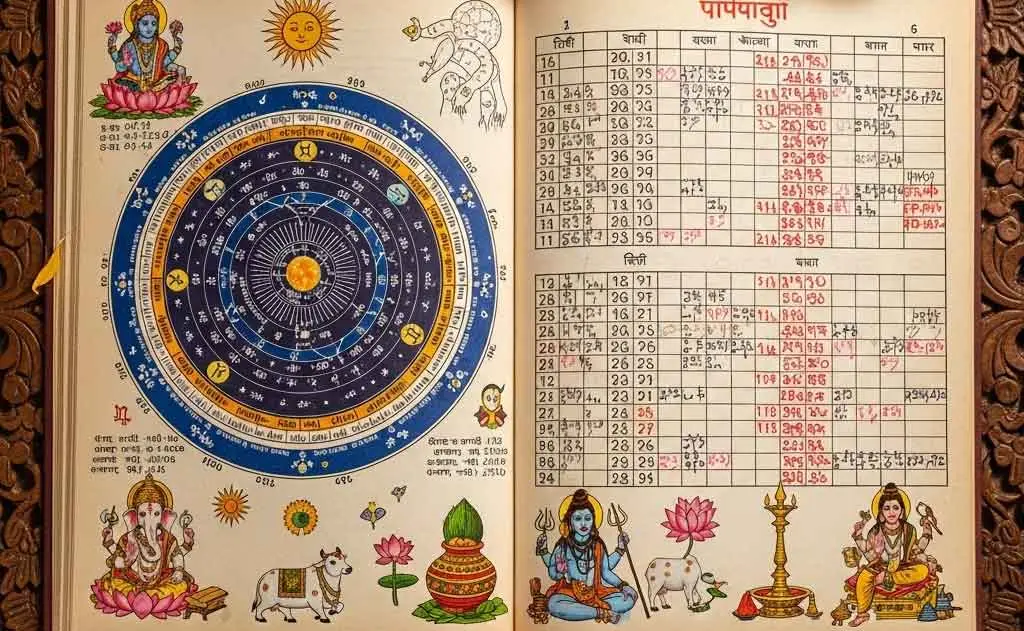
What Is a Tithi? The 30 Tithis Explained, with Names, Kshaya and Vriddhi Tithis and Why Festival Dates Shift
Navamsa Chart (D9) Explained: How It Is Calculated, Vargottama and Why It Matters
Choghadiya Muhurat Explained: How to Read the Day and Night Choghadiya Table