What Is a Tithi? The 30 Tithis Explained, with Names, Kshaya and Vriddhi Tithis and Why Festival Dates Shift
The tithi is the lunar day at the heart of every Hindu festival date. Here is how it is calculated (each 12 degrees of separation between the Moon and the Sun), a table of all 30 tithis in Shukla and Krishna paksha, why a tithi can be skipped or repeated, the real 2026 Navratri example, and why dates differ outside India.
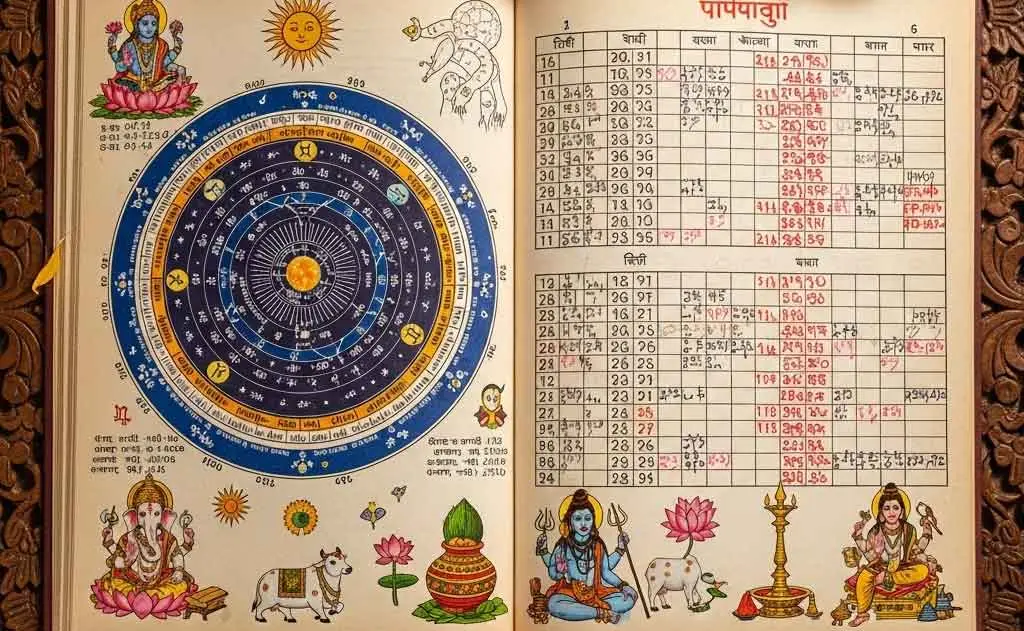
The tithi is the lunar day at the heart of every Hindu festival date. Here is how it is calculated (each 12 degrees of separation between the Moon and the Sun), a table of all 30 tithis in Shukla and Krishna paksha, why a tithi can be skipped or repeated, the real 2026 Navratri example, and why dates differ outside India.
Quick answer: A tithi is a lunar day. It is the time the Moon takes to move 12 degrees further from the Sun. A full cycle from new moon to new moon is 360 degrees, so there are 30 tithis in a lunar month: 15 in the bright fortnight (Shukla paksha, ending at Purnima) and 15 in the dark fortnight (Krishna paksha, ending at Amavasya). Tithis do not match calendar days, so one can stretch across two sunrises or be skipped altogether. That is why Hindu festival dates move and can differ between India and other countries.
How a tithi is calculated
Every month the Moon laps the Sun. At the new moon (Amavasya) the two are at the same longitude; at the full moon (Purnima) they are 180 degrees apart. Jyotisha divides this changing gap, called the elongation, into 30 steps of 12 degrees:
- Tithi number = (Moon's longitude minus Sun's longitude) divided by 12, rounded up.
- 0 to 12 degrees is Shukla Pratipada, 12 to 24 degrees is Shukla Dwitiya, and so on up to Purnima at 168 to 180 degrees.
- 180 to 192 degrees is Krishna Pratipada, and the cycle ends with Amavasya at 348 to 360 degrees.
Worked example: if at a given moment the Moon is at 100 degrees and the Sun at 10 degrees, the gap is 90 degrees. 90 divided by 12 is 7.5, so seven tithis are complete and the eighth, Shukla Ashtami, is running. When the gap reaches 96 degrees, Navami begins. Because only the difference between the two bodies matters, the ayanamsa (sidereal correction) does not affect the tithi, unlike the nakshatra.
The Moon moves about 13 degrees a day and the Sun about 1 degree, so the gap grows by roughly 12 degrees a day. That is why a tithi lasts about a day on average. But the Moon's speed varies along its elliptical orbit, so in practice a tithi can be anywhere from about 20 to 27 hours long.
The 30 tithis: names table
Tithi names are Sanskrit ordinal numbers. The 15th is Purnima in Shukla paksha and Amavasya in Krishna paksha. The traditional five-fold grouping (Nanda, Bhadra, Jaya, Rikta, Purna) repeats every five tithis and is used in muhurta (timing) rules; Rikta ("empty") tithis, the 4th, 9th and 14th, are traditionally avoided for starting new ventures.
| No. | Shukla paksha tithi | Moon ahead of Sun | Krishna paksha tithi | Moon ahead of Sun | Group | Example observances |
|---|---|---|---|---|---|---|
| 1 | Pratipada (Prathama) | 0° to 12° | Pratipada (Prathama) | 180° to 192° | Nanda | Ugadi / Gudi Padwa (Chaitra Shukla); Navratri Ghatasthapana (Ashvin Shukla) |
| 2 | Dwitiya | 12° to 24° | Dwitiya | 192° to 204° | Bhadra | Bhai Dooj (Kartika Shukla Dwitiya) |
| 3 | Tritiya | 24° to 36° | Tritiya | 204° to 216° | Jaya | Akshaya Tritiya (Vaishakha Shukla) |
| 4 | Chaturthi | 36° to 48° | Chaturthi | 216° to 228° | Rikta | Ganesh Chaturthi (Bhadrapada Shukla) |
| 5 | Panchami | 48° to 60° | Panchami | 228° to 240° | Purna | Vasant Panchami; Nag Panchami |
| 6 | Shashthi | 60° to 72° | Shashthi | 240° to 252° | Nanda | Skanda Shashti |
| 7 | Saptami | 72° to 84° | Saptami | 252° to 264° | Bhadra | Ratha Saptami |
| 8 | Ashtami | 84° to 96° | Ashtami | 264° to 276° | Jaya | Durga Ashtami; Krishna Janmashtami (Krishna paksha) |
| 9 | Navami | 96° to 108° | Navami | 276° to 288° | Rikta | Ram Navami; Maha Navami |
| 10 | Dashami | 108° to 120° | Dashami | 288° to 300° | Purna | Vijayadashami |
| 11 | Ekadashi | 120° to 132° | Ekadashi | 300° to 312° | Nanda | Ekadashi vrat (both pakshas) |
| 12 | Dwadashi | 132° to 144° | Dwadashi | 312° to 324° | Bhadra | Ekadashi parana (breaking the fast) |
| 13 | Trayodashi | 144° to 156° | Trayodashi | 324° to 336° | Jaya | Pradosh vrat; Dhanteras (Krishna paksha) |
| 14 | Chaturdashi | 156° to 168° | Chaturdashi | 336° to 348° | Rikta | Maha Shivaratri and Naraka Chaturdashi (Krishna paksha) |
| 15 | Purnima (full moon) | 168° to 180° | Amavasya (new moon) | 348° to 360° | Purna | Purnima: Guru Purnima, Sharad Purnima / Amavasya: Diwali Lakshmi Puja, Mahalaya |
Some calendars number the tithis 1 to 30 straight through, so Krishna Pratipada is tithi 16 and Amavasya is 30. Regional spellings vary (Padyami, Pournami, Amavasai).
Kshaya and vriddhi: skipped and repeated tithis
The general rule (udaya tithi) is that the tithi present at local sunrise names the whole day. Since tithis are not exactly 24 hours long, two things can happen:
- Kshaya tithi (skipped): a short tithi begins after one sunrise and ends before the next. It never touches a sunrise, so no calendar day carries its name. The panchang goes, for example, from Tritiya straight to Panchami.
- Vriddhi tithi (repeated): a long tithi begins just before one sunrise and ends just after the next. It is present at both sunrises, so two consecutive days carry the same tithi.
This is why a "nine-night" Navratri can be eight or ten calendar days long, and why two festivals sometimes fall on one day.
A real example: Navratri 2026
In Sharad Navratri 2026, Saptami prevailed at sunrise on both Saturday 17 and Sunday 18 October in New Delhi. Because Saptami covered two sunrises, the next tithis were pushed later in the day. Ashtami was the tithi at sunrise on Monday 19 October and ended at about 10:52 AM IST that morning, after which Navami began. Following the traditional rules for these observances, Drik Panchang lists Durga Ashtami and Maha Navami both on Monday 19 October 2026 in India, and Dussehra on Tuesday 20 October (Dashami from 12:50 PM IST on 20 October to 2:11 PM IST on 21 October).
Outside India the sunrise moments fall differently against the same tithi changes, and Drik lists Durga Ashtami on 18 October and Maha Navami on 19 October for the USA, Canada and the UK. For the full day-by-day picture, see the Navratri 2026 NRI guide and the Kanya Pujan 2026 guide.
Sunrise rule vs festival-specific rules
The sunrise rule decides the tithi of an ordinary day, but many festivals have their own rule about which part of the day the tithi must cover. The dharmashastra digests (such as the Nirnaya Sindhu and Dharma Sindhu) set these out, and panchang makers apply them. The main ones:
| Rule | Time window | Typical examples |
|---|---|---|
| Udaya (sunrise) | Tithi present at local sunrise | Most vrats, Ekadashi (with additional rules), daily panchang |
| Pradosh | Roughly the first part of the night after sunset | Pradosh vrat (Trayodashi); Diwali Lakshmi Puja (Amavasya in pradosh) |
| Nishita | Around local midnight | Krishna Janmashtami; Maha Shivaratri; Kali Puja |
| Madhyahna | Midday | Ganesh Chaturthi; Ram Navami |
| Aparahna | Afternoon | Vijayadashami (Dashami in the afternoon); Shraddha rites |
So a festival is not always on the day the tithi is "at sunrise". Diwali's Lakshmi Puja, for example, follows the Amavasya that covers the evening (pradosh) period. In 2026 Diwali falls on Sunday 8 November; see the Diwali 2026 complete guide for the muhurat.
Why Ekadashi, Amavasya and Purnima matter
Ekadashi, the 11th tithi, is the most widely observed fast in the Vaishnava tradition, kept twice a month. The fast is broken (parana) on Dwadashi within a set window. Rules for which day to keep Ekadashi are stricter than the plain sunrise rule, and Vaishnava sampradayas sometimes observe a day later than smarta calendars. Examples: Rama Ekadashi 2026 and Karthika (Prabodhini) Ekadashi 2026.
Amavasya, the new moon, is traditionally the day for remembering ancestors (pitru tarpana); Mahalaya Amavasya and Diwali Amavasya are the best known. Purnima, the full moon, is associated with Satyanarayana puja, Guru Purnima and, in 2026, Sharad Purnima on 25 October and Karthika Pournami.
Why festival dates differ abroad
A tithi begins and ends at the same instant everywhere on Earth, because it depends only on the Sun and Moon. What differs is the local clock and the local sunrise. When it is sunrise in Toronto, it is already evening in India. So the tithi in force at sunrise in Toronto, London or Sydney may not be the one in force at sunrise in New Delhi, and festivals that follow the sunrise or a specific time window can shift by a day.
Two practical points for NRI families:
- Use a panchang calculated for your own city rather than an Indian calendar. Your local temple calendar usually does this.
- Do not convert an Indian muhurat time to your local time zone. A time like "Lakshmi Puja 7 PM IST" applies to India only; the muhurat must be recalculated for your location.
Country-specific dates are in our Diwali 2026 USA guide and the Navratri 2026 USA city-by-city guide.
Amanta and purnimanta months
Tithis also help explain why the same festival has two month names. In the amanta system (used in most of South and West India) a month ends at Amavasya; in the purnimanta system (used in most of North India) it ends at Purnima. Shukla paksha tithis carry the same month name in both, but Krishna paksha tithis are one month apart. Diwali's Amavasya, for example, is Ashvin Amavasya in amanta and Kartika Amavasya in purnimanta: the same day, two labels. The panchang guide explains this in more detail.
Frequently asked questions
How long is a tithi?
On average a tithi lasts a little under 24 hours (about 23 hours 37 minutes), because a lunar month of about 29.5 days is divided into 30 tithis. Because the Moon's speed varies, an individual tithi can be roughly 20 to 27 hours long.
Which tithi is today?
The tithi is listed in any daily panchang for your location. By the general rule, the tithi prevailing at local sunrise is the tithi of the whole day, even if it ends a few hours later; the panchang will also show the exact time it ends.
What is the difference between Shukla paksha and Krishna paksha?
Shukla paksha is the bright fortnight, from the day after the new moon to the full moon, when the Moon waxes. Krishna paksha is the dark fortnight, from the day after the full moon to the new moon, when it wanes. Each has 15 tithis.
Why did Ashtami and Navami fall on the same day in Navratri 2026?
Saptami was present at sunrise on both 17 and 18 October 2026 in New Delhi, so the following tithis ran later in the day. Ashtami was present at sunrise on 19 October and ended at about 10:52 AM IST, after which Navami began; Drik Panchang lists Durga Ashtami and Maha Navami together on Monday 19 October in India.
Why is a festival on a different date in the USA or UK?
The tithi changes at the same physical moment worldwide, but local sunrise happens at different times. The tithi in force at sunrise in New York or London can differ from the one at sunrise in New Delhi, so a festival may fall a day earlier or later abroad. Use a panchang set to your own city.
Is Ekadashi always on the 11th day of the month?
Ekadashi is the 11th tithi of each paksha, so it comes twice a month, but it does not always fall exactly ten days after the new or full moon on the calendar, because tithis can be skipped or repeated.
Editor's note (9 October 2026)
This guide was written in October 2026. The definition of the tithi and the names are standard across Jyotisha traditions. The 2026 Navratri dates and the Dashami window are from Drik Panchang for New Delhi; the sunrise tithi notes (Saptami at sunrise on 17 and 18 October, Ashtami ending about 10:52 AM IST on 19 October) are from HinduTone's ephemeris calculator, which we validated against Drik. Festival rules vary between regional and sampradaya calendars, so follow your family's tradition or local temple when they differ.
Related guides
You might also like
What Is a Panchang? The Five Limbs Explained: Tithi, Vara, Nakshatra, Yoga and Karana
Navamsa Chart (D9) Explained: How It Is Calculated, Vargottama and Why It Matters
Choghadiya Muhurat Explained: How to Read the Day and Night Choghadiya Table