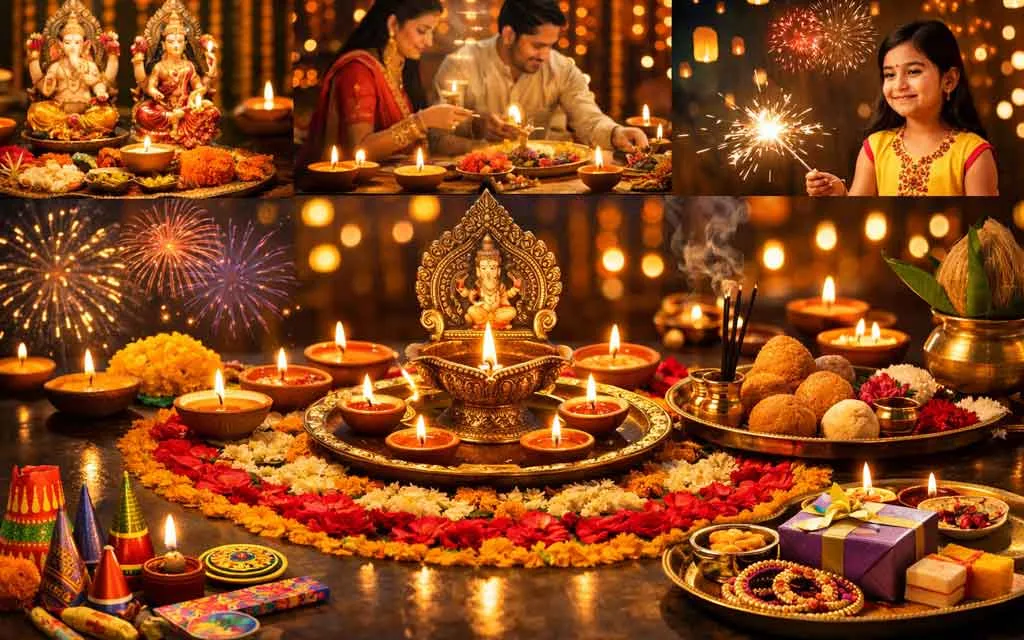
How Lord Rama's Return to Ayodhya Inspires Diwali Celebrations
Introduction The festival of Diwali finds its most beloved and enduring origin in the triumphant return of Lord Rama to Ayodhya after fourteen years of exile.
Introduction The festival of Diwali finds its most beloved and enduring origin in the triumphant return of Lord Rama to Ayodhya after fourteen years of exile.
Introduction
The festival of Diwali finds its most beloved and enduring origin in the triumphant return of Lord Rama to Ayodhya after fourteen years of exile. This momentous event, chronicled in the ancient epic Ramayana composed by Sage Valmiki, represents not just a king's homecoming but the restoration of dharma (righteousness), the reunion of separated loved ones, and the victory of good over evil. The spontaneous celebrations that erupted in Ayodhya on that sacred day continue to inspire our Diwali festivities thousands of years later.
The Background: The Path to Exile and Return
The Promise That Changed Everything
The story begins in the magnificent kingdom of Ayodhya, ruled by the noble King Dasharatha. Having decided to crown his eldest son Rama as the heir apparent (Yuvaraja), preparations for the grand coronation were underway. The entire kingdom rejoiced at the prospect of Rama's rule, for he embodied all virtues—courage, compassion, wisdom, and unwavering commitment to dharma.
However, fate had different plans. Queen Kaikeyi, Rama's stepmother, influenced by her maidservant Manthara's poisonous words, invoked two boons that King Dasharatha had once promised her. She demanded:
- That her son Bharata be crowned king instead of Rama
- That Rama be exiled to the forest for fourteen years
Rama's Acceptance and Departure
Rama, upon hearing of his father's predicament, immediately accepted the exile without the slightest hesitation or resentment. His response exemplifies the spirit of dharma:
"यदि राज्यं प्रियं पित्रे वनवासो यदि प्रियः। तदनुष्ठेयमेवास्य किं वचः प्रतिवारयेत्।।"
"If the kingdom pleases father, or if exile pleases him, that alone should be done. Why should I oppose his words?"
Sita, his devoted wife, insisted on accompanying him, as did his beloved brother Lakshmana. The three left Ayodhya, leaving behind a kingdom plunged into grief. King Dasharatha, heartbroken at the separation from his beloved son, passed away within days of Rama's departure.
The Fourteen Years of Exile
The exile years were filled with extraordinary events:
- Living as ascetics in the Dandaka forest
- Protecting sages from demonic attacks
- Sita's abduction by Ravana, the demon king of Lanka
- The alliance with Sugriva and the Vanara (monkey) army
- Hanuman's legendary leap to Lanka and discovery of Sita
- The construction of the bridge to Lanka (Ram Setu)
- The epic battle between Rama and Ravana
- Ravana's defeat and the rescue of Sita
- The completion of the fourteen-year exile period
The Journey Home: Anticipation Builds
Bharata's Steadfast Devotion
While Rama was in exile, his brother Bharata refused to sit on the throne. Despite being crowned, Bharata placed Rama's golden sandals (paduka) on the throne and ruled as Rama's representative, awaiting his brother's return. He lived outside the capital in Nandigrama, adopting an ascetic lifestyle, counting each day until Rama's return.
As the fourteen years drew to a close, Bharata's joy knew no bounds. He had kept his promise to return the kingdom to its rightful king.
The Divine Chariot: Pushpaka Vimana
After defeating Ravana and completing the exile period, Rama, Sita, Lakshmana, and their Vanara allies prepared to return home. Vibhishana, Ravana's brother who had sided with Rama and was crowned king of Lanka, offered them the magnificent Pushpaka Vimana—a celestial flying chariot that had once belonged to Kubera, the god of wealth.
The Ramayana describes this magnificent vehicle:
"तच्छोभनं पुष्पकं विमानं भ्राजमानं समन्ततः। गृहाण त्वमिदं श्रीमान् प्रयातः सानुगस्सुखम्।।"
"That beautiful Pushpaka Vimana, shining brilliantly on all sides—accept this, O glorious one, and travel comfortably with your companions."
The Aerial View of Victory
As the Pushpaka Vimana soared through the skies toward Ayodhya, Rama pointed out various landmarks to Sita, recounting their journey—the forests where they lived, the places of their trials, and the battlefield where dharma triumphed. Each landmark carried memories of their sacrifice and ultimate victory.
Hanuman was sent ahead as a messenger to inform Bharata and the citizens of Ayodhya about Rama's imminent arrival.
The Preparations in Ayodhya: A Kingdom Awakens
Bharata's Response to the News
When Hanuman reached Nandigrama and conveyed the news of Rama's return to Bharata, the devoted brother was overcome with joy. The Ramayana beautifully captures this moment:
"न च शक्नोमि विज्ञातुं सुखेन सुखमात्मनः। रामं दृष्ट्वा पुनर्नाथं भविष्यामि सुखी ध्रुवम्।।"
"I cannot understand my own happiness. Only after seeing Rama, my lord, again shall I truly be happy."
Bharata immediately made arrangements:
- Ordered that the entire city of Ayodhya be decorated
- Sent messengers throughout the kingdom announcing Rama's return
- Arranged for the roads to be cleaned and adorned
- Prepared the royal palace for Rama's arrival
- Assembled all ministers, priests, and citizens for the welcoming ceremony
The Transformation of Ayodhya
According to Valmiki's Ramayana, the citizens of Ayodhya embarked on an extraordinary transformation of their capital:
Cleaning and Purification
Every house, every street, every public space was thoroughly cleaned and purified. Water was sprinkled on the roads to settle the dust. The city that had been in mourning for fourteen years suddenly burst into activity.
Decoration with Flags and Banners
"ध्वजैश्च विविधाकारैः पताकाभिश्च शोभिताः। बभूवुर्नगरद्वाराण्यभिरामाणि सर्वशः।।"
"The city gates were adorned on all sides with flags of various kinds and banners, making them beautiful everywhere."
Colorful flags, banners, and festoons were hung from every building. The royal standards of Ayodhya flew proudly once again.
Floral Decorations
The city was adorned with fresh flowers. Garlands of fragrant blooms hung from doorways. Flower petals were scattered on the streets. The air was filled with the perfume of jasmine, lotus, and champak flowers.
Rangoli and Auspicious Designs
At every doorstep, women created beautiful rangoli patterns using colored powders, rice flour, and flower petals. These intricate designs symbolized welcome and prosperity.
The Historic Evening: Lighting the Lamps
The Darkest Night Becomes the Brightest
The day of Rama's return fell on the new moon night of Kartik month (Kartik Amavasya)—the darkest night of the year. The citizens of Ayodhya faced a dilemma: how could they adequately welcome their beloved prince on such a dark night?
The solution emerged spontaneously from the hearts of the people. The Ramayana describes:
"ततः प्रदीपान् संज्वाल्य सर्वे हृष्टाः प्रजास्तदा। श्रिया परमया युक्ताः स्वेषु वेश्मसु तस्थिरे।।"
"Then all the people, filled with joy, lit lamps and stood in their homes endowed with supreme splendor."
The First Diwali: Deepavali is Born
The citizens of Ayodhya illuminated every home, every temple, every street with countless oil lamps (diyas). The specifications from various texts describe:
- Clay Lamps (Diyas): Filled with ghee or sesame oil, with cotton wicks
- Positioning: On rooftops, windowsills, doorways, courtyards, and along streets
- Continuous Lines: Creating pathways of light guiding Rama home
- Sacred Fires: Large ceremonial fires (yajnas) performed by priests
- Palace Illumination: The royal palace lit up with thousands of lamps
The darkness of the moonless night was transformed into the brightest spectacle the kingdom had ever witnessed. This spontaneous act of love and celebration became the template for all future Diwali celebrations.
The Symbolism of Light
The lighting of lamps carried deep significance:
- Dispelling Physical Darkness: Providing light for Rama's arrival
- Symbolizing Joy: Expressing the citizens' happiness
- Representing Victory: Celebrating the triumph of dharma over adharma
- Spiritual Illumination: Acknowledging Rama as the light of righteousness
- Removing Sorrow: Ending fourteen years of grief and mourning
The Grand Arrival: A Celebration Beyond Words
The Pushpaka Vimana Descends
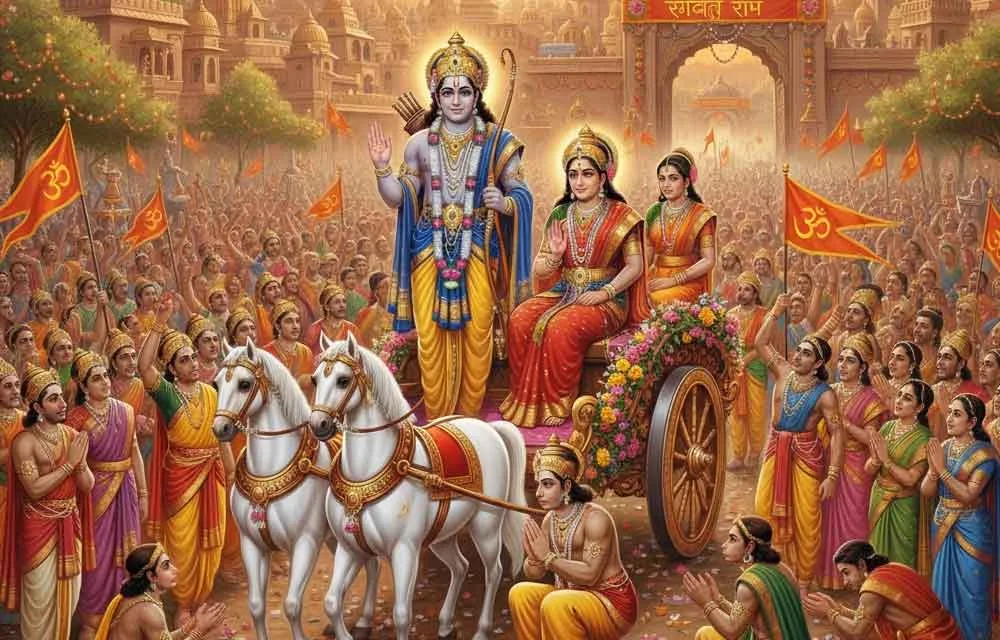
As evening approached on that sacred Kartik Amavasya, the citizens of Ayodhya, gathered outside the city, heard celestial music from the skies. The Pushpaka Vimana, glowing with divine radiance, descended slowly toward Ayodhya.
The Ramayana captures this magical moment:
"ततः प्रहृष्टाः सर्वे तु रामं दृष्ट्वा महाबलम्। सादरं प्राञ्जलयः स्थिताः प्रमुदिताः प्रजाः।।"
"Then all the people, seeing the mighty Rama, stood with folded hands, filled with joy and reverence."
The Sacred Reunion
The reunion scenes are among the most touching in all of literature:
Bharata's Embrace
Bharata rushed forward, tears streaming down his face, and embraced his elder brother. He immediately placed Rama's golden sandals at his feet and said:
"इदं राज्यं दासभृत्यं च सर्वं यच्चेदमर्जितम्। तव एतत् पादुके चेमे प्रतिगृह्णीष्व राघव।।"
"This kingdom, all servants and subjects, and whatever has been earned—all this is yours. Accept these sandals, O Raghava."
Mothers' Joy
The three queens—Kausalya (Rama's mother), Kaikeyi, and Sumitra—came forward to embrace their sons. Kausalya, who had endured fourteen years of separation from Rama, wept tears of joy. Even Kaikeyi, whose demands had caused the exile, sought and received Rama's forgiveness.
Guru Vasishtha's Blessings
Sage Vasishtha, the royal priest and Rama's guru, blessed the returned prince and prepared for the coronation ceremony.
The Citizens' Welcome
The population of Ayodhya erupted in celebration:
"रामं प्रविष्टं नगरे प्रहृष्टा अयोध्यावासिनः सर्व एव। सुखेन पूर्णास्तु बभूवुरङ्गा हृष्टास्सुमनसः प्रमुदिताः।।"
"With Rama entering the city, all the residents of Ayodhya were delighted. Everyone was filled with happiness, their limbs content, their minds joyful and gladdened."
The celebrations included:
- Chanting and Prayers: Vedic hymns and auspicious mantras echoed everywhere
- Music and Dance: Musicians played instruments, dancers performed
- Distribution of Gifts: Wealth and food were distributed to the poor
- Feasting: Grand feasts were prepared for everyone
- Decorative Processions: People carried lamps in processions through streets
The Coronation: Dharma Restored
The Sacred Ceremony
The next day, on the first day of Kartik month (Kartik Shukla Pratipada), Rama's coronation took place. Sage Vasishtha performed the ancient Vedic rituals. Holy water from sacred rivers was brought for the abhisheka (consecration).
The Ramayana describes the coronation:
"ततः शुक्लाम्बरधरं दीप्तमग्निमिवावृतम्। राजसिंहासने रम्ये रामं संभाविताध्वरे। न्यवेशयन्महात्मानं वसिष्ठो ब्रह्मवित्तमः।।"
"Then Vasishtha, foremost among knowers of Brahman, seated the great soul Rama, dressed in white garments and radiant as blazing fire, upon the beautiful royal throne in the properly consecrated ceremony."
The Kingdom Rejoices
With Rama's coronation, dharma was fully restored to Ayodhya. The reign of Lord Rama, known as Ram Rajya, began—an era that became synonymous with perfect governance, justice, prosperity, and happiness.
The citizens continued their celebrations for days:
- Lamps were kept lit throughout the nights
- Musical performances and theatrical presentations continued
- Gifts were exchanged among families
- Prayers and thanksgiving were offered in temples
- Stories of Rama's valor and virtue were recounted everywhere
How Ayodhya's Celebration Became Diwali Tradition
The spontaneous celebration in Ayodhya established patterns that continue in modern Diwali observances:
1. Lighting Diyas (Oil Lamps)
Ayodhya: Citizens lit countless lamps to welcome Rama and dispel darkness Modern Diwali: We light diyas in homes, temples, and public spaces
The tradition of lighting diyas remains the most iconic Diwali practice, directly traced to that first celebration in Ayodhya.
2. Cleaning and Decorating Homes
Ayodhya: The entire city was cleaned and decorated for Rama's return Modern Diwali: Families thoroughly clean and renovate homes before Diwali, considering it preparation for Lakshmi's (prosperity's) arrival
3. Rangoli and Decorative Arts
Ayodhya: Women created beautiful patterns at doorways to welcome Rama Modern Diwali: Rangoli designs at entrances invite divine blessings and welcome guests
4. New Clothes
Ayodhya: Citizens wore their finest garments for the historic occasion Modern Diwali: Families purchase and wear new clothes, symbolizing renewal and fresh beginnings
5. Sweets and Feasting
Ayodhya: Grand feasts were prepared, and food was distributed to all Modern Diwali: Special sweets and delicacies are prepared, exchanged, and shared
6. Fireworks and Celebration
Ayodhya: The sky lit up with the Pushpaka Vimana's celestial glow Modern Diwali: Fireworks illuminate the night sky, recreating the magical brilliance of that first Diwali
7. Family Reunions
Ayodhya: Rama's return reunited a separated family Modern Diwali: Families gather from distant places to celebrate together
8. Wealth and Prosperity (Lakshmi Puja)
Ayodhya: Rama's return brought the restoration of the kingdom's prosperity Modern Diwali: Goddess Lakshmi is worshipped, symbolizing the return of prosperity and abundance
9. Victory of Good Over Evil
Ayodhya: Rama's defeat of Ravana represented dharma's triumph Modern Diwali: The festival continues to celebrate this eternal victory
10. Forgiveness and Reconciliation
Ayodhya: Rama forgave Kaikeyi and reconciled with all Modern Diwali: People seek forgiveness, settle disputes, and begin fresh relationships
Regional Variations Rooted in the Ramayana
Different regions of India emphasize various aspects of Rama's return:
North India
Focuses on Rama's return and coronation. Ram Lila performances depicting the Ramayana culminate on Dussehra (Ravana's defeat) and continue through Diwali (Rama's return).
South India
While celebrating Rama's victory, equal emphasis is placed on Krishna's victory over Narakasura, which occurred on the same day according to tradition.
Eastern India
Particularly in Bengal, Kali Puja coincides with Diwali, but the celebration of Rama's triumph is equally honored.
Western India
Gujarat celebrates the Gujarati New Year on this day, marking it as a time of new beginnings, directly inspired by Rama's coronation marking a new era.
The Deeper Significance: Why This Story Endures
The Universal Message
The story of Rama's return transcends religious boundaries because it speaks to universal human experiences:
- Hope in Adversity: Even after fourteen years of hardship, righteousness prevailed
- Family Bonds: The unwavering loyalty between Rama, Sita, Lakshmana, and Bharata
- Patient Justice: Rama neither rushed back nor gave up; he completed his exile with dignity
- Collective Joy: An entire kingdom united in celebration
- Light Over Darkness: The eternal human aspiration for enlightenment and goodness
Historical and Cultural Impact
The celebration of Rama's return has shaped Indian civilization profoundly:
- Literary Tradition: Countless retellings in every Indian language
- Performing Arts: Ram Lila, classical dance forms, and theatrical traditions
- Architecture: Temples dedicated to Rama across the subcontinent
- Values and Ethics: Ram Rajya as an ideal of governance and social harmony
- Festival Culture: Diwali as the most widely celebrated Hindu festival globally
The Living Tradition: Ayodhya Today
Modern Ayodhya continues to celebrate Diwali with special fervor:
The Grand Diwali at Ayodhya
The city of Ayodhya, on the banks of the Sarayu River, hosts spectacular Diwali celebrations:
- Lakhs of Diyas: In recent years, Ayodhya has set world records by lighting millions of diyas simultaneously
- Ram Mandir: The sacred site associated with Rama's birthplace becomes the epicenter of celebrations
- Cultural Programs: Week-long festivities including Ram Lila performances
- Ghat Celebrations: The river banks are illuminated with countless lamps, recreating the ancient scene
Pilgrimage Destination
Thousands of devotees visit Ayodhya during Diwali to:
- Witness the lighting of lamps as was done millennia ago
- Offer prayers at temples associated with Rama
- Participate in the recreation of that historic celebration
- Experience the spiritual atmosphere of the sacred city
The Timeless Lessons
Rama's return to Ayodhya and the subsequent celebration teach us enduring lessons:
1. Dharma Always Triumphs
Despite fourteen years of hardship, Rama's commitment to righteousness led to ultimate victory and restoration.
2. Patience and Perseverance
Rama neither complained nor compromised. He fulfilled his father's promise completely before returning.
3. The Power of Unity
From Bharata's devotion to the Vanara army's loyalty to the citizens' celebration—unity achieved the impossible.
4. Light Conquers Darkness
Physically and metaphorically, the illumination of Ayodhya on the darkest night symbolizes hope's eternal victory.
5. Forgiveness and Fresh Starts
Rama's forgiveness of all who wronged him shows that new beginnings require letting go of grievances.
6. Collective Celebration
Joy multiplies when shared. Ayodhya's celebration became legendary because everyone participated.
How to Celebrate Diwali with Rama's Spirit
To truly honor the tradition established by Rama's return:
1. Light with Awareness
When you light diyas, remember you're participating in a celebration that began thousands of years ago to welcome dharma home.
2. Clean with Purpose
House cleaning isn't mere hygiene—it's preparing your space to welcome righteousness, just as Ayodhya did for Rama.
3. Reunite with Love
Like Rama's reunion with family, use Diwali to strengthen bonds with loved ones.
4. Give Generously
Just as wealth was distributed in Ayodhya, share your blessings with those less fortunate.
5. Forgive Freely
Rama forgave even Kaikeyi. Use this occasion to release old grudges and start fresh.
6. Celebrate Dharma
Beyond the festivities, reflect on righteousness in your own life. How can you be more like Rama?
7. Spread Light
Just as one lamp lit millions in Ayodhya, let your positive actions inspire others.
Conclusion: The Eternal Return
Lord Rama's return to Ayodhya after fourteen years of exile remains one of the most celebrated events in human history. The spontaneous outpouring of love, the lighting of countless lamps on the darkest night, and the establishment of Ram Rajya created a template for celebration that continues to inspire millions.
Every Diwali, we don't just remember that ancient celebration—we participate in it. Every lamp we light connects us to those first citizens of Ayodhya who illuminated their city to welcome their beloved prince home. Every sweet we share echoes the feasts prepared in celebration. Every family reunion mirrors that sacred moment when Rama embraced his brothers and mothers.
The story endures because it speaks to something eternal in the human spirit—the longing for the return of righteousness, the victory of good over evil, the reunion of what was separated, and the triumph of light over darkness.
As the Ramayana says:
"यावत् स्थास्यन्ति गिरयः सरितश्च महीतले। तावद् रामायणकथा लोकेषु प्रचरिष्यति।।"
"As long as mountains and rivers exist on earth, the story of Ramayana shall prevail in the world."
This Diwali, when you light your lamps, remember you are part of an unbroken chain of celebration stretching back thousands of years to that magical evening when Ayodhya glowed like a second sun, welcoming home its prince, its protector, its embodiment of dharma.
May the light of Rama's righteousness illuminate your path, just as the lamps of Ayodhya illuminated his homecoming.
Jai Shri Ram!
For more stories and insights into Hindu festivals and traditions, visit www.hindutone.com
Also read: Ayodhya Deepotsav and Diwali 2026.
Related 2026 guides
- Diwali 2026: dates, Lakshmi Puja muhurat & 5-day guide
- Lakshmi Puja muhurat 2026 in 30 Indian cities
- Lakshmi Puja vidhi 2026: step-by-step
- Dhanteras 2026
- Diwali 2026 5-day calendar at a glance
Share the Diwali 2026 blessing
As commonly told, the people of Ayodhya lit rows of lamps to welcome Lord Rama, Sita and Lakshmana home after their long exile. Every diya we light this Diwali 2026 carries that same joy of homecoming, the victory of dharma over darkness, and the inner light that guides the soul back to the divine. May Maa Lakshmi's grace bless every home that glows tonight. Share one of these blessings with your family and let Ayodhya's light shine in your home too.
Deepa shloka: the lamp prayer
शुभं करोति कल्याणम् आरोग्यं धनसम्पदा। शत्रुबुद्धिविनाशाय दीपज्योतिर्नमोऽस्तु ते॥
Shubham karoti kalyanam arogyam dhana-sampada, shatru-buddhi-vinashaya deepa-jyotir namostu te.
Meaning: I bow to the light of the lamp, which brings what is auspicious and good, health and prosperity, and destroys ill-will. Many families recite it as they light the evening diya.
Lakshmi mantra for Diwali
ॐ श्रीं महालक्ष्म्यै नमः॥
Om Shreem Mahalakshmyai Namah.
Meaning: Salutations to Mahalakshmi. Shreem is the seed syllable traditionally associated with Lakshmi.
Diwali 2026 messages to share
🪔 Just as Ayodhya rejoiced at Lord Rama's return, may our home be filled with reunion, love and laughter this Diwali. Happy Diwali to our dear family! ✨ Share on WhatsApp
🙏 Dear parents and elders, like Lord Rama honoured his father's word, we honour your love and guidance. May this Diwali bless you with health, peace and joy. 🪔 Share on WhatsApp
✨ Happy Diwali, my friend! Like Lakshmana stood by Rama, may true friendship always light your path, and may this festival bring you joy and success. 🌸 Share on WhatsApp
🪔 Warm Diwali greetings to you and your team. May the spirit of Ram Rajya, fairness, trust and dedication, guide our work together in the year ahead. 🙏 Share on WhatsApp
🌸 May Maa Lakshmi, who returned to Ayodhya as Sita, enter your home tonight with grace, and bless it with harmony, contentment and a generous heart. 🪔✨ Share on WhatsApp
🏹 Lord Rama is home, and Ayodhya glows with a thousand lamps! May his light of dharma drive away all darkness from your life this Diwali. Jai Shri Ram! 🪔🙏 Share on WhatsApp
A short Diwali prayer
Maa Lakshmi and Lord Ganesha, on this night when Ayodhya welcomed Lord Rama home, I bow to you with a grateful heart. Light the lamp of dharma within me and remove the obstacles of pride and anger. Bless my family with good health, unity and peace. Like Bharata's patient devotion, give me steadfast faith, and guide me always toward honest, right effort.
Use the share buttons on this page to send these blessings to your family and friends.
Frequently Asked Questions
When is Diwali in 2026?
Diwali falls on Sunday, November 8, 2026, in India and in most countries, including the USA, UK, Canada and Australia. Check a local panchang for the Lakshmi Puja timing in your city.
Why is Diwali linked to Lord Rama's return to Ayodhya?
As commonly told, Rama returned to Ayodhya on Kartik Amavasya, the darkest new moon night, after defeating Ravana and completing his exile. The citizens lit countless oil lamps to welcome him, and that celebration is remembered as the first Deepavali.
How long was Lord Rama in exile before returning to Ayodhya?
Rama spent fourteen years in exile with Sita and Lakshmana, after Queen Kaikeyi invoked two boons from King Dasharatha. During that time Sita was abducted by Ravana, and Rama defeated him in Lanka before returning home on the Pushpaka Vimana.
Which Diwali traditions come from Ayodhya's welcome for Rama?
Lighting diyas, cleaning and decorating homes, drawing rangoli at doorways, wearing new clothes, sharing sweets and feasts, and gathering as a family all echo how Ayodhya welcomed Rama, as the story is commonly told. Forgiveness and reconciliation, like Rama forgiving Kaikeyi, are also part of the spirit of the festival.
How can families living abroad honor Rama's return this Diwali?
Light diyas at the door and windows, draw a simple rangoli, and retell the story of Rama's return to Ayodhya to children on Diwali night, November 8, 2026. Many NRI families also join local temple celebrations and share sweets with friends and neighbors.
You might also like
Diwali 2026 Celebrations in Dubai: Complete Guide to Events, Temples, Fireworks & Festivities in the Desert City
Diwali 2026 Celebrations in New York: Complete Guide to Events, Temples, and Grand Festivities in the Big Apple
Diwali 2026 Celebrations in London: Complete Guide to Events, Temples, and Grand Festivities in the UK Capital