Gudi Padwa – Vikram Samvat New Year 2083 | Chaitra Shukla Pratipada
Warm greetings from HinduTone.com to everyone! May Vikram Samvat 2083 bring auspiciousness and prosperity! Heartiest wishes on the occasion of Hindu New Year!
Warm greetings from HinduTone.com to everyone! May Vikram Samvat 2083 bring auspiciousness and prosperity! Heartiest wishes on the occasion of Hindu New Year!
Warm greetings from HinduTone.com to everyone! May Vikram Samvat 2083 bring auspiciousness and prosperity!
Heartiest wishes on the occasion of Hindu New Year! On this sacred day of Chaitra Shukla Pratipada, we extend countless congratulations and best wishes for Gudi Padwa and Vikram Samvat New Year to all brothers and sisters in Uttar Pradesh, Madhya Pradesh, Rajasthan, Bihar, and across India.
Gudi Padwa 2026 – Date & Muhurat
- Date: Thursday, 19 March 2026
- Tithi Start: 19 March 2026 – around early morning (exact time varies by location)
- Tithi End: 20 March 2026 – early morning hours
- Ghatasthapana Muhurat: Morning 6:56 AM – 7:49 AM (approx.; confirm with local panchang)
- Abhijit Muhurat: Afternoon 12:35 PM – 1:23 PM
- Year Lord (Planet): Jupiter (Brihaspati) – symbol of wisdom, prosperity & auspiciousness
- Samvatsara Name: Siddharthi – year of success, goal achievement & self-realization
- Shalivahana Shaka: 1948
- Also begins: Chaitra Navratri – starting 19 March
States Where New Year is Celebrated Prominently
What is Gudi Padwa? Gudi Padwa is the Hindu New Year festival celebrated on Chaitra Shukla Pratipada, mainly in Maharashtra. It marks the beginning of the Vikram Samvat calendar year.
- 2026 Date: Thursday, 19 March
- Samvat: Vikram Samvat 2083 (Siddharthi)
- Ruling Planet: Jupiter – highly auspicious for education, dharma, family & spiritual growth
- Significance: Believed to be the day Brahma created the universe, Lord Rama’s return to Ayodhya, and the beginning of Satya Yuga
Traditions & Celebrations
- Raising the Gudi flag
- Consuming neem leaves + jaggery + cumin mixture
- Wearing new clothes
- Performing puja, Ghatasthapana & auspicious rituals
- Beginning of Chaitra Navratri – worship of Goddess Durga across India
Special Significance of Vikram Samvat 2083
- Samvatsara: Siddharthi – indicates success in endeavors, achievement of goals, and spiritual wisdom
- Ruling Planet: Jupiter – brings blessings of knowledge, righteousness, wealth, and family harmony
On 19 March 2026, the following festivals begin together:
- Gudi Padwa (Maharashtra)
- Vikram Samvat New Year / Hindu New Year (North & West India)
- Ugadi (Andhra Pradesh, Telangana, Karnataka)
- Chaitra Navratri (across India)
Special New Year Ringtones – HinduTone.com
[image: 👉] Download all ringtones completely free: www.hindutone.com
What’s available on HinduTone.com?
- Festival ringtones in HD quality (Gudi Padwa, Vikram Samvat, Chaitra Navratri)
- Hundreds of bhajans & kirtans in Braj, Awadhi, Bundeli, Rajasthani & other languages
- Complete collection of aartis for New Year puja, Ghatasthapana & Navratri
- Free download for Android & iOS devices
New Year Message May the new Samvatsar bring fresh hopes and aspirations. May Siddharthi year shower happiness and prosperity. May Jupiter’s blessings flow continuously, filling every home with joy and auspiciousness.
Best wishes for Vikram Samvat 2083 from the entire HinduTone.com family!
❈ Jai Shri Ram ❈ Jai Maa Durga ❈ Om Namah Shivaya ❈
© 2026 HinduTone.com – All Rights Reserved
Why does the Hindu New Year begin on Chaitra Shukla Pratipada — what do the scriptures say?
The Brahma Purana explicitly states that Lord Brahma commenced the act of creation — srushti aarambha — on Chaitra Shukla Pratipada at sunrise, making this tithi the very first moment of measured cosmic time. Because the Panchanga (Hindu almanac) tracks time from this point, every subsequent year is considered a renewal of that primordial creative act rather than merely a civil calendar reset.
The Skanda Purana and Vishnu Purana both associate this day with the victory of cosmic order (rita) over chaos. The Rig Veda's concept of the year as a sacrificial cycle — the Samvatsara yajna — finds its practical expression here: the first tithi of the first month of spring is when the sun's northward journey (Uttarayana) has sufficiently advanced to bring warmth and growth, making it a natural anchor for a new agricultural and spiritual year.
Yugadi-related traditions across Andhra Pradesh, Telangana, Karnataka, and Maharashtra all share this scriptural foundation even while their regional names (Ugadi, Gudi Padwa) differ. The underlying theological premise is identical: Chaitra Pratipada is a tirtha in time — a sacred crossing-point — not just a date.
What is the Gudi, and what does every element of its construction symbolise?
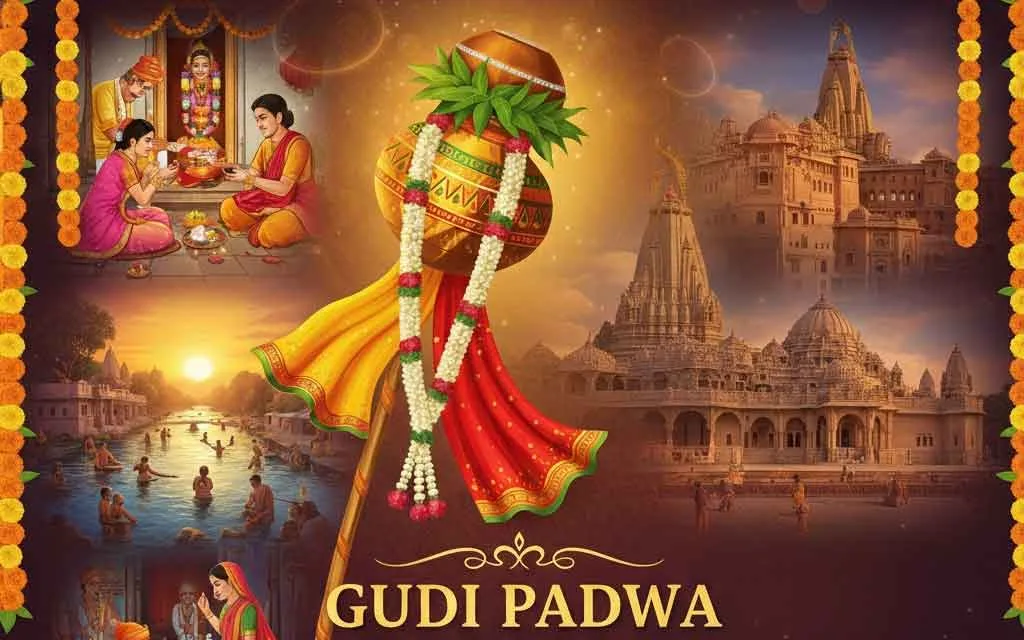
The Gudi is a tall bamboo staff (velu or kathi) draped with a bright silk cloth — traditionally yellow or saffron — topped with an inverted silver or copper kalasha (pot). A garland of neem leaves, mango leaves, and marigold flowers is strung around it, and a sacred thread (mauli) is tied at intervals. Each element carries precise symbolism: the bamboo's straight vertical rise represents dharmic uprightness; the inverted pot echoes the shape of the cosmic womb from which creation pours forth.
Neem leaves are placed on the Gudi and also consumed on this day as part of the traditional Bevu-Bella (neem-jaggery) mixture. The Charaka Samhita mentions neem (nimba) as the premier herb for purifying the blood and fortifying the body at the start of the spring season, when Kapha dosha tends to accumulate. By incorporating neem into the New Year's first ritual act, the tradition merges Ayurvedic seasonal wisdom with religious observance.
The Gudi is erected facing east, toward the rising sun, before or at sunrise on Pratipada. After the evening aarti, it is respectfully brought down — it is never left standing overnight. This deliberate act of erecting and retiring the Gudi mirrors the Vedic concept of daily creation and dissolution, echoing the Surya's own cycle of rising and setting.
Who was Vikramaditya, and how did the Vikram Samvat calendar originate?
Vikram Samvat takes its name from Samrat Vikramaditya of Ujjayini (modern Ujjain, Madhya Pradesh), the legendary king celebrated in texts like the Kathasaritsagara and Simhasana Dwatrimsika. According to tradition, he inaugurated this calendar era to commemorate his decisive victory over the Shakas, dating the start of Samvat 1 to 57 BCE by the Gregorian count. Ujjain, which sits on the Tropic of Cancer and served as the prime meridian (zero longitude) in classical Indian astronomy, was the natural seat for a new astronomical era.
Unlike purely lunar or purely solar calendars, the Vikram Samvat is lunisolar: months are defined by the moon's cycle (tithi-based), but the year is corrected periodically so that Chaitra always falls in spring. This sophisticated intercalation system — adding an adhika masa (leap month) roughly every 32.5 months — was elaborated in the Vedanga Jyotisha and later refined by astronomers like Varahamihira at Ujjain's celebrated Vikramaditya court.
Vikram Samvat 2083 therefore represents an unbroken record-keeping tradition of over two millennia, making it one of the oldest continuously used calendar systems in the world. Its persistence through centuries of political change reflects the depth to which it is embedded in the religious, agricultural, and social life of the subcontinent.
What is the significance of the Samvatsara name 'Siddharthi' for Vikram Samvat 2083?
Hindu astronomical tradition divides time into a cycle of 60 Samvatsaras, each with a unique Sanskrit name whose meaning is understood to colour the character of that year. These 60 names appear in the Brihat Samhita of Varahamihira and in various Jyotisha Shastra texts. Siddharthi — literally 'one whose purpose is accomplished' (siddha = accomplished, artha = purpose or goal) — is considered highly favourable for new undertakings, long-delayed projects, and spiritual practices aimed at self-realisation.
The year's ruling planet, Brihaspati (Jupiter), amplifies Siddharthi's themes. In Jyotisha, Jupiter governs vidya (learning), dharma (righteous conduct), guru-shishya parampara (teacher-student lineage), and griha sukha (household harmony). A year in which both the Samvatsara name and the ruling graha point toward wisdom and fulfilment is traditionally regarded as especially suited for education, marriage alliances, temple construction, and beginning new spiritual disciplines.
Families and communities across India consult the year's Samvatsara name when making major decisions — naming newborns, commencing businesses, or initiating charitable projects. The Panchanga reading (Panchanga Sravanam) performed on Chaitra Pratipada morning, in which a priest recites the full astronomical details of the new year, is precisely the ritual moment when Siddharthi's qualities are formally invoked and its blessings sought for the coming twelve months.
How is Chaitra Shukla Pratipada linked to the simultaneous beginning of Chaitra Navratri?
The coincidence of the Hindu New Year and Chaitra Navratri on the same tithi is theologically intentional rather than incidental. The Devi Mahatmya (Markandeya Purana, chapters 81–93) describes the Goddess Durga as the primordial Shakti from whom creation itself proceeds. Beginning Navratri — nine nights of her worship — on the very first day of the new year consecrates the entire year under her protection and sets a tone of shakti-upasana (power-worship) for all endeavours that follow.
Ghatasthapana, the ritual installation of a kalasha filled with sacred water and sown with barley seeds, marks the formal commencement of Navratri on this day. The sprouting of the barley (ankura) over nine days is a visible, living metaphor for the growth and auspiciousness one seeks in the new year. In many households, the sprouted shoots (called javara or navadurga ankura) are offered to the Goddess on Navami and then distributed as prasad.
Temples dedicated to Navadurga forms — such as the Shri Katyayani Shakti Peeth in Vrindavan, the Chamundeshwari Temple in Mysuru, and the Tulja Bhavani Temple in Tuljapur, Maharashtra — draw especially large congregations during Chaitra Navratri, intertwining the New Year celebration with a pan-India surge of devotional worship that links the domestic Gudi or Ghatam in every home to the great temple traditions of the land.
Frequently Asked Questions
When is Gudi Padwa – Vikram Samvat New Year 2083?
Gudi Padwa – Vikram Samvat New Year 2083 falls on 19 March 2026.
What is the significance of Gudi Padwa – Vikram Samvat New Year 2083?
Warm greetings from HinduTone.com to everyone! May Vikram Samvat 2083 bring auspiciousness and prosperity!
How is Gudi Padwa – Vikram Samvat New Year 2083 celebrated?
Devotees observe it with puja, fasting or special offerings, visiting temples, chanting mantras, and gathering with family. Customs vary by region and tradition.
What should devotees do on Gudi Padwa – Vikram Samvat New Year 2083?
Take a sacred bath, perform the day's puja and charity (dana), observe any prescribed fast, and chant mantras with sincere devotion.
You might also like

Marathi New Year (Gudi Padwa) Celebrations in Canada: Comprehensive Guide for Marathi Diaspora – 2026 Edition
Marathi New Year (Gudi Padwa) Celebrations in the UAE: Comprehensive Guide for Marathi Diaspora – 2026 Edition
Marathi New Year (Gudi Padwa) Celebrations Worldwide: Comprehensive Guide for Marathi Diaspora – 2026 Edition