


Holi Hai 2026: Krishna-Radha Story & Spiritual Significance

Holi Hai 2026: Krishna-Radha Holi Story, Mythology, Legends & Spiritual Significance in Hinduism
When is Holi 2026?
Holi 2026 Date: Friday, March 13, 2026 (Holi)
Holika Dahan: Thursday, March 12, 2026
Holi, the festival of colors, love, and spring, returns in 2026 with its vibrant celebration of divine love, mythology, and spiritual renewal. This ancient Hindu festival carries deep spiritual significance rooted in the eternal love story of Lord Krishna and Radha.
The Enchanting Krishna-Radha Holi Story
The Divine Romance of Vrindavan
The most beloved Holi legend centers on the divine love between Lord Krishna and Radha in the sacred land of Vrindavan. This timeless story explains why Holi is celebrated with colors and joyous abandon.
Why Did Krishna Play Holi with Colors?
According to Hindu mythology, young Krishna was deeply troubled by his dark complexion compared to Radha’s fair skin. Krishna’s mother, Yashoda, noticed her son’s distress and playfully suggested he apply color to Radha’s face to make her look like him.
Krishna, the mischievous cowherd, took this advice to heart. He gathered his friends, the Gopas and Gopis (cowherd boys and girls), and playfully smeared colored powder on Radha and the other milkmaids. What began as Krishna’s innocent ploy to win Radha’s heart transformed into a joyous celebration of love.
The Colors of Divine Love
Radha, instead of being offended, embraced this playful gesture with love and laughter. The colored powders symbolized the dissolution of superficial differences and the triumph of pure, unconditional love. This divine play, known as “Raas Leela” and “Holi Leela,” became the foundation for the colorful Holi celebrations we know today.
The playful banter between Krishna and the Gopis, their dance, songs, and color fights in the lanes of Vrindavan, created a spiritual template for celebrating love that transcends physical boundaries.
Ancient Holi Mythology and Legends
1. The Legend of Holika and Prahlad
The most prominent origin story of Holi involves Prahlad, a young devotee of Lord Vishnu, and his evil aunt Holika.
The Story:
- King Hiranyakashipu, Prahlad’s father, demanded everyone worship him as God
- Prahlad remained devoted to Lord Vishnu, defying his father
- Hiranyakashipu ordered his sister Holika, who was immune to fire, to sit in flames with Prahlad on her lap
- Through divine intervention, Prahlad emerged unharmed while Holika burned to ashes
- This symbolizes the victory of devotion and good over evil
Holika Dahan (bonfire night before Holi) commemorates this triumph, with communities lighting bonfires to burn away evil and negativity.
2. The Kamadeva Legend
Another significant Holi mythology involves Kamadeva (the god of love) and Lord Shiva.
The Story:
- Shiva was deep in meditation after Sati’s death
- The gods needed Shiva to marry Parvati to produce a son who could defeat the demon Tarakasura
- Kamadeva shot his flower arrow at Shiva to break his meditation
- Enraged, Shiva opened his third eye and reduced Kamadeva to ashes
- Later, moved by Rati’s (Kamadeva’s wife) pleas, Shiva restored Kamadeva
This legend represents the power of love and sacrifice, celebrated through Holi’s festivities.
3. The Legend of Dhundhi
In some regions, Holi celebrates the defeat of the ogress Dhundhi who terrorized children. She was driven away by young boys’ pranks and noise, explaining why children play such a central role in Holi celebrations.
Spiritual Significance of Holi in Hinduism
1. Victory of Good Over Evil
Holi fundamentally represents dharma (righteousness) triumphing over adharma (unrighteousness). The burning of Holika symbolizes destroying our inner demons—ego, jealousy, hatred, and negativity.
2. Rebirth and Renewal
Celebrated at the spring equinox, Holi marks nature’s renewal. It’s a time to:
- Shed old grudges and conflicts
- Forgive past mistakes
- Embrace new beginnings
- Rejuvenate relationships
3. Equality and Unity
The colors of Holi dissolve social barriers:
- Caste distinctions disappear under the rainbow hues
- Economic differences fade in collective celebration
- Age hierarchies soften as everyone plays together
- Spiritual unity is emphasized over material divisions
4. Transcendence of Duality
Krishna and Radha’s story teaches profound spiritual truths:
- Love transcends physical appearance
- The soul is beyond bodily identification
- Divine love (prema) is unconditional and pure
- Unity in diversity, like different colors creating beauty together
5. Celebration of Divine Love (Bhakti)
Holi is ultimately a celebration of bhakti (devotion):
- Krishna represents the Supreme Divine
- Radha symbolizes the devoted soul
- Their play represents the soul’s union with the Divine
- Colors represent the various aspects of divine creation
6. Letting Go of Ego
Smearing colors on each other breaks down ego barriers. When covered in colors, distinctions of beauty, status, and identity fade, revealing our common humanity and divinity.
Regional Holi Celebrations Honoring Krishna-Radha
Vrindavan and Mathura (Uttar Pradesh)
The birthplace of Krishna hosts India’s most authentic Holi celebrations:
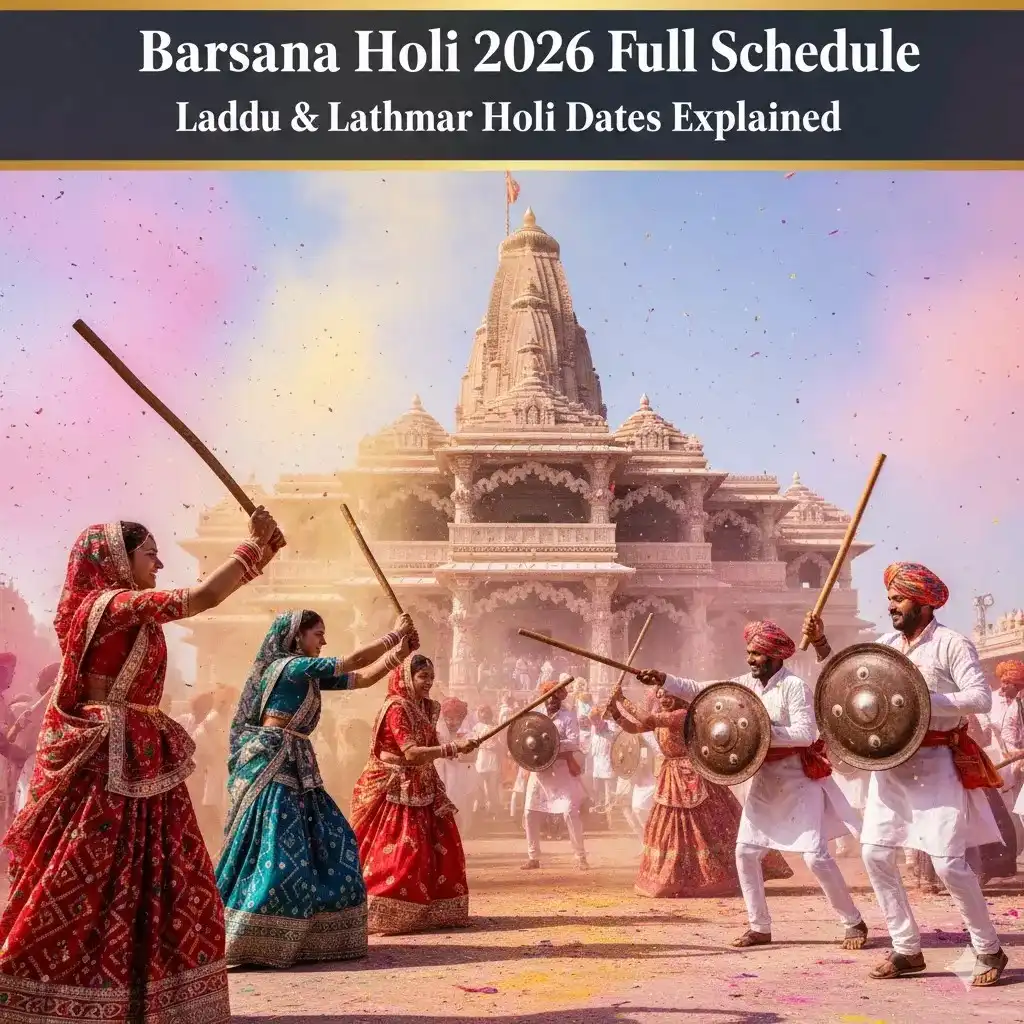
- Lathmar Holi in Barsana: Women playfully beat men with sticks, reenacting the Krishna-Radha legend
- Phoolon ki Holi at Banke Bihari Temple: Flowers instead of colors
- Widows’ Holi at Vrindavan temples: Breaking social taboos with celebration
- Celebrations last nearly a week with different themes each day
Manipur
Yaosang Festival combines Holi with local traditions, featuring Krishna-themed dances and performances.
Maharashtra
Rangapanchami is celebrated five days after Holi with special emphasis on Krishna worship and Govinda Pathaks (dance groups).
Holi Rituals and Traditions
Holika Dahan (Choti Holi)
Date in 2026: March 12, 2026 (Evening)
Rituals:
- Gather wood and combustible materials weeks in advance
- Place Holika effigy in the bonfire
- Perform puja with offerings of grains, flowers, and coconut
- Light the fire after sunset with Vedic mantras
- Circumambulate the fire three times
- Collect ash for protection and prosperity
Dhulandi (Rangwali Holi)
Date in 2026: March 13, 2026
Celebrations:
- Begin morning with prayers to Krishna-Radha
- Apply gulal (colored powder) to elders’ feet as blessing
- Play with colors, water guns (pichkaris), and water balloons
- Visit friends and family
- Exchange sweets and festive foods
- Evening gatherings with music and dance
Traditional Holi Foods and Prasad
Special Krishna-Radha Prasad
- Makhan Mishri – Butter and sugar crystals (Krishna’s favorite)
- Panjiri – Sweet mixture of dry fruits and wheat flour
- Thandai – Spiced milk drink with bhang (traditional intoxicant)
- Gujiya – Sweet dumplings filled with khoya and dry fruits
- Malpua – Sweet pancakes soaked in sugar syrup
- Puran Poli – Flatbread stuffed with sweet lentils
- Dahi Vada – Lentil fritters in yogurt
- Bhang Pakora – Fritters with cannabis leaves (traditional, where legal)
Holi Mantras and Prayers
Krishna Holi Mantra
ॐ नमो भगवते वासुदेवाय
Om Namo Bhagavate Vasudevaya
Salutations to Lord Krishna, the divine indweller
Radha-Krishna Prayer
राधे राधे गोविन्द गोपाल राधे
Radhe Radhe Govinda Gopala Radhe
Chant celebrating Radha and Krishna’s divine love
Holika Dahan Mantra
असतो मा सद्गमय।
तमसो मा ज्योतिर्गमय।
मृत्योर्मा अमृतं गमय।
Asato Ma Sad Gamaya
Tamaso Ma Jyotir Gamaya
Mrityor Ma Amritam Gamaya
Lead us from untruth to truth, darkness to light, death to immortality
Holi Colors and Their Spiritual Meanings
| Color | Spiritual Significance |
|---|---|
| Red | Love, passion, fertility; Radha’s devotion |
| Yellow | Knowledge, learning, happiness; turmeric’s purifying power |
| Blue | Krishna himself; divine consciousness; infinity |
| Green | New beginnings, spring, prosperity, nature’s renewal |
| Pink | Compassion, caring, nurturing energy |
| Orange | Spiritual awakening, warmth, energy |
| Purple | Mysticism, magic, spiritual transformation |
| White | Purity, peace, truth; the canvas of creation |
Modern Holi Celebrations: Staying True to Traditions
Eco-Friendly Holi
With growing environmental awareness, many devotees now embrace:
- Natural colors from flowers, turmeric, beetroot, henna
- Water conservation by minimizing water usage
- Organic celebrations avoiding synthetic chemicals
- Sustainable bonfires with proper waste management
Spiritual Practices for Holi 2026
- Morning meditation on Krishna-Radha’s divine love
- Reading Bhagavata Purana sections about Holi
- Kirtan and bhajans dedicated to Krishna
- Acts of charity feeding the poor and distributing sweets
- Forgiveness rituals seeking and granting forgiveness
- Temple visits to Krishna-Radha shrines
Lessons from Krishna-Radha Holi for Modern Life
1. Embrace Playfulness
Krishna teaches us that spirituality isn’t always serious—divine joy comes through innocent play and laughter.
2. Love Beyond Appearances
The story reminds us to look beyond superficial differences and recognize the divine in everyone.
3. Dissolve Barriers
Just as colors wash away, we should let go of divisions, prejudices, and rigid identities.
4. Celebrate Relationships
Holi emphasizes nurturing bonds—with family, friends, community, nature, and the Divine.
5. Renewal is Essential
Like spring renews nature, we must periodically refresh our spiritual practice and worldview.
Preparing for Holi 2026: A Spiritual Checklist
Two Weeks Before:
- [ ] Deep clean your home and heart
- [ ] Resolve pending conflicts
- [ ] Plan eco-friendly celebrations
- [ ] Prepare natural colors
One Week Before:
- [ ] Study Krishna-Radha stories
- [ ] Practice Holi bhajans
- [ ] Prepare traditional foods
- [ ] Organize community gathering for Holika Dahan
On Holika Dahan (March 12):
- [ ] Fast or eat sattvic food
- [ ] Participate in bonfire rituals
- [ ] Meditate on releasing negativity
- [ ] Offer prayers for protection
On Holi Day (March 13):
- [ ] Wake early for Krishna darshan
- [ ] Offer prayers and prasad
- [ ] Play with natural colors
- [ ] Share joy with everyone
- [ ] Forgive and seek forgiveness
- [ ] Celebrate with devotional music
The Universal Message of Holi
Holi transcends religious boundaries to offer universal wisdom:
From Darkness to Light: The Holika bonfire represents burning ignorance and illuminating wisdom.
From Division to Unity: Colors blend on everyone equally, teaching oneness.
From Seriousness to Joy: Krishna’s playful nature reminds us that the Divine delights in our happiness.
From Fear to Love: Radha’s acceptance of Krishna’s playful colors represents fearless, unconditional love.
Conclusion: Holi Hai 2026!
As Holi 2026 approaches on March 13, we’re reminded of the eternal spring that Krishna and Radha’s love represents in our hearts. This festival isn’t merely about throwing colors—it’s about coloring our consciousness with devotion, love, forgiveness, and joy.
The Krishna-Radha Holi story teaches us that divine love is playful, innocent, beyond physical boundaries, and accessible to all. Whether you celebrate in the sacred lanes of Vrindavan or in your own home, Holi offers an opportunity to reconnect with your spiritual essence and celebrate the victory of light over darkness.
This Holi, as you smear colors on your loved ones, remember you’re participating in a tradition that dates back millennia—a tradition that celebrates the most fundamental truth of existence: that we are all united in divine love, just as Krishna and Radha are eternally united in their cosmic dance.
Holi Hai! Radhe Radhe! Jai Shri Krishna!
Frequently Asked Questions (FAQs)
Q: Why is Holi associated with Krishna?
A: Krishna’s playful application of colors on Radha and the Gopis in Vrindavan established the tradition of playing with colors during Holi, making it a celebration of divine love.
Q: What is the spiritual significance of colors in Holi?
A: Colors represent diversity in unity, the dissolution of ego and social barriers, and the vibrant manifestation of divine creation.
Q: How long does Holi last?
A: Holi is primarily a two-day festival—Holika Dahan on the first evening and Rangwali Holi the next day. In places like Vrindavan, celebrations extend for a week.
Q: Can non-Hindus celebrate Holi?
A: Holi’s message of love, unity, and joy is universal. People of all backgrounds participate respectfully in its celebrations worldwide.
Q: What should I chant during Holi?
A: “Om Namo Bhagavate Vasudevaya,” “Radhe Radhe,” or “Hare Krishna” mantras are traditionally chanted during Holi celebrations.
May this Holi 2026 bring divine colors of love, prosperity, and spiritual awakening into your life!
For more Hindu festivals, traditions, and spiritual wisdom, visit HinduTone.com
Related posts:
 Holi 2026: Worldwide Celebrations of the Festival of Colors
 Holi 2026: Festival of Colors, Love and Renewal in Hinduism
 Holi 2026: Date, Significance, Rituals & How Hindus Celebrate Worldwide
 Holi 2026 Worldwide: Date, Rituals & Celebrations
 Holika Dahan 2026: Date, Muhurat, Puja Vidhi, Mantra, Significance & How to Celebrate at Home
 Holi 2026 Messages for WhatsApp & Facebook


 ︎
︎

