Karthika Pournami Snanam Mahatmyam – Sacred River Bath Benefits
Karthika Pournami is one of the most auspicious days in the Hindu calendar, falling on the full moon day (Pournami) in the month of Karthika…
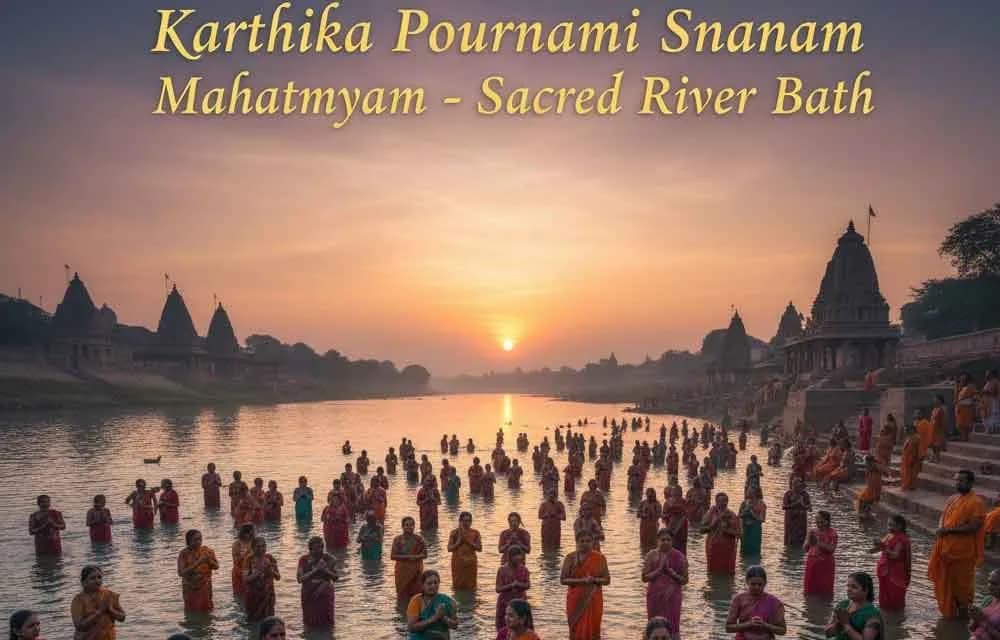
Karthika Pournami is one of the most auspicious days in the Hindu calendar, falling on the full moon day (Pournami) in the month of Karthika…
Karthika Pournami is one of the most auspicious days in the Hindu calendar, falling on the full moon day (Pournami) in the month of Karthika (October-November). The sacred bath (snanam) taken on this day holds immense spiritual significance.
Spiritual Significance
Karthika Pournami is considered highly sacred as it commemorates several divine events:
- The day Lord Shiva manifested as a column of light (Karthika Deepam)
- Lord Vishnu's Matsya Avatar appearance
- The birth of Kartikeya (Lord Murugan)
- Completion of the holy month dedicated to Lord Vishnu and Shiva
Benefits of Karthika Pournami Snanam
Spiritual Purification
- Cleansing of sins: Bathing in sacred rivers washes away past karmas and sins
- Liberation (Moksha): Believed to help attain spiritual liberation
- Divine blessings: Invokes the grace of deities, especially Lord Vishnu and Shiva
Material Benefits
- Prosperity: Attracts wealth and abundance
- Health: Promotes physical and mental well-being
- Peace: Brings harmony to family life
- Merit (Punya): Accumulates spiritual merit equivalent to performing yajnas
Sacred Rivers for the Bath
The most auspicious places include:
- Ganga (Varanasi, Haridwar, Rishikesh)
- Yamuna (Mathura, Vrindavan)
- Godavari (Nashik, Rajahmundry)
- Krishna (Vijayawada)
- Kaveri (Srirangapatna, Kumbakonam)
- Any holy river, temple tank, or even home if unable to visit sacred sites
Traditional Practices
- Pre-dawn bath (Brahma Muhurta is most auspicious)
- Chanting mantras while bathing
- Offering prayers to the Sun God and presiding deities
- Lighting lamps (deepa danam) - especially important
- Charity (dana) - giving to the needy
- Observing fast throughout the day
- Temple visits and circumambulation of sacred hills
Special Observance
On Karthika Pournami, devotees also perform:
- Tulsi Vivah (marriage of Tulsi plant with Lord Vishnu)
- Giri Pradakshina - circumambulation of sacred hills like Arunachala in Tiruvannamalai
- Lighting earthen lamps throughout the night
- Reading sacred texts like Bhagavad Gita or Shiva Purana
Modern Relevance
While the spiritual benefits are rooted in tradition, the practice also promotes:
- Connection with nature and water bodies
- Community gathering and cultural continuity
- Personal reflection and renewal
- Environmental consciousness about river conservation
The essence of Karthika Pournami Snanam lies not just in the physical act but in the devotion, faith, and pure intention with which it is performed. Even if one cannot reach a sacred river, bathing at home with devotion while chanting prayers is considered equally beneficial.
May the sacred bath on Karthika Pournami bring peace, prosperity, and spiritual elevation to all devotees.
What do the Puranas specifically say about the Karthika Pournami bath?
The Skanda Purana, in its Karthika Mahatmya section, declares that a single bath in a sacred river on Karthika Pournami equals the merit (punya) of performing one thousand Ashvamedha yajnas and one hundred Vajapeya yajnas combined. The Padma Purana similarly states that the waters of all sacred tirthas converge invisibly into every holy river during the entire month of Karthika, and this confluence reaches its peak potency on the Pournami day itself.
The Vishnu Dharmottara Purana specifies that Lord Vishnu, in his subtle (sukshma) form, resides in every body of water during Karthika month — from the great rivers like the Ganga and Godavari down to a simple household well. This is why the texts permit home bathing with sanctified water when a devotee cannot travel to a sacred river. Reciting the Vishnu Sahasranama or the Shiva Panchakshara mantra (Na-Ma-Shi-Va-Ya) while pouring water over oneself is considered to replicate the effect of bathing at Kashi (Varanasi).
Why is the Brahma Muhurta bath considered uniquely powerful on this day?
Brahma Muhurta refers to the sacred time window approximately 96 minutes before sunrise — literally 'the hour of Brahma.' On ordinary days this period is considered ideal for spiritual practice because the atmosphere carries elevated sattva guna (purity). On Karthika Pournami, however, the full moon's gravitational pull maximises the water level in rivers and, according to traditional reckoning, also heightens the flow of prana in the human body, making the mind especially receptive to mantra and meditation.
The Dharmasindhu, a classical compendium of Hindu observances, specifies that the Karthika Pournami snanam must be completed before the end of Brahma Muhurta to earn the full prescribed merit. Devotees are advised to wake before 4 a.m., apply sesame paste (til ubtan) to the body — a practice endorsed in the Smriti texts as a purifier of the skin and subtle body — and then enter the water while facing east, chanting 'Om Namo Narayanaya' or 'Om Namah Shivaya' depending on their chosen deity (ishta devata).
How does the Karthika Deepam at Tiruvannamalai connect to the sacred bath?
Tiruvannamalai in Tamil Nadu hosts one of the most spectacular Karthika Pournami observances in all of South Asia. At the Arunachaleswarar Temple — one of the Pancha Bhuta Stalas representing the element of fire (agni) — a massive beacon flame (Maha Deepam) is lit atop Arunachala Hill on this very night, symbolising Lord Shiva's manifestation as an infinite column of light (Jyoti Lingam) described in the Shiva Purana. Hundreds of thousands of devotees complete the Giri Pradakshina — a 14-kilometre barefoot circumambulation of the hill — before or after bathing in the temple's sacred tank, Brahma Tirtham.
The theological significance is that bathing in Brahma Tirtham on Karthika Pournami and then witnessing the Maha Deepam is held to grant simultaneous grace of both Shiva (as Jyotir Linga) and Vishnu (as the month's presiding deity). The Arunachala Mahatmya section of the Skanda Purana states that seeing the Deepam on the hill is equivalent to beholding Shiva's original form — and that any purificatory act, including the sacred bath, performed on this day at Tiruvannamalai yields liberation (mukti) directly.
What is the correct procedure (vidhi) for performing Karthika Pournami Snanam at home?
For devotees unable to reach a sacred river, the Smriti tradition provides a clear ritual substitution. Before bathing, place a copper pot (kalasha) filled with water at the puja space and invoke all sacred tirthas into it by chanting: 'Gange cha Yamune chaiva Godavari Sarasvati / Narmade Sindhu Kaveri jalesmin sannidhim kuru.' This invocation from the daily sandhyavandanam ritual formally sanctifies the water. Add a few drops of Ganga jal, tulsi leaves, and sesame seeds to the water before use.
The bath itself should be preceded by applying sesame paste or turmeric to the body, symbolising the removal of impurity (mala). While pouring the sanctified water over oneself, recite the Purusha Sukta or at minimum the Shiva Panchakshara mantra 108 times. After bathing, wear clean white or yellow clothing, light a sesame-oil lamp (deepam) — the Deepa Danam on this night carries exceptional merit according to the Karthika Mahatmya — and offer it to a Shiva Linga or Vishnu murti, or place it at the tulsi plant in the courtyard.
The rite is completed by performing charity (dana) before breaking any fast. The Padma Purana specifically recommends donating sesame seeds (til), jaggery (gur), and warm clothing to Brahmins or the poor on this day, since these items carry both practical warmth in the onset of winter and deep ritual symbolism of sustaining life and burning away ignorance.
Which sacred rivers beyond the Ganga carry special Karthika Pournami significance for Telugu and Kannada devotees?
The Godavari River at Rajahmundry (officially Rajamahendravaram) in Andhra Pradesh holds extraordinary importance for Telugu-speaking Vaishnavas and Shaivas alike. The Pushkara Ghat at Rajahmundry is traditionally regarded as the point where the Godavari's sanctity is highest, and on Karthika Pournami massive gatherings — sometimes exceeding a million pilgrims — converge for the predawn bath. Local temple records and oral tradition hold that a bath here on this day equals the merit of the Godavari Pushkaralu (the 12-year festival), a claim echoed in regional Mahatmya texts.
Further south, the Kaveri River at Kumbakonam in Tamil Nadu draws enormous Karthika Pournami crowds to the Mahamaham tank, considered one of the holiest temple tanks (pushkarini) in India. In Karnataka, the Tungabhadra River at Hampi — site of the ancient Vijayanagara capital and the Virupaksha Temple — is a prominent bathing site, since the Tungabhadra is eulogised in the Skanda Purana as a river that bestows both dharma and moksha. Devotees in these regions often combine the sacred bath with a visit to the presiding deity's shrine, ensuring the full merit of both snanam and darshan on the same auspicious day.
How should devotees approach mantra chanting during the bath to maximise spiritual benefit?
Classical texts prescribe specific mantras keyed to the presiding energies of Karthika Pournami. For Shaiva devotees, the Maha Mrityunjaya mantra — 'Om Tryambakam Yajamahe Sugandhim Pushti-vardhanam / Urvarukamiva Bandhanan Mrityor Mukshiya Mamritat' — is considered especially powerful when chanted during the bath, as it invokes Shiva in his life-restoring, liberation-granting aspect. Repeating it 11 or 108 times while standing in the water is recommended in multiple Shaiva Agama commentaries.
For Vaishnava devotees, the Dvadasha Nama Stotra of Vishnu — including names such as Kesava, Narayana, Madhava, and Govinda — is traditionally recited at each pour of water over the head, one name per pour. This practice aligns with the significance of Karthika as Vishnu's dedicated month (Vishnu Priya Masa). Children and elderly who cannot recite extended mantras are advised in the Dharmasindhu to simply repeat 'Om Namo Narayanaya' or 'Shiva Shiva' throughout, since the texts assure that sincere repetition of the divine name (nama japa) during this sacred bath carries merit proportional to the devotee's sincere intent (bhava), not merely the technical correctness of the ritual.
Frequently Asked Questions
When is Karthika Pournami Snanam Mahatmyam – Sacred River?
Karthika Pournami Snanam Mahatmyam – Sacred River is observed on its traditional tithi in the Hindu lunar calendar; refer to the year's panchang for the exact date in your region.
What is the significance of Karthika Pournami Snanam Mahatmyam – Sacred River?
Karthika Pournami is one of the most auspicious days in the Hindu calendar, falling on the full moon day (Pournami) in the month of Karthika (October-November). The sacred bath (snanam) taken on this day holds immense spiritual significance.
How is Karthika Pournami Snanam Mahatmyam – Sacred River celebrated?
Devotees observe it with puja, fasting or special offerings, visiting temples, chanting mantras, and gathering with family. Customs vary by region and tradition.
What should devotees do on Karthika Pournami Snanam Mahatmyam – Sacred River?
Take a sacred bath, perform the day's puja and charity (dana), observe any prescribed fast, and chant mantras with sincere devotion.
You might also like
Karthika Masam 2026: Dates, Rituals, Vrat, Festivals & North vs South India Guide
June 2026 Hindu Festival Calendar — Complete Dates, Vrat & Puja Guide for NRIs
Shani Deva Temples Worldwide & Must-Performed Rituals — Complete Devotee's Guide