
Dussehra 2026 in London: Date, Vijay Muhurat, Temples and Navratri Celebrations
Vijayadashami falls on Tuesday 20 October 2026 in London. Local Vijay Muhurat and Dashami timings, Hindu temples across the capital for Navratri and Dussehra, how London's Gujarati, Punjabi, Bengali, Tamil and other communities celebrate, and a simple home puja.
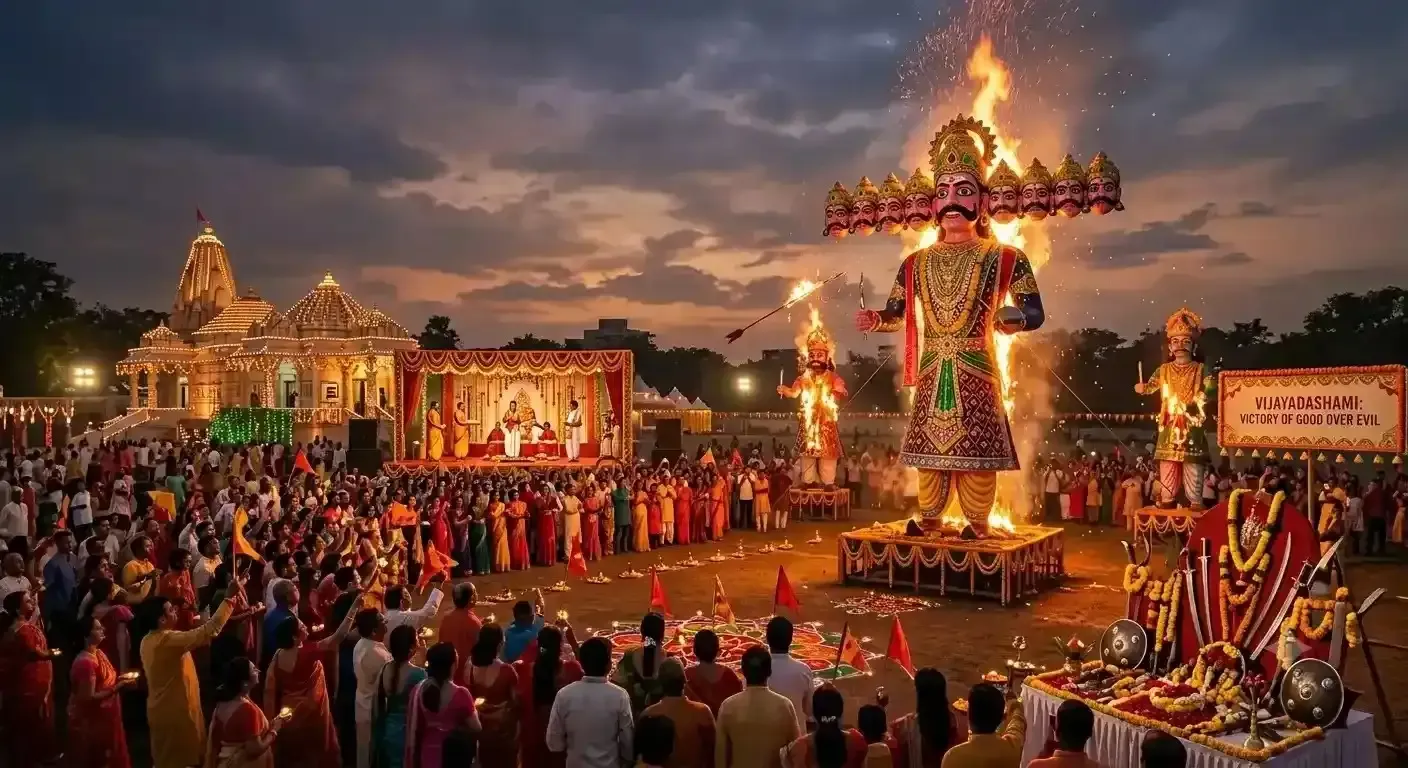
Vijayadashami falls on Tuesday 20 October 2026 in London. Local Vijay Muhurat and Dashami timings, Hindu temples across the capital for Navratri and Dussehra, how London's Gujarati, Punjabi, Bengali, Tamil and other communities celebrate, and a simple home puja.
Quick answer: Dussehra (Vijayadashami) 2026 in London is on Tuesday 20 October 2026. The Vijay Muhurat for London is 2:29 PM – 3:10 PM local time (BST, UTC+1), calculated by the Drik Panchang method. Navratri begins on Sunday 11 October, and Durga Ashtami and Maha Navami fall together on Monday 19 October 2026.
Editor's note (5 October 2026): The London timings on this page were calculated for the city's own sunrise and sunset using the Drik Panchang method, in local British Summer Time (the UK is still on summer time on 20 October). India's Dashami tithi runs from 12:50 PM IST on 20 October to 2:11 PM IST on 21 October; the London equivalents are shown below. We do not list 2026 event schedules, venues or ticket details, because temples and community groups announce these themselves. Please check their official websites and social pages before you go.
London has one of the largest Hindu populations of any city outside South Asia. Gujarati families, many of whom came from East Africa, settled in Brent, Harrow and the north-west; Punjabi Hindus in Southall, Hounslow and Ealing; Tamil communities from Sri Lanka and South India in Newham, Croydon, Wembley and Tooting; and Bengali, Marathi, Telugu, Kannada, Malayali and Nepali families across the capital. Navratri here brings together garba, Durga Puja, Golu and Ramayana traditions in temples and community halls across the capital.
Dussehra 2026 dates and timings for London
| Observance | London (local time, BST) |
|---|---|
| Navratri begins (Ghatasthapana) | Sunday 11 October 2026 |
| Durga Ashtami and Maha Navami | Monday 19 October 2026 |
| Dussehra / Vijayadashami | Tuesday 20 October 2026 |
| Dashami tithi begins | Tue 20 Oct, 8:20 AM |
| Dashami tithi ends | Wed 21 Oct, 9:41 AM |
| Vijay Muhurat (Drik Panchang method) | 2:29 PM – 3:10 PM |
| Aparahna (afternoon puja window) | 1:47 PM – 3:52 PM |
| Sunset | 5:57 PM |
In London the Dashami tithi begins on Tuesday morning and lasts through the whole afternoon, so the Aparahna and Dashami overlap fully and there is no doubt about the date: Vijayadashami is Tuesday 20 October. The Vijay Muhurat, the eleventh of the fifteen daytime muhurtas, sits comfortably within both the Aparahna and the Dashami tithi. Ravan Dahan, where held, traditionally takes place after sunset.
Hindu temples in London for Navratri & Dussehra
These temples and organisations are established in London and its edges. Programmes vary from year to year, so check each one's official website for current details.
- BAPS Shri Swaminarayan Mandir, Neasden: the hand-carved stone mandir in north-west London, opened in 1995 and often described as Britain's first traditional Hindu stone temple, and one of the city's best-known landmarks.
- Shri Vallabh Nidhi Mandir, Wembley (Alperton): a carved limestone temple on Ealing Road serving the large Gujarati community of Brent.
- London Sri Murugan Temple, Manor Park: a granite South Indian temple in Newham with a tall Rajagopuram, at the heart of East London's Tamil community.
- London Sri Mahalakshmi Temple, Manor Park: an East London temple dedicated to the Goddess Mahalakshmi, where Navaratri is an important time of worship.
- Shree Ghanapathy Temple, Wimbledon: a long-established Ganesha temple in south-west London that also has shrines to Durga, Hanuman and Krishna.
- Radha Krishna Temple (ISKCON London), Soho: the central London Hare Krishna temple, where Vijayadashami is remembered as the day of Lord Rama's victory.
- Bhaktivedanta Manor, Letchmore Heath (near Watford): ISKCON's main UK centre, just outside London in Hertfordshire, and a popular visit for London families.
- London Durgotsav Committee, Camden: the Bengali organisation that has run one of the UK's oldest and best-known Durga Pujas since the 1960s.
Temples and community groups usually announce Navratri garba, Durga Puja, Ramlila and Ravan Dahan programmes a few weeks ahead — check their websites/social pages.
How London celebrates Navratri and Dussehra
Garba and dandiya nights
London's Gujarati community is one of the largest anywhere outside India, and garba and dandiya raas are the most visible part of Navratri in the capital, particularly in Brent, Harrow and the north-west suburbs. Typical evenings start with an aarti to Amba Mata, followed by hours of circular garba and dandiya with live music, with families dressed in chaniya choli and kediyu. Some groups hold garba every night of Navratri in school or community halls, while the largest events tend to be at weekends in bigger venues.
Durga Puja
Bengali associations in London have held Durga Puja since the 1960s, and today there are many pujas across the city. A typical puja includes the dhak, pushpanjali on Ashtami, Sandhi Puja, bhog, cultural programmes and, at the end, Bijoya Dashami with Sindoor Khela and farewell to the Goddess. In India the Bengal-tradition Bijoya Dashami falls on Wednesday 21 October 2026 (Drik Panchang, Kolkata), but diaspora pujas follow their own committee's schedule, often fitted around weekends.
Golu, Ayudha Puja and Vidyarambham
London's Tamil, Telugu, Kannada and Malayali families keep South Indian Navaratri customs alive. Many homes set up a Golu (Bommai Kolu) of dolls on stepped shelves and invite friends for kumkum, songs and sundal, and South Indian temples hold special abhishekams and alankarams for the Goddess through the nine nights. On Navami, Ayudha Puja honours tools, books, instruments and vehicles, and on Vijayadashami many children begin learning with Vidyarambham, often at a temple.
Ramlila and Ravan Dahan
Punjabi and North Indian families mark Dussehra with Rama's victory over Ravana. In London this usually means Ramayana readings, children's Ramlila performances and, where permission is given, a small effigy burning organised by a temple or community group. Large open-air Ravan Dahan events are far less common than in India, and any burning depends on the rules of the local council and the London Fire Brigade.
Dussehra puja at home
Because 20 October is a working Tuesday, many London families keep a short home puja and join community celebrations at the weekend. A simple vidhi:
- Prepare: clean the puja area, place an image of Durga, Rama or your family deity, and keep flowers, rice, kumkum, a diya and incense ready.
- Aparajita puja: in the Aparahna (1:47 PM – 3:52 PM), draw a small eight-petalled lotus with kumkum or rice and worship Goddess Aparajita, praying for victory over obstacles.
- Shami puja: offer worship to a Shami plant or a few Shami or Apta leaves, ideally during the Vijay Muhurat (2:29 PM – 3:10 PM).
- Ayudha / Shastra puja: clean and decorate tools, laptops, books, musical instruments and the car, apply kumkum and offer a flower.
- Vidyarambham: children can write their first letters or 'Om' in rice, or begin a new class or instrument.
- Close: light the diya, offer naivedya and sing an aarti. If you kept the Navratri fast, break it as per your family custom.
For the meaning of Dussehra, the stories behind it and a fuller puja procedure, see our Dussehra / Vijayadashami 2026 pillar guide.
Practical tips for Dussehra in London
- Weekday festival: Tuesday 20 October and Wednesday 21 October are school and work days. The Vijay Muhurat falls in mid-afternoon, so plan a short break or keep the Shami puja simple at home.
- Weekend events: many garba nights, Durga Pujas and Ramlila programmes are held on the weekends either side of Dussehra. Check dates directly with the organisers.
- Fire and fireworks: rules on fireworks, open flames and effigy burning are set by UK law and local authorities. Check with your council before planning anything outdoors, and never light diyas near curtains or decorations.
- Getting there: parking near the larger temples is limited on festival days. The Tube, Overground and buses are usually the easier option; allow extra time and arrive early.
- Clock check: the UK is still on British Summer Time on 20 October, so the times on this page are BST (UTC+1).
Frequently asked questions
When is Dussehra 2026 in London?
Tuesday 20 October 2026. Navratri begins on Sunday 11 October, and Durga Ashtami and Maha Navami both fall on Monday 19 October. In London the Dashami tithi runs from Tue 20 Oct, 8:20 AM to Wed 21 Oct, 9:41 AM local time, so it covers the whole afternoon of the 20th.
What is the Vijay Muhurat in London on Dussehra 2026?
2:29 PM – 3:10 PM British Summer Time on Tuesday 20 October 2026, calculated by the Drik Panchang method for London. It falls inside the Aparahna (1:47 PM – 3:52 PM), and the whole window is within the Dashami tithi.
Can I use the Vijay Muhurat published for India?
No. Muhurat windows depend on local sunrise and sunset, so India's times cannot simply be converted into UK time. Use the London timings on this page or your mandir's calendar.
When is Bijoya Dashami and Sindoor Khela in London?
In India, the Bengal-tradition Bijoya Dashami and Sindoor Khela fall on Wednesday 21 October 2026 (Drik Panchang, Kolkata). London's Durga Puja committees set their own schedules, often around the weekend, so follow your puja committee's announcements.
Which temples in London celebrate Navratri and Dussehra?
The BAPS Shri Swaminarayan Mandir in Neasden, Shri Vallabh Nidhi Mandir in Wembley, the London Sri Murugan and Sri Mahalakshmi temples in Manor Park, the Shree Ghanapathy Temple in Wimbledon and ISKCON's Radha Krishna Temple in Soho are among the places that mark the festival, alongside Bengali groups such as the London Durgotsav Committee. Check each one's website for its 2026 programme.
Is there Ravan Dahan in London?
Large open-air effigy burnings are rare in London because of fire safety rules and permissions. Some community groups and temples hold Ramlila performances or a symbolic Ravan Dahan, usually on a weekend near Dussehra. Temples and community groups usually announce these a few weeks ahead, so check their websites and social pages.
Related guides
You might also like
Dussehra 2026 in London, Ontario: Date, Vijay Muhurat, Temples and Navratri Celebrations
Dussehra 2026 in Victoria, BC: Date, Vijay Muhurat, Temples and Navratri Celebrations
Dussehra 2026 in Surrey: Date, Vijay Muhurat, Temples and Navratri Celebrations