
Dussehra 2026 in Manchester: Date, Vijay Muhurat, Temples and Navratri Celebrations
Vijayadashami in Manchester falls on Tuesday 20 October 2026. Local Dashami timings, the Vijay Muhurat calculated for Manchester, Hindu temples across Greater Manchester, Navratri garba, Durga Puja and a simple Dussehra puja at home.
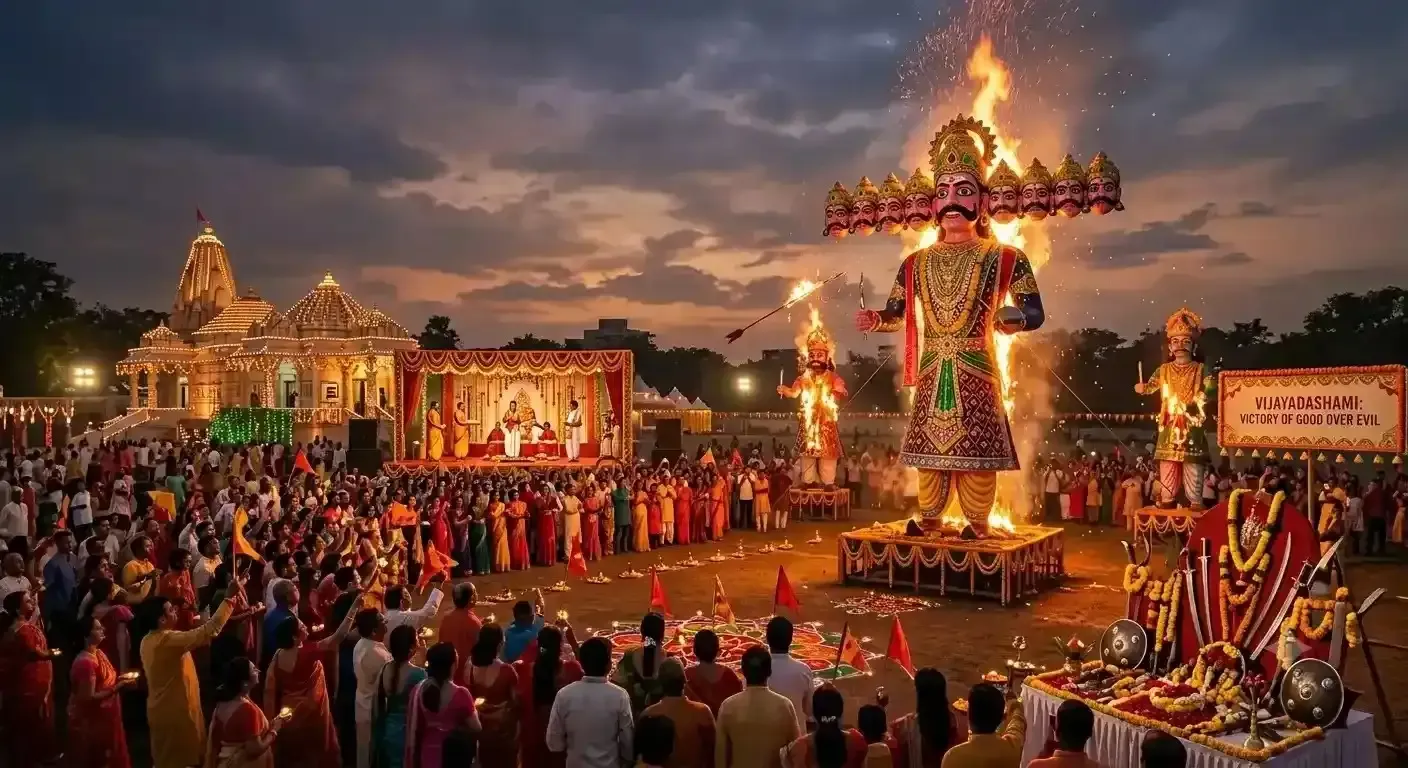
Vijayadashami in Manchester falls on Tuesday 20 October 2026. Local Dashami timings, the Vijay Muhurat calculated for Manchester, Hindu temples across Greater Manchester, Navratri garba, Durga Puja and a simple Dussehra puja at home.
Quick answer: Dussehra (Vijayadashami) 2026 in Manchester is on Tuesday 20 October 2026. The Vijay Muhurat for Manchester is 2:36 PM – 3:17 PM UK time (BST, UTC+1), calculated by the Drik Panchang method. The Dashami tithi begins locally at 8:20 AM on 20 October, so the whole afternoon is auspicious for Shami puja, Aparajita puja and Shastra puja.
Editor's note (5 October 2026): The Manchester times on this page were calculated for the city's own sunrise and sunset using the Drik Panchang method, with the all-India Dashami tithi (12:50 PM IST 20 October to 2:11 PM IST 21 October) shown in UK time. The UK is still on British Summer Time on 20 October. We do not list 2026 event schedules, venues or ticket details, because temples and community groups announce these themselves each year; please check their official channels before you go.
Greater Manchester is home to a long-established Hindu community with roots in Gujarat, Punjab, Bengal, South India, Sri Lanka and East Africa. Navratri here means nine nights of garba in halls and community centres, Durga Puja organised by the city's Bengali families, and quieter Devi worship in mandirs from Whalley Range to Bolton, all leading up to Vijayadashami.
Dussehra 2026 dates and Manchester timings
| Observance | Date / time (Manchester, BST) |
|---|---|
| Navratri begins (Ghatasthapana) | Sunday 11 October 2026 |
| Durga Ashtami and Maha Navami | Monday 19 October 2026 |
| Dussehra / Vijayadashami | Tuesday 20 October 2026 |
| Dashami tithi begins | Tue 20 Oct, 8:20 AM |
| Dashami tithi ends | Wed 21 Oct, 9:41 AM |
| Vijay Muhurat (Drik Panchang method) | 2:36 PM – 3:17 PM |
| Aparahna (afternoon puja window) | 1:55 PM – 3:58 PM |
| Sunset | 6:02 PM |
Navratri and Ashtami/Navami dates follow Drik Panchang for India. In India, Vijayadashami is on Tuesday 20 October 2026, with the Dashami tithi running from 12:50 PM IST that day to 2:11 PM IST on 21 October. In Manchester the Dashami covers the entire afternoon of 20 October, overlapping the Aparahna by more than two hours, so there is no doubt about the date: Dussehra is Tuesday 20 October. The UK clocks go back only at the end of October, so all times here are in BST (UTC+1).
Hindu temples in Manchester for Navratri & Dussehra
These mandirs and organisations serve Hindu families across Manchester and Greater Manchester. Temples and community groups usually announce Navratri garba, Durga Puja, Ramlila and Ravan Dahan programmes a few weeks ahead — check their websites/social pages.
- Gita Bhavan Hindu Temple — Whalley Range, one of the city's long-standing mandirs.
- Radha Krishna Mandir (Gandhi Hall) — Withington, a centre of worship and community events.
- ISKCON Manchester — Whalley Range, the Hare Krishna temple serving the city.
- BAPS Shri Swaminarayan Mandir Manchester — Ashton-under-Lyne, Tameside.
- Shree Kutch Satsang Swaminarayan Temple — Bolton, among the first purpose-built Swaminarayan mandirs in the UK.
- Shree Swaminarayan Mandir Oldham — Oldham.
- Greater Manchester Bengali Hindu Cultural Association (GMBHCA) — the Bengali community group that has held Durga Puja at Gandhi Hall in Withington.
Bolton, Oldham, Ashton-under-Lyne and Stockport all have sizeable Hindu communities, so many Manchester families travel across the conurbation during Navratri. Visit the official site or social page of the temple you plan to attend for current opening hours and festival plans.
How Manchester celebrates Navratri and Dussehra
Garba and dandiya nights
For Manchester's large Gujarati community, Navratri is above all a season of garba. Evenings typically begin with aarti to Ambe Maa around a decorated garbo or image of the Goddess, followed by hours of circle dancing to live or recorded music, with dandiya raas on some nights. Larger events often take place in hired halls and leisure centres because temple premises cannot hold the crowds, and weekends tend to be the busiest nights. Traditional chaniya choli and kediyu are worn by many, and young people from across the North West join in.
Durga Puja
Manchester's Bengali families celebrate Durga Puja with an idol of Ma Durga flanked by Lakshmi, Saraswati, Ganesha and Kartikeya, daily anjali, the sound of the dhak, bhog and evening cultural programmes. Diaspora pujas are often arranged around weekends, so the days may not match India exactly. In India, Bijoya Dashami and Sindoor Khela fall on Wednesday 21 October 2026 (Drik Panchang, Kolkata); in Manchester, follow the puja committee's own schedule for Sindoor Khela and the farewell to the Goddess.
Ramlila and Ravan Dahan
North Indian families remember Rama's victory over Ravana on Dussehra. In the UK, large outdoor effigy burnings are less common than in India and depend on venue and local-authority permission, so celebrations are often a Ramayana recital, a children's Ramlila performance or a symbolic small effigy at a community event. Where a Ravan Dahan is held, it is usually after dark, and with sunset at 6:02 PM in Manchester, evening programmes can start early.
South Indian traditions: Golu, Ayudha Puja and Vidyarambham
Tamil, Telugu, Kannada and Malayali families in Greater Manchester keep their own customs. Many Tamil homes set up a Golu (Bommai Kolu) of dolls on steps and invite friends over during Navratri. Saraswati and Ayudha Puja honour books, instruments, tools and vehicles, and Vijayadashami is the day for Vidyarambham, when small children write their first letters. Telangana families may celebrate Bathukamma with flower stacks and songs in the run-up to Dasara.
Dussehra puja at home in Manchester
With 20 October a working day, a short home puja is how many Manchester families mark Vijayadashami. The ideal time for the main worship is the Vijay Muhurat, 2:36 PM – 3:17 PM, or failing that anywhere in the Aparahna (1:55 PM – 3:58 PM). If you are at work, a puja in the evening with family is still meaningful.
- Aparajita puja: draw a simple eight-petalled lotus with kumkum or rice flour, invoke Goddess Aparajita, the unconquered, and offer flowers, akshata and a lamp, praying for victory over obstacles.
- Shami puja: the Shami tree is hard to find in the UK, so many families use Shami leaves bought from an Indian grocer, a small potted plant or simply a mental offering. Exchange leaves (or Apta leaves in the Maharashtrian custom) as 'gold' with elders and friends.
- Ayudha / Shastra puja: clean and decorate tools, cars, bikes, laptops and books, apply tilak, and offer flowers and incense.
- Vidyarambham: help a young child write 'Om' or the first letters of the alphabet in a plate of rice, ideally guided by a grandparent, teacher or priest.
- Simple vidhi: bathe, light a diya, offer prayers to Ganesha first, then the Goddess and Lord Rama; recite a Ramayana passage or the Durga Saptashati if you can; offer sweets as prasad and seek elders' blessings.
For the full puja procedure, stories and meaning of Vijayadashami, see our Dussehra / Vijayadashami 2026 complete guide.
Practical tips for Dussehra in Manchester
- Weekday planning: Tuesday 20 and Wednesday 21 October are normal work and school days. Book leave early if you want to attend a daytime puja, and check whether your temple is holding its main programme at the weekend.
- Fireworks and effigies: rules on fireworks, bonfires and effigy burning are set by local authorities and venues. Check with your council and the organisers, and only attend properly managed events.
- Getting there: car parks at popular mandirs and halls fill quickly during Navratri. Metrolink, buses and car sharing can make evening garba easier, and allow extra time on busy weekend nights.
- Weather: late October in Manchester is often cool and wet, so bring a warm layer and umbrella for evening events and queues.
- Fasting: Indian grocers across the city stock kuttu, singhara and sabudana for Navratri vrat food in the run-up to the festival.
- Use local times: do not convert India's muhurat into UK time; use the Manchester times above or your temple's panchang.
Frequently asked questions
When is Dussehra 2026 in Manchester?
Dussehra (Vijayadashami) in Manchester is on Tuesday 20 October 2026, the same day as in India. Navratri begins on Sunday 11 October, and Durga Ashtami and Maha Navami fall on Monday 19 October.
What is the Vijay Muhurat in Manchester on Dussehra 2026?
2:36 PM – 3:17 PM UK time (BST) on Tuesday 20 October 2026, calculated by the Drik Panchang method for Manchester. It falls inside the Aparahna (1:55 PM – 3:58 PM) and well within the Dashami tithi, which runs locally from 8:20 AM on 20 October to 9:41 AM on 21 October.
Can I use India's Dussehra muhurat times in Manchester?
No. Muhurat windows depend on local sunrise and sunset, so India's times cannot simply be converted into UK time. Use the Manchester times on this page or your mandir's own calendar.
Where can I celebrate Navratri and Dussehra in Manchester?
Temples such as Gita Bhavan in Whalley Range, the Radha Krishna Mandir at Gandhi Hall in Withington, ISKCON Manchester and the BAPS Shri Swaminarayan Mandir in Ashton-under-Lyne, along with community groups like the Greater Manchester Bengali Hindu Cultural Association, usually mark the festival. They announce their programmes a few weeks ahead, so check their websites and social pages.
When is Bijoya Dashami and Sindoor Khela in 2026?
In the Bengal tradition, Bijoya Dashami and Sindoor Khela fall on Wednesday 21 October 2026 in India (Drik Panchang, Kolkata). Durga Pujas in Manchester follow their own committee's schedule, so check with the organisers.
Is Dussehra a holiday in the UK?
No. Tuesday 20 October 2026 is a normal working and school day in the UK. Many temples and community groups hold larger celebrations on the nearest weekend, and families often do a short puja in the evening or during the Vijay Muhurat if they can.
Related guides
You might also like
Dussehra 2026 in Victoria, BC: Date, Vijay Muhurat, Temples and Navratri Celebrations
Dussehra 2026 in Surrey: Date, Vijay Muhurat, Temples and Navratri Celebrations
Dussehra 2026 in Vancouver: Date, Vijay Muhurat, Temples and Navratri Celebrations