
Dussehra 2026 in Milwaukee: Date, Vijay Muhurat, Temples and How the City Celebrates
Vijayadashami in Milwaukee falls on Tuesday 20 October 2026. Local Vijay Muhurat and Dashami times for Central Time, the Hindu temples of the Milwaukee area, how the city's communities celebrate Navratri and Dussehra, and a simple puja you can do at home.
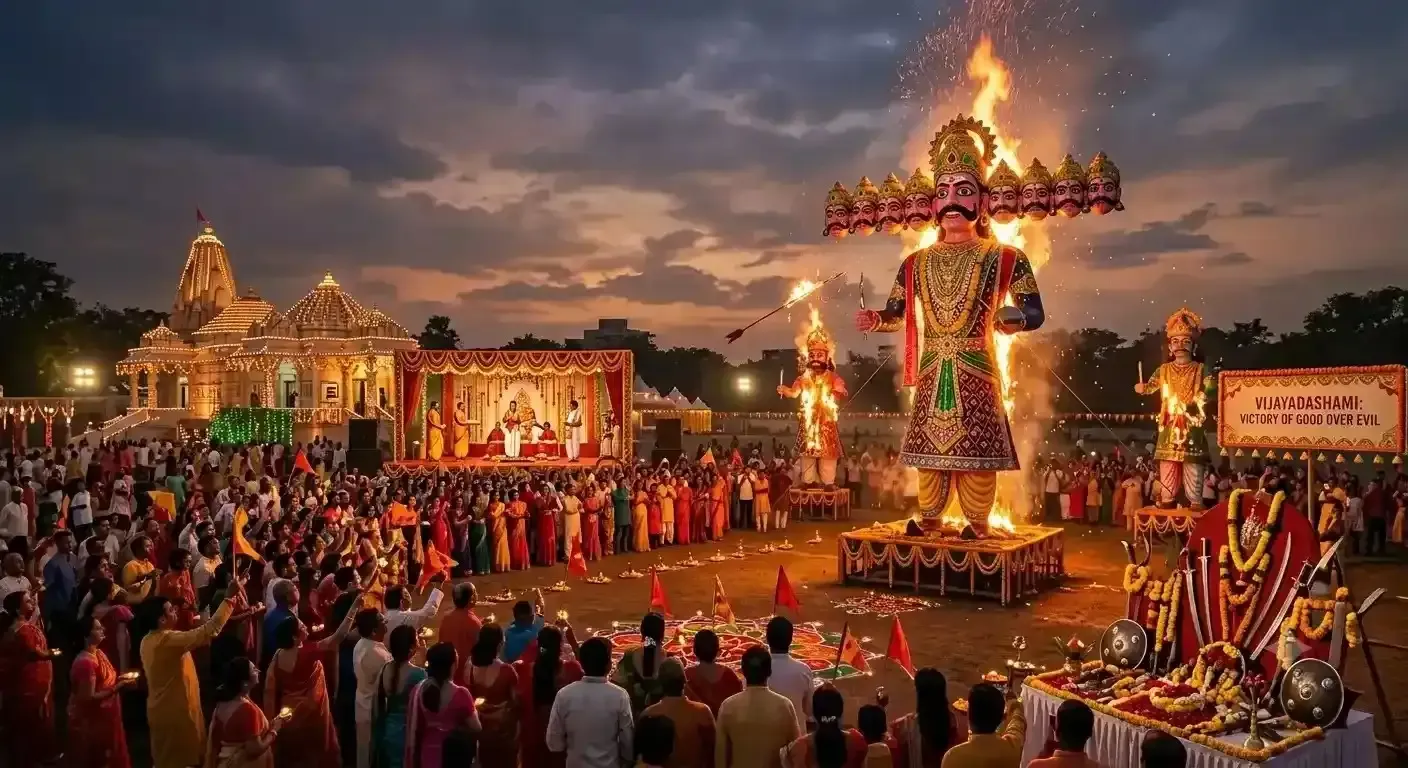
Vijayadashami in Milwaukee falls on Tuesday 20 October 2026. Local Vijay Muhurat and Dashami times for Central Time, the Hindu temples of the Milwaukee area, how the city's communities celebrate Navratri and Dussehra, and a simple puja you can do at home.
Quick answer: Dussehra (Vijayadashami) 2026 in Milwaukee is on Tuesday 20 October 2026. The Vijay Muhurat for Milwaukee is 2:24 PM – 3:07 PM Central Time, calculated by the Drik Panchang method. Navratri begins on Sunday 11 October, and Durga Ashtami and Maha Navami fall together on Monday 19 October 2026.
Editor's note (5 October 2026): The Milwaukee times on this page were calculated for the city's own latitude, longitude and time zone (Central Daylight Time, UTC-5 on 20 October) using the Drik Panchang method, which we have checked against Drik Panchang's published figures for several cities. India's dates are from Drik Panchang. We do not list 2026 event schedules, because temples and community groups announce their own programmes each year. Please check their official channels before you go.
Milwaukee's Hindu community is spread across the city and its western and northern suburbs, and over the past three decades it has built a cluster of temples in Pewaukee, in Waukesha County. During Navratri these temples come alive with evening aartis, garba nights and Devi pujas, and on Vijayadashami families gather to worship the Goddess, honour their tools and books, and mark the victory of good over evil.
Dussehra 2026 dates and timings for Milwaukee
| Observance | Date / time (2026) |
|---|---|
| Navratri begins (Ghatasthapana) | Sunday 11 October |
| Durga Ashtami and Maha Navami | Monday 19 October |
| Dussehra / Vijayadashami in Milwaukee | Tuesday 20 October 2026 |
| Dashami tithi begins (Milwaukee time) | Tue 20 Oct, 2:20 AM |
| Dashami tithi ends (Milwaukee time) | Wed 21 Oct, 3:41 AM |
| Vijay Muhurat (Drik Panchang method) | 2:24 PM – 3:07 PM |
| Aparahna (afternoon puja period) | 1:41 PM – 3:51 PM |
| Sunset | 6:01 PM |
All Milwaukee times are local Central Time. Wisconsin is still on daylight saving time on 20 October, so the city is five hours behind UTC that day. In India, Dussehra is also on Tuesday 20 October, with Dashami running from 12:50 PM IST on 20 October to 2:11 PM IST on 21 October. Do not convert those Indian clock times into Milwaukee time; the Milwaukee figures above have been calculated separately for the city.
The Vijay Muhurat is the eleventh of the fifteen daytime muhurtas, and it falls comfortably inside both the Dashami tithi and the Aparahna in Milwaukee this year. It is the traditional time for Shami puja, Aparajita puja, Shastra puja and starting something new. If you cannot manage the Vijay Muhurat on a working Tuesday, any time in the Aparahna is the next best choice.
Hindu temples in Milwaukee for Navratri & Dussehra
Most of the Milwaukee area's Hindu temples are a short drive west of the city in Pewaukee, which has become an unlikely centre of Indian religious life in Wisconsin. These are established temples and organisations we have confirmed; we have not listed timings, addresses or event details, which can change.
- Hindu Temple of Wisconsin (Pewaukee): the oldest Hindu temple in the state, combining North Indian and South Indian traditions, with the Jain Temple of Wisconsin on the same campus.
- BAPS Shri Swaminarayan Mandir (Pewaukee): the first BAPS mandir in Wisconsin, opened in 2018 and serving the Swaminarayan community of greater Milwaukee.
- Wisconsin Shirdi Sai (downtown Pewaukee): a temple for devotees of Shirdi Sai Baba, housed in a former church.
- Hare Krishna (ISKCON-tradition) temple (Far South Side, Milwaukee): a Gaudiya Vaishnava temple devoted to Radha and Krishna.
- Bengali Association of Madison (Madison): the best-known Bengali group in the state for Durga Puja, about an hour and a half west of Milwaukee.
Temples and community groups usually announce Navratri garba, Durga Puja, Ramlila and Ravan Dahan programmes a few weeks ahead — check their websites/social pages. Navratri programmes at diaspora temples typically include daily Devi aarti, Lalitha Sahasranama or Durga Saptashati recitation, a Kanya pujan on Ashtami or Navami, and a Vijayadashami puja with Shami or Aparajita worship.
How Milwaukee celebrates Navratri and Dussehra
Garba and dandiya
Gujarati families form a large part of the Milwaukee area's Indian community, and garba and dandiya raas are the most visible part of Navratri here. Temples and cultural associations usually hold garba nights on the Friday and Saturday evenings of Navratri, often in a temple hall, school gym or rented banquet space, with dancers circling an image of Amba Mata in colourful chaniya cholis and kediyus. Many people drive between events across southeastern Wisconsin and northern Illinois over the nine nights.
Durga Puja
Bengali families in Wisconsin celebrate Durga Puja with an idol of the Goddess and her children, Saptami to Dashami rituals, the sound of the dhak, bhog and cultural programmes. Because volunteers organise it, diaspora Durga Puja is often held over a weekend near the festival. In the Bengal tradition, Bijoya Dashami and Sindoor Khela fall on Wednesday 21 October 2026 in India; Milwaukee-area families follow their own committee's dates.
Ramlila and Ravan Dahan
North Indian families remember the Ramlila grounds and towering Ravana effigies of home. In the diaspora these traditions are usually scaled down: a children's Ramlila, a story session about Rama's victory, or a small effigy where local rules allow. Any open fire or fireworks must follow the regulations of the city or village where the event is held.
Golu, Bathukamma and Ayudha Puja
South Indian families in the Milwaukee area keep their own traditions. Tamil and Telugu households set up a Golu (Bommai Kolu) of dolls on stepped shelves and invite friends to view it, Telangana families celebrate Bathukamma with flower stacks and songs, and many families perform Ayudha Puja and Saraswati Puja, placing tools, books and instruments before the Goddess. On Vijayadashami, children begin learning with Vidyarambham.
Dussehra puja at home in Milwaukee
You do not need a temple visit to mark Vijayadashami. A simple home puja on Tuesday 20 October, ideally during the Vijay Muhurat (2:24 PM – 3:07 PM) or at least within the Aparahna (1:41 PM – 3:51 PM), is traditional.
- Aparajita puja: draw an eight-petalled lotus with rice flour or kumkum, place a lamp in the centre and worship Goddess Aparajita, the unconquerable, for victory and protection.
- Shami puja: worship a Shami plant or leaves (Apta leaves are used in Maharashtra). If you cannot find Shami in Wisconsin, a picture of the tree or a few saved leaves is a common substitute. Exchange leaves as 'gold' with family and friends.
- Ayudha / Shastra puja: clean your tools, car keys, laptop and work equipment, mark them with kumkum and turmeric, and offer flowers.
- Vidyarambham: if you have a young child, help them write their first letters in rice or on a slate after a prayer to Saraswati.
- Simple vidhi: bathe, light a lamp and incense, offer flowers, fruit and sweets, recite a Devi stotra or the Rama raksha, do aarti, and share prasad.
Practical tips for Dussehra in Milwaukee
- Working day: Tuesday 20 and Wednesday 21 October 2026 are ordinary weekdays. Do the puja during a lunch break or after work within the Aparahna, and look for weekend community events.
- Getting to Pewaukee: the Pewaukee temples are about a half-hour drive west of downtown Milwaukee. Arrive early for popular garba nights, as parking fills up, and consider carpooling.
- Weather: late October evenings in Wisconsin can be cold, so bring a warm layer to outdoor gatherings.
- Fireworks and effigies: rules on fireworks and open burning are set by local authorities. Check your city or village before planning anything at home.
- Fasting and food: Indian grocery stores in the area stock vrat items such as sabudana, kuttu and singhara flour; stock up before Navratri begins.
Frequently asked questions
When is Dussehra 2026 in Milwaukee?
Tuesday 20 October 2026. The Dashami tithi begins at 2:20 AM on Tuesday 20 October in Milwaukee and runs until 3:41 AM on Wednesday 21 October (local time), so the whole of Tuesday afternoon falls within Dashami.
What is the Vijay Muhurat in Milwaukee on Dussehra 2026?
2:24 PM – 3:07 PM Central Time on Tuesday 20 October 2026, calculated by the Drik Panchang method for Milwaukee. The wider Aparahna period is 1:41 PM – 3:51 PM, and sunset is at 6:01 PM.
Can I use India's Dussehra times in Milwaukee?
No. Muhurat windows depend on local sunrise and sunset, so India's times cannot simply be converted into Central Time. Use the Milwaukee times on this page or your temple's calendar.
Where can I celebrate Navratri and Dussehra near Milwaukee?
Most of the area's Hindu temples are in Pewaukee, west of the city, including the Hindu Temple of Wisconsin, the BAPS Shri Swaminarayan Mandir and Wisconsin Shirdi Sai. There is also a Hare Krishna temple on Milwaukee's Far South Side. Temples and community groups usually announce their programmes a few weeks ahead, so check their websites and social pages.
Is there Ravan Dahan in Milwaukee?
Some diaspora communities hold a Ramlila or a small Ravan Dahan, often on the nearest weekend. Any effigy burning or fireworks must follow the rules set by local authorities, so it depends on what organisers are permitted to do. Check announcements from temples and community groups.
When is Bijoya Dashami and Sindoor Khela in 2026?
In the Bengal tradition, Bijoya Dashami and Sindoor Khela fall on Wednesday 21 October 2026 in India (Drik Panchang, Kolkata). Durga Pujas in the diaspora follow their own committee's schedule, often on a weekend.
Related guides
You might also like
Dussehra 2026 in Oakville: Date, Vijay Muhurat, Temples and How Halton Celebrates
Dussehra 2026 in Victoria, BC: Date, Vijay Muhurat, Temples and Navratri Celebrations
Dussehra 2026 in Surrey: Date, Vijay Muhurat, Temples and Navratri Celebrations