Dussehra Activities for Kids: 6 Easy Crafts, a 15-Question Quiz and Classroom Ideas (2026)
Six easy Dussehra crafts with materials and steps, a 15-question Dussehra quiz with answers, drawing prompts, classroom and home activities like a story circle and a 'defeat one bad habit' kindness challenge, plus tips for NRI children doing show-and-tell at school abroad.
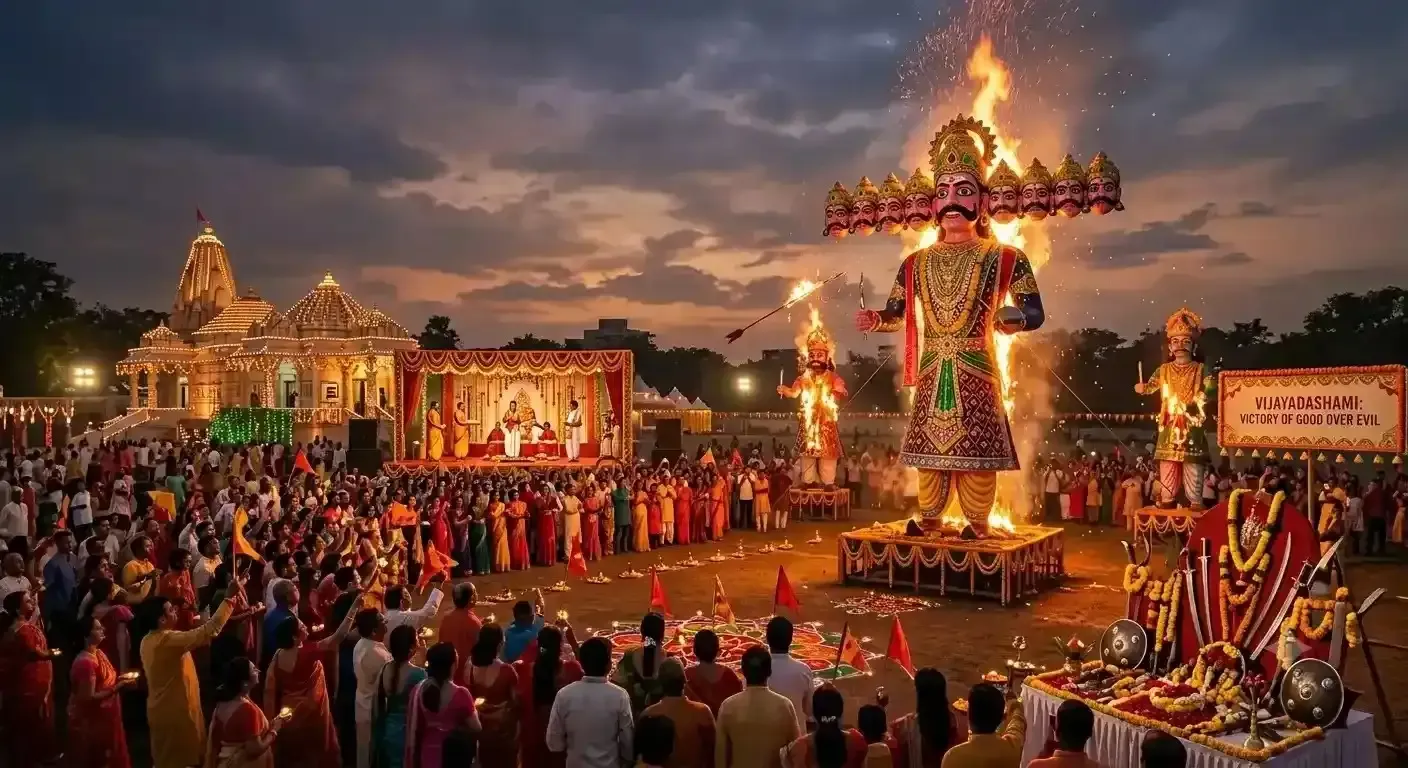
Six easy Dussehra crafts with materials and steps, a 15-question Dussehra quiz with answers, drawing prompts, classroom and home activities like a story circle and a 'defeat one bad habit' kindness challenge, plus tips for NRI children doing show-and-tell at school abroad.
Quick answer: The best Dussehra activities for kids are simple crafts linked to the story, such as a paper-plate Ravana with ten heads, a safe straw bow and arrow, a paper-leaf toran, a Golu doll, a Durga mask and a flower rangoli, followed by a 15-question quiz and a kindness challenge to "defeat one bad habit". Navratri 2026 runs from Sunday 11 to Monday 19 October, and Dussehra (Vijayadashami) is on Tuesday 20 October 2026 in India (Drik Panchang).
Dussehra is a wonderful festival to share with children, because it has everything they love: heroes, a ten-headed king, a brave monkey, a goddess on a lion, flowers, dolls and fireworks. The ideas below use cheap, everyday materials and work at home, in a classroom, or in a temple Bal Vihar or Sunday school. Read the story first with our Dussehra story for kids so the crafts and quiz make sense.
6 easy Dussehra crafts for kids
1. Paper-plate Ravana with ten heads
Ages: 4 and up. Time: 30 minutes.
Materials: one large paper plate, a strip of card about 40 cm long, nine small paper circles or squares, crayons or felt pens, glue, a lolly stick (optional).
- Draw one big face in the middle of the plate. Give it a crown and a moustache.
- Draw nine small faces on the paper circles. Make each one show a different feeling: angry, proud, greedy, grumpy.
- Glue the card strip across the top of the plate, sticking out on both sides.
- Glue four small faces on one side of the strip and five on the other, so that, with the big face in the middle, Ravana has ten heads in a row.
- Tape a lolly stick to the back to hold it up like a puppet.
Talk about it: ask your child to name each face after a bad habit. Our guide to the ten heads of Ravana explains the different ways people interpret them.
2. Rama's bow and arrow from straws or ice-cream sticks
Ages: 5 and up, with supervision. Time: 20 minutes.
Materials: a bendy plastic or paper straw, or two ice-cream sticks taped end to end; string or a rubber band; tape; a second straw for the arrow; a soft pom-pom or pencil eraser; coloured paper for feathers.
- Gently bend the long straw or sticks into a curve.
- Tie or tape string from one end to the other, so it is slightly tight.
- For the arrow, tape paper feathers to one end of the second straw and a soft pom-pom to the other end.
- Decorate the bow with gold paper or stickers.
Safety note: never use toothpicks, skewers or sharpened pencils as arrows. Arrows must have a soft tip. Set a clear rule: shoot only at a paper target on the floor or wall, never at people, faces or pets.
3. Toran from paper leaves
Ages: 4 and up. Time: 30 to 40 minutes.
Materials: green paper or card, orange and yellow paper, a long piece of ribbon or string, glue or a stapler, scissors (adult help for little ones).
- Draw and cut out 10 to 15 leaf shapes from green paper, about the size of a hand.
- Make paper marigolds: cut orange and yellow circles with zigzag edges and layer two or three together.
- Fold the top of each leaf over the string and glue or staple it.
- Alternate leaves and paper flowers along the string.
- Hang it over the front door or the puja room door for Dussehra.
4. Clay or paper Golu doll
Ages: 5 and up. Time: 30 minutes, plus drying time for clay.
Materials: air-dry clay or play dough, or a toilet-roll tube and coloured paper; paints or pens; glue; scraps of fabric or ribbon.
- Clay version: roll a ball for the head and a cone for the body, press them together, and add arms. Let it dry, then paint a face and clothes.
- Paper version: cover a toilet-roll tube with coloured paper, glue a paper circle on top for the face, and add a fabric sari or dhoti and a crown.
- Make a few dolls, perhaps Rama, Sita, Lakshmana and Hanuman, and arrange them on stepped boxes covered with cloth.
Golu, or Bommala Koluvu, is a Navratri doll display popular in Tamil Nadu, Karnataka and Andhra Pradesh. See our Golu setup guide for the traditional steps.
5. Durga mask
Ages: 5 and up. Time: 30 minutes.
Materials: a paper plate, red, yellow and gold paper, glitter or sequins, a lolly stick or elastic, scissors and glue.
- An adult cuts eye holes in the plate.
- Colour the face, add a red bindi and big, kind eyes.
- Cut a tall crown from gold or yellow paper and glue it on top.
- Add sequins for jewellery and paper hair at the sides.
- Tape a stick to the side to hold it up, or attach elastic.
Tip: children can make a Durga mask and a lion mask and act out the story together.
6. Flower rangoli
Ages: 3 and up. Time: 20 to 40 minutes.
Materials: chalk, loose petals (marigold, rose, chrysanthemum) or leftover flowers from the shop, a few leaves, small diyas or battery tea lights.
- Draw a simple shape in chalk on a clean floor or doorstep: a circle, a flower or a star.
- Fill each section with a different colour of petals. Little ones can drop petals; older ones can make patterns.
- Add leaves around the edge and a battery tea light or a diya (adult only) in the centre.
- Take a photo before the petals dry.
Abroad, supermarket flowers that are past their best work well. In flats, do the rangoli on a large tray so it can be moved.
15-question Dussehra quiz with answers
Read the questions aloud, let children answer, then check below. Score one point each.
- How many nights does Navratri last?
- What does Vijayadashami mean?
- How many heads did Ravana have, as the story is told?
- Who leapt across the ocean to find Sita in Lanka?
- Which brother went with Rama into the forest?
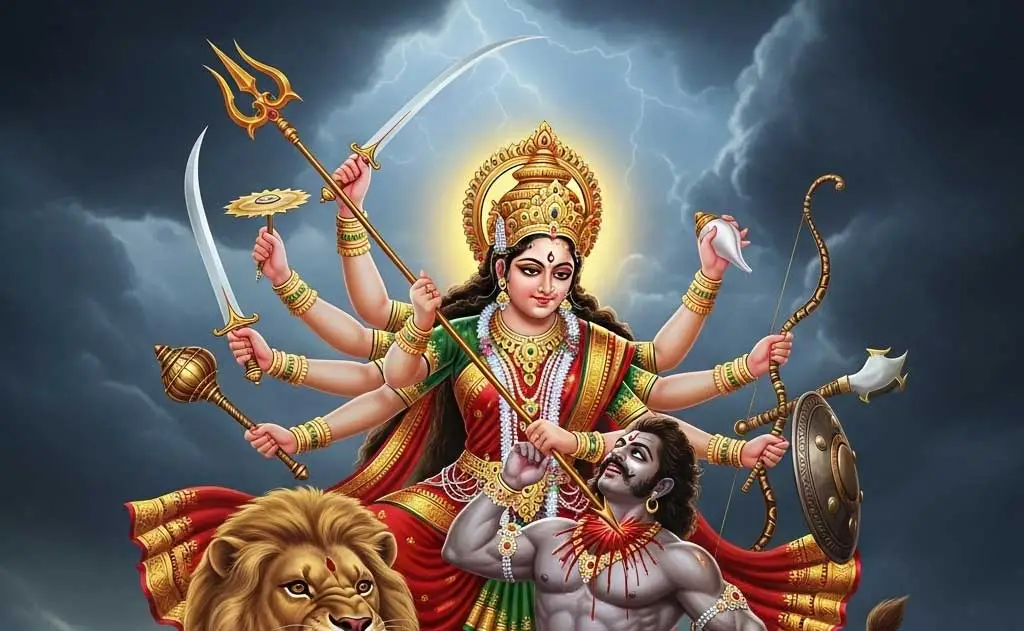
- Which goddess defeated the buffalo demon Mahishasura?
- Which animal does Goddess Durga ride?
- Which city in Karnataka is famous for its Dasara elephant procession and lit-up palace?
- In which Indian state is Durga Puja with big pandals especially famous?
- What is worshipped on Ayudha Puja?
- Which tree is worshipped on Vijayadashami, and is where the Pandavas hid their weapons in the Mahabharata?
- Bathukamma is a flower festival of which state?
- What is the Navratri doll display in Tamil Nadu called?
- Which Himachal Pradesh valley holds a famous Dussehra that begins on Vijayadashami?
- On which day and date is Dussehra in 2026?
Answers
- Nine nights. "Nava" means nine and "ratri" means night.
- The "tenth day of victory". Vijaya means victory and Dashami means the tenth day.
- Ten. That is why he is also called Dashanana, "the ten-faced one".
- Hanuman.
- Lakshmana.
- Goddess Durga.
- A lion (some pictures show a tiger).
- Mysuru (Mysore).
- West Bengal.
- Tools, weapons, vehicles, books and instruments, giving thanks for the things that help us work and learn.
- The Shami tree.
- Telangana. Saddula Bathukamma, the grand last day, is on Sunday 18 October 2026.
- Golu (also Kolu).
- Kullu.
- Tuesday 20 October 2026 (in India).
Older children can find out more about Ayudha Puja, Kullu Dussehra and Bathukamma.
Drawing and colouring ideas
No printer needed. Give children paper and one of these prompts:
- Hanuman leaping over the ocean, with fish and waves below.
- The monkeys and bears building the floating stone bridge, with the little squirrel helping.
- Goddess Durga on her lion, holding the gifts from the gods.
- Ravana with ten heads, each showing a different expression.
- Your family's Navratri: Golu steps, Garba, Bathukamma flowers or a puja.
- A giant Ravana figure at night, with fireworks in the sky.
- Rama, Sita and Lakshmana returning home to a city full of lamps.
Classroom and home activities
Story circle. Sit in a circle. The first child begins, "Long ago, in Ayodhya...", and each child adds one sentence until the story ends with the victory on Vijayadashami. It shows how much they remember and keeps everyone involved.
Kindness challenge: defeat one bad habit. Each child writes or draws one habit they want to defeat, such as shouting, not sharing or leaving toys out, on a paper "Ravana head". On Dussehra, they tear it up and put it in the recycling bin, which is a safe way to share the idea behind Ravana Dahan. For the next ten days, they try one kind act a day and add a sticker to a chart.
Mini Ramlila. Act out four scenes: leaving Ayodhya, the golden deer, Hanuman meeting Sita, and coming home. Masks and the straw bow make perfect props. Read about Ramlila traditions.
Golu corner. Older children can build a small stepped display in the classroom with their clay dolls and toys, and take turns explaining one doll each.
Essay or writing time. Children aged 9 and up can write about how their family celebrates. Our Dussehra essay for students page has sample essays and outlines.
NRI tips: Dussehra show-and-tell at school abroad
- Ask the teacher first and agree a time; many schools welcome cultural sharing in October.
- Keep it to three points: what Dussehra is (a Hindu festival of good winning over bad), the story, and how your family celebrates.
- Bring something to hold: the paper-plate Ravana, a Golu doll, a toran or family photos. Classmates love touching crafts.
- Avoid anything that could scare or confuse young classmates; skip battle details and the burning, or describe it simply as "a big bonfire-style figure that reminds us to let go of bad habits".
- If food is allowed, check the school's allergy rules first; many schools allow only shop-bought, labelled snacks.
- Show the date: Dussehra 2026 is Tuesday 20 October in India, and many temples abroad celebrate on the nearest weekend.
- For tips on age-appropriate explanations, see Explaining Navratri and Dussehra to children: a parent's guide.
For dates, muhurat and celebrations across India and abroad, see the Dussehra / Vijayadashami 2026 guide.
Also read: Diwali crafts and quiz for kids.
Frequently asked questions
What are easy Dussehra crafts for toddlers and preschoolers?
Choose crafts with big pieces and no sharp tools: a paper-plate Ravana with pre-cut faces to glue on, a paper-leaf toran, or a flower rangoli made by dropping petals into a chalk outline. An adult can do any cutting while the child sticks, colours and arranges.
Is the Dussehra bow and arrow craft safe?
It can be, with care. Use straws or ice-cream sticks, put a soft pom-pom or eraser on the arrow tip, never use toothpicks or skewers, and set a simple rule: aim only at a paper target, never at people or pets. Always supervise younger children.
How can I explain Ravana Dahan to young children?
Keep it simple: Ravana stands for pride and wrong behaviour, and burning his figure is a way of saying goodbye to bad habits. The kindness challenge on this page, where each child picks one habit to defeat, turns that idea into something they can actually do.
What can my child bring for Dussehra show-and-tell at school?
Good choices are a homemade paper-plate Ravana, a small Golu doll, a toran, photos of the family's Navratri celebration, or a picture book of the Ramayana. Keep the talk to three short points: what Dussehra is, the story behind it, and how your family celebrates.
When is Dussehra 2026?
Dussehra (Vijayadashami) is on Tuesday 20 October 2026 in India, after Navratri from Sunday 11 to Monday 19 October (Drik Panchang). Check your local temple abroad, as dates can differ by a day in some countries.
What age is the Dussehra quiz suitable for?
The 15 questions work well for children aged about 7 to 12. For younger children, read the questions aloud and offer two choices; for older children, ask them to explain each answer in a sentence.
Editor's note (8 October 2026)
We wrote these activities in October 2026 for parents, teachers and temple class volunteers. Quiz answers use well-established facts only; regional names and customs vary. Craft ages and times are rough guides; please supervise children with scissors, glue, diyas and anything with string. Dates follow Drik Panchang for India.
Related guides
You might also like
Garba for Beginners: Easy Steps, Circle Etiquette and Garba with Kids (Navratri 2026)
Navratri vs Durga Puja vs Dussehra vs Dasara vs Vijayadashami: The Differences Explained (2026)
Dussehra 2026 for Women: Shakti Puja, Prayers and New Beginnings on Vijayadashami (Tuesday 20 October)