Ten Heads of Ravana: Meaning, Stories and Interpretations Explained
Ravana is called Dashanana, the ten-faced one. Here is what the Valmiki Ramayana tradition says, the popular explanations (a boon, the Vedas and Shastras), the Jain retelling with a necklace of nine gems, the modern ten-vices reading, Ravana the scholar and Shiva devotee, and what burning the ten heads on Dussehra means.
Ravana is called Dashanana, the ten-faced one. Here is what the Valmiki Ramayana tradition says, the popular explanations (a boon, the Vedas and Shastras), the Jain retelling with a necklace of nine gems, the modern ten-vices reading, Ravana the scholar and Shiva devotee, and what burning the ten heads on Dussehra means.
Quick answer: Ravana is called Dashanana (ten-faced) and Dashagriva (ten-necked). In the Valmiki Ramayana tradition he is simply described as having ten heads; later tellings explain it in different ways, such as a boon from Brahma or his mastery of the four Vedas and six Shastras. In the Jain retelling, his face was reflected in a necklace of nine gems. Today, many people read the ten heads as ten vices such as desire, anger, greed and pride. That is the idea behind burning the ten heads on Dussehra, which falls on Tuesday 20 October 2026 in India (Drik Panchang).
The ten-headed Ravana is one of the most recognisable figures in Indian storytelling, from Ramlila stages and temple carvings to the giant effigies that go up in flames every Vijayadashami. But ask ten people why he has ten heads and you may get ten answers. This guide separates what the Ramayana tradition says, what is commonly told, and what is a later or modern interpretation, so you can understand, and explain, the symbol clearly.
Dashanana and Dashagriva: Ravana in the Ramayana tradition
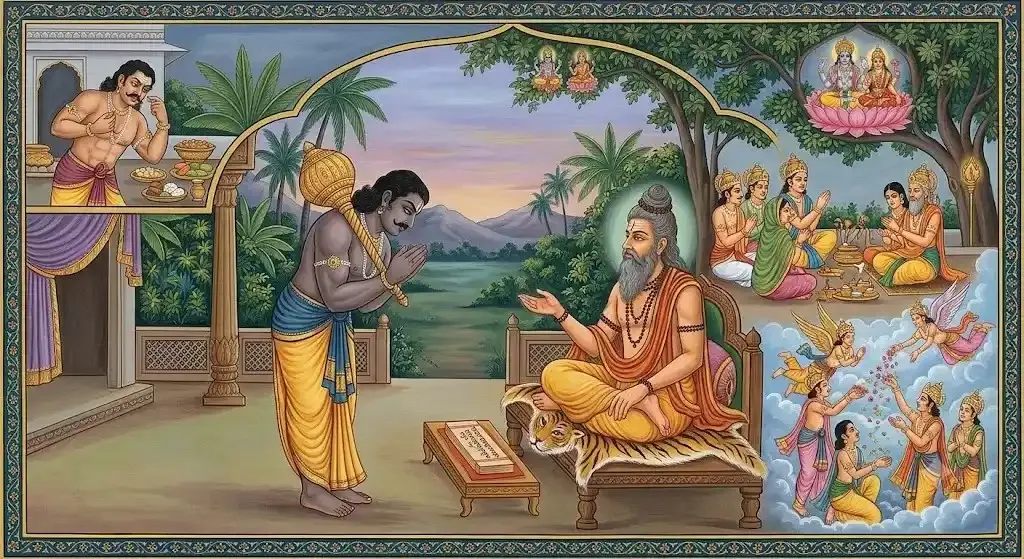
In the Valmiki Ramayana tradition, Ravana is the king of Lanka, the son of the sage Vishrava and the grandson of the sage Pulastya. He is described throughout as ten-headed and twenty-armed, a mighty and splendid figure. Hanuman, seeing him in Lanka, is struck by both his majesty and his menace.
Several of his names describe the ten heads:
| Name | Meaning |
|---|---|
| Dashanana | the ten-faced one |
| Dashamukha | the ten-faced one |
| Dashagriva | the ten-necked one |
| Dashakantha | the ten-throated or ten-necked one |
| Dashasheesha | the ten-headed one |
In the Uttara Kanda, the last book of the Valmiki Ramayana (which many scholars regard as a later addition), the child is named Dashagriva because he is born with ten heads. The name Ravana comes later. As commonly retold from the Uttara Kanda, he tried to lift Mount Kailasa; Shiva pressed the mountain down with his toe, trapping Ravana's arms, and Ravana let out a mighty roar. Pleased by his praises, Shiva named him Ravana, traditionally explained as "the one who roars" or "the one who makes the worlds cry".
For the full story of how Ravana's pride led to his downfall, read Rama vs Ravana and Durga vs Mahishasura: both Dussehra legends.
Traditional explanations, as commonly told
1. The boon and the penance. In the Uttara Kanda tradition, as it is commonly retold, Dashagriva performed long austerities to please Brahma. He is said to have offered his heads one by one into the sacred fire, and as he was about to offer the last, Brahma appeared, restored his heads and granted him a boon: he could not be killed by gods, demons and other celestial beings. Ravana, in his pride, did not think to ask for protection from humans or animals, and so a human prince, Rama, aided by monkeys and bears, could defeat him.
2. The heads that kept growing back. In the great battle, as told in the Valmiki tradition, Rama cuts off Ravana's heads again and again, and they keep growing back. Rama finally defeats him with the Brahmastra. In Tulsidas's later Ramcharitmanas, Vibhishana reveals that Ravana holds nectar in his navel, and Rama's arrows strike there.
3. Ten heads of learning. A very popular explanation, often heard in pravachans and family storytelling, is that the ten heads stand for Ravana's extraordinary knowledge: the four Vedas and six Shastras. In this reading, Ravana held the wisdom of ten scholars. This is a popular explanation, not something stated in the Valmiki Ramayana.
4. A great mind of many moods. Some storytellers say the ten heads show a restless mind pulled in ten directions at once, which is why Ravana, for all his brilliance, could never settle into wisdom. This too is a teaching interpretation.
The Jain retelling: a necklace of nine gems
The Ramayana is told in many traditions, not only Hindu ones. One of the oldest Jain versions is the Paumachariya of Vimalasuri, written in Prakrit. In this Jain retelling, Ravana is not a demon but a powerful Vidyadhara king.
In the Jain retelling, when Ravana was a child, he was given a necklace of nine gems. When he wore it, his face was reflected in each of the nine gems, so that people saw ten faces, his own and nine reflections. That is how he came to be called Dashamukha, the ten-faced one. In this version, the ten heads are not literal at all; they are a trick of light that became a name.
The Jain retelling differs from the Valmiki tradition in other ways too, for example in who kills Ravana. It is a good reminder that the Ramayana has always been a living story, told with different emphases by different communities.
The ten vices: a modern devotional interpretation
Today, the most widely shared explanation, in school talks, Dussehra speeches and social media, is that each of Ravana's heads stands for a vice or negative quality. This is a modern devotional interpretation, not a list found in the Ramayana, and the lists vary. Most begin with the six "inner enemies" (shadripu or arishadvarga) described in Hindu teaching:
| Quality | Simple meaning |
|---|---|
| Kama | uncontrolled desire or lust |
| Krodha | anger |
| Moha | delusion, blind attachment |
| Lobha | greed |
| Mada | pride, arrogance |
| Matsarya | jealousy, envy |
The other four differ from list to list. Common choices include swartha (selfishness), anyaya (injustice), amanavta (cruelty) and ahankara (ego). Some versions instead use the four parts of the inner mind (manas, buddhi, chitta and ahankara), and others read the ten heads as the ten senses, five of perception and five of action, which must be brought under control.
Whatever the list, the message is the same: Ravana was brought down not by a lack of power or intelligence, but by qualities he never conquered within himself.
Ravana the scholar and devotee of Shiva
It would be unfair to see Ravana only as a villain. The Ramayana tradition and later stories present him as a learned Brahmin, a skilled ruler of a golden city, a musician and a deep devotee of Shiva. The Shiva Tandava Stotram, a powerful hymn describing Shiva's cosmic dance, is traditionally attributed to Ravana; it is said that he sang it while trapped beneath Mount Kailasa.
A popular story, not found in the Valmiki Ramayana, says that as Ravana lay dying, Rama sent Lakshmana to learn from him, because such knowledge should not be lost. Whether told as history or as a moral tale, it captures a real point in the tradition: Ravana's tragedy is that of a brilliant person who let pride and desire overrule his wisdom. Some communities in India and Sri Lanka continue to regard him with respect for his learning and devotion.
Ravana Dahan: burning the ten heads within
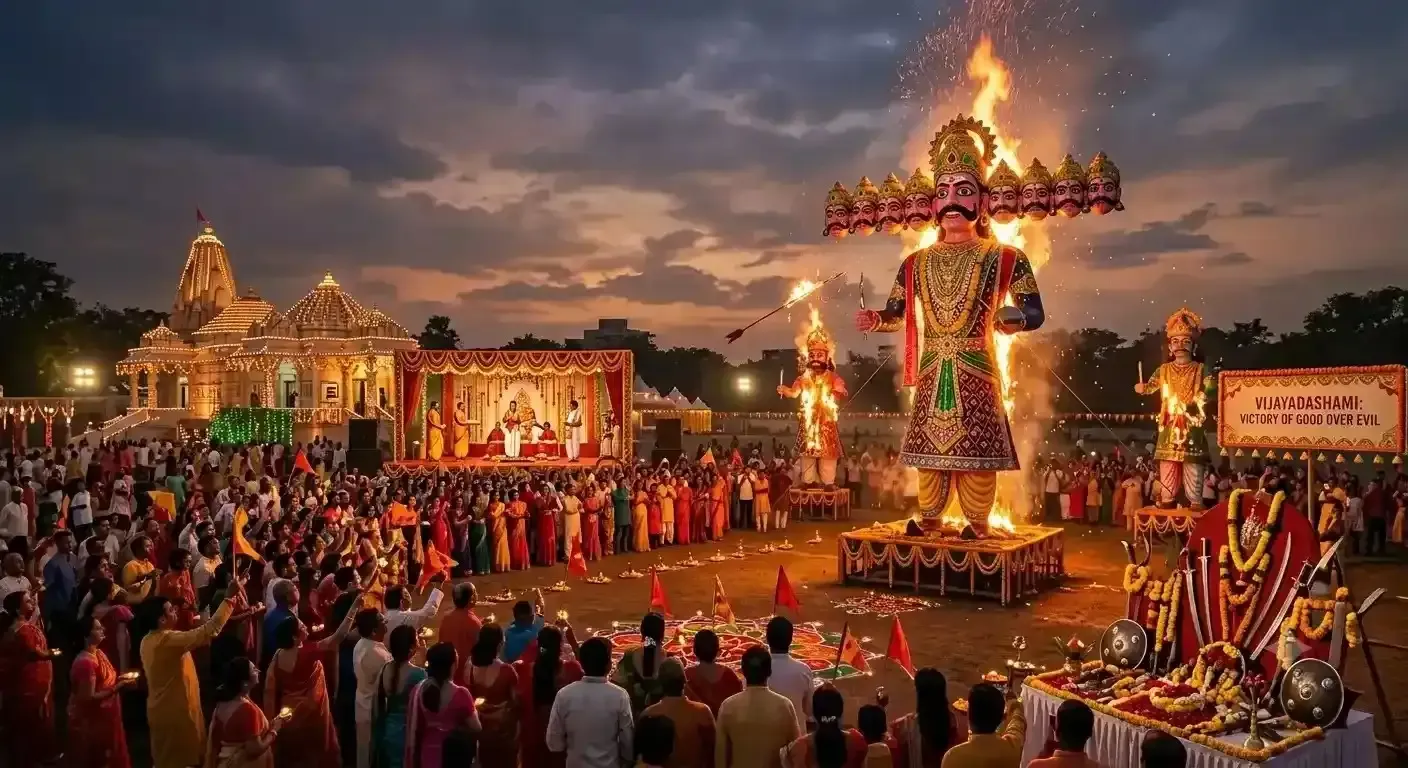
As traditionally told, Rama's victory over Ravana is remembered on Vijayadashami, the "tenth day of victory". Across North India and in many cities abroad, towering ten-headed effigies of Ravana, often with his brother Kumbhakarna and son Meghanada, are set alight at dusk after the Ramlila.
For many families, the real meaning lies in the ten heads. Watching them burn is a reminder to examine our own anger, greed, pride and jealousy, and to let one of them go this year. Read more in Ravana Dahan: why we burn Ravana and what it really means, and find city-wise timings in Ravan Dahan 2026: date and time city-wise.
| Day | Date in India (Drik Panchang) |
|---|---|
| Navratri | Sunday 11 to Monday 19 October 2026 |
| Saddula Bathukamma | Sunday 18 October 2026 |
| Durga Ashtami and Maha Navami | Monday 19 October 2026 |
| Dussehra / Vijayadashami | Tuesday 20 October 2026 |
Abroad, dates can differ by a day, and many temples hold Ravana Dahan on the nearest weekend. See the Dussehra / Vijayadashami 2026 guide for details.
How to explain Ravana's ten heads to children
- Start with the story: Ravana was a very clever and strong king who, the stories say, had ten heads.
- Then the twist: even with ten heads, he did not use them well. He was too proud to listen to good advice from his own brother.
- Make it personal: "If each head was a bad habit, what would they be?" Children often suggest shouting, not sharing, lying, or being grumpy.
- Turn it into action: pick one habit to "burn" this Dussehra and one kind habit to grow in its place.
- Keep the Jain story for curious older children; it shows that the same tale can be told in different ways.
For read-aloud versions, try our Dussehra story for kids, and for hands-on fun, the paper-plate Ravana in Dussehra activities for kids.
Frequently asked questions
Why does Ravana have ten heads?
In the Valmiki Ramayana tradition, Ravana is simply described as ten-headed, and he is called Dashanana (ten-faced) and Dashagriva (ten-necked). Later explanations vary: a boon from Brahma after his penance, his mastery of ten branches of learning, or, in the Jain retelling, his face reflected in a necklace of nine gems. Many people today read the ten heads symbolically as ten vices.
What do the 10 heads of Ravana represent?
A popular modern interpretation links them to ten negative qualities, usually starting with the six inner enemies: kama (desire), krodha (anger), moha (delusion), lobha (greed), mada (pride) and matsarya (jealousy). The remaining four differ from list to list, for example selfishness, injustice, cruelty and ego. This is a devotional interpretation, not a list found in the Ramayana.
What are the names for Ravana that mean ten-headed?
Common names include Dashanana and Dashamukha (ten-faced), Dashagriva and Dashakantha (ten-necked), and Dashasheesha (ten-headed). In the Ramayana tradition, Dashagriva is his name at birth and Ravana is a later title.
Did Ravana write the Shiva Tandava Stotram?
The Shiva Tandava Stotram is traditionally attributed to Ravana, and the story of him singing it under Mount Kailasa is widely told. As with many old hymns, scholars cannot confirm authorship, so it is best described as traditionally attributed to him.
Why is Ravana with ten heads burned on Dussehra?
As traditionally told, Rama's victory over Ravana is remembered on Vijayadashami, so huge ten-headed effigies are burned in many parts of India and abroad. For many families, the ten heads also stand for the faults each person hopes to leave behind. Dussehra 2026 is on Tuesday 20 October in India (Drik Panchang).
How do I explain Ravana's ten heads to a child?
Say that Ravana was very clever and strong, and the stories show him with ten heads. But he was too proud to listen to good advice, and that is why he lost. Then ask the child which bad habit they would like to burn this Dussehra.
Editor's note (8 October 2026)
We wrote this guide in October 2026. We have tried to separate three things clearly: what the Valmiki Ramayana tradition describes, explanations that are commonly told, and modern devotional interpretations such as the ten-vices list, which varies from source to source. The Jain account is given as found in the Jain retelling. Dates follow Drik Panchang for India.
Related guides
You might also like
Diwali Stories for Kids: One Story Every Night for the 5 Days of Diwali (2026)
Dussehra Story for Kids: Rama and Ravana, Durga and Mahishasura (Read-Aloud Versions)
Navratri Stories for Kids: One Story Every Night for the 9 Forms of Durga (2026)