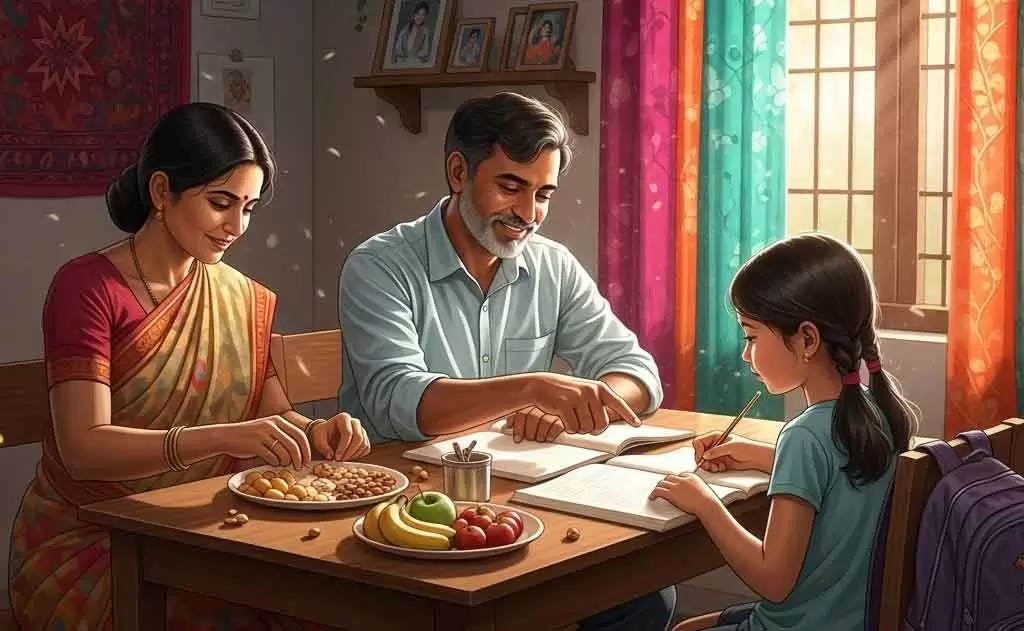
Navratri Stories for Kids: One Story Every Night for the 9 Forms of Durga (2026)
One gentle story every night of Navratri 2026: nine short read-aloud stories of the Navadurga for children aged 5 to 11, from Shailaputri on Sunday 11 October to Siddhidatri on Monday 19 October, plus a Vijayadashami story night. Each comes with a simple lesson, a one-line activity and a safe 9-day kids challenge.
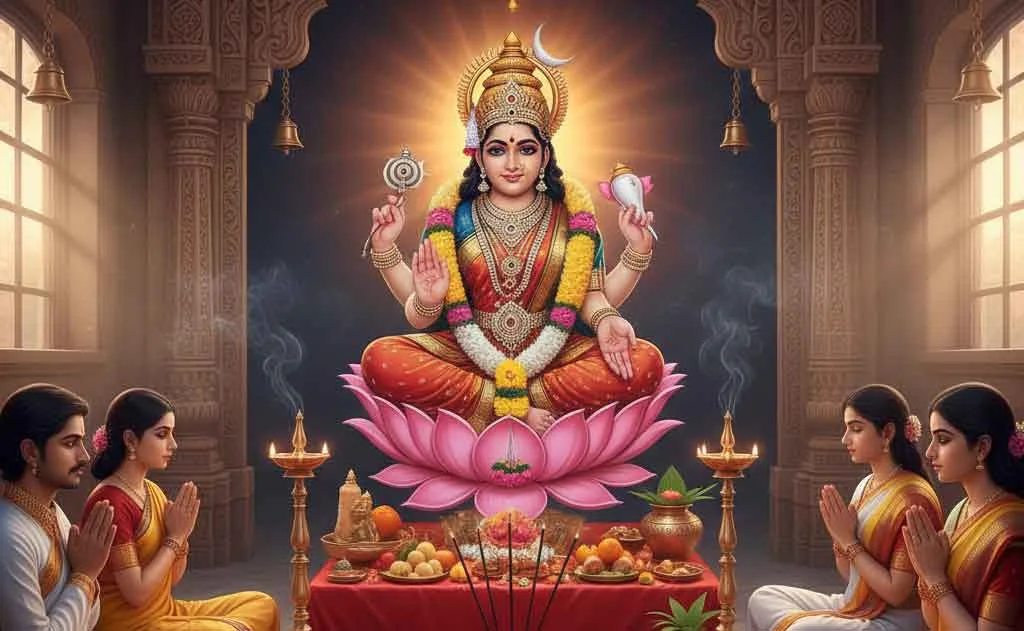
One gentle story every night of Navratri 2026: nine short read-aloud stories of the Navadurga for children aged 5 to 11, from Shailaputri on Sunday 11 October to Siddhidatri on Monday 19 October, plus a Vijayadashami story night. Each comes with a simple lesson, a one-line activity and a safe 9-day kids challenge.
Quick answer: Navratri has nine nights, and each night honours one of the nine forms of Goddess Durga (the Navadurga). In 2026, Navratri runs from Sunday 11 October (Shailaputri) to Monday 19 October (Siddhidatri) in India, per Drik Panchang, with Dussehra on Tuesday 20 October. Below are nine short read-aloud stories, one for each night, for children aged about 5 to 11, plus a tenth story night for Vijayadashami, a simple lesson and a small activity for every night.
Each story takes two or three minutes to read aloud. They are retold gently, as traditionally told, not translations of scripture. If your grandparents tell a story differently, ask them for their version too.
How to use these stories
- Read one story each evening, on the matching day of Navratri, near the home altar if you have one.
- Ask your child to say the lesson in their own words, then do the one-line activity.
- Tick off the day in the 9-day kids challenge table further down.
Night 1: Shailaputri, Daughter of the Mountain
Day 1: Sunday 11 October 2026
Long ago, Goddess Sati was married to Lord Shiva. Her father, King Daksha, did not respect Shiva, and one day he spoke unkind words about him in front of everyone at a great fire ceremony. Sati was so hurt that she left that life behind.
But love never really ends. As traditionally told, Sati was born again, this time as the daughter of Himavan, the great king of the Himalaya mountains, and his queen Mena. They named her Parvati, which means "daughter of the mountain". She is also called Shailaputri, because shaila means mountain and putri means daughter.
Shailaputri is shown riding a gentle bull, holding a trident in one hand and a lotus in the other. She is strong like a mountain and soft like a flower. On the first night of Navratri, families welcome her, just as the mountain king welcomed his little daughter home.
What this story teaches (HinduTone's simple lesson): Be steady like a mountain: when something hurts, stay calm and kind, and begin again.
Tonight's activity: Build a small "mountain" from pillows or blocks and place a paper flower on top for Shailaputri.
Puja guide: Navratri Day 1: Maa Shailaputri
Night 2: Brahmacharini, the Girl Who Never Gave Up
Day 2: Monday 12 October 2026
Young Parvati had one wish: to be with Lord Shiva again. But Shiva was deep in meditation and did not notice anyone. So Parvati decided to do tapas, which means practising with great patience and focus.
She went into the forest. She lived very simply, prayed every day and kept going through hot summers, heavy rains and cold winters. As the story is told, for a long time she ate only fruits, then only leaves, and later not even leaves. That is why she is also called Aparna.
One day, a young visitor came and said, "Why do you want Shiva? He lives on a mountain and wears ashes!" Parvati answered firmly, "I know his true goodness." The visitor smiled, and suddenly there stood Shiva himself. He had been testing her, and her patience had won his heart.
Brahmacharini is shown walking barefoot, holding prayer beads and a small water pot.
What this story teaches (HinduTone's simple lesson): Patience and practice: big goals take many small, steady days.
Tonight's activity: Pick one small thing to practise every day of Navratri (a sloka, a drawing, reading) and keep going for nine days.
Puja guide: Navratri Day 2: Maa Brahmacharini
Night 3: Chandraghanta and the Half-Moon Bell
Day 3: Tuesday 13 October 2026
After her long tapas, Parvati and Shiva were to be married. In one popular telling, Shiva arrived for the wedding with a most unusual procession: ghosts, goblins, wild-haired sages and creatures of every shape, with Shiva himself covered in ash and snakes. Parvati's mother, Queen Mena, was so frightened that she fainted!
Parvati did not panic. She took a shining, brave form with a half-moon shaped like a bell (chandra means moon and ghanta means bell) on her forehead. Riding a tiger, she went to Shiva and gently asked him to appear in a form her family could welcome. Shiva smiled and became a handsome prince, decorated with jewels. The wedding was joyful after all.
Devotees say the sound of Chandraghanta's bell chases away fear and anything harmful, like a protector standing guard.
What this story teaches (HinduTone's simple lesson): Be brave and calm for others: when people around you are scared, a steady voice helps everyone.
Tonight's activity: Ring a small puja bell (or tap a steel bowl with a spoon) and say one thing that makes you feel brave.
Puja guide: Navratri Day 3: Maa Chandraghanta
Night 4: Kushmanda and the Smile That Made Light
Day 4: Wednesday 14 October 2026
Before there were stars or planets or anything at all, there was only darkness. Endless, quiet darkness, everywhere.
Then, as traditionally told, the Goddess smiled. Just a gentle smile. And from that smile came a warm glow, like a tiny golden egg of light. The light grew and grew, and out of it came the sun, the stars, the earth, the rivers and every living thing.
That is why she is called Kushmanda. Many teachers explain the name as ku (a little), ushma (warmth) and anda (egg): the little warm egg of the universe. It is also said that she lives at the very heart of the sun, giving it its brightness and heat.
Kushmanda is shown with eight arms, riding a lion, and is sometimes called Ashtabhuja, the eight-armed one. Pumpkins (kushmanda) are a traditional offering to her in some homes.
What this story teaches (HinduTone's simple lesson): A smile is powerful: one kind smile can bring light into a dark day.
Tonight's activity: Draw a big sun with a smiling face, and give a real smile to three people tomorrow.
Puja guide: Navratri Day 4: Maa Kushmanda
Night 5: Skandamata, the Loving Mother
Day 5: Thursday 15 October 2026
Parvati and Shiva had a son named Skanda, also known as Kartikeya or Murugan. As the stories tell, a powerful demon named Tarakasura was troubling the gods, and only a son of Shiva and Parvati could stop him.
Skanda grew up brave and bright. The gods made him the commander of their army, and he defeated Tarakasura and brought peace back to the world.
But to Parvati, he was always her little boy. That is how we see her on the fifth night: as Skandamata, the mother of Skanda, sitting on a lion with baby Skanda on her lap, holding lotus flowers in her hands. She is sometimes called Padmasana, because she sits on a lotus.
Devotees say that when you pray to Skandamata, you are praying to a mother and her child together, so her blessings are double. She reminds every family that even the bravest heroes start as children held close by someone who loves them.
What this story teaches (HinduTone's simple lesson): Love at home makes us strong: the bravest people grew up feeling cared for.
Tonight's activity: Look at a baby photo of yourself with a parent or grandparent, and ask them to tell you one story about it.
Puja guide: Navratri Day 5: Maa Skandamata
Night 6: Katyayani, the Warrior Born in an Ashram
Day 6: Friday 16 October 2026
There once lived a wise sage named Katyayana. For many years he prayed, "Mother Goddess, please be born as my daughter."
Around that time, the buffalo demon Mahishasura was troubling the gods and had chased them from their home. In many tellings, the gods gathered their powers together, and the Goddess appeared in sage Katyayana's ashram, as he had wished. The sage was the first to worship her, so she was called Katyayani, the daughter of Katyayana.
Katyayani rode a mighty lion, carried a shining sword and a lotus, and was full of courage. She went out to face Mahishasura, who kept changing shape to trick her: a buffalo, a lion, an elephant. She was never fooled. In many tellings, it is Katyayani who defeats Mahishasura and brings peace back to the world.
There is another sweet story: the cowherd girls of Vrindavan prayed to Katyayani during a whole month of winter, asking for Krishna's friendship.
What this story teaches (HinduTone's simple lesson): Stand up for what is right, even when the problem looks very big.
Tonight's activity: Make a paper sword or lotus and write on it one thing you will be brave about this week.
Puja guide: Navratri Day 6: Maa Katyayani
Night 7: Kalaratri, the Dark Night Who Protects
Day 7: Saturday 17 October 2026
Kalaratri means "the dark night". She is the fiercest of the nine forms, with dark skin, wild flowing hair and eyes that shine. But here is the secret: to good people, she is the kindest protector of all. That is why devotees also call her Shubhankari, the one who does good.
As told in the Devi Mahatmya tradition, there was once a demon called Raktabija with a very tricky power. Whenever a drop of his blood touched the ground, a brand-new copy of him popped up! The gods were worried: how do you defeat someone who keeps multiplying?
The Goddess, in her dark, fierce form, had an idea. She stretched out wide and caught every single drop before it could touch the ground. No new copies could appear, and at last the trouble ended.
Kalaratri is shown riding a donkey. She reminds us that darkness is nothing to fear when the Mother is near.
What this story teaches (HinduTone's simple lesson): Do not judge by looks: someone who looks fierce may be the one who protects you most.
Tonight's activity: Make a "night sky" with black paper and a few stars, and talk about one thing that used to scare you but does not anymore.
Puja guide: Navratri Day 7: Maa Kalaratri
Night 8: Mahagauri, Bright as Moonlight
Day 8: Sunday 18 October 2026
Remember Parvati's long tapas in the forest? As commonly told, after all those years in the sun, rain and dust, she was tired and covered in the earth of the forest.
When Shiva saw her great devotion, he was deeply moved. He gently poured the pure water of the holy river Ganga over her. As the water touched her, Parvati began to shine, bright and peaceful like the full moon or a jasmine flower. From then on she was called Mahagauri, the greatly bright one.
Mahagauri is shown dressed in white, riding a white bull, calm and gentle. After the fierce night of Kalaratri, her night feels like the quiet glow after a storm.
Her brightness is not about how anyone looks on the outside. It is the light that comes from a peaceful, patient heart. In many homes, the eighth day is also when little girls are honoured as forms of the Goddess in Kanya Pujan.
What this story teaches (HinduTone's simple lesson): Peace after hard work: patience leaves us calm and shining from the inside.
Tonight's activity: Help tidy and wipe the puja space or your room, then sit quietly for one minute and notice how calm it feels.
Puja guide: Navratri Day 8: Maa Mahagauri
Night 9: Siddhidatri, Giver of Blessings
Day 9: Monday 19 October 2026 (Durga Ashtami and Maha Navami in India)
On the ninth night we meet Siddhidatri, the giver of siddhis, which are special gifts, skills and blessings. She sits on a lotus with four arms, holding a lotus, a conch, a discus and a mace, smiling peacefully.
As traditionally told, even Lord Shiva prayed to her, and she blessed him with all the siddhis. In one popular telling, she became one half of Shiva's own body, so that the form of Shiva who is half Shiva and half Goddess, called Ardhanarishvara, came to be.
Gods, sages and ordinary people all come to Siddhidatri, and she gives each of them what they truly need. Not always what they ask for, but what helps them grow.
Siddhidatri's night is the last night of Navratri. It is like the end of a long journey: nine nights of stories, nine lessons, and now a blessing to carry forward.
What this story teaches (HinduTone's simple lesson): Every gift is meant to be shared: use your talents to help others.
Tonight's activity: Write a thank-you note to someone who taught you something, and give it to them tomorrow.
Puja guide: Navratri Day 9: Maa Siddhidatri
Night 10: Vijayadashami, the Day of Victory
Dussehra / Vijayadashami: Tuesday 20 October 2026
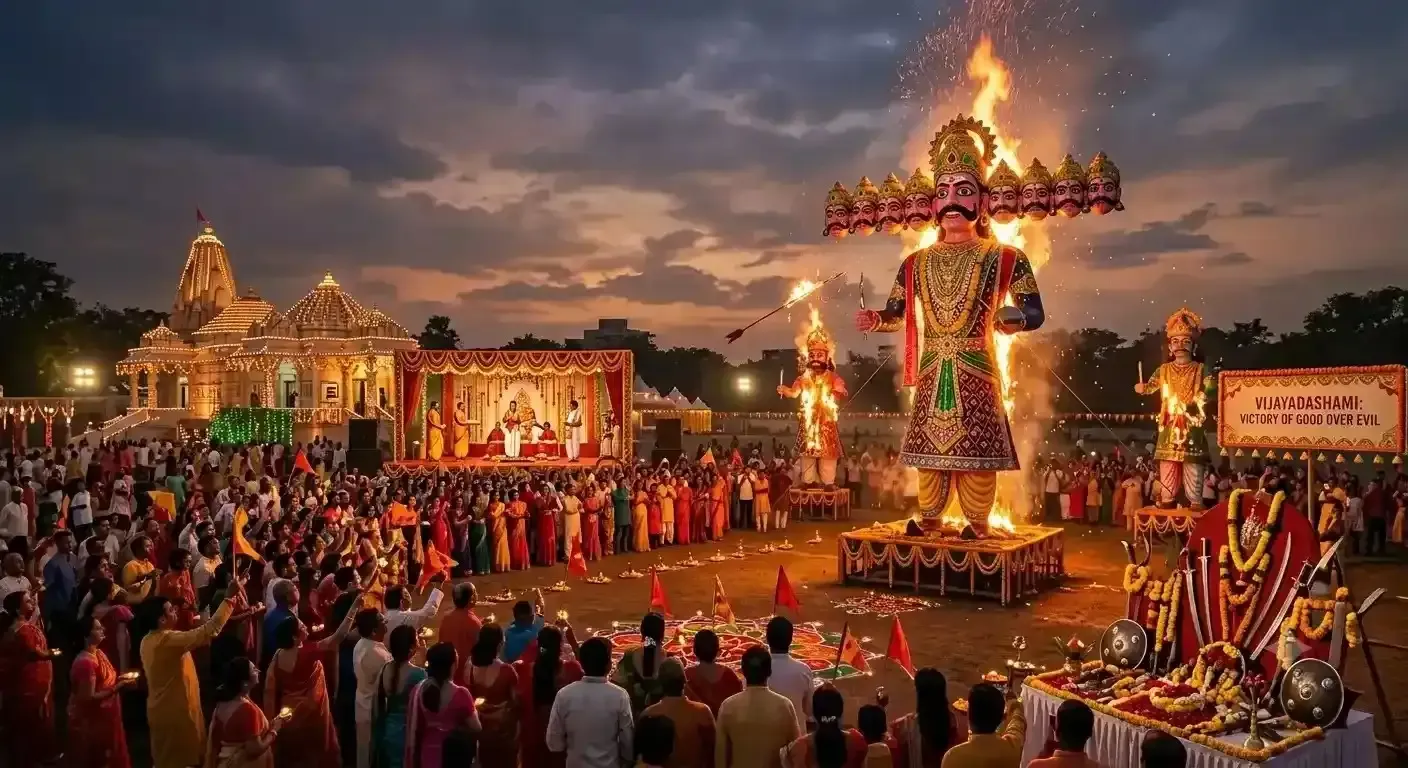
After nine nights comes the tenth day, Vijayadashami, which means "the tenth day of victory". As traditionally told, it celebrates two great victories: Goddess Durga's win over Mahishasura, and Prince Rama's win over the ten-headed king Ravana. For the tenth night, read our two gentle read-aloud versions in Dussehra story for kids: Rama and Ravana, Durga and Mahishasura. In South India, many children also begin a new subject or write their first letters on this day; for the meaning, dates and muhurat, see the Dussehra / Vijayadashami 2026 guide.
Navratri 2026 9-day kids challenge
Print this or copy it onto a chart. One small challenge each day; tick it off after the story.
| Day | Devi | Challenge |
|---|---|---|
| Day 1 (Sun 11 Oct) | Shailaputri | Make a pillow mountain and a paper flower for the altar |
| Day 2 (Mon 12 Oct) | Brahmacharini | Choose one thing to practise for 9 days, and do it today |
| Day 3 (Tue 13 Oct) | Chandraghanta | Ring the bell at aarti and name one brave thing you did |
| Day 4 (Wed 14 Oct) | Kushmanda | Draw a smiling sun; smile at three people |
| Day 5 (Thu 15 Oct) | Skandamata | Hug a parent or grandparent and ask for a story from when you were little |
| Day 6 (Fri 16 Oct) | Katyayani | Stand up kindly for a friend, or make a paper sword of courage |
| Day 7 (Sat 17 Oct) | Kalaratri | Help light the evening diya, only with an adult holding the match |
| Day 8 (Sun 18 Oct) | Mahagauri | Tidy your room or the puja corner without being asked |
| Day 9 (Mon 19 Oct) | Siddhidatri | Write a thank-you note to a teacher, friend or family member |
| Day 10 (Tue 20 Oct) | Vijayadashami | Say goodbye to one bad habit and pick one good habit for the year |
Safety first: children should never light lamps, candles or incense on their own. Battery tea-lights suit little ones and flats with sensitive smoke alarms.
A simple name mantra to say together
Some families have children say the day's short name mantra after the story. Here is Day 1 (Shailaputri); each night the Devi's name changes, as listed on the day pages.
ॐ देवी शैलपुत्र्यै नमः॥
Om Devi Shailaputryai Namah
It means "Salutations to Goddess Shailaputri."
Tips for parents (in India and abroad)
- Keep it short, and let children ask questions afterwards rather than adding detail.
- Before each new story, ask them to retell yesterday's. It helps them remember all nine forms.
- Go gently with fierce forms: for Kalaratri, focus on protection and clever problem-solving.
- Abroad, match the story nights to your local temple's calendar.
- For age-by-age advice, see Explaining Navratri and Dussehra to children: a parent's guide, and for crafts and games try fun Navratri activities for kids and Dussehra activities for kids: crafts and quiz.
Also read: Navadurga mantras for all nine days.
Frequently asked questions
What are the nine forms of Durga for kids?
The Navadurga are Shailaputri, Brahmacharini, Chandraghanta, Kushmanda, Skandamata, Katyayani, Kalaratri, Mahagauri and Siddhidatri, honoured one per night in that order. A simple explanation: they are nine faces of the same loving Mother Goddess, each showing a different quality, such as patience, courage or kindness.
When is Navratri 2026 and which story goes on which night?
In India, Navratri 2026 runs from Sunday 11 October (Day 1, Shailaputri) to Monday 19 October (Day 9, Siddhidatri), per Drik Panchang. Durga Ashtami and Maha Navami both fall on Monday 19 October, and Dussehra is Tuesday 20 October.
Is the Kalaratri story too scary for young children?
It does not have to be. Devotees also call Kalaratri Shubhankari, the one who brings good. Our version leaves out battle details and focuses on protection and a clever solution. For a sensitive child, tell just the first and last paragraphs.
Are these stories from scripture?
They are simplified retellings as traditionally told in temples and families, drawing on the Puranic and Devi Mahatmya traditions. Details differ between regions, and some, such as the Chandraghanta wedding story, are popular tellings rather than fixed texts. The lessons are HinduTone's own simple lessons.
We live abroad. Do we follow the India dates?
Follow your local temple's Navratri calendar. Dates can differ by a day outside India; for example, Drik Panchang lists Durga Ashtami on Sunday 18 October in the USA, Canada and the UK.
Editor's note (8 October 2026)
We wrote these stories in October 2026 for children aged roughly 5 to 11. They are simplified retellings as traditionally told, and details vary between regions. Where a story is one popular telling among several, we have said so. The lessons are HinduTone's simple lessons. Dates follow Drik Panchang for India.
Related guides
- Dussehra story for kids: Rama and Ravana, Durga and Mahishasura
- Dussehra activities for kids: crafts and quiz
- Navratri vs Durga Puja vs Dussehra: the differences explained
- Navratri 2026 colours: the 9-day list
- The story of Goddess Durga and Mahishasura
- Dussehra / Vijayadashami 2026: date, muhurat and meaning
You might also like
Diwali Stories for Kids: One Story Every Night for the 5 Days of Diwali (2026)
Dussehra Story for Kids: Rama and Ravana, Durga and Mahishasura (Read-Aloud Versions)
Ten Heads of Ravana: Meaning, Stories and Interpretations Explained