Navratri in the UK: How Gujaratis & South Indians Celebrate Abroad
Published on HinduTone.com | Festival & Culture "When the dhol beats in Leicester or London, it doesn't matter that it's raining outside — for those nine…
Published on HinduTone.com | Festival & Culture "When the dhol beats in Leicester or London, it doesn't matter that it's raining outside — for those nine…
Published on HinduTone.com | Festival & Culture
"When the dhol beats in Leicester or London, it doesn't matter that it's raining outside — for those nine nights, we are home." — Priya Shah, Gujarati community organiser, Birmingham
Introduction: Nine Nights, One Diaspora, Many Traditions
Every autumn, as the British sky turns grey and the leaves begin to fall, something extraordinary happens in Leicester, Harrow, Wembley, Birmingham, and dozens of other cities across the UK. Tens of thousands of British Hindus transform community halls, temple grounds, and open parks into blazing celebrations of Navratri — one of Hinduism's most beloved and electrifying festivals.
But here is what makes the UK's Navratri uniquely fascinating: this is not one celebration. It is two. Sometimes side by side. Sometimes intertwined. Sometimes in the same family.
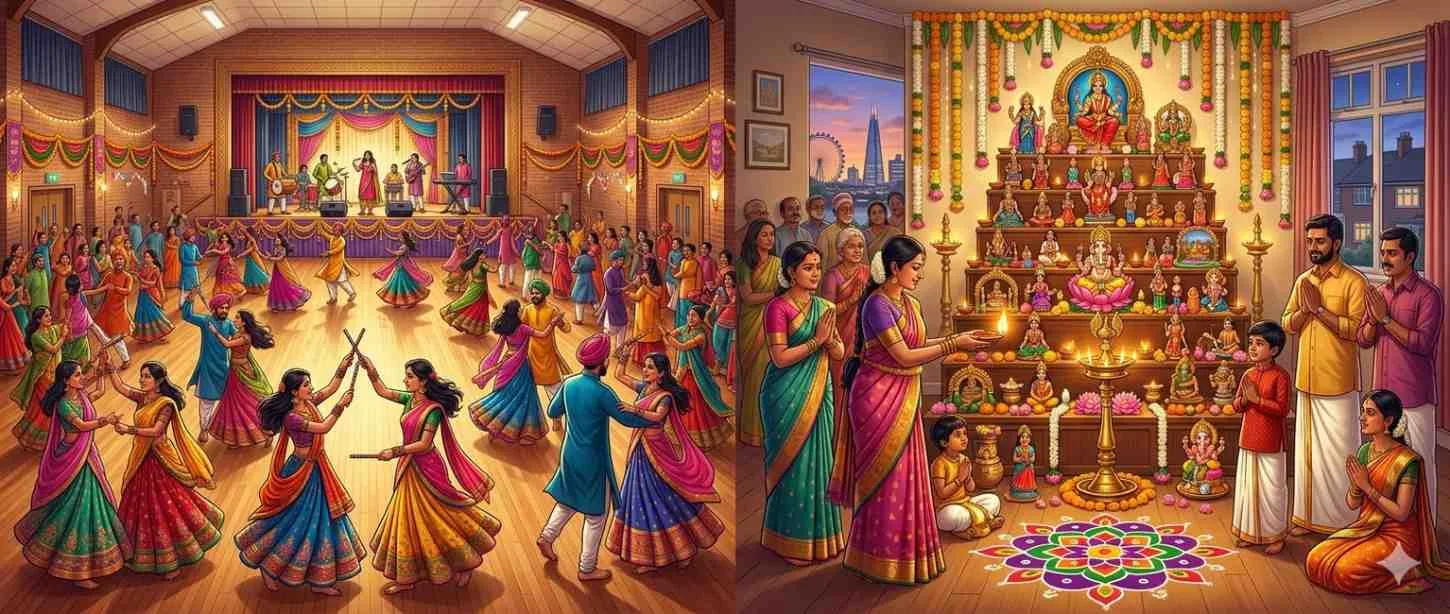
Gujaratis — predominantly from Gujarat and East Africa — bring the thunder of Garba and Dandiya Raas. South Indians — Tamil, Telugu, Kannada, and Malayalam communities — honour the festival through Golu (the sacred doll display), Saraswati Puja, and Vijaya Dasami prayers. Both traditions trace back to the same nine sacred nights honouring the Divine Mother, Goddess Durga. Yet they look, sound, taste, and feel entirely different.
This article explores both — from first-hand community experiences to the logistics of celebrating a monsoon-season festival in a country where October is decidedly not monsoon season.
Part One: The Gujarati Celebration — Garba, Glamour & the Global Stage
What Is Garba?
Garba is a circular folk dance originating from Gujarat, performed around an earthen lamp or image of the Goddess Amba (a form of Durga). The word garba derives from the Sanskrit garbha deep — a clay lamp with holes, representing life emerging from within. The dance is devotional at its core, though it has evolved into a spectacular cultural performance.
Dandiya Raas is performed alongside Garba on certain nights — a stick dance symbolising the mock battle between Goddess Durga and the demon Mahishasura.
How It Started in the UK
The Gujarati diaspora in the UK is one of the most organised and culturally active communities in the country. Many arrived as East African expats in the 1960s and 1970s — Gujaratis who had first migrated to Kenya, Uganda, and Tanzania during the colonial era, and then resettled in Britain after Idi Amin's expulsion in 1972.
They brought Navratri with them. What began as small gatherings in rented church halls became, within decades, some of the largest Garba events outside India.
The Scale of UK Garba Today
Today, UK Garba has grown into a major cultural industry:
- Leicester's Navratri at the Aadhar Navratri festival attracts over 30,000 attendees across nine nights, making it one of Europe's largest Garba events.
- London's Shree Swaminarayan Temple in Neasden hosts nightly Garba open to thousands.
- Wembley SSE Arena, Birmingham NEC, and ExCeL London have all hosted ticketed Garba events drawing over 10,000 people in a single night.
- Commercial Garba events now feature Bollywood celebrities, live dhol players flown in from Gujarat, and lighting rigs rivalling concert productions.
The Dress: Chaniya Choli as Cultural Expression
One of the most visible aspects of UK Garba is the extraordinary effort that goes into dress. Women wear chaniya choli — a three-piece ensemble of flared skirt (chaniya), blouse (choli), and dupatta — often embroidered with mirrors, beads, or bandhani (tie-dye) work. Men wear kediyu (a pleated top) and dhoti or churidar.
In the UK, the fashion industry around Navratri is booming:
- Boutiques in Leicester's Golden Mile and Wembley High Road stock thousands of chaniya cholis in the lead-up to Navratri.
- Many families commission custom outfits from Gujarat or purchase from UK designers who specialise in diaspora fashion.
- Social media influencers document their nine different outfits for nine nights — a tradition called navrang (nine colours).
Community Voice: "I've been going to Garba in Leicester since I was four years old. My mum would stitch my chaniya choli herself. Now I buy from a boutique in Belgrave Road, but the feeling when I step onto the floor — that is exactly the same." — Heena Patel, 34, Leicester
The Music: Dhol, Synthesiser & Remix Culture
Traditional Garba is sung to raas garbas — devotional folk songs in Gujarati praising Goddess Amba. In the UK, this tradition has fused with Bollywood, electronic music, and bhangra influences.
The evolution of UK Garba music reflects the diaspora's dual identity:
Artists like Hemant Chauhan, Kirtidan Gadhvi, and UK-based performers have enormous followings in the British Gujarati community.
Navratri Food: Fasting & Feasting
Gujarati Navratri food follows vrat (fasting) rules — many community members fast during the day, abstaining from grains, lentils, and certain vegetables. Evening prasad and post-Garba meals focus on:
- Sabudana khichdi (tapioca pearl pilaf)
- Rajgira puri (amaranth flour flatbreads)
- Makhana (foxnut) curry
- Fruits and dry fruits
- Farali pattice (potato and water chestnut patties)
After Garba ends — often past midnight — many families head to Gujarati restaurants or friends' homes for puri shak, khichdi, or lapsi (wheat pudding).
Part Two: The South Indian Celebration — Golu, Goddess & Scholarly Devotion
A Different Navratri Entirely
Ask a Tamil or Telugu Hindu in the UK what Navratri means to them, and the answer will be strikingly different from their Gujarati neighbour. There is no Garba. There is no Dandiya. Instead, there is quiet artistry, family ritual, scholastic devotion — and an extraordinary tradition called Golu.
What Is Golu?
Golu (also called Bommai Kolu in Tamil, Bommala Koluvu in Telugu) is a display of dolls and figurines arranged on an odd number of stepped shelves — typically 3, 5, 7, 9, or 11 steps — during Navratri.
The word kolu means "royal court" or "assembly," and the display indeed resembles a divine court: at the top are Goddess Durga (and her forms — Lakshmi, Saraswati), followed by gods, saints, folk figures, mythological scenes, and miniature everyday life tableaux — farmers, dancers, village scenes.
Each family's Golu is unique. It tells their story, their heritage, their aesthetic sensibility. Golu figures are passed down through generations — grandmother's clay dolls sit beside recently purchased ones from Chennai Silks. Some British South Indian families own Golu collections spanning 50 to 100 years.
Golu in UK Homes: Adapting a Sacred Tradition
Setting up Golu in a UK home presents practical challenges — and creative solutions:
Space constraints: British terraced houses and flats have limited space. Many families use staircase landings, bay window alcoves, or purpose-built wooden padi (steps). Compact Golu setups of 3 or 5 steps are most common.
Sourcing figures: Golu dolls are sourced from:
- Visits to India (many families "shop for Golu" during summer trips to Chennai, Hyderabad, or Bengaluru)
- Indian grocery shops in Tooting, Southall, and Wembley that stock Golu figures seasonally
- Online stores — including Indian e-commerce platforms with international shipping
- Community WhatsApp groups where families buy, sell, and gift figures
The mariyaadai (etiquette): Homes with Golu are open to visitors throughout Navratri. Women and children are welcomed, offered prasad (usually sundal — a spiced legume dish, different each day), kumkum (vermilion), tamboolam (a small gift parcel of coconuts, turmeric, fruits, and bangles), and haldi-kumkum.
Community Voice: "Golu is how I stayed connected to my ammamma . She would arrange her Golu in Mylapore with such care. Now I do it in my living room in Tooting, and when my daughters help me set it up, I feel her with us. It's not a big event like Garba — it's quiet, but it goes very deep." — Kavitha Krishnaswamy, 47, London
The Nine Days: Different Goddesses, Different Offerings
South Indian Navratri divides the nine nights into three triads, each devoted to one aspect of the Divine Mother:
Saraswati Puja: The Day Learning Stops
The eighth day of Navratri — Saraswati Puja (also called Ashtami) — holds special significance in South Indian tradition. On this day, books, musical instruments, tools, and vehicles are placed before the Goddess Saraswati for her blessings.
Students do not study. Artisans do not work. The idea is that all knowledge and craft belong to Saraswati, and one day each year, they are surrendered back to her.
In the UK, this translates to beautiful home rituals:
- Children's school bags, textbooks, and musical instruments are arranged before the Golu
- Professional tools — stethoscopes, laptops, drawing tablets — are blessed
- Vidyarambham (initiation of learning) ceremonies are performed for young children
Vijaya Dasami: The Day of New Beginnings
The tenth day — Vijaya Dasami (Dussehra) — marks the culmination. In South Indian tradition, this is an auspicious day to:
- Begin learning a new instrument, language, or skill
- Enrol children in their first music or dance class
- Sign business contracts and start new ventures
- Dismantle the Golu with prayers, and carefully pack away the dolls for next year
Many British South Indian families use Vijaya Dasami to enrol their children in Carnatic music or Bharatanatyam classes — continuing arts education traditions they carried from India.
Sundal: The Sacred Food of Golu
Every day of Navratri, homes with Golu prepare sundal — a dry, spiced preparation of legumes, offered first as neivedhyam (offering to God) and then distributed to visitors. A different legume is used each day:
Part Three: Where the Two Traditions Meet
Shared Roots, Different Flowers
Both traditions spring from the same theological soil: the worship of Shakti — the Divine Mother in her many forms. Durga as destroyer of evil. Lakshmi as bestower of abundance. Saraswati as goddess of knowledge. Adi Shakti — the primordial feminine energy — is at the centre of both.
Yet the regional expressions evolved in almost entirely different directions. This is one of Hinduism's greatest gifts — its capacity to hold vast diversity within a unified spiritual framework.
Multicultural Hindu Families in the UK
The British Hindu community is increasingly multicultural — marriages between Gujarati and Tamil families, between North and South Indians, between different castes and communities, are more common than ever before. This means:
- A family in Harrow may celebrate both Garba and Golu
- Children navigate between chaniya choli one night and sundal the next
- Grandparents from Ahmedabad Skype with grandparents from Chennai, both blessing the same grandchildren through different rituals
- WhatsApp family groups bubble with photos of Golu setups AND Garba outfits simultaneously
Community Voice: "My husband is Gujarati and I'm Tamil. For Navratri, we do Golu for nine days at home — my tradition — and attend Garba on the weekend — his tradition. Our children genuinely don't understand why anyone would choose only one." — Deepa Menon-Shah, 38, Harrow
Key UK Venues & Community Hubs
Gujarati Garba:
- Shree Swaminarayan Temple, Neasden, London
- Shree Jalaram Prarthana Mandal, Wembley
- Navratri Festival Leicester (NFAL), Aadhar events
- Shree Hindu Temple, Birmingham
- Swaminarayan Gurukul, Ahmedabad London (Kingsbury)
South Indian Navratri / Golu Events:
- Sri Kanaga Thurkkai Amman Temple, East Ham, London
- Murugan Temple, Manor Park, London
- Tamil Sangam UK (various locations)
- Sri Venkateswara (Balaji) Temple, Tividale, West Midlands
- Arulmigu Murugan Thirukkoil, Tooting
Part Four: The Experience of Celebrating Abroad
What the UK Gets Right
Celebrating Navratri abroad is not a compromise. In many ways, the diaspora has developed something extraordinary — a supercharged, community-forged version of the festival, sharpened by distance and devotion.
Community cohesion: In India, people celebrate in their streets and neighbourhoods. In the UK, the festival becomes a reason to gather across distance — families drive hours to attend the "right" Garba or the most beautiful Golu. The effort makes it more precious.
Intergenerational transmission: British-born Hindu children learn their culture through active participation rather than osmosis. The festival becomes a conscious choice — not just a backdrop — and that intentionality can deepen the connection.
Innovation: UK Garba has pioneered production values that are now exported back to Gujarat. London-based chaniya choli designers influence fashion in Ahmedabad. UK-produced Garba remixes top charts in India.
What Is Lost — And What Communities Do About It
Distance and the British climate present genuine challenges:
- No monsoon freshness. Navratri in Gujarat arrives after the monsoon — the air is clean, the earth is alive. In the UK, it is cold, rainy, and autumnal. Temple courtyards become heated community halls.
- No neighbourhood immersion. The festival cannot spill into streets. It must be contained, ticketed, scheduled.
- Language drift. Second and third-generation British Hindus may not speak Gujarati or Tamil fluently. Devotional songs lose some of their meaning. Communities run garba geet classes and Tamil cultural programmes to address this.
- Commercialisation tension. As UK Garba scales up, some community members feel the devotional spirit is overwhelmed by spectacle. Smaller temple-based events have seen renewed popularity as an alternative to arena Garba.
Technology as Bridge
British Hindu families have used technology to maintain festival connections:
- Live-streaming Garba for elderly relatives in Gujarat or South Africa
- Zoom Golu tours shared on WhatsApp with family in Chennai
- YouTube tutorials for setting up Golu or learning Garba steps
- Instagram Navratri communities where diaspora Hindus share their setups worldwide
- Online prasad ordering — some UK temples offer doorstep Navratri prasad delivery
Navratri Across UK Cities: A Quick Guide
The Deeper Meaning: Why Navratri Matters in the Diaspora
For Hindus in the UK, Navratri is not just a festival. It is an anchor.
It is proof that culture survives transplanting. That devotion does not require a particular latitude or a particular landscape. That a clay doll placed on a step in a Tooting flat carries exactly the same blessing as one placed in a Chennai home. That the circle of Garba can be drawn anywhere — in a Leicester arena, in a Birmingham car park, in a school gymnasium — and still be sacred.
There is also something profound about the dual nature of Navratri's UK celebration. The Gujarati community's Garba — joyful, exuberant, social — and the South Indian community's Golu — intimate, artistic, devotional — together represent the full spectrum of how humans relate to the divine: through dance and through stillness, through sound and through silence, through community and through family.
Neither is more Hindu than the other. Both are completely Hindu.
Practical Guide: Celebrating or Attending Navratri in the UK
For First-Time Garba Attendees
- Dress code is important. Most events request traditional Indian attire. Hiring or borrowing a chaniya choli/kediyu is perfectly acceptable.
- Arrive early. Major Garba events in Leicester and London fill up fast. Book tickets in advance.
- Learn basic Garba steps. YouTube has excellent beginner tutorials — even knowing one or two steps helps you join the circle.
- Don't just watch. The circular format of Garba is inclusive by design. Join in.
For First-Time Golu Visitors
- Visit neighbours or community families who display Golu — most are delighted to welcome visitors.
- Accept prasad and tamboolam graciously — this is central to the tradition.
- Ask about the figures. Golu owners love to explain their collection's history.
- Take off shoes before approaching the Golu.
How to Find Events Near You
- Gujarati Garba: Check local BAPS Swaminarayan, Swaminarayan Sanstha, or Shree Hindu Temple websites; search Facebook groups for "Navratri Garba "
- South Indian events: Contact local Tamil or Telugu cultural associations; check Sri Kanaga Thurkkai Amman Temple (East Ham) or Murugan Temple (Manor Park) event listings
Conclusion: The Festival as Living Tradition
Navratri in the UK is one of the most compelling examples of how tradition evolves without losing its soul. The festival has been adapted, amplified, and sometimes reinvented — but the Goddess at its centre remains unchanged. Whether she is invoked through the thunder of a thousand feet in a Leicester arena or the soft scent of camphor before a clay doll in a Tooting living room, Shakti — the divine feminine power — is present.
For Gujaratis and South Indians alike, Navratri in Britain is not a lesser version of the "real" festival back home. It is its own thing — shaped by migration, memory, community, and devotion. It is proof that the divine travels well.
Jai Mata Di.
Also read: Garba 2026 events in the UK.
Frequently Asked Questions
Q: When is Navratri 2025 in the UK? Navratri 2025 falls between 2–11 October, with Vijaya Dasami (Dussehra) on 2 October. Major UK Garba events will be concentrated in the weekends of 4–5 October and 11–12 October.
Q: Can non-Hindus attend Garba events? Absolutely. Most UK Garba events are open to all. Many non-Hindu British residents attend annually and are warmly welcomed.
Q: Do I need to know how to dance to enjoy Garba? No. But most people find themselves dancing within twenty minutes. The circular format and repetitive steps are designed to be learnt on the floor.
Q: Is Golu only for South Indians? Golu is predominantly a South Indian tradition (Tamil, Telugu, Kannada). Some North Indian families celebrate a version called Ashtami Ka Kolu, but it is distinct.
Q: Where can I buy chaniya choli in the UK? Leicester's Belgrave Road ("the Golden Mile"), Wembley High Road, Southall Broadway, and East Ham High Street North all have boutiques that stock chaniya choli, especially in the September–October period.
Written for HinduTone.com — Celebrating the living traditions of the global Hindu community.
Tags: Navratri UK, Gujarati Garba UK, Golu UK, South Indian Navratri, British Hindu festivals, Dandiya Raas UK, Navratri Leicester, Hindu diaspora UK, Navratri 2025, chaniya choli UK
© HinduTone.com — For republication permissions, contact editorial@hindutone.com
You might also like
Navratri Aarti Lyrics in Hindi & English – 2026 Special Collection for NRIs
Navratri 2026: Complete Guide to the Nine Days of Worship, Dates, Colors, Goddesses & Rituals
Dussehra 2026 (Vijayadashami) in New York, USA f