

Raksha Bandhan Around the World: How 15 Countries and Every Indian Region Celebrate
The fullest picture of how Raksha Bandhan is actually celebrated — first across India under its many regional names, then across the world from Nepal's Janai Purnima to Mauritius, the Caribbean, the Gulf and the diaspora.
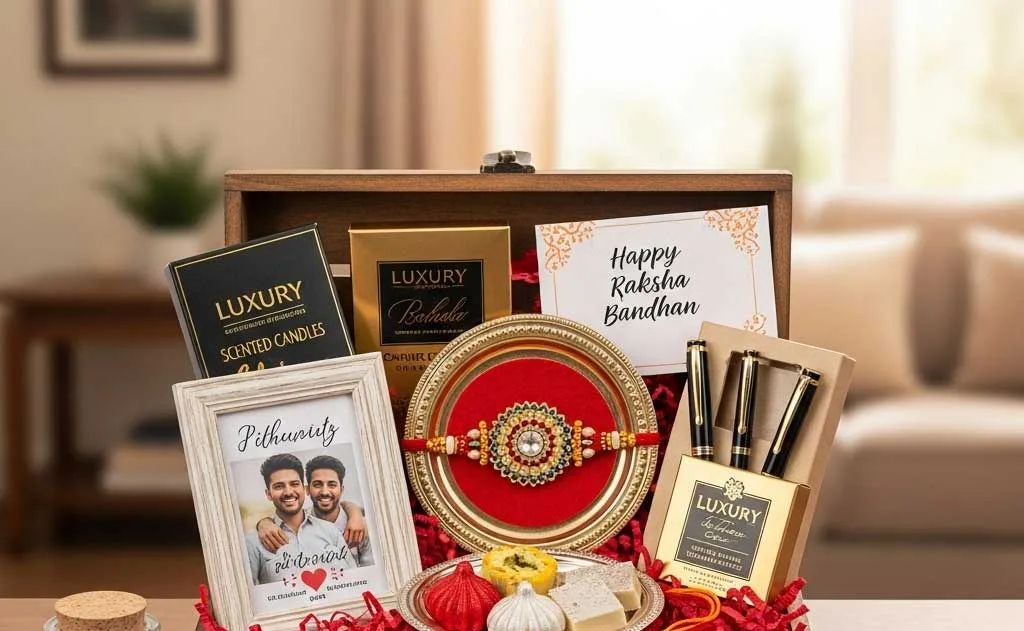
The fullest picture of how Raksha Bandhan is actually celebrated — first across India under its many regional names, then across the world from Nepal's Janai Purnima to Mauritius, the Caribbean, the Gulf and the diaspora.
Quick answer: Raksha Bandhan is observed across India and Nepal and by Hindu communities worldwide — most prominently in Nepal, Mauritius, Fiji, Trinidad and Tobago, Guyana, Suriname, the United States, the United Kingdom, Canada, Australia, the UAE, Singapore, Malaysia, South Africa and New Zealand. In 2026 it falls on Friday, 28 August in India, Nepal, the Gulf, Southeast Asia and Australia; in the UK, Europe and North America local panchangas generally place it on Thursday, 27 August, because the Purnima Tithi ends before those regions' sunrise on the 28th.
On the same full moon, a fisherman in Konkan offers a coconut to the sea. A Newar family in Kathmandu shares a soup of nine sprouted beans. A Brahmin in Madurai renews his sacred thread. A grandmother in Port Louis ties a rakhi she has kept in a drawer since June. And in a kitchen in New Jersey, a sister props up a phone at 8 PM so that a ceremony can happen simultaneously in two hemispheres.
They are all observing Shravana Purnima. Almost none of them would recognise each other's version of it. This is the fullest picture of how Raksha Bandhan is actually celebrated — first across India, then across the world.
Quick Answer: Where Is Raksha Bandhan Celebrated?
Raksha Bandhan is observed across India and Nepal, and by Hindu communities worldwide — most prominently in Nepal, Mauritius, Fiji, Trinidad and Tobago, Guyana, Suriname, the United States, the United Kingdom, Canada, Australia, the UAE, Singapore, Malaysia, South Africa and New Zealand.
In 2026 it falls on Friday, 28 August in India, Nepal, the Gulf, Southeast Asia and Australia. In the UK, Europe and North America, local panchangas will generally place it on Thursday, 27 August, because the Purnima Tithi ends before those regions' sunrise on the 28th.
Part One: Across India — One Day, Many Names
Raksha Bandhan is not one festival with regional decorations. In several parts of India it is a genuinely different observance that happens to share a date.
North India: Rakhi in its most familiar form
Uttar Pradesh, Delhi, Punjab, Haryana, Himachal and Bihar celebrate what most of the world pictures: the sister's thali, the tilak, the aarti, the thread on the right wrist, the sweet, the gift. In parts of Haryana and Punjab the day is called Salono, and priests distribute amulets of consecrated thread alongside the family ceremony. In Jammu, the days around Raksha Bandhan bring an unexpected companion tradition — the sky fills with kites, and rooftops become the centre of the celebration.
Rajasthan: the Lumba Rakhi
Marwari and Rajasthani families observe a custom that deserves to be far better known. Alongside the rakhi tied to a brother's wrist, a lumba — a dangling, ornamented rakhi — is tied to the bhabhi's bangle. The logic is quietly profound: a brother's vow of protection is only as good as the household he is part of. Honouring the sister-in-law acknowledges that she is now co-owner of that promise. Few customs anywhere in India do so much relational work with so small an object.
Maharashtra and Konkan: Narali Purnima
Along the western coast, the day belongs to the sea. Narali Purnima — naral meaning coconut — marks the end of the monsoon fishing ban. Koli fishing communities gather at the shore, offer coconuts to Varuna, lord of the waters, and formally reopen the season. Boats are decorated, and the first voyage after the offering is made with ceremony. The kitchen follows the ritual: narali bhaat, sweet coconut rice, is the dish of the day.
Gujarat: Pavitropana
Shravana Purnima closes the month of Shiva, and Gujarat marks it with Pavitropana. Devotees offer a pavitra — a woven thread garland — to the Shiva lingam, a ritual purification that atones for any incompleteness in the month's worship. It is one of the busiest days of the year at Somnath and other major Shiva temples in the state.
Bengal: Jhulan Purnima and Rakhi Purnima
In Bengal the day is Jhulan Purnima, the conclusion of the swing festival in which Radha and Krishna are placed on a decorated jhula and gently rocked amid kirtan. Temples in Kolkata, Mayapur and Vrindavan draw large crowds for the final darshan of the swing. Bengal also carries a second, more recent layer of meaning: in 1905, Rabindranath Tagore turned the rakhi into an instrument of communal unity against the partition of Bengal.
Odisha: Gamha Purnima
Odisha observes Gamha Purnima, associated with the appearance of Lord Balabhadra, Jagannath's elder brother. The connection to a sibling festival is exact and rather beautiful. Cattle are washed, decorated and honoured on this day, and gamha dian — a traditional swing — is set up in villages.
Madhya Pradesh, Chhattisgarh and Eastern UP: Kajari Purnima
Here the day is Kajari Purnima, a farmers' and mothers' observance. Barley is sown in leaf bowls seven days earlier; on Purnima the shoots are offered, and mothers keep a vrat for the wellbeing of their sons. Folk kajari songs — monsoon songs of longing — are sung through the night.
South India: Avani Avittam and Upakarma
In Tamil Nadu, Kerala, Andhra Pradesh, Telangana and Karnataka, Shravana Purnima is primarily Upakarma — known as Avani Avittam in Tamil Nadu and Kerala, and Janivarada Hunnime in Karnataka. Brahmin men perform the annual renewal of the yajnopavita, the sacred thread worn across the chest, with prayaschitta for lapses in daily observance. Gayatri Japam follows the next day.
Historically, the sibling rakhi was not a strong South Indian tradition — Bhai Dooj-type observances took different forms here. Over the past few decades it has spread widely through migration, media and marriage across regions, and is now commonly celebrated in urban South India alongside Upakarma. Both traditions coexist comfortably: one thread across the chest, another on the wrist.
Part Two: Around the World
Nepal: Janai Purnima, and the richest version anywhere
Nepal arguably observes this full moon more elaborately than any country on earth, because three distinct festivals converge on it.
Janai Purnima: Hindu men — particularly of the Brahmin and Chhetri communities — replace the janai, the sacred thread worn across the chest, in a ceremony performed by priests. Thousands undertake a pilgrimage to Gosaikunda, the high-altitude lake in the Langtang region, to bathe before the renewal. Pashupatinath in Kathmandu and Kumbheshwar in Patan are the other major sites.
The doro: priests tie a consecrated coloured thread — the doro — on the wrists of men, women, children and elders alike, cutting across caste and gender. Two details distinguish Nepali practice from Indian: men wear it on the right wrist and women on the left, and the thread is not discarded when it frays. It is kept until Laxmi Puja during Tihar, months later, and then tied to the tail of a cow — in the belief that it will help the soul cross the river Baitarni after death. A thread tied in August is still doing spiritual work in November.
Kwati Purnima / Gunhi Punhi: the Newar community knows the day by food. Kwati is a thick soup of nine sprouted beans — mung, soybean, kidney bean, black gram, black-eyed pea, chickpea, field pea and others — eaten to restore strength after the exhausting labour of rice planting and to fortify the body against monsoon illness. Newar households also coat their thresholds with mud and, in a custom found almost nowhere else, offer food to frogs in the fields as thanks for the rain.
Raksha Bandhan: in the Terai and parts of the hills, the day is observed as Rakhi much as in North India, with sisters tying the thread and brothers pledging protection.
Mauritius: where it is part of the national calendar
With Hindus forming close to half the population, Mauritius observes Raksha Bandhan as a mainstream cultural event rather than a minority one. Celebrations run through Port Louis, Quatre Bornes, Curepipe, Vacoas-Phoenix, Beau Bassin-Rose Hill and Triolet, combining home puja with temple gatherings and community cultural programmes. Mauritian Hindu practice descends largely from Bihari and Bhojpuri indentured labourers who arrived from 1834 onwards, and the rituals preserve North Indian forms with striking fidelity.
Fiji: Girmitiya traditions, kept
Fiji's Indo-Fijian community, descended from the girmitiya indentured labourers, has maintained Raksha Bandhan for over a century. The festival functions there as it does in every diaspora: not merely as an observance, but as an instrument for transmitting identity to a generation that has never seen India. Temples and cultural associations organise collective ceremonies alongside family ones.
Trinidad and Tobago, Guyana, Suriname: the Caribbean thread
This is the least-known chapter of the festival's global story, and among the most remarkable. Between 1845 and 1917, indentured Indians were transported in enormous numbers to the British Caribbean — over 140,000 to Trinidad alone. They arrived with almost nothing and under conditions designed to erase what they carried. Hindu Dharma survived anyway.
Today Hindus form roughly 18% of Trinidad and Tobago, 31% of Guyana and 20% of Suriname. Raksha Bandhan sits within a full ritual calendar — Phagwah, Ram Naumi, Krishna Janmashtami, Ganesh Chaturthi, Kartik Snan — observed across thousands of Caribbean temples.
What survives there is a version of Hindu practice carried out of the United Provinces and the Madras Presidency before Partition, preserved in isolation for a century and a half. For anyone interested in what the tradition looked like before the twentieth century reshaped it, the Caribbean is an archive. The migration continued: large Indo-Caribbean communities now anchor neighbourhoods in New York and Florida, where Raksha Bandhan is celebrated in a third register again.
United Kingdom: temple-scale celebration
The UK has one of the most organised diaspora observances anywhere. Leicester, Wembley, Southall, Harrow, Birmingham and Manchester see temple ceremonies, cultural programmes and rakhi-making workshops for children in the fortnight beforehand. A distinctly British pattern has emerged: because the date rarely falls on a weekend and schools are often mid-term, many families hold the formal ceremony in the morning at home and the community celebration on the nearest Saturday. Two observances, one festival — a sensible adaptation rather than a dilution.
United States and Canada: the postal season
Across North America, BAPS, ISKCON and independent temples host ceremonies, and Indian student and professional associations organise events on university campuses. The defining feature here is logistics: rakhi mailing begins weeks in advance, sisters in India post to brothers in Texas and Toronto, and the reverse.
It is worth knowing that many North American panchangas will place Raksha Bandhan 2026 on Thursday, 27 August, a day earlier than India, because Purnima ends before local sunrise on the 28th. Families frequently celebrate twice — once on the local date, once on the Indian date over video with relatives at home.
The Gulf: UAE, Saudi Arabia, Qatar, Oman, Kuwait, Bahrain
The Gulf hosts one of the largest concentrations of Indians anywhere in the world, and Raksha Bandhan is observed widely in homes, at the temples of Dubai and Abu Dhabi, and through Indian associations and schools. The Gulf's advantage is timing: at just 90 minutes to two hours behind IST, the Indian muhurat lands in the early morning — the 5:57 to 9:48 AM IST window falls at roughly 4:27 to 8:18 AM in the UAE — making a genuinely simultaneous ceremony with family in India straightforward.
Singapore and Malaysia: visible and public
Little India along Serangoon Road in Singapore and the Indian districts of Kuala Lumpur and Penang fill with rakhi stalls in the run-up. Malaysia's large Tamil Hindu population means the day frequently carries an Upakarma emphasis alongside the rakhi, mirroring South Indian practice. Both countries sit within two and a half hours of IST, so ceremonies align comfortably with India.
Australia and New Zealand: ahead of India
Sydney, Melbourne, Brisbane, Perth, Auckland and Wellington all host substantial celebrations through Hindu councils and temple societies. Australia has the happy distinction of celebrating ahead of India: the Indian morning muhurat falls in Australia's mid-morning to early afternoon on the same date, so an Australian family can complete its ceremony and then join the Indian one by video a few hours later.
South Africa: Durban and the 1860 legacy
South Africa's Indian community, concentrated in Durban and dating to the arrival of indentured labourers from 1860, observes Raksha Bandhan through temples and cultural bodies. As in the Caribbean, the traditions preserved here carry a distinctly nineteenth-century North Indian character.
Part Three: Celebrating Across Borders
Which date should a diaspora family follow?
The governing rule is that the tithi should prevail at your local sunrise.
| Region | Likely local date, 2026 |
|---|---|
| India, Nepal, Sri Lanka | Friday, 28 August |
| UAE and the Gulf | Friday, 28 August |
| Singapore, Malaysia | Friday, 28 August |
| Australia, New Zealand | Friday, 28 August |
| UK and Europe | Thursday, 27 August |
| USA and Canada | Thursday, 27 August |
Confirm with your local temple — regional traditions vary, and many families deliberately keep the Indian date so the ceremony is shared live with relatives at home.
Posting a rakhi overseas
- Consecrate it before it leaves. Place the rakhi before your home altar, offer kumkum and akshata, and chant over it. The consecration travels with the thread.
- Post three to four weeks early for international destinations. Courier services running dedicated rakhi routes are faster but book out.
- Declare it as a gift of nominal value. Rakhis are routinely admitted duty-free, but customs delays are the single most common cause of a missed date.
- Include a written line of the vow — not just a card. The words are the ritual; let them arrive with the thread.
Making a video ceremony feel real
Diaspora families often treat the video call as a compromise. It does not have to be.
- Both sides light a diya. Two flames, one ceremony. This does more than anything else to make the ritual feel joined rather than broadcast.
- Chant together, out loud. Sound crosses the connection better than gesture does. The Raksha Sutra mantra chanted in unison across continents is genuinely affecting.
- Have a parent or the sibling themselves tie the posted rakhi at the agreed moment while the sister watches. Temples widely accept this practice.
- Agree the time in advance, in both time zones. More diaspora ceremonies are ruined by a missed slot than by distance.
- Record it. In twenty years it will be the most valuable file on the drive.
Teaching children born abroad
The honest difficulty is that a child raised outside India has no ambient context — no rakhi stalls on the street, no school holiday, no cousins arriving. Everything must be built deliberately.
- Make the rakhi rather than buying it. A child who has threaded beads for an hour has a relationship with the object.
- Tell one story properly — Krishna and Draupadi, or Yamuna and Yama. One story told well outperforms a general explanation of our culture.
- Attend the temple ceremony. Seeing fifty other families do the same thing is the single most effective corrective to a child's sense that their household is odd.
- Extend it beyond blood. A rakhi tied to a school friend of any background makes the festival portable — and is precisely what Tagore argued for in 1905.
Closing Thought
A thread was tied in a village in the United Provinces in 1860. Its descendants are tied today in Durban, in Port Louis, in Suva, in a suburb of Toronto, in a flat in Dubai, on a rooftop in Jammu, at a lakeside at 4,380 metres in the Langtang Himalaya.
None of those people can see each other. All of them are, this Friday, doing the same thing: naming someone they are responsible for, and saying so out loud. That is what has actually travelled. Not the thread — the sentence. Shubh Raksha Bandhan from all of us at Hindutone, wherever in the world you are reading this.
Frequently Asked Questions
Is Raksha Bandhan celebrated outside India?
Yes, widely. It is observed across Nepal, Mauritius, Fiji, Trinidad and Tobago, Guyana, Suriname, the USA, UK, Canada, Australia, New Zealand, the UAE and wider Gulf, Singapore, Malaysia and South Africa.
What is Raksha Bandhan called in Nepal?
Janai Purnima, and among the Newar community Kwati Purnima or Gunhi Punhi. Hindu men renew the sacred janai thread, priests tie the protective doro on wrists, and in the Terai the day is also observed as Rakhi.
Why do some countries celebrate Raksha Bandhan on a different date?
Because the Purnima Tithi is measured against local sunrise. In 2026 the tithi ends at 9:48 AM IST on 28 August, which falls before sunrise in the UK and North America — so those regions' panchangas generally place the festival on 27 August.
What is Raksha Bandhan called in different Indian states?
Narali Purnima in coastal Maharashtra, Pavitropana in Gujarat, Jhulan Purnima and Rakhi Purnima in Bengal, Gamha Purnima in Odisha, Kajari Purnima in Madhya Pradesh and eastern UP, Avani Avittam in Tamil Nadu and Kerala, Janivarada Hunnime in Karnataka, and Salono in parts of Haryana and Punjab.
Is Raksha Bandhan celebrated in South India?
Shravana Purnima in South India is historically observed primarily as Upakarma, the annual renewal of the sacred thread, rather than as a sibling festival. The rakhi tradition has spread widely in recent decades through migration and media, and the two observances now commonly coexist.
Why is Raksha Bandhan important to diaspora communities?
Because it does something no other festival in the calendar does: it obliges contact. A festival that cannot be observed alone forces a call, a package, a journey — which is precisely why it has survived in communities separated from India by generations.
How do Indo-Caribbean communities celebrate Raksha Bandhan?
Much as North India does, through home puja and temple ceremonies. Their traditions descend from indentured labourers who arrived in the nineteenth century, preserving pre-Partition North Indian practice within a full Hindu ritual calendar.
You might also like
Vaikuntha Ekadashi 2026 — Wed 30 December: Vaikuntha Dwaram, Vrat Rules, Gita Jayanti & NRI Guide
Guru Nanak Jayanti 2026 — Wed 25 November: 557th Prakash Utsav, Gurpurab Celebrations, Langar & NRI Guide
Ganesh Mandapam Permission for Illinois 2026: Temporary Pavilions, Festival Permits & Permanent Temple Construction