Sawan Somwar 2026: 4 Mondays, Vrat Vidhi & Mantras | HinduTone
Sawan 2026 begins 30 July (Purnimanta). All four Sawan Somwar Monday dates, the complete vrat vidhi, the Shiva mantras and top NRI Shiva temples.
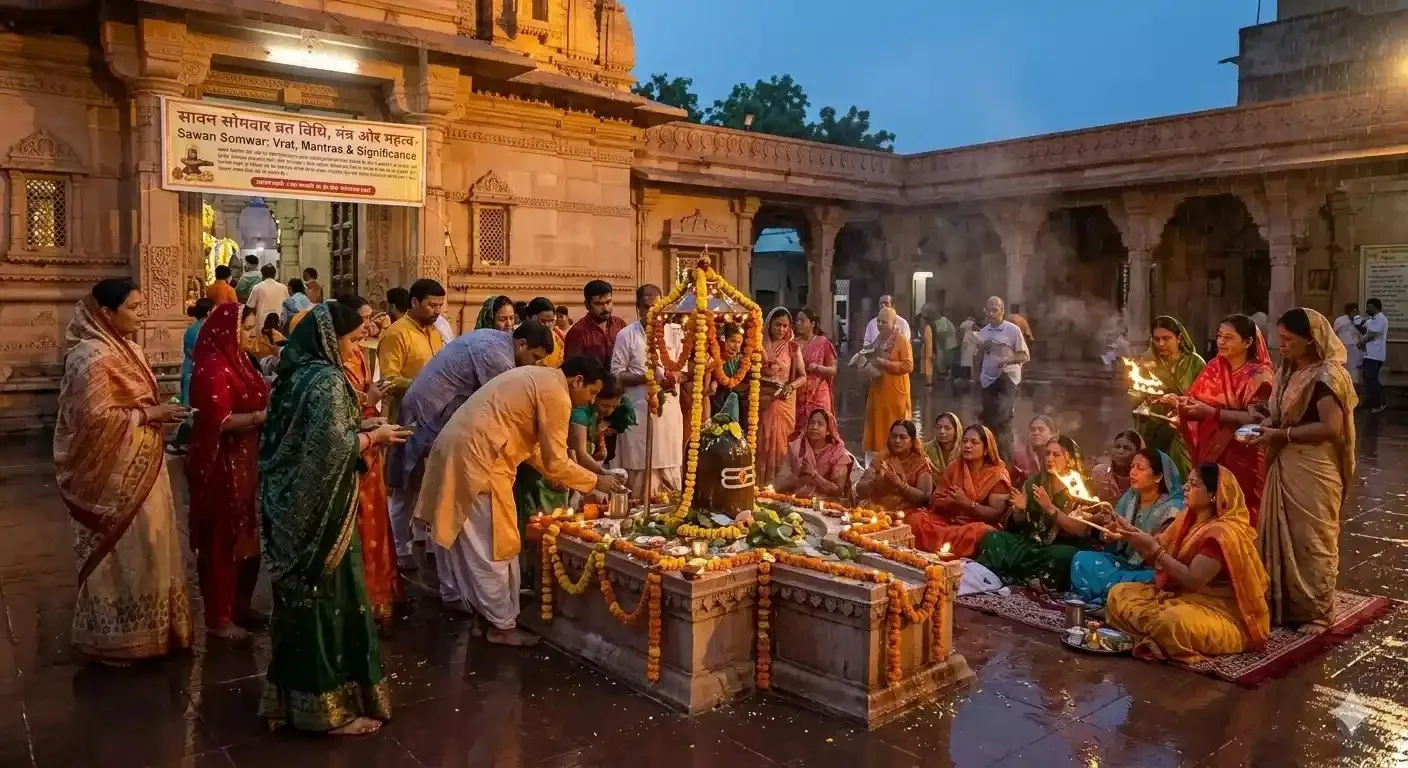
Shravan begins on Thursday, 30 July 2026 in the Purnimanta tradition followed across North India and most NRI households — and with it, the four most spiritually-charged Mondays of the Hindu year. Whether you live in Hyderabad or Houston, Sawan Somwar 2026 lands on 3, 10, 17 and 24 August. South-Indian and Maharashtrian devotees who follow the Amanta calendar observe Sawan a fortnight later (17 August – 7 September). This guide gives you the verified dates from Drik Panchang, the complete vrat vidhi, the Sanskrit mantras with transliteration and meaning, and the closest Shiva temples for NRI devotees worldwide.
Reviewed for date accuracy and ritual procedure by Sreekanth Bathalapalli, Founder, HinduTone — based on Drik Panchang published Panchang for 2026 and the Shiva Purana, Vidyeshvara-samhita.
Sawan Somwar 2026: All Four Monday Dates
Sawan Somwar dates differ by 14–15 days depending on the lunar-calendar tradition you follow. Both versions are correct for their respective regions — what matters is consistency with your family acharya. The dates below match the Drik Panchang Panchang published for 2026.
Purnimanta tradition (North India, most NRI diaspora)
- Shravan begins: Thursday, 30 July 2026
- 1st Sawan Somwar: Monday, 3 August 2026
- 2nd Sawan Somwar: Monday, 10 August 2026
- 3rd Sawan Somwar: Monday, 17 August 2026
- 4th Sawan Somwar: Monday, 24 August 2026
- Shravan Purnima (Raksha Bandhan): Friday, 28 August 2026
Followed in: Uttar Pradesh, Bihar, Jharkhand, Madhya Pradesh, Rajasthan, Haryana, Punjab, Himachal, Uttarakhand, Delhi, Chhattisgarh — and by the bulk of NRI households across the United States, United Kingdom, Canada, the Gulf and Australia whose roots are in those states.
Amanta tradition (South & West India)
- Shravan begins: Thursday, 13 August 2026
- 1st Sawan Somwar: Monday, 17 August 2026
- 2nd Sawan Somwar: Monday, 24 August 2026
- 3rd Sawan Somwar: Monday, 31 August 2026
- 4th Sawan Somwar: Monday, 7 September 2026
- Shravan ends: Friday, 11 September 2026
Followed in: Maharashtra, Gujarat, Karnataka, Andhra Pradesh, Telangana, Tamil Nadu, Kerala and Goa — and by Telugu/Kannada/Marathi/Gujarati NRI families everywhere.
Important content note: 2026 is a late-Sawan year. A lot of older articles on the open web still parrot the 2025 pattern of "Sawan starts mid-July." For 2026 the verified Purnimanta start is 30 July, not the 12th, 14th or 21st — figures that show up if you only check stale pages.
What Is Sawan Somwar — and Why Mondays?
Shravan (Sawan in Hindi) is the fifth lunar month of the Hindu calendar and is considered the most beloved of all months by Lord Shiva. Each Monday, or Somwar, that falls within Shravan is treated as a special vrat day — a day of fasting, simplified eating, mantra recitation and abhishekam at a Shiva temple.
Two threads weave the tradition together. First: the Samudra Manthan — the churning of the cosmic ocean by the devas and asuras described in the Bhagavata Purana and Vishnu Purana. When the deadly Halahala poison rose to the surface, Shiva drank it to save creation. The poison did not kill him but turned his throat blue (hence Nilakantha). The devas then poured cooling water over Shiva for the entire month of Shravan to soothe him — and that is why we offer water, milk and bilva leaves on Sawan Somwar to this day.
Second: the Shiva Purana, Vidyeshvara-samhita explicitly recommends Monday vrat in Shravan for unmarried girls seeking a good husband, married couples seeking harmony, and for students seeking discipline. The same scripture lists Mondays in Shravan as agni-tulya — equal to fire — for burning away accumulated karma when the vrat is observed with sincerity.
Sawan Somwar Vrat Vidhi — Step-by-Step
A complete Sawan Somwar vrat has six parts. Follow them in order on each of the four Mondays.
1. Sankalpa — the morning resolve
Wake before sunrise on Monday. Bathe (a head-bath if practical), wear clean clothes — preferably white or saffron. Sit facing east in front of your home shrine. Take a small spoon of water in your right palm and resolve aloud: "Adya brahmaṇo dvitīya-parārdhe… Ahaṃ Śravaṇa-māsiya prathamam (dvitīyam, tṛtīyam, caturtham) Somavāra-vratam ārabhe." — On this date in this lunar half-year, I begin the first (or second, third, fourth) Sawan Somwar vrat. Pour the water onto a tulasi plant or copper vessel. The intention is what binds the day; the rest is its outward form.
2. Pratah Smarana — invocation of Shiva
Light a single ghee lamp before any image of Shiva — a Shivalinga, a Nataraja icon, or a printed image is acceptable. Offer akshata (whole rice grains tinted with turmeric), one bilva leaf if available, and a cup of cold water. Recite the Panchakshari five times:
ॐ नमः शिवाय Oṃ Namaḥ Śivāya — Salutation to the auspicious one.
3. Upavasa — the fast
Two formats are accepted in shastra and both earn the punya of the vrat:
- Phalahara (fruit-based): fruits, milk, yoghurt, dry fruits, sabudana, makhana, rock salt only. Permitted at any hour after sunrise.
- Nirjala (water-only): nothing but water from sunrise to the next morning. Recommended for the able-bodied; not for the very young, the elderly, the pregnant or the ill.
Whichever format you choose, the fast is broken the next morning (Tuesday) after another bath, with a simple meal. Never break a Sawan vrat with onion, garlic, alcohol, meat, eggs or any rajasic food on the same day.
4. Abhishekam — the bath of Shiva
The heart of the day. Visit your nearest Shiva temple between roughly 6 a.m. and 11 a.m. (the period sastra calls mukhya-abhisheka-kala). Carry:
- Pure water — ideally Ganga jal, otherwise filtered water from home
- Cow milk — unboiled, in a small steel or copper vessel
- Bilva (bel) leaves — a triplet of three leaves, no torn or worm-eaten ones
- White flowers — datura, mogra or kaner. Avoid kewra and ketaki, which the Shiva Purana explicitly forbids
- Bhasma (sacred ash) and chandan (sandalwood paste)
- Dhoop, deepa, naivedyam — incense, lamp, a small fruit offering
Pour the water on the linga first, then the milk, place the bilva leaves smooth-side down on the linga while reciting the Mahamrityunjaya, then offer flowers and bhasma. Conclude with three full pradakshina (circumambulation) of the temple, leaving from where you entered.
5. Mantra-japa — recitation count
At minimum:
- 108 recitations of Om Namah Shivaya on a rudraksha mala, OR
- 11 recitations of the Mahamrityunjaya Mantra (text below), OR
- the full Shiva Tandava Stotram once, if you know it.
6. Katha and Aarti
In the evening, read or hear the Sawan Somwar Vrat Katha — the story of the merchant Suchitra who recovers his fortune by observing sixteen Mondays of fasting. Conclude with the Shiva Aarti (Om Jai Shiv Omkara) and a final pradakshina around your home shrine. The day is complete.
The Mantras to Chant on Each Sawan Somwar
Keep these printed in front of you. The Sanskrit is intentional — recite the Devanagari aloud as best you can, and read the meaning in your own language to anchor the bhava.
1. Panchakshari (Five-Syllable) Mantra
ॐ नमः शिवाय
Oṃ Namaḥ Śivāya · Salutation to Shiva, the auspicious one. Recite at least 108 times.
2. Mahamrityunjaya Mantra
ॐ त्र्यम्बकं यजामहे सुगन्धिं पुष्टिवर्धनम् ।
उर्वारुकमिव बन्धनान्मृत्योर्मुक्षीय माऽमृतात् ॥
Oṃ Tryambakaṃ yajāmahe sugandhiṃ puṣṭi-vardhanam | urvārukam-iva bandhanāt mṛtyor-mukṣīya mā’mṛtāt || · We worship the three-eyed one, fragrant, the nourisher of all. Just as the cucumber falls free from its stem when ripe, so may we be released from the bondage of death — but never from immortality. From the Rig Veda, Mandala 7.59.12. Recite eleven times, twenty-one times, or 108 times for serious vrats.
3. Rudra-Gayatri
ॐ तत्पुरुषाय विद्महे महादेवाय धीमहि । तन्नो रुद्रः प्रचोदयात् ॥
Oṃ Tat-puruṣāya vidmahe Mahādevāya dhīmahi | tanno Rudraḥ pracodayāt || · We meditate upon the Supreme Person, on the Great Deva, and may Rudra inspire our intellect. Sourced from the Maha-Narayana Upanishad. Eleven recitations is a beautiful daily addition.
Sawan Somwar Abhishekam — What to Take to the Temple
A devotee can offer Shiva almost anything sincerely; but the Shiva Purana lists specific dravya-s that bring specific phala-s (fruits). The chart below is the practical NRI-friendly version that uses ingredients you can buy in any Indian grocery overseas.
- Water (Jala) — peace, tranquillity, mental clarity
- Cow milk (Dugdha) — long life, family harmony
- Honey (Madhu) — sweet speech, persuasiveness
- Curd (Dadhi) — progeny, healthy lineage
- Sugar / Mishri — happiness, wealth
- Ghee (Ghrita) — spiritual brilliance, victory in disputes
- Bilva leaves — liberation from accumulated sin (the supreme offering)
- Dhatura flower — removal of pride; offered with one’s own ego acknowledged
- Bhasma — detachment from the fear of death
All offerings should be made with bare clean hands — never use a glove, plastic spoon or pre-packaged sachet. Steel or copper vessels only; aluminium is forbidden in shastra for Shiva worship.
What to Eat (and Avoid) During Sawan
Sawan is a sattvic month. Many devotees go vegetarian for the full thirty days, not just the four Mondays. The recommendations below are drawn from the Skanda Purana, Kashi-khanda chapters that describe Sawan as the rishi-month.
Permitted (and encouraged)
- [object Object]
- [object Object]
- [object Object]
- [object Object]
- [object Object]
Avoided strictly
- [object Object]
- [object Object]
- [object Object]
- [object Object]
- [object Object]
- [object Object]
Five Sacred Sawan Mythologies Every Devotee Should Know
1. The drinking of Halahala
At the churning of the milk-ocean, fourteen ratnas emerged — but before any of them, the Halahala poison rose. It threatened to consume every world. Vishnu directed all the devas to Shiva, who held the poison in his throat without swallowing it. Parvati, alarmed, pressed his throat — and the poison stayed there, turning him Nilakantha. The devas then poured Ganga jal over him for the entire month of Shravan to cool the heat. Every drop of water you pour on a Shivalinga during Sawan re-enacts that gratitude.
2. Markandeya and the Mahamrityunjaya
Markandeya, son of the rishi Mrikandu, was destined to die at sixteen. On his sixteenth birthday he embraced a Shivalinga and recited the Mahamrityunjaya mantra. When Yama’s noose fell on the boy it caught the linga as well. Shiva burst from the linga and dispatched Yama. Markandeya became a chiranjivi — one of the seven immortals. The mantra he chanted is the same Mahamrityunjaya you recite on Sawan Somwar.
3. Parvati’s tapasya for Shiva
After Sati immolated herself at Daksha’s yajna, she was reborn as Parvati and resolved to win Shiva as her husband. She undertook severe Sawan-Somwar vrat-s for sixteen consecutive years, fasting in the Himalayas. It is from her tapasya that the tradition of unmarried Hindu girls fasting on Sawan Somwar for a virtuous husband originates — directly cited in the Devi Bhagavatam, Skanda 5.
4. Sage Markandeya teaches Sukracharya
In the Skanda Purana, Markandeya later teaches Sukracharya, guru of the asuras, the Sanjivani Vidya — but only after Sukracharya completes a thousand-year Sawan-Somwar vrat. The episode is the source of the popular belief that long, sustained Sawan vrats unlock secret knowledge as well as worldly boons.
5. Ravana’s offering of his head
Ravana, the most learned of devotees, undertook a thousand-year tapas in Shravan and offered his ten heads — one each year — to the linga at Mount Kailash. After the tenth head Shiva himself appeared, returned all his heads, and granted him the boon that no deva, asura, gandharva or yaksha could kill him. Ravana’s downfall came only because he forgot to ask immunity from a human.
Top Shiva Temples for NRIs to Visit on Sawan Somwar
You do not have to fly to Varanasi or Kashi to perform a meaningful Sawan abhishekam. A vibrant network of authentic Shiva temples now exists across the diaspora — many built in the last twenty years by Indian-American, British-Indian and Australian Hindu communities. Pick the closest, ring ahead to confirm Sawan Somwar timing, and go early.
United States
- BAPS Shri Swaminarayan Mandir, Robbinsville NJ — daily abhishekam slot reserved 7–9 a.m. on every Sawan Somwar
- Hindu Temple of Greater Chicago, Lemont IL — large Shiva linga in the dedicated Shiva shrine, public abhishekam permitted
- Sri Venkateswara Swamy (Balaji) Temple, Pittsburgh PA — book a Rudrabhishekam through the temple’s portal a week ahead
- Malibu Hindu Temple, Calabasas CA — bilva trees on the property; bring your own milk and water
- Hindu Temple of Atlanta, Riverdale GA — Shaiva shrine performs Mondays-only Rudrabhishekam in Sawan
United Kingdom
- BAPS Shri Swaminarayan Mandir, Neasden London — abhishekam 8–10 a.m., bilva leaves provided
- Shri Sanatan Hindu Temple, Wembley — designated Sawan Somwar parikrama at 7 a.m.
- Bharatiya Mandir, Leicester — large Midlands Shiva community gathers each Monday in Sawan
Canada
- BAPS Shri Swaminarayan Mandir, Toronto ON — Rudrabhishekam slot daily; book in advance for Sawan Mondays
- Hindu Temple of Ottawa-Carleton — full bilva-puja kit available at the temple shop
- Vishnu Temple, Richmond Hill ON — Shiva pavilion with public access
Australia
- Sri Venkateswara Temple, Helensburgh NSW — Tirumala-affiliated; runs a special Sawan Rudrabhishekam package
- Shri Shiva Vishnu Temple, Carrum Downs (Melbourne) — central Shiva linga, Sawan Mondays open from 7 a.m.
- Sri Karpaga Vinayaga Temple, Helensburgh NSW — performs combined Ganesh-Shiva puja on Sawan Mondays
UAE, Singapore, New Zealand
- Hindu Temple, Bur Dubai (UAE) — the oldest Hindu temple in the Gulf; very crowded on Sawan Mondays, arrive by 6 a.m.
- BAPS Hindu Mandir, Abu Dhabi — opened February 2024, performs full Sawan Rudrabhishekam
- Sri Mariamman Temple, Singapore — Shaiva-Shakta temple with a beautiful Sawan calendar
- Ganesh Mandir, Auckland (NZ) — annexe Shiva shrine, public abhishekam Mondays 7 a.m. – noon
Sawan Shivratri 2026, Mangala Gauri & Other Sawan Observances
- Sawan Shivratri 2026 (Masik Shivratri): Tuesday, 11 August 2026 (Purnimanta) — the night-vigil Shivratri that falls inside Shravan; especially powerful for Kashi-Vishwanath devotees.
- Mangala Gauri Vrat: every Tuesday in Shravan — observed by married women for marital harmony. In 2026 (Purnimanta): 4, 11, 18, 25 August.
- Hariyali Amavasya: Wednesday, 12 August 2026 — the new-moon of Shravan; tree-planting and the start of Sawan in Vrindavan tradition.
- Hariyali Teej: Sunday, 16 August 2026 — Shukla-paksha tritiya of Shravan, marking Parvati uniting with Shiva.
- Nag Panchami: Wednesday, 19 August 2026 — worship of Nagaraja, Shiva’s ornament.
- Putrada Ekadashi: Saturday, 22 August 2026 — fast for the well-being of children.
- Raksha Bandhan / Shravan Purnima: Friday, 28 August 2026 — concludes the Purnimanta Shravan.
Frequently Asked Questions
What are the four Sawan Somwar dates in 2026?
In the Purnimanta calendar (North India and most NRI households): Monday 3 August, Monday 10 August, Monday 17 August and Monday 24 August 2026. In the Amanta calendar (South and West India): Monday 17 August, Monday 24 August, Monday 31 August and Monday 7 September 2026.
Why is Sawan starting so late in 2026?
The Hindu lunar calendar drifts about eleven days back each year compared to the Gregorian calendar, then resets every two-to-three years with an Adhik Maas (extra month). 2026 follows a year of late Adhik Maas alignment, so the Purnimanta Shravan begins on 30 July rather than the 12–14 July dates we saw in 2024 and 2025. The Drik Panchang Panchang for 2026 is the authoritative source.
Can NRIs observe nirjala vrat in summer / monsoon climates?
Yes, but with care. In hot diaspora climates — Houston, Dubai, Singapore — devotees often switch to phalahara (fruit-and-milk) format. Shastra explicitly permits this for the elderly, the ill, the pregnant, and anyone in a climate where dehydration is a real risk. The bhava of the vrat counts more than the strictness of the format.
Is bilva leaf available outside India?
Yes — most large diaspora temples (BAPS, ISKCON, the Sri Venkateswara temples) keep bilva trees on the temple grounds and distribute fresh leaves at the abhishekam queue. If you cannot reach a temple, dried bilva leaves are sold by Indian grocers. Soak overnight before offering.
What if Monday falls on a working day for me?
Begin sankalpa before sunrise, recite the Panchakshari 108 times before leaving for work, fast through the day in phalahara format, and visit the temple after work. The abhishekam is most auspicious in the morning but is permitted at any hour during a Somwar.
Can I do Solah Somwar (sixteen Mondays) starting in 2026?
Yes. The Solah Somwar Vrat begins on the first Monday of any Shravan and runs for sixteen consecutive Mondays — the four in Sawan plus twelve more across Bhadrapada, Ashvin, Kartik and into Margashirsha. Concluding Udyapan (formal closing puja) is performed on the seventeenth Monday. Many families keep a written log; we recommend you do too.
Which mantra is most important for beginners?
Begin with Om Namah Shivaya, 108 times daily through the four Mondays. As your discipline grows, add eleven recitations of the Mahamrityunjaya, then the Rudra Gayatri. Do not start with the full Rudram or the Tandava Stotram unless you have prior pronunciation training.
Is it acceptable to do Sawan vrat for a specific worldly intention?
Absolutely. The Shiva Purana describes Shiva as Bholenath — the simple, easily-pleased one. Devotees fast for marriage, progeny, recovery from illness, removal of debt, and family harmony. The shastra only cautions against intentions that harm another being.
Related Reading
- Hindu Festivals 2026 — Full Calendar
- Slokas & Mantras Library
- Temple Directory by Region
- Spiritual Yatra & Pilgrimage Guides
- Hindu Gods & Goddesses
Last reviewed by Sreekanth Bathalapalli, Founder of HinduTone, on 28 April 2026. Date verification source: Drik Panchang 2026 Panchang for Chennai, Tamil Nadu. Ritual procedure cross-referenced with Shiva Purana, Vidyeshvara-samhita and the Skanda Purana, Kashi-khanda. For local muhurat times specific to your city, please confirm with your kula-acharya.
ॐ नमः शिवाय 🙏
Share this with family and friends
Send it on WhatsApp, post it, or copy the link.
More from Festivals
- Mirabai Jayanti 2026: A Living Symbol of Krishna Bhakti – Life, Significance and Bhajans
- Masik Shivaratri 2027 Dates: Monthly Shivaratri List, Nishita Kaal Times and Dates Abroad
- Sankashti Chaturthi 2027 Dates and Moonrise Times: Full List for India and Abroad
- Pradosh Vrat 2027 Dates: All 25 Pradosham Days, Pradosh Kaal Times and Dates Abroad
- Amavasya 2027 Dates: New Moon Days, Darsha Amavasya, Tithi Times and Dates Abroad