12 Jyotirlinga Yatra 2026: Pilgrimage Guide, Itinerary & Costs | HinduTone
Complete 12 Jyotirlinga Yatra guide for 2026 — verified locations, darshan timings, sacred stories of all 12 Shiva shrines, plus a 21-day itinerary and NRI travel tips.

The Twelve Jyotirlingas are the twelve self-manifested abodes of Lord Shiva — not idols installed by devotees, but pillars of light that broke through the earth at twelve specific sites where, the Shiva Purana says, Shiva agreed to remain forever in concentrated form. Completing the Dwadasha Jyotirlinga Yatra — visiting all twelve in one continuous journey — is considered the most consequential pilgrimage a Shaivite can undertake. This guide gives you the verified locations, current darshan timings, a practical 21-day itinerary, the budget for an NRI traveller, and the sacred story that justifies the visit at every shrine.
Reviewed by Sreekanth Bathalapalli, Founder, HinduTone — based on the Shiva Purana (Koti Rudra Samhita), the Dwadasha Jyotirlinga Stotram of Adi Shankaracharya, and the published travel advisories of each shrine's administration as of April 2026. Darshan timings are typical and may shift on festival days; always verify on the temple's official website 48 hours before travel.
What is a Jyotirlinga?
The word means "linga of light" — jyotis (luminous) + linga (the formless symbol of Shiva). The Shiva Purana, Koti Rudra Samhita, narrates the foundational story: a quarrel between Lord Brahma and Lord Vishnu over which of them was supreme produced an infinite pillar of fire that pierced through all worlds. Neither could find its top or bottom, and they bowed to it as Shiva himself. Out of compassion, Shiva agreed to remain in twelve specific places on earth in this very form. Those twelve places are the Jyotirlingas.
Adi Shankaracharya composed the Dwadasha Jyotirlinga Stotram, a single Sanskrit hymn that names all twelve in the canonical order. Reciting this stotram at any Shiva temple, the shastra says, gives the merit of visiting all twelve in person.
सौराष्ट्रे सोमनाथं च श्रीशैले मल्लिकार्जुनम् | उज्जयिन्यां महाकालमोङ्कारममलेश्वरम् ॥
परल्यां वैद्यनाथं च डाकिन्यां भीमशङ्करम् | सेतुबन्धे तु रामेशं नागेशं दारुकावने ॥
वाराणस्यां तु विश्वेशं त्र्यम्बकं गौतमीतटे | हिमालये तु केदारं घुश्मेशं च शिवालये ॥
The Twelve Jyotirlingas — In Order
The canonical order from Adi Shankaracharya's stotram. Pilgrims who undertake the full yatra typically follow this sequence; those with limited time pick clusters by region.
1. Somnath — Veraval, Saurashtra
- State: Gujarat
- Coordinates: 20.8880° N, 70.4011° E
- Nearest railway / airport: Veraval railway station (7 km); Diu / Rajkot airports
- Darshan timings (typical): 06:00 to 21:00 daily; aarti at 07:00, 12:00 and 19:00
- Best season: October–February (avoid May–June heat)
- Dress code: No dress code at the main shrine; modest clothing recommended
Somnath is the first Jyotirlinga, established by Lord Soma (the Moon-god). Cursed by his father-in-law Daksha to wane, Soma performed severe tapas at this site for six months. Shiva appeared, granted the boon that the Moon would wax and wane in cycles, and remained as a Jyotirlinga thereafter. The temple was famously rebuilt seven times after invasions — the current structure dates from 1951, after Sardar Patel oversaw its restoration.
Travel note for NRIs: Pair with Dwarka (40 km away) and Nageshwar (also nearby) — three pilgrimages in one Saurashtra trip. Allow two full days.
2. Mallikarjuna — Srisailam, Kurnool
- State: Andhra Pradesh
- Coordinates: 16.0747° N, 78.8682° E
- Nearest railway / airport: Markapur Road railway station (85 km); Hyderabad airport (215 km, 5-hour drive through Nallamala forest)
- Darshan timings (typical): 04:30 to 22:30 (with breaks); Pradosh kala 16:00–18:00 is highly auspicious
- Best season: October–March; monsoon (July–September) is dramatic but the access road is closed in heavy rain
- Dress code: Traditional dress preferred; trousers and shirts permitted
Mallikarjuna is the only Jyotirlinga where Shiva appears with His consort Parvati (here as Bhramaramba Devi) in the same shrine — making it both a Jyotirlinga and a Shakti Peetha. The Shiva Purana describes this as the place where Shiva went to comfort Parvati after their son Kartikeya left for Tamil Nadu in a sulk. The temple has been continuously worshipped since at least the 7th century.
Travel note for NRIs: Steepest forest road approach of all twelve — hire a driver. The temple is inside the Sri Saila Tiger Reserve; the mood is genuinely remote.
3. Mahakaleshwar — Ujjain
- State: Madhya Pradesh
- Coordinates: 23.1827° N, 75.7682° E
- Nearest railway / airport: Ujjain railway station (3 km); Indore airport (55 km)
- Darshan timings (typical): 04:00 to 22:00 daily; the Bhasma Aarti at 04:00 is the most famous ritual in all of Hindu India
- Best season: October–March
- Dress code: For Bhasma Aarti — men: dhoti-only (no shirt); women: traditional saree or salwar. Otherwise normal modest dress is fine
Mahakaleshwar is the Lord of Time. Uniquely among the twelve, the linga here is south-facing (Dakshinamukhi) — the only Jyotirlinga in this orientation, considered tantrically the most powerful. The daily Bhasma Aarti uses fresh ash; until very recently the ash was traditionally taken from a cremation pyre, signifying Shiva as the conqueror of death itself.
Travel note for NRIs: Bhasma Aarti at 04:00 requires advance booking through the official Mahakal Mandir Trust portal — book 30 days ahead. NRI pilgrims should also visit Kaal Bhairav temple within the same trip.
4. Omkareshwar — Mandhata, Khandwa
- State: Madhya Pradesh
- Coordinates: 22.2422° N, 76.1492° E
- Nearest railway / airport: Omkareshwar Road railway station (12 km); Indore airport (75 km)
- Darshan timings (typical): 05:30 to 21:00; Mangala Aarti at 05:30, Madhyahna Bhog at 12:00, Sayanaarti at 21:00
- Best season: October–March
- Dress code: No strict code; modest attire
Omkareshwar sits on Mandhata island in the Narmada — the island itself is shaped like the Sanskrit symbol Om (ॐ) when viewed from above. Two shrines exist here: Omkareshwar (on the island) and Amareshwar (on the southern bank). Devotees worship both, and the Shiva Purana counts them together as the single fourth Jyotirlinga.
Travel note for NRIs: Often combined with Mahakaleshwar in a 2-day Madhya Pradesh circuit — they are 140 km apart by road.
5. Kedarnath — Garhwal Himalayas
- State: Uttarakhand
- Coordinates: 30.7346° N, 79.0669° E
- Nearest railway / airport: Rishikesh railway station (220 km); Dehradun airport (250 km); then 18 km trek from Gaurikund to the shrine (or helicopter from Phata/Sitapur)
- Darshan timings (typical): Open only May to October–November (closed in winter due to snow). Roughly 04:00–21:00 during open months. Closing dates announced at Dussehra.
- Best season: May–June and September are best; July–August has landslide risk
- Dress code: Warm clothing essential — temperatures drop below 5°C even in May. Trekking shoes, rain gear
Kedarnath is one of the four Char Dham yatra shrines. The Shiva Purana narrates that after the Kurukshetra war, the Pandavas sought Shiva for absolution from the sin of killing their kinsmen. Shiva, displeased, took the form of a buffalo and attempted to escape into the earth at Kedarnath. Bhima caught him by the hump — and that hump remains as the Kedarnath linga to this day. The other parts of the buffalo emerged at four other sites, called the Panch Kedar.
Travel note for NRIs: Helicopter packages from IRCTC and several private operators run May–October; book by January. The 18-km trek is rigorous but possible at any age with porters and ponies. Allow two full days.
6. Bhimashankar — Pune district
- State: Maharashtra
- Coordinates: 19.0762° N, 73.5363° E
- Nearest railway / airport: Pune railway station (110 km); Pune airport
- Darshan timings (typical): 04:30 to 21:30; Mahapuja at 12:00 with abhishekam
- Best season: June–September the Sahyadri hills are at their lush best; October–February for clearer access
- Dress code: No strict code; rain gear in monsoon
The Shiva Purana names Bhimashankar as the place where Shiva slew the asura Tripurasura's son Bhima. The name means "Shankar of Bhima" — and the temple stands at the source of the Bhima River, which flows southeast to merge with the Krishna in Karnataka. The 13th-century Hemadpanthi-style stone temple is one of the architectural high points of Maharashtra.
Travel note for NRIs: The temple is inside the Bhimashankar Wildlife Sanctuary — combine with a half-day trek. Pune is the natural base; many ISKCON Pune devotees include this as part of their Pune-Alandi-Bhimashankar weekend.
7. Kashi Vishwanath — Varanasi
- State: Uttar Pradesh
- Coordinates: 25.3109° N, 83.0107° E
- Nearest railway / airport: Varanasi (Banaras) Junction railway station (4 km); Varanasi (Lal Bahadur Shastri) airport (25 km)
- Darshan timings (typical): 02:30 to 23:00 daily; Mangala Aarti at 02:45, Shringar Bhog at 11:30, Sayan Aarti at 21:00
- Best season: October–March
- Dress code: Modest dress; mobile phones not permitted inside the sanctum
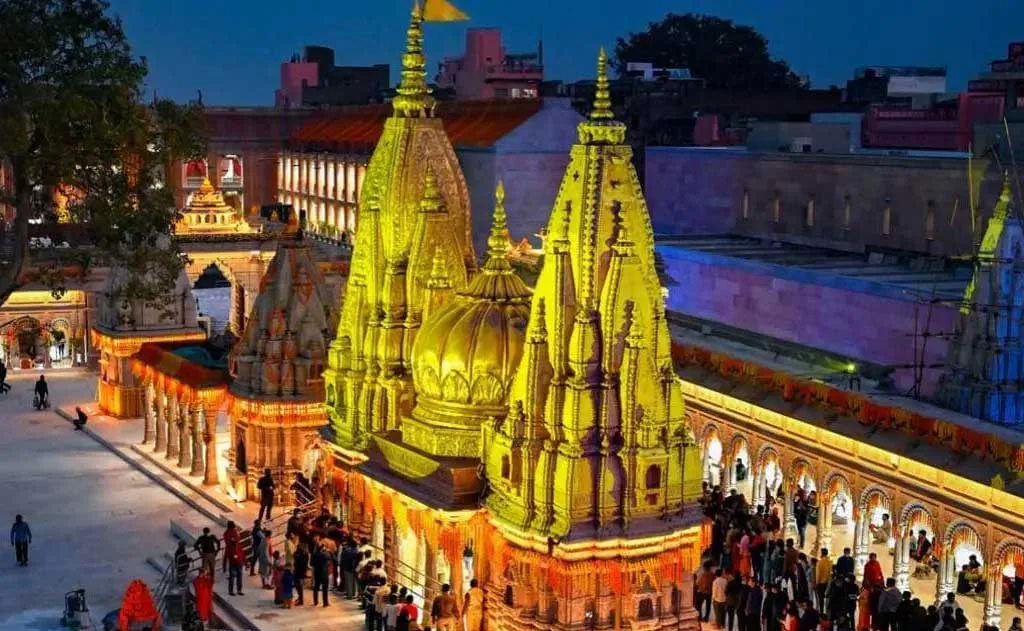
Kashi Vishwanath is the spiritual capital of Shaivism. The Skanda Purana states that even one breath of the Kashi air, even one drop of Ganga water taken at the Manikarnika Ghat, equals the merit of all other pilgrimages combined. The current temple, with its golden spire, was rebuilt by Ahilyabai Holkar in 1780; the magnificent corridor connecting the temple to the Ganga was inaugurated in 2021.
Travel note for NRIs: Use the new Kashi Vishwanath Corridor entry — book a sparsh (touch) darshan slot online for ₹500 (NRI rate); this skips the 4-hour general queue. Combine with Sarnath (10 km) for the Buddhist parallel and Vindhyachal (90 km) for the Shakti Peetha.
8. Trimbakeshwar — Nashik district
- State: Maharashtra
- Coordinates: 19.9322° N, 73.5290° E
- Nearest railway / airport: Nashik Road railway station (35 km); Mumbai airport (180 km, 4 hours)
- Darshan timings (typical): 05:30 to 21:00; Mahapuja at 12:00
- Best season: October–March; the Kumbh Mela is held here every twelve years (next one: 2027)
- Dress code: Men entering the sanctum wear dhoti only (no shirt); women in sarees
Trimbakeshwar is the only Jyotirlinga where the linga has three faces — representing Brahma, Vishnu and Shiva. It stands at the source of the Godavari River, one of the four sacred rivers along with the Ganga, Yamuna and Saraswati. The temple is associated with the Tryambakam mantra (the Mahamrityunjaya); pilgrims to Trimbakeshwar typically perform a 108-recitation here.
Travel note for NRIs: Pair with Shirdi (60 km away) — one of the most popular two-day temple combinations in Maharashtra. Sahasrabhojanam (feeding 1000 brahmins) packages start at ₹50,000 for serious yatris.
9. Vaidyanath — Deoghar
- State: Jharkhand
- Coordinates: 24.4926° N, 86.7000° E
- Nearest railway / airport: Jasidih Junction railway station (8 km); Deoghar airport (15 km)
- Darshan timings (typical): 04:00 to 21:00; Shravan Mela attracts millions during the four Sawan Mondays (August 2026)
- Best season: October–February (Sawan in July–August is intense but most spiritually charged)
- Dress code: No dress code; saffron clothing typical for Sawan kanwariyas
Vaidyanath Jyotirlinga's name means "Lord of Physicians." The Shiva Purana narrates that Ravana attempted to take this linga to Lanka by performing a thousand-year tapas. Shiva agreed, on the condition that the linga not be set down on earth until it reached Lanka. Ravana tricked into setting it down at Deoghar by Lord Vishnu — and could not lift it again. Devotees come here especially during the four Sawan Somwar Mondays for healing.
Travel note for NRIs: Combine with Tarapith (Shakti Peetha, 110 km in West Bengal) and Vaishno Devi parikrama. The Deoghar airport opened in 2022 — reduces what was a 6-hour road journey to a 90-minute flight from Kolkata.
10. Nageshwar — Dwarka
- State: Gujarat
- Coordinates: 22.3380° N, 69.0863° E
- Nearest railway / airport: Dwarka railway station (17 km); Jamnagar airport (137 km)
- Darshan timings (typical): 06:00 to 21:00; Madhyahna Aarti at 12:30
- Best season: October–February (May–June extremely hot)
- Dress code: Modest dress
Nageshwar means "Lord of Serpents." The Shiva Purana tells of an asura named Daruka who tormented the devotee Supriya. When Supriya prayed to Shiva inside Daruka's prison, Shiva manifested as a Jyotirlinga, killed the asura, and remained at the spot. The current temple has a striking 25-metre statue of Shiva in the seated lotus position outside the main shrine — the second-tallest Shiva statue in India.
Travel note for NRIs: Most pilgrims combine Nageshwar with Dwarkadhish Temple (Krishna's capital, 17 km away) and Beyt Dwarka (an island shrine reached by ferry). Plan at least two full days for the Dwarka triad.
11. Rameshwaram — Tamil Nadu
- State: Tamil Nadu
- Coordinates: 9.2885° N, 79.3174° E
- Nearest railway / airport: Rameshwaram railway station (1 km); Madurai airport (175 km, 4-hour drive across Pamban Bridge)
- Darshan timings (typical): 05:00 to 21:00; the 22-Tirtha snanam ritual takes about 90 minutes
- Best season: October–March (cyclone season July–November can disrupt the Pamban crossing)
- Dress code: Wet clothes required for the 22-Tirtha snanam — bring change of clothes
Rameshwaram is where Lord Rama, returning from Lanka after defeating Ravana, established a Jyotirlinga to absolve himself of the brahmahatya dosha (sin of killing a brahmin — Ravana was a brahmin). Hanuman was sent to Mount Kailash to fetch a linga; when he was delayed, Sita made a temporary one from sand. Rama installed Sita's sand-linga and worshipped it first, before installing the larger Mahadeva linga that Hanuman finally brought. Both lingas remain in the sanctum to this day.
Travel note for NRIs: The 22 sacred wells (Tirthas) inside the temple complex are the unique ritual here — devotees are bathed in water from each in sequence. Combine with Madurai Meenakshi temple (175 km) and the Adam's Bridge / Dhanushkodi point.
12. Grishneshwar — Aurangabad district
- State: Maharashtra
- Coordinates: 20.0240° N, 75.1788° E
- Nearest railway / airport: Aurangabad railway station (29 km); Aurangabad airport
- Darshan timings (typical): 05:30 to 22:00; closes briefly mid-day for naivedya
- Best season: October–February
- Dress code: Men remove shirts before entering the sanctum
Grishneshwar (also Ghushmeshwar) is the twelfth and final Jyotirlinga. The Shiva Purana tells the story of Ghushma, a devout woman who created 101 small mud-clay lingas every day and immersed each in a lake after worship. Her husband's second wife, jealous of Ghushma's spiritual power, killed Ghushma's only son. Ghushma did not stop her daily worship — and Shiva, moved by her unbroken faith, restored her son and remained at the spot as the final Jyotirlinga.
Travel note for NRIs: Just 1 km from the UNESCO World Heritage Ellora Caves — Cave 16 is the famous Kailasa Temple carved from a single rock. A combined 2-day Ellora-Grishneshwar trip is the canonical conclusion to a Jyotirlinga yatra.
Optimal Yatra Routes — Three Realistic Itineraries
Few pilgrims complete all twelve in a single trip. Three feasible structures:
21-Day Full Yatra (the traditional Dwadasha)
- Days 1–2: Somnath + Nageshwar + Dwarka (Gujarat West Coast)
- Days 3–4: Mumbai → Trimbakeshwar → Bhimashankar (Maharashtra)
- Days 5–7: Aurangabad → Grishneshwar → Ellora (Maharashtra)
- Days 8–9: Mahakaleshwar (Ujjain) + Omkareshwar (Madhya Pradesh)
- Days 10–11: Vaidyanath (Deoghar, Jharkhand)
- Days 12–13: Kashi Vishwanath (Varanasi)
- Days 14–17: Kedarnath (Uttarakhand — allow buffer for weather)
- Days 18–19: Mallikarjuna (Srisailam, Andhra Pradesh)
- Days 20–21: Rameshwaram (Tamil Nadu)
Total cost: approximately ₹1.5–2.5 lakh per person (₹1,800–₹3,000 per day at moderate comfort), excluding international flights. Heli-tour to Kedarnath adds ₹15,000.
North-Only Yatra (10 days)
Kashi Vishwanath → Vaidyanath → Kedarnath → Mahakaleshwar → Omkareshwar. Most accessible from US/UK via Delhi. Skip the deep south for a future trip.
South + West Yatra (12 days)
Rameshwaram → Mallikarjuna → Bhimashankar → Trimbakeshwar → Grishneshwar → Somnath → Nageshwar. Access from Mumbai or Hyderabad airports. Avoids the Himalayan trek.
NRI Travel Tips for the Dwadasha Yatra
- Visa: e-Tourist Visa (60 days, multiple entry) is sufficient. NRIs holding OCI/PIO need no visa. Apply 4 weeks before travel.
- Best season: mid-October to mid-March — weather, road conditions, and temple opening timings all align. Avoid May–June (heat) and July–August (monsoon) unless you are specifically observing Sawan at Vaidyanath.
- Health: Hepatitis A vaccine, typhoid booster, and a basic stomach-medication kit are recommended. Drink only bottled water. The Kedarnath trek requires moderate cardiovascular fitness.
- Money: Many small-town shrines do not accept cards. Carry ₹500 and ₹100 notes. UPI works almost everywhere now (PhonePe / Google Pay) — set up via your Indian SIM if possible.
- Photography: Most main shrines forbid phones inside the sanctum. Locker facilities are typically available; carry a ₹100 padlock.
- Booking: book Kedarnath helicopter, Mahakal Bhasma Aarti, Rameshwaram pujas, and Vaidyanath Sawan slot at least 30 days in advance via the official temple-trust portals (avoid third-party "instant darshan" sites which mostly resell the same official slots at 4-5× markup).
- Driver vs self-drive: hire a driver. Indian highway driving, especially the Aurangabad–Ujjain and Rishikesh–Kedarnath routes, has a learning curve.
- Language: Hindi works almost everywhere; English at all major temples. Learn five phrases: "Aarti time kya hai?" "Pradakshina kahan se?" "Mandir ke andar phone allow hai?" "Photographer chaiye?" "Bilva patra mil sakta hai?"
Five Lesser-Known Facts About the Dwadasha Jyotirlingas
- 1. Eight of the twelve Jyotirlingas are in the southern half of India — but the most-visited (Kashi, Kedarnath) are in the north. The geographic distribution mirrors the all-India spread of Shaiva traditions.
- 2. Only Trimbakeshwar has three faces on the linga itself; only Mahakaleshwar faces south; only Mallikarjuna also serves as a Shakti Peetha.
- 3. The temple architecture spans 1,500 years of Indian art history: Somnath is post-1947 modern; Mahakaleshwar 14th century; Grishneshwar 18th century (rebuilt by Ahilyabai); Trimbakeshwar pure 18th-century Maratha; Kedarnath's stone shrine is 8th century, established by Adi Shankaracharya.
- 4. The longest Jyotirlinga journey in pre-modern times took up to two years — pilgrims walked. Adi Shankaracharya is recorded as having visited all twelve before his 32nd year.
- 5. There is a dispute between the Vaidyanath in Deoghar (Jharkhand) and the Vaidyanath in Parli (Maharashtra) — both claim to be the canonical fifth in the stotram's "Vaidyanatham cha." Most acharyas accept Deoghar; some traditional Maharashtrian families visit Parli.
Frequently Asked Questions
How long does the full Dwadasha Yatra take?
Realistically 18–25 days for the full circuit, with travel between shrines being the largest time sink. Faster than 18 days means cutting major shrines short; longer than 25 makes scheduling difficult. The traditional ideal is exactly 21 days.
Can the Dwadasha Yatra be done in stages over multiple years?
Yes. Most NRI families divide it into north-circuit (one year), south-circuit (next year), and west-circuit (third year). The Shiva Purana does not require a single continuous journey — only that all twelve be visited in this lifetime with bhava.
What if I cannot travel to all twelve?
The Shiva Purana itself states: "Eka-mukhe-darshanam dvadasha-jyotirvat" — one sincere darshan equals the merit of all twelve. Reciting Adi Shankaracharya's Dwadasha Jyotirlinga Stotram daily for 40 days at any Shiva temple grants the same fruit, the shastra says, as a physical visit.
Is Kedarnath open year-round?
No. Kedarnath closes on the day after Diwali (~early November) and reopens on Akshaya Tritiya (~late April / early May). During the closed months, the deity is moved to Ukhimath (40 km lower) where darshan continues.
Are there any restrictions on non-Hindus visiting the Jyotirlingas?
Most are open to anyone — Somnath, Mahakaleshwar, Kashi Vishwanath, Trimbakeshwar all welcome international visitors of any background. A few have stricter policies (some Tamil Nadu temples restrict the inner sanctum to Hindus born or formally accepted into a sampradaya). Verify with the specific temple website before traveling.
What is the most spiritual Jyotirlinga of the twelve?
The shastra is unambiguous: all twelve are equal in spiritual potency. Personal preference, family tradition, and the resonance you feel with the place determine the "best" for any individual. That said: Kashi Vishwanath has the deepest Vedic literature about it, Kedarnath the most demanding pilgrimage path, and Mahakaleshwar the most-talked-about Bhasma Aarti.
Are pujas for ancestors permitted at the Jyotirlingas?
Yes — and Trimbakeshwar in particular is famous for Tripindi Shraddha, the comprehensive ritual for ancestors who died unnatural deaths. Sankalpa for naga dosha, kalasarpa dosha, pitra dosha is performed at most major Jyotirlingas; arrange in advance through the temple's priest committee.
When is the next Maha Kumbh Mela near a Jyotirlinga?
The Nashik Kumbh Mela (held at Trimbakeshwar) is next due in 2027. The Ujjain Simhastha Kumbh (at Mahakaleshwar) was last in 2016 and next in 2028. Both occur once every 12 years and are extraordinary times to visit those Jyotirlingas — but expect very heavy crowds.
Related Reading
- Sawan Somwar 2026: Vrat Vidhi & Mantras
- Char Dham Yatra — Badrinath, Kedarnath, Gangotri, Yamunotri
- Maha Kumbh Mela — The World's Largest Spiritual Gathering
- Hindu Temple Directory by Region
- Slokas, Mantras & Stotrams Library
- All Spiritual Yatra Guides
Last reviewed by Sreekanth Bathalapalli, Founder of HinduTone, on 28 April 2026. Geographic coordinates verified against Survey of India maps. Darshan timings accurate as of April 2026 — official temple websites are the canonical source 48 hours before travel. Stories paraphrased from the Shiva Purana, Koti Rudra Samhita, and Adi Shankaracharya's Dwadasha Jyotirlinga Stotram. Cost estimates are 2026 averages and will rise with INR depreciation.
ॐ नमः शिवाय 🪷
Share this with family and friends
Send it on WhatsApp, post it, or copy the link.
More from Spiritual Yatra
- Ashtavinayak Yatra: Complete Guide to the Eight Ganesha Temples of Maharashtra
- Pashupatinath: Divine Mysteries & Soul-Stirring Miracles of Lord Shiva in Nepal
- Dwarkadhish: Divine Mysteries & Soul-Stirring Miracles of Lord Krishna's Eternal Kingdom
- Badrinath: Divine Mysteries & Soul-Stirring Miracles of Lord Vishnu's Himalayan Abode
- Ayodhya Ram Mandir: Divine Mysteries & Soul-Stirring Miracles of Lord Rama's Birthplace
You might also like
Top 20 Sivalayam in USA: A Devotee's Guide to America's Most Sacred Shiva Temples (2026)
Must Visit Temples on Saturday: Top 12 Shani & Hanuman Temples in India for Powerful Shanivar Blessings
Top 20 Lakshmi Devi Temples to Visit in India: Ultimate Pilgrimage Guide for Wealth, Prosperity & Divine Blessings