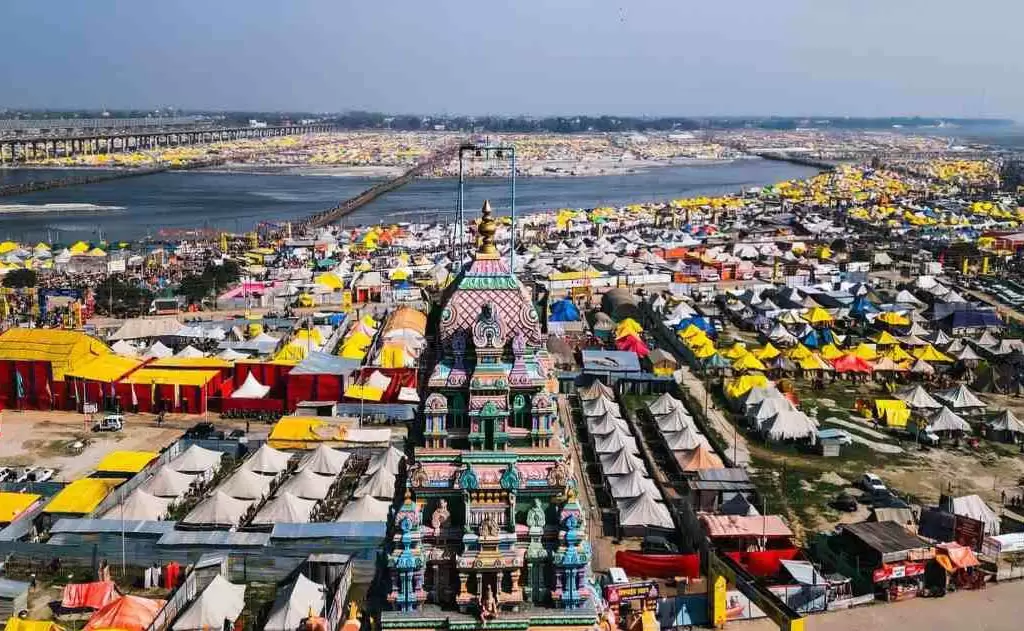
Gangotri to Gaumukh Trek 2026: The Ultimate Glacier Pilgrimage
"Gangā ca Yamunā caiva Godāvarī Sarasvatī —Narmadā Sindhu Kāverī jalesmin sannidhiṃ kuru.""O Ganga, Yamuna, Godavari, Saraswati, Narmada, Sindhu, and Kaveri…
"Gangā ca Yamunā caiva Godāvarī Sarasvatī —Narmadā Sindhu Kāverī jalesmin sannidhiṃ kuru.
"Gangā ca Yamunā caiva Godāvarī Sarasvatī —
Narmadā Sindhu Kāverī jalesmin sannidhiṃ kuru."
"O Ganga, Yamuna, Godavari, Saraswati, Narmada, Sindhu, and Kaveri —
may your sacred waters be present here."
— Ancient Snana Mantra (Bath Invocation)
✦ The Trek That Is Also a Prayer
There are treks. And then there are pilgrimages that happen to require trekking boots.
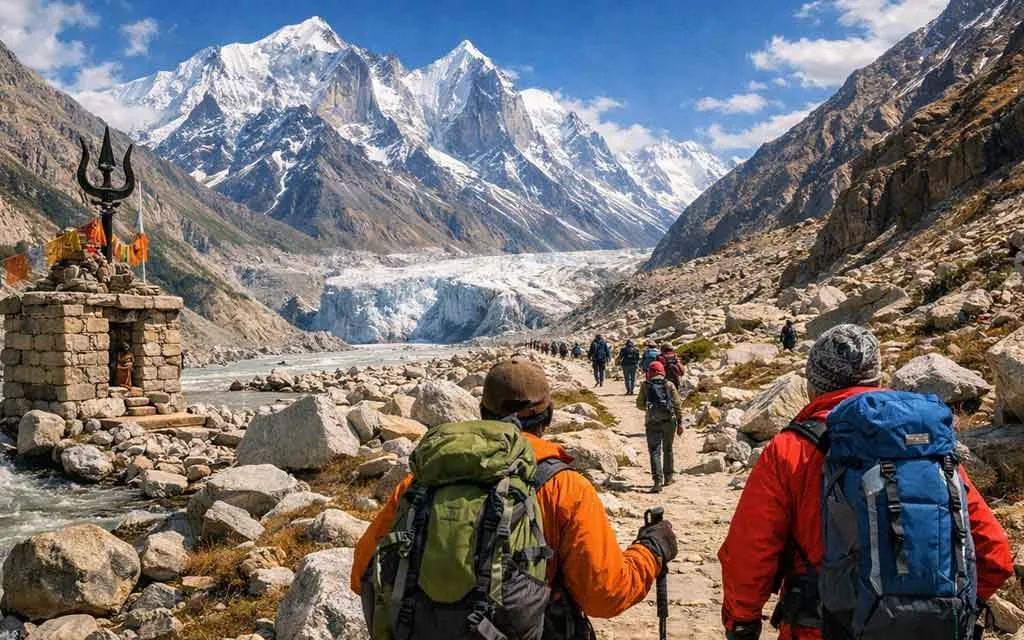
The trail from Gangotri to Gaumukh belongs entirely to the second category. At an elevation that makes every breath a conscious act, along a path carved through one of the most awe-inspiring Himalayan landscapes on Earth, this 19-kilometre route leads to the source of the Ganga — India's most sacred river, the liquid biography of Shiva, the artery of an entire civilization.
Gaumukh — literally Cow's Mouth — is the terminal snout of the Gangotri Glacier, the 30-kilometre tongue of ancient ice from which the Bhagirathi River emerges, eventually joining other sacred streams to become the Ganga at Devprayag. Standing at Gaumukh and watching the milky-blue glacial meltwater roar out from beneath a cathedral of ice is, for every pilgrim and trekker who has done it, one of those moments that permanently rearranges something inside you.
In 2026, with the Himalayan season fully open, the trail freshly cleared, and the spiritual and ecological significance of this trek more relevant than ever, this is the complete guide you need — from the mythology that makes every stone sacred, to the permits you need before you step foot on the trail, to what to pack for a journey that will test your body and transform your spirit.
✦ Part I: The Sacred Geography — Why Gaumukh Matters
The Ganga's Story — Descent from Heaven
The origin of the Ganga is not merely geological. It is cosmological.
The story begins with King Sagar of the Ikshvaku dynasty — ancestor of Lord Rama. Sagar had sixty thousand sons, born of divine boon. While performing the great Ashwamedha Yajna (horse sacrifice), the sacrificial horse was stolen and hidden near the ashram of the meditating sage Kapila by the jealous god Indra. Sagar's sixty thousand sons, searching for the horse, broke into Kapila's meditation with tremendous noise and violence. The sage, roused from his samadhi in fury, turned his blazing gaze upon them — and all sixty thousand were reduced to ash in an instant.
Their souls, unbirthed into proper death rites, wandered the netherworld without peace. Their salvation required the water of a celestial river to purify their ashes. The river that could do this existed only in heaven — it was Mandakini, the celestial Ganga.
King Bhagiratha, Sagar's great-great-grandson, undertook the most extraordinary tapas in the epics' history: he stood on one toe for a thousand years, arms raised, sustained only by air, in burning devotion to Brahma, to bring the heavenly river to Earth.
Brahma was moved. He granted the boon — but with a warning: the force of the Ganga's descent from heaven would shatter the Earth itself. Only Shiva could absorb the impact.
Bhagiratha then turned his tapas toward Shiva with equal intensity. Shiva, pleased with this devotion born of selfless love for sixty thousand lost souls, agreed. He stood in the Himalayas with His matted locks spread wide, and received the Ganga's thundering descent upon His head — absorbing Her infinite force, letting Her flow gently through the gentle maze of His locks, emerging as gentle streams down the mountainside.
The Ganga reached the plains. Bhagiratha led Her to the ashes of his ancestors. The sacred water touched the ash — and sixty thousand souls were liberated.
This is why the Ganga is called Bhagirathi at Gangotri — the river Bhagiratha brought. And Gaumukh, where She first emerges from the ice, is the Earth's Shiva-locks — the place where heaven and earth first meet in that divine water.
Every pilgrim who touches the Ganga at Gaumukh is, in the symbolic language of the tradition, completing Bhagiratha's act — participating in the liberation of the ancestors, in the healing of broken lineages, in the meeting of the human and the divine.
Gangotri Temple — The Doorway
The town of Gangotri (3,100 metres / 10,170 ft) sits at the threshold between the accessible world and the high Himalayan wilderness. The Gangotri Temple — white-spired, elegant, set against the roaring river and pine forests — is dedicated to the goddess Ganga and was built in the 18th century by the Gorkha commander Amar Singh Thapa. It stands at the precise point where Bhagiratha is said to have performed his tapas — the Bhagirath Shila (stone of Bhagiratha) stands in the river nearby, worn smooth by centuries of sacred touch.
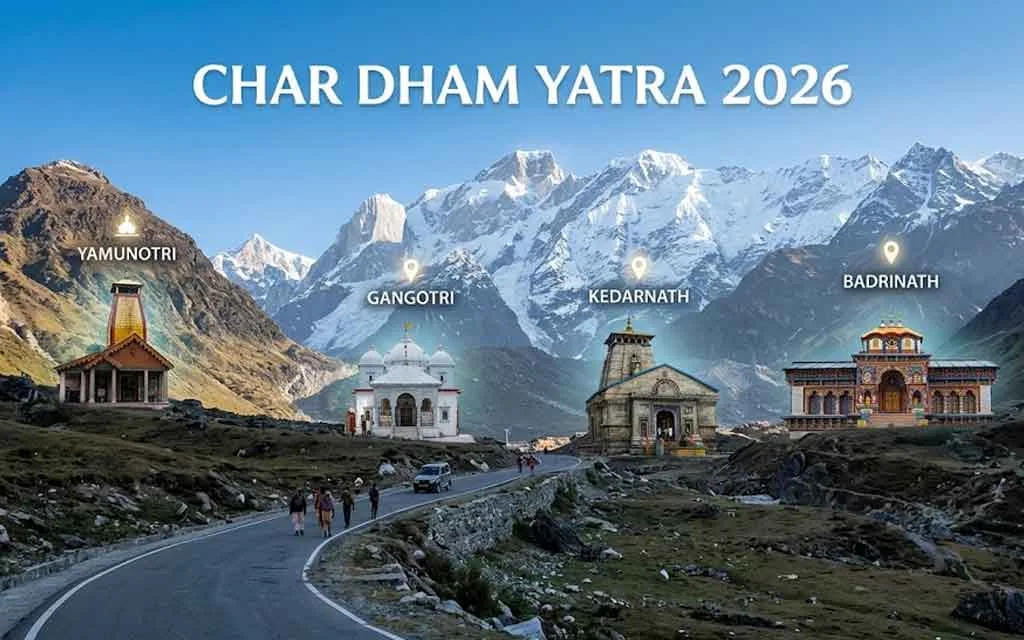
The temple is one of the Char Dham — the four sacred abodes of the Himalayan pilgrimage circuit (along with Yamunotri, Kedarnath, and Badrinath) — which every devout Hindu aspires to visit in a lifetime.
✦ Part II: Understanding the Gangotri Glacier — Sacred Ice in Crisis
The Glacier
The Gangotri Glacier is one of the largest glaciers in the Himalayas — approximately 30 kilometres long and up to 2–4 kilometres wide, spanning an area of roughly 144 square kilometres. It flows from elevations above 6,000 metres down to Gaumukh at approximately 4,023 metres.
The glacier feeds not just the Bhagirathi but contributes to the water systems that sustain hundreds of millions of people across the Gangetic plain. Its ice is ancient — some of it laid down over thousands of years of accumulated Himalayan snowfall, compressed into the blue-white crystal that now flows slowly, inexorably, toward the plains.
The Crisis of Retreating Ice
The glacier is retreating. This is not alarmism — it is documented, measured fact, and for a pilgrim standing at Gaumukh, it is visible and visceral.
Over the past 200 years, the Gangotri Glacier has retreated approximately 22 kilometres. In recent decades:
- Average annual retreat: 22 metres per year
- Some years have seen retreat of up to 40 metres
- The snout at Gaumukh in 2026 stands significantly further uphill than it did when the first modern surveys were made
Old photographs from the early 20th century show the glacier snout at locations now a substantial walk from the current terminus. For the Hindu pilgrim, this is not merely an ecological statistic — it is the slow withdrawal of the sacred. The Ganga's source is moving away from humanity — and the tradition's interpretation is that this is both a consequence and a warning of collective adharma toward the natural world.
The Gangotri National Park (2,390 sq km) was established in part to protect this fragile ecosystem. Trekking to Gaumukh requires permits precisely because unregulated human traffic was accelerating glacial degradation.
For the 2026 trekker and pilgrim: approach Gaumukh with awareness. You are visiting something irreplaceable and threatened. Your footprint — literal and figurative — matters here more than almost anywhere else.
✦ Part III: Trek Overview — The Essential Numbers
✦ Part IV: The 2026 Season — Dates, Conditions & Temple Opening
Gangotri Temple Opening (Akshaya Tritiya 2026)
The Gangotri Temple follows the sacred Hindu calendar. It opens every year on Akshaya Tritiya (Vaishakha Shukla Tritiya) and closes on Diwali (Kartika Amavasya).
In 2026:
- Opening Date: Around April 30, 2026 (Akshaya Tritiya — confirm exact date with temple trust as it varies by panchanga calculation)
- Closing Date: Around October 20, 2026 (Diwali)
After the temple opens, the trail takes a few weeks to become fully safe for trekking — snow at higher elevations and unstable conditions immediately post-winter make the early weeks hazardous.
Best Trekking Windows 2026
Window 1: Pre-Monsoon (May 15 — June 20, 2026)
- Skies are clear, views of Shivling and Bhagirathi peaks spectacular
- Wildflowers beginning — Brahma Kamal emerging by late May
- Snow still on the trail above Bhojbasa; crampons may be needed
- Cold nights (-5°C to -10°C at Bhojbasa)
- Best for: Serious trekkers and pilgrims who want solitude and crystal clarity
Window 2: Post-Monsoon (September 1 — October 20, 2026)
- [image: ⭐] Most recommended for 2026
- Monsoon has washed the trail clean; rivers high but crossable
- Skies dramatically clear — the visibility at this time is extraordinary
- Autumn colours on the Bhojpur birch trees
- Shivling (6,543 m) at its most photogenic
- Moderate temperatures; cold but not extreme
- Trail drier and firmer than pre-monsoon
- Best for: First-timers, pilgrims, families, and photographers
Window 3: Late Pre-Monsoon (June 20 — July 10, 2026)
- Crowds of pilgrims during summer holidays
- Weather increasingly unpredictable
- Avoid: July 10 — September 1 (Monsoon — trail dangerous, landslide risk, permit often suspended)
Avoid October 21 onward: Post-Diwali, the temple closes and conditions deteriorate rapidly toward winter.
✦ Part V: Permits & Regulations 2026 — Everything You Must Know
This is non-negotiable information. Trekking to Gaumukh without a permit is illegal and can result in heavy fines and removal from the trail.
The Gaumukh Glacier Trek Permit
Issuing Authority: Uttarkhand Forest Department / Gangotri National Park Office
Where to Obtain in 2026:
- Online: forest.uk.gov.in or the Uttarakhand Tourism Portal (online booking strongly recommended to secure one of the 150 daily slots)
- In Person: Forest Department office, Gangotri town (arrive early — slots go fast in peak season)
Permit Fee (2026 approximate — verify current rates):
- Indian nationals: ₹150 per person per day
- Foreign nationals: ₹600 per person per day
- Camping at Bhojbasa: Additional ₹50–100 per night
What to Carry:
- Original Government-issued photo ID (Aadhaar, passport, or driving licence)
- Two passport-size photographs
- Permit printout or screenshot
- Register at all checkposts — do NOT skip checkpost registration
The 150-Person Daily Limit: This limit is strictly enforced. During peak season (late September, early October), permits can run out by midday. Book at least 2–3 weeks in advance for the September-October window.
Rules on the Trail
- No plastic beyond Gangotri — zero tolerance, heavy fines
- No campfires beyond Chirbasa — only kerosene/gas stoves permitted
- No camping at Gaumukh itself — only at designated Bhojbasa camp
- No loud music or speakers in the national park
- Do not disturb the glacier — no climbing on the snout
- Carry all waste out — pack it in, pack it out absolutely
- No alcohol in the restricted zone
- Trekking after dark on the trail is not recommended and in some sections prohibited
- Horses not permitted beyond Bhojbasa to Gaumukh section
✦ Part VI: The Trail — Day by Day
Day 0: Arrive Gangotri — Acclimatize, Pray, Prepare
Altitude: 3,100 m | Travel: Drive from Uttarkashi (100 km, 4–5 hours)
Arrive in Gangotri by afternoon. This day is not wasted — it is essential. Acute Mountain Sickness (AMS) is a real risk on this trek, and the elevation gain from the plains is substantial. Give your body 24 hours to begin adjusting.
What to do on Day 0:
[image: 🙏] Morning Puja at Gangotri Temple: Begin your pilgrimage properly. The aarti at sunrise (Brahma Muhurta aarti) is one of the most moving experiences in the Char Dham circuit — the sound of conch, bell, and hymn rising into the cold mountain air, the Bhagirathi roaring below in darkness. Queue begins at 4:30 AM. Do not skip this.
[image: 🏊] Ganga Snan (Sacred Bath): The steps below the temple lead to a ghats area. Bathe in the Bhagirathi — cold does not begin to describe it, but the tradition holds that a single dip here purifies all accumulated karma. The pilgrimage has already begun.
[image: 📋] Collect permits, register at the Forest Department office, stock up on supplies. Check your kit one final time.
[image: 🍽️] Eat well, hydrate aggressively, sleep early.
Where to Stay:
- GMVN Tourist Rest House (₹1,200–2,500/night)
- Hotel Gangotri, Hotel Surya, various dharamshalas for pilgrims (₹400–800/night)
- Temple trust accommodation for pilgrims (free/donation)
Day 1: Gangotri → Bhojbasa
Distance: 14 km | Elevation Gain: +675 m (3,100 m → 3,775 m) Duration: 6–8 hours | Difficulty: Moderate
This is the longest day of the trek and sets the tone for everything that follows. Start by 6:00 AM at the latest — the afternoon can bring cloud cover and the trail is best in morning light.
The Trail Profile:
Gangotri to Chirbasa (5 km, ~2 hours)
The first 5 kilometres follow the left bank of the Bhagirathi through a magnificent forest of Himalayan blue pine, cedar (deodar), and Bhoj (birch) trees. The trail is well-marked and relatively gradual. The river roars beside you, milky with glacial sediment.
At Chirbasa (3,600 m) — named for the chir pine forest — there is a tea stall (operational in season), toilet facilities, and the first forest checkpost. Register your permit here. This is also the last reliable tree shelter — above Chirbasa, the landscape opens into the sub-alpine zone.
Chirbasa to Bhojbasa (9 km, ~4 hours)
Beyond Chirbasa the landscape transforms dramatically. The trees thin, the valley widens, and the scale of what you are walking into begins to register in the body. The trail crosses occasional boulder fields and seasonal streams, gaining elevation gradually but consistently.
At around the 11-kilometre mark, the trail opens fully onto a wide glacially carved valley and the first proper views of Shivling (6,543 m) appear — a perfect granite pyramid that is arguably the most beautiful peak in the entire Himalayas, and one of the most sacred, considered a natural Shivalingam by the tradition.
When Shivling comes into view for the first time, most trekkers and pilgrims stop involuntarily. Something about that peak — its symmetry, its height, its bare rock face catching the morning light — makes silence the only appropriate response.
Bhojbasa (3,775 m) arrives as a welcome relief. It is a small settlement of stone huts, the GMVN rest house, and the remarkable Lal Baba Ashram — a spiritual retreat maintained by a sanyasi (renunciant) who has lived here through multiple Himalayan winters in a commitment to the sacred landscape that is humbling to witness.
At Bhojbasa:
- Register at the second checkpost (mandatory)
- Check into GMVN rest house (₹600–1,200/night, basic but functional) or carry a tent
- The evening views of Shivling catching the alpenglow are among the finest in the Himalayas — have your camera ready at 5:00–6:00 PM
- Temperature drops fast after sunset: prepare for -5°C to -10°C
- Drink 3–4 litres of water today. Hydration is your primary defence against AMS.
- No campfires — gas stove only; hot food and warm drink are essential
Accommodation at Bhojbasa:
- GMVN Eco Hut: Basic dormitory and double rooms — book ahead in peak season
- Lal Baba Ashram: Simple accommodation for pilgrims (donation-based)
- Camping: Permitted in designated areas with your own tent
Day 2: Bhojbasa → Gaumukh → Return to Bhojbasa (or Gangotri)
Distance: 5 km one-way (10 km return) | Elevation Gain: +248 m Duration: 4–6 hours for the complete day | Difficulty: Moderate to Strenuous
This is the day the trek was made for.
Wake before dawn — 4:30 AM. Make tea, eat something warm, dress in full layers. You want to be walking toward Gaumukh as the sky begins to lighten. The reasons are both spiritual and practical: the morning light on the glacier is extraordinary, the trail is firmer before afternoon melt, and you want to arrive at the snout before the day's other trekkers.
Bhojbasa to Gaumukh (5 km, ~2.5 hours)
The trail from Bhojbasa to Gaumukh is the most dramatic section of the entire trek. You are now above the treeline entirely. The landscape is raw and planetary — enormous boulders deposited by glacial movement, the valley floor smoothed by ice that once filled it entirely, the scale humbling in a way that city-dwellers rarely encounter.
The trail crosses the glacier's lateral moraine — the ridge of rock and debris pushed to the side by the advancing ice — and in sections you are walking on the moraine itself, which can be unstable. Tread carefully. Use your trekking poles. Do not rush.
As you round the final bend, the Gaumukh snout comes into view.
The Experience of Gaumukh
No description is adequate. You have to be there.
The glacier snout is a massive, collapsing, roaring, crumbling wall of ancient ice — blue-white-grey, streaked with the moraines of a thousand years, fractured into crevasses that plunge into blue darkness, and at its base, from a cave-like opening, pours the Bhagirathi River — the Ganga at her birth.
The water is the color of glacial milk — thick with suspended rock flour ground fine by the glacier's immense weight. It is shockingly, piercingly cold. It roars with a force that you feel in your chest. And it is, in the Hindu understanding of sacred geography, the most holy water on Earth — the liquid form of Shiva's grace, brought from heaven by Bhagiratha's love.
Pilgrims take snan (bath) here. The water is approximately 4–6°C. Most pilgrims do not fully immerse but cup the water in their hands, pour it over their heads, drink a sip, fill a vessel to carry home. The tradition holds that water from Gaumukh, carried home and used in rituals, purifies the space in which it is used and the ancestors of the family for seven generations.
What to do at Gaumukh:
- Sit in silence — even if only for 10 minutes. Let the sound and the cold and the height register in your body and spirit.
- Perform Ganga puja — if you have brought flowers, rice, incense, perform a simple offering. Many pilgrims recite the Ganga Stotram or chant Om Namah Shivaya or Jai Gange Mata here.
- Collect Gangajal — bring a copper vessel or clean glass bottle. Gangajal from Gaumukh is among the most sacred of all ritual waters.
- Do not approach the snout closely — ice calving (large chunks falling) is frequent and unpredictable. Maintain safe distance from the active face. The barrier markers exist for your safety.
- No bathing in deep sections — currents are extremely strong and cold. The shallow stream near the bank is sufficient.
Return Options:
Option A: Return to Bhojbasa, rest, then descend to Gangotri (full return on Day 2). Total trekking: 24 km. Demanding but achievable for fit trekkers.
Option B: Return to Bhojbasa, overnight again, descend fresh on Day 3. More comfortable, allows proper rest.
Option C: Extend to Tapovan — see Day 3 below.
Day 3 (Optional): Bhojbasa → Tapovan
Distance: 5 km one-way | Elevation Gain: +688 m (3,775 m → 4,463 m) Duration: 4–6 hours ascent | Difficulty: Strenuous
Tapovan is the high meadow above Gaumukh, at the base of Shivling's southeast face. It is one of the most sacred and most beautiful high-altitude meadows in the Himalayan world — a flat, green carpet at 4,463 metres, ringed by some of the most spectacular peaks in India: Shivling (6,543 m), Meru (6,660 m), Thalay Sagar (6,904 m), and the Bhagirathi group (6,454–6,856 m).
The route from Bhojbasa to Tapovan is a separate, more demanding day — it requires crossing the glacier (roped crossings in some seasons) and ascending steeply up the lateral moraine.
Tapovan requires:
- A separate permit (often arranged along with the Gaumukh permit — confirm at Forest Office)
- A guide familiar with the glacier crossing
- Camping equipment (no GMVN facility at Tapovan; tent only)
- Physical fitness significantly above the Gangotri-Gaumukh baseline
Why go to Tapovan: Several sadhus and sanyasis maintain year-round or seasonal ashrams at Tapovan — meditating in the roar and cold of the high Himalayas, in the direct sight of Shivling, in a state of devotion that is difficult to comprehend from the perspective of ordinary life. Meeting these practitioners — even briefly, even in silence — is itself a form of darshan.
The dawn view from Tapovan of Shivling catching the first light of day, turning from grey to gold to blazing white against a dark sky, is one of the great visual experiences the Himalayas offer.
Final Day: Return Descent to Gangotri
Descend fully to Gangotri — 19 km downhill, typically 5–6 hours.
Before leaving Gangotri:
- Perform final puja at Gangotri Temple
- Visit Bhagirath Shila — the stone where Bhagiratha stood in tapas
- Bathe once more in the Bhagirathi
- Offer your completed pilgrimage — the gratitude, the completion, the internal transformation — to the goddess Ganga at Her temple
✦ Part VII: The Route at a Glance
GANGOTRI (3,100 m)
    |
    | 5 km — 2 hrs — Forest trail along Bhagirathi
    |
CHIRBASA (3,600 m) — Checkpost, tea stall, last trees
    |
    | 9 km — 4 hrs — Sub-alpine valley, boulder fields
    |
BHOJBASA (3,775 m) — Camp, GMVN rest house, Shivling views
    |
    | 5 km — 2.5 hrs — Moraine trail, above treeline
    |
GAUMUKH (4,023 m) — Glacier snout, Bhagirathi origin
    |
    | [Optional extension]
    | 5 km — 4-6 hrs — Glacier crossing + steep ascent
    |
TAPOVAN (4,463 m) — Sacred meadow, Shivling base
✦ Part VIII: How to Reach Gangotri in 2026
From Delhi (The Classic Route)
Delhi → Haridwar → Uttarkashi → Gangotri
Train Options Delhi → Haridwar:
- Jan Shatabdi Express (12055): Dep. 6:15 AM, Arr. 11:35 AM
- Mussoorie Express (14041): Overnight option
- Book on IRCTC — advance booking essential in season
Road from Haridwar: The road follows the Ganga/Bhagirathi valley upstream — one of the great scenic drives of India. It passes through Rishikesh, Tehri (new reservoir), Chamba, Uttarkashi, and then climbs through increasingly dramatic gorges to Gangotri.
Note on 2026 Roads: The Uttarkashi-Gangotri road (NH-108) passes through landslide-prone sections. Check BSNL/state road department updates before travel, especially in the early season (May-June). The Uttarakhand government typically ensures the road is clear by mid-May.
From Dehradun
Dehradun → Uttarkashi → Gangotri
- Distance: ~250 km
- Duration: 8–9 hours
- Jolly Grant Airport (Dehradun) has regular flights from Delhi (1 hour)
By Helicopter (For Pilgrims with Mobility Limitations)
Helicopter services from Harsil to Gangotri are available through GMVN and private operators. Contact GMVN Uttarakhand for 2026 booking details. This is used primarily by elderly pilgrims completing the Char Dham circuit.
✦ Part IX: Fitness, Training & Acclimatization
Who Can Do This Trek?
This trek is accessible to anyone with reasonable fitness and proper preparation. It is NOT a technical climb — no ropes, no ice axes (for the basic Gaumukh route). But it is also NOT a casual forest walk. The elevation, the distance, and the terrain require honest preparation.
You are ready if:
- You can walk 15+ km on a flat day without distress
- You exercise regularly (3–4 times per week)
- You have no unmanaged cardiac or respiratory conditions
- You can carry a 10–12 kg daypack comfortably
You need additional preparation if:
- You live at low altitude and have never trekked above 3,000 m
- You are above 60 or have any cardiovascular concerns — consult your doctor
- You have not exercised regularly in the past 3 months
Recommended Pre-Trek Training (8-Week Plan)
Weeks 1-2 — Foundation
- Walk 45–60 minutes daily on varied terrain
- 2 × weekly strength sessions: squats, lunges, step-ups, core work
Weeks 3-4 — Build
- Introduce stair climbing with a loaded pack (5–8 kg)
- Weekend hikes of 10–12 km with 300–400 m elevation
- Add cycling or swimming for cardiovascular base
Weeks 5-6 — Specific
- One long hike of 18–20 km per week with 600+ m elevation
- Daily pack carrying of 8–10 kg on any walk
- Practice eating and drinking on the move
Weeks 7-8 — Taper
- Reduce intensity, maintain frequency
- Focus on stretching, sleep, hydration
- Mental preparation — read about the route, visualize the journey
Acclimatization Protocol
The single most important thing you can do to prevent AMS:
- Arrive in Haridwar or Rishikesh (300 m) and spend one night
- Drive to Uttarkashi (1,150 m) — spend one night
- Drive to Gangotri (3,100 m) — this is a significant jump; spend minimum 24 hours here before starting the trek
- Day 1: Gangotri to Bhojbasa (3,775 m) — moderate gain, manageable
- Day 2: Bhojbasa to Gaumukh (4,023 m) — return to Bhojbasa same day; sleep at 3,775 m
The rule: climb high, sleep low. On Day 2, go to Gaumukh but return to sleep at Bhojbasa — your body acclimatizes to the altitude of sleep, not the altitude of brief exposure.
Recognizing and Responding to AMS
Mild AMS (Common, Manageable):
- Headache, fatigue, mild nausea, poor sleep
- Response: Rest, hydrate, do not ascend further that day
- Take paracetamol for headache; avoid alcohol
Moderate AMS (Take Seriously):
- Persistent headache unresponsive to medication, vomiting, dizziness, loss of coordination
- Response: Descend immediately to lower camp. Do not sleep at altitude with these symptoms.
Severe AMS / HACE / HAPE (Medical Emergency):
- Confusion, inability to walk straight, coughing up pink froth, extreme shortness of breath at rest
- Response: Immediate descent and emergency medical assistance. This is life-threatening.
Diamox (Acetazolamide): Many trekkers use this prescription medication for AMS prevention. Consult your doctor before the trek. It is not a substitute for acclimatization but a supplement to it.
✦ Part X: Complete Packing List 2026
Clothing
Equipment
Health & Safety
Pilgrimage & Spiritual Items
Documents (Originals + 2 Photocopies)
- Government photo ID (Aadhaar/Passport)
- Gaumukh Glacier Trek Permit
- GMVN/hotel booking confirmations
- Emergency contact list
- Travel insurance details
- Doctor's note (if any medical condition)
✦ Part XI: Food, Water & Nutrition on the Trail
Water
Never drink directly from the Bhagirathi or any stream without purification — despite its sacred nature, the water carries bacteria and parasites. Exception: many devout pilgrims drink directly from the Gaumukh source as a sacred act and experience no ill effects — but be aware of the general caution, especially for those with sensitive systems.
Daily water target: 4–5 litres while trekking. This is non-negotiable for AMS prevention.
Water sources:
- Gangotri: Tap/restaurant water available
- Chirbasa: Tea stall with water
- Bhojbasa: Available at GMVN and ashram
- Between Bhojbasa and Gaumukh: Stream sources (purify before drinking)
Food on the Trail
Gangotri: Full range of dhabas, restaurants, and kitchen options. Eat heartily — this is your base.
Chirbasa: Simple tea stall — chai, biscuits, Maggi. Operational in season.
Bhojbasa: GMVN rest house canteen serves simple hot meals — dal, rice, chapati, tea. Lal Baba Ashram often provides simple prasad meals. Pre-arrange meals if possible. Carry some emergency snacks regardless.
On the trail: Carry your own food for the stretch beyond Bhojbasa to Gaumukh. No shops or stalls.
Recommended trail foods:
- Dried fruits and nuts (high calorie, lightweight)
- Energy bars
- Chikki (sesame/groundnut bars) — traditional and effective
- Dry roasted chana (chickpeas)
- Dark chocolate (morale as much as calories)
- Electrolyte tablets or powder
Altitude and appetite: Many trekkers experience reduced appetite above 3,500 m. Eat anyway — even when not hungry. Your body needs fuel to manage altitude.
✦ Part XII: Budgeting the Trek — 2026 Cost Breakdown
Budget Trekker (₹ per person, approximate)
Mid-Range Trekker
Organized Trek Package (through reputable operators)
All-inclusive packages (Delhi to Delhi, accommodation, guide, porter, permits, meals):
- Budget operators: ₹8,000–12,000 per person
- Mid-range operators: ₹15,000–22,000 per person
- Premium operators: ₹25,000–40,000 per person
Recommended operators for 2026 (verify current credentials):
- GMVN (Garhwal Mandal Vikas Nigam) — government operator, reliable
- IndiaHikes — established, safety-focused, eco-responsible
- Trek the Himalayas
- Bikat Adventures
- Indiahikes Base Camp operators in Gangotri
✦ Part XIII: The Sacred Stops Along the Way — Pilgrimage Points
Gangotri Temple — Maa Ganga's Eternal Home
The white marble and stone temple faces the rushing Bhagirathi. Inside, the main deity is Goddess Ganga — depicted here not as the full-river goddess of the plains but as a young, powerful, mountain-born river deity, fierce and pristine. The Bhagirath Shila — a natural rock in the river — marks where Bhagiratha stood in tapas.
Puja timings (approximate — verify locally):
- Mangala Aarti: 5:00–6:00 AM (pre-dawn, especially beautiful)
- Shringar Darshan: 7:00–10:00 AM
- Afternoon closure: 12:00–3:00 PM
- Evening Aarti (Sandhya): 6:00–7:00 PM
Pandava Gufa — Cave of the Five Brothers
Near Gangotri, a sacred cave said to have been the meditation retreat of the Pandavas during their exile. A short detour from the main trail, it is considered a place of concentrated spiritual energy.
Gauri Kund — Parvati's Sacred Pool
A natural pool near Gangotri associated with Goddess Parvati, where She is said to have bathed before Her marriage to Shiva. The pool is shockingly cold and remarkably clear — pilgrims bathe here as a supplement to the Gangotri Snan.
Suraj Kund — The Sun's Sacred Pool
A sacred pool associated with Surya (the Sun God), slightly beyond Gangotri. Pilgrims perform sun worship here, especially appropriate given the Suryavansha lineage of both Bhagiratha and Rama.
Chirbasa — The Pause Between Worlds
Though not a formal pilgrimage site, Chirbasa sits at the precise elevation where the chir pine forest gives way to the open alpine valley — the visible threshold between the inhabited world and the glacier world. Many pilgrims pause here to chant, to rest, to consciously mark the transition.
Bhojbasa — Where the Bhoj Trees End
The Bhoj (birch) trees at Bhojbasa are the last trees before the high-altitude desert. The white-barked birch, whose bark was used as paper for ancient manuscripts, has a particular poignancy here — standing at the edge of the habitable, bearing witness to all the pilgrims who have passed beneath them for thousands of years.
The Lal Baba Ashram at Bhojbasa is a living spiritual institution — the Baba and his disciples maintain a meditation practice and offer simple hospitality to pilgrims in conditions that would break most people within a week.
Gaumukh — The Mouth of the Sacred
Already described in the trail section — but the spiritual register deserves a dedicated note. At Gaumukh, you are not a tourist. You are a pilgrim at a living deity's source.
The tradition holds that standing at Gaumukh and receiving the spray of the Bhagirathi on your body, chanting Jai Gange Mata, offers the merit of visiting all major pilgrimage sites in India simultaneously. This is not hyperbole — it is the tradition's way of expressing that Gaumukh contains all of sacred India within itself.
✦ Part XIV: Photography on the Glacier Pilgrimage
The Photographer's Calendar
The October window is widely considered the finest for photography on the Gangotri-Gaumukh trail:
- Post-monsoon atmosphere: exceptional clarity, zero haze
- Autumn colours of Bhoj trees at Bhojbasa in October (yellow and gold against white peaks)
- Shivling's southeast face catches alpenglow most dramatically in autumn
- Golden hour lasts longer at this latitude in autumn
Best Shots on the Trail:
Responsible Photography:
- Do not use drones in Gangotri National Park — strictly prohibited
- Do not photograph sadhus or pilgrims without permission
- Do not move rocks or disturb the landscape for a shot
- Cold at altitude drains batteries — carry spares and keep them warm in an inner pocket
✦ Part XV: Ecological Responsibility — The Trek as Dharma
The Himalayan Ecosystem Under Stress
The Gangotri region's ecological crisis is inseparable from its spiritual significance. The glacier's retreat, the degradation of the forest below Gangotri, the pollution of the Bhagirathi by urban waste in the plains — these are not abstract environmental issues. They are the slow erosion of the sacred.
The ancient Indian concept of Prakriti (nature) as sacred — the Ganga as a living goddess, the Himalayas as the abode of the divine — is not a metaphor to be poetically admired and practically ignored. It is a calling to a relationship of reverence, care, and restraint.
The Trekker's Ecological Dharma:
- Carry all waste out. Not "most waste." All waste. Every wrapper, every bottle, every cigarette stub.
- Use the toilet facilities at Chirbasa and Bhojbasa. Human waste is one of the glacier zone's most serious pollution sources. Bury human waste at minimum 70 metres from any water source if no facilities are available.
- Do not pick flowers or plants — especially the Brahma Kamal (Saussurea obvallata), the sacred lotus of the Himalayas, protected by law and revered in Hindu tradition as Brahma's own flower.
- Buy locally — support the guides, porters, and small dhabas of Uttarkashi and Gangotri rather than bringing all supplies from the city.
- Hire local guides and porters — the knowledge and livelihoods of local communities are the deepest infrastructure of this pilgrimage route.
- No plastic bottles — use a reusable bottle with a filter.
The tradition says: the Ganga herself will evaluate the worthiness of her pilgrims. Those who come to Her source and leave it dirtier have missed the entire point of the pilgrimage.
✦ Part XVI: Emergency Contacts & Safety 2026
Emergency Numbers
Nearest Medical Facilities
- District Hospital Uttarkashi: 100 km from Gangotri (3–4 hour drive) — most comprehensive facility in the region
- Primary Health Centre, Gangotri: Basic facilities; can manage mild AMS and first aid
- Harsil CHC (Community Health Centre): 25 km from Gangotri; intermediate facility
Helicopter Evacuation
In serious emergencies (HACE/HAPE, severe injury), helicopter evacuation from the trail area is possible through coordination with the Forest Department and SDRF. This requires adequate travel insurance with emergency evacuation cover — without it, costs can be astronomical (₹1,50,000–5,00,000 or more).
Travel insurance for altitude treks is not optional. It is essential.
Recommended: World Nomads, HDFC Ergo Travel, Bajaj Allianz Travel with adventure sports cover — verify the altitude and activity coverage explicitly before purchase.
✦ Epilogue: What Gaumukh Does to a Person
The glacier does not care about your ambitions. The Bhagirathi does not care about your camera settings or your Instagram plans. The mountains that ring Gaumukh have been here for fifty million years and will be here for fifty million more.
When you arrive — breathless, cold, having walked through forest and boulder field and moraine to reach the exact point where one of the world's great rivers is born from a cave of ancient ice — something shifts. The shift is not dramatic. It is quiet. But it is real.
You understand, in the body rather than in the mind, how small you are. And strangely — paradoxically — this smallness feels not humiliating but liberating. The weight of your own self-importance falls away in the cold spray. The noise of your ordinary life becomes inaudible in the roar of the Bhagirathi.
The pilgrims who have come here for thousands of years — barefoot, in white, carrying copper vessels, chanting — understood something that all the trekking technology in the world cannot substitute: this place is a doorway. Not in a metaphorical sense. In a direct, immediate, experiential sense. Standing at Gaumukh with an open heart, what you encounter is not scenery. It is the Sacred, wearing ice.
The Ganga was brought from heaven by a man who stood on one toe for a thousand years out of love for sixty thousand souls he had never met. She was received by a god who held the entire force of heaven on His head so the Earth would not be shattered.
She flows now through your hands — cold, milky, ancient, alive.
You are not separate from this story. You never were.
Jai Gange Mata. Har Har Gange. Har Har Mahadev.
✦ Quick Reference Card — Gangotri to Gaumukh Trek 2026
 TREK ESSENTIALS AT A GLANCE

Trailhead:      Gangotri Temple (3,100 m)
Destination:    Gaumukh Glacier Snout (4,023 m)
Distance:       19 km one-way
Duration:       2–4 days (basic to extended)
Best Season:    May 15–Jun 15 | Sep 1–Oct 20, 2026

PERMITS:        Mandatory — 150/day limit
                Book online: forest.uk.gov.in
                Fee: ₹150 (Indian) / ₹600 (Foreign)

KEY DISTANCES:
Gangotri → Chirbasa:   5 km (2 hrs)
Chirbasa → Bhojbasa:   9 km (4 hrs)
Bhojbasa → Gaumukh:   5 km (2.5 hrs)
Gaumukh → Tapovan:    5 km (4–6 hrs, optional)

EMERGENCY:      SDRF Uttarkashi: 01374-222221
                Forest Office Gangotri: 01374-222413
                District Hospital Uttarkashi: 01374-222246

CARRY:          Travel insurance with evacuation cover
                Government ID (original)
                Copper vessel for Gangajal
                Reusable water bottle + filter
                All waste out — leave no trace
✦ Recommended Reading & Resources
- The Ramayana (Valmiki) — for the story of Bhagiratha and the Ganga's descent
- Ganga: The Many Pasts of a River by Sudipta Sen — history and ecology
- Sacred Waters by Stephen Alter — travel and spiritual memoir on Ganga's source
- Himalayan Pilgrimage by David Snellgrove — comparative Himalayan sacred geography
- Uttarakhand Tourism Official Site: uttarakhandtourism.gov.in
- GMVN Official Site: gmvnl.in
- Gangotri National Park: forestuttarakhand.gov.in
Published with devotion on HinduTone.com — Your sanctuary of Hindu spirituality, devotion, and sacred wisdom.
May the Ganga's blessings flow through every reader who walks this path — whether in boots or in spirit.
Jai Gange Mata. Har Har Gange.
© HinduTone.com | All content for informational and devotional purposes. Always verify current permit regulations, road conditions, and temple timings with local authorities before travel.
Frequently Asked Questions
How long is the Gangotri to Gaumukh trek?
The route from Gangotri to Gaumukh is 19 kilometres. It leads to the snout of the Gangotri Glacier, the source of the Bhagirathi River, at approximately 4,023 metres.
Why is Gaumukh sacred to Hindus?
As commonly told, King Bhagiratha performed tapas to bring the celestial Ganga to Earth, and Shiva absorbed her descent in his matted locks. Gaumukh, where she emerges from the ice, is regarded as the place where heaven and earth meet.
When does the Gangotri Temple open and close in 2026?
The temple opens on Akshaya Tritiya, around April 30, 2026, and closes on Diwali, around October 20, 2026. Exact dates depend on the panchanga, so confirm with the temple trust.
What is the best time to trek to Gaumukh in 2026?
September 1 to October 20, 2026, after the monsoon, is the most recommended window, with clear skies, a firmer trail and moderate temperatures. Pre-monsoon, May 15 to June 20, suits serious trekkers who want solitude.
Is it safe to trek to Gaumukh in July and August?
No. July 10 to September 1 is the monsoon, when the trail is dangerous because of landslide risk and permits are often suspended.
How is the Gangotri Glacier changing?
The glacier has retreated about 22 kilometres over 200 years, averaging 22 metres a year and up to 40 metres in some years. Permits are required to limit human traffic in the fragile Gangotri National Park.
You might also like
Chardham Yatra 2025: 7 Lakh Registrations in 5 Days, A New Record!
Amarnath Yatra 2026 — Registration Open, Dates, Route, Safety & Complete NRI Pilgrimage Guide
Char Dham Yatra 2026 — Complete Pilgrimage Planning Guide for NRIs (USA, UK, Canada, Australia, GCC)