

The Spiritual Meaning of Rakhi: What the Sacred Thread Is Really Teaching Us
Of all the objects a tradition could have chosen to carry its most tender vow, Hindu civilisation chose a piece of string. This is what the rakhi actually means — seven layers of symbolism in the Raksha Sutra and seven lessons it asks each of us to live.
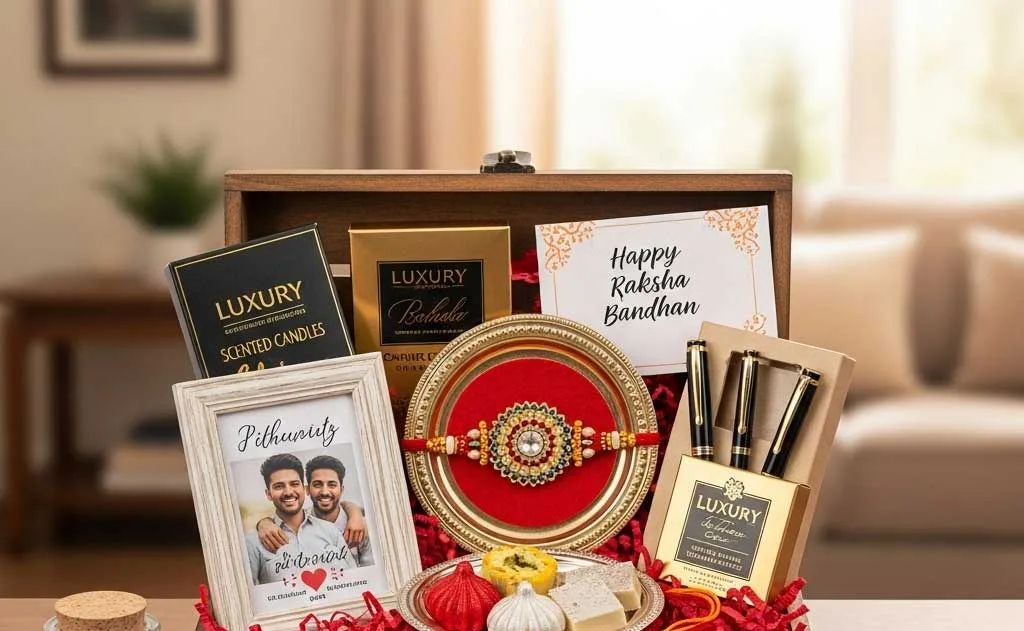
Of all the objects a tradition could have chosen to carry its most tender vow, Hindu civilisation chose a piece of string. This is what the rakhi actually means — seven layers of symbolism in the Raksha Sutra and seven lessons it asks each of us to live.
Quick answer: The rakhi is a Raksha Sutra, a thread of protection. Raksha means safeguarding; bandhan means binding. Together they describe a sacred contract in which one person binds themselves, before God, to the wellbeing of another. The thread symbolises the invisible cord that connects all beings, the vow that outlives the object, and the truth that real strength exists in order to shelter, never to dominate. The sibling relationship is the most beautiful vessel for that vow — it was never meant to be its only one.
Every year the thread is tied, the sweet is eaten, the photograph is posted. And every year a question sits unasked underneath it all: why a thread?
Of all the objects a tradition could have chosen to carry its most tender vow — a ring, a stone, a coin, a weapon — Hindu civilisation chose the humblest thing in the house. A piece of string. That choice was not accidental. It is the entire teaching, hidden in plain sight.
This is what the rakhi actually means, and what it is quietly asking each of us to become.
In Short: What Is the Spiritual Meaning of Rakhi?
The rakhi is a Raksha Sutra — a thread of protection. Raksha means safeguarding; bandhan means binding. Together they describe a sacred contract in which one person binds themselves, before God, to the wellbeing of another. The thread symbolises the invisible cord that connects all beings, the vow that outlives the object, and the truth that real strength exists in order to shelter, never to dominate.
The sibling relationship is the most beautiful vessel for that vow. It was never meant to be its only one.
Part One: Seven Layers of Meaning in a Single Thread
1. Sutra: the thread on which everything is strung
The Sanskrit word sutra carries two meanings at once. It means a thread. It also means a scripture — the Yoga Sutras, the Brahma Sutras — because an aphorism strings truths together the way a cord strings beads.
The Bhagavad Gita gives us the image directly. Sri Krishna says that all of this universe is strung upon Him as pearls are strung upon a thread — sutre mani-gana iva (7.7). The beads are visible; the thread is not. What holds reality together is precisely the thing nobody sees.
When you tie a rakhi, you are making that invisible thread briefly visible. You are pointing at the connection that was already there and saying: look, this is real.
2. Raksha: protection as duty, not as favour
In dharmic thought, protection is not generosity. It is obligation. The highest of all charitable gifts is abhaya-dana — the gift of fearlessness — ranked above the gift of food, wealth or knowledge, because a frightened person cannot receive any of the others.
To accept a rakhi is therefore not to accept a compliment. It is to accept a duty. The brother who ties on the thread and forgets it by evening has misunderstood the transaction entirely.
3. Bandhan: the binding that sets you free
Hindu philosophy is generally suspicious of binding. Moha-bandhan, the bondage of attachment, is what sadhana works to dissolve. The yogic path speaks of untying the granthis — the psychic knots at the navel, heart and brow — that keep consciousness constricted. So why does one festival celebrate a knot?
Because there are two kinds of binding. One ties you to your cravings and shrinks you. The other ties you to your duty and expands you. A vow freely taken is not a cage — it is a spine. The rakhi's knot is the second kind, and the distinction is one of the more useful things Hinduism has to offer anyone trying to live well.
4. The right wrist: the hand of action
The rakhi is tied on the dakshina hasta, the right hand. This is the hand of sankalpa — of resolve, of giving, of ritual action. Water is poured from it during a vow. Offerings are made with it.
The thread is not placed on the heart, where feeling lives, or on the head, where thought lives. It is placed on the hand, where things actually get done. The symbolism is blunt: sentiment that does not convert into action is not protection.
5. Shravana Purnima: a full moon, a full mind
Raksha Bandhan falls on the full moon that closes Shravana, the most sacred month of the Hindu year. In Vedic thought, Chandra governs the manas — the moon rules the mind. The full moon is the mind at its most complete, its most luminous, its least fragmented.
The tradition chose this day deliberately. A vow of protection is made when the mind is whole, not when it is scattered. You promise from fullness, not from lack.
6. The reversal: the weaker one binds the stronger
Look closely at who ties and who is tied in every founding story. Lakshmi binds Bali, a king of immense power. Sachi Devi binds Indra, lord of the devas. Yamuna binds Yama, the lord of death himself. In each case, the one with less worldly power places a thread on the one with more — and by that act, the greater is bound.
This is a radical statement about power. Strength is not diminished by being bound to love; it is completed by it. Unbound strength is merely force. This is why the festival has always sat comfortably alongside the kshatriya ideal: the warrior's power is legitimate only when someone weaker has a claim on it.
7. The thread frays: the vow does not
A rakhi is cotton. Within weeks it has faded, frayed and fallen away. This is not a design flaw.
The tradition could have prescribed gold. It prescribed string, because the object was never the point. What remains after the thread is gone is the only thing that was ever real. The rakhi is a receipt, not the transaction.
Part Two: Seven Lessons Raksha Bandhan Is Asking Us to Learn
Lesson 1: Protection is owed, not granted
When Yamuna tied a thread on her brother Yama, he did not thank her for the gesture and move on. He granted her immortality, and declared that any brother who receives a rakhi and pledges protection would himself be granted long life.
Note the direction of benefit. The protector gains. Dharma is arranged so that the one who shelters is the one who is enriched. If you have ever wondered why looking after someone leaves you feeling larger rather than depleted, this is the mechanism.
Lesson 2: Strength exists in order to shelter
Bali was undefeated. Indra commanded the heavens. Neither was asked to become weak. They were asked to become bound — to accept that their power had an owner outside themselves.
The lesson translates without modification into a life: your competence, your income, your position, your voice. None of it is diminished by being pledged to someone. All of it is unfinished until it is.
Lesson 3: A small act of love is repaid beyond all proportion
Draupadi did not deliberate. Krishna's finger was bleeding, and she tore her garment and bound it. It cost her a strip of cloth. At the Kaurava court, when everything was being stripped from her, the cloth did not end.
The teaching is not transactional — it is not that good deeds earn rewards. It is subtler and better: you cannot calculate what a small kindness will turn out to have been. The scale of the return has nothing to do with the scale of the giving. This alone should make us far less careful about when we help.
Lesson 4: Bonds need maintenance, not just feeling
Here is the quiet genius of making it annual. Relationships do not survive on affection. They survive on ritual — on the recurring, slightly inconvenient act that says you are still in my calendar, still in my accounts, still in my prayers. Love that is felt but never performed slowly stops being felt at all.
Once a year, the tradition compels a phone call, a journey home, a package posted overseas. It refuses to let the bond become theoretical. Anyone with a sibling they have not spoken to in eight months already knows exactly why this rule exists.
Lesson 5: Widen the circle
In 1905, Lord Curzon's partition of Bengal came into effect on 16 October, drawing a line intended to divide Hindus from Muslims. Rabindranath Tagore declared the day one of mourning, began it by bathing in the Ganga, and then walked the streets in procession tying rakhis on the wrist of everyone he met. He urged Bengalis of every religion to observe Raksha Bandhan not as a family custom but as a public act of unity, tying the thread on one another as a pledge of mutual protection and trust — transforming a religious tradition into a motif of unity in diversity, and with it resisting the Banga Bhanga.
Tagore understood something the festival had always contained: the thread has no natural edge. Nothing in the ritual restricts it to blood. A tradition that binds a sister to a brother can bind a neighbour to a neighbour, a community to a community, a citizen to a stranger — and when it does, it becomes something close to a civilisational technology for peace.
The question the day poses is simple. Who, outside your household, has a claim on your protection that you have never formally acknowledged?
Lesson 6: Learn how to receive
We speak endlessly about the giving. Almost never about the receiving. Bali, at the height of his sovereignty, extended his wrist to a woman who had come to take something from him. Yama, before whom all things end, sat still and let his sister tie a string on him. Neither deflected. Neither said you shouldn't have.
Receiving graciously is a spiritual discipline in its own right, and most of us are far worse at it than we are at giving. To accept care without embarrassment, without immediately calculating repayment, is to let someone else's love have somewhere to land.
Lesson 7: Update the vow for the world we actually live in
For most of history, raksha meant physical safety — a brother stood between his sister and harm. A sister today is far more likely to need something else: someone who defends her right to choose her own work, her own partner, her own faith and her own silence. Someone who does not report her decisions to relatives. Someone who takes her side in a room where she is not present.
The modern rakhi asks for the protection of dignity and agency, not merely of the body. A brother who would take a blow for his sister but will not speak up when she is talked over at a family gathering has honoured the letter of the vow and abandoned its spirit.
And the vow now clearly runs both ways. Sisters protect brothers — from isolation, from the silence men are trained into, from the pressure to appear invulnerable. The thread never specified a direction.
Carrying It Past the Single Day
If the meaning is real, it should survive the calendar. A few ways to let it:
- Name the vow aloud when you tie it. Not happy Raksha Bandhan — something specific. One thing you are actually undertaking for the coming year.
- Keep the thread until it falls. Let it be a reminder on the hand that acts. When it goes, immerse it in water or return it to the earth at the root of a tree.
- Tie one outside the family — a colleague, an elderly neighbour who lives alone, someone in a hospital or a shelter, a soldier. Tagore's point, made small.
- Perform abhaya-dana once during the year. Do one thing that removes fear from someone's life — a debt cleared, a difficult truth told on their behalf, a place to stay for a while.
- Read the katha to a child. A generation that receives gifts on Raksha Bandhan will pass on gifts. A generation that hears why the thread exists will pass on the thread.
Closing Thought
Hinduism could have handed us a monument. It handed us a piece of string. A monument would have told us that the sacred is grand, distant and permanent. The string tells us the opposite: that the sacred is ordinary, close at hand, and will not last unless someone renews it. That the largest vow a human being can make fits comfortably around a wrist. That what holds the universe together is invisible, and that once a year we get to make it briefly, tenderly, visible.
Tie it well. Mean it out loud. Then live the rest of the year as though the thread were still there. Shubh Raksha Bandhan from all of us at Hindutone.
Frequently Asked Questions
What is the spiritual meaning of a rakhi?
The rakhi is a Raksha Sutra, a consecrated thread of protection. It represents the invisible cord connecting all beings, a vow of safeguarding taken before God, and the principle that strength exists in order to shelter others.
What do the words raksha and bandhan actually mean?
Raksha means protection or safeguarding, and bandhan means binding or tying. Together they name a sacred contract in which one person binds themselves to another person's wellbeing.
Why is the rakhi tied on the right wrist?
The right hand is the dakshina hasta, the hand of resolve, offering and ritual action. Placing the thread there signifies that the vow must translate into deeds, not remain only a feeling.
Why is the rakhi made of simple thread rather than something precious?
Deliberately. The object is temporary and unremarkable so that attention falls on the vow rather than the gift. The thread frays; the promise is what is meant to last.
Is Raksha Bandhan only for brothers and sisters?
No. The scriptural pattern includes a goddess binding a king, a wife binding her husband, and a devotee binding the Divine. The sibling bond is the most cherished expression of the ritual, not its boundary.
How did Rabindranath Tagore use Raksha Bandhan?
During the 1905 partition of Bengal, Tagore called on Hindus and Muslims to tie rakhis on one another as a public pledge of mutual protection, turning the festival into an act of communal unity and peaceful resistance.
What is the deepest lesson of Raksha Bandhan?
That protection is a duty rather than a favour — and that the one who shelters is enriched more than the one who is sheltered.
You might also like
Vaikuntha Ekadashi 2026 — Wed 30 December: Vaikuntha Dwaram, Vrat Rules, Gita Jayanti & NRI Guide
Guru Nanak Jayanti 2026 — Wed 25 November: 557th Prakash Utsav, Gurpurab Celebrations, Langar & NRI Guide
Ganesh Mandapam Permission for Illinois 2026: Temporary Pavilions, Festival Permits & Permanent Temple Construction