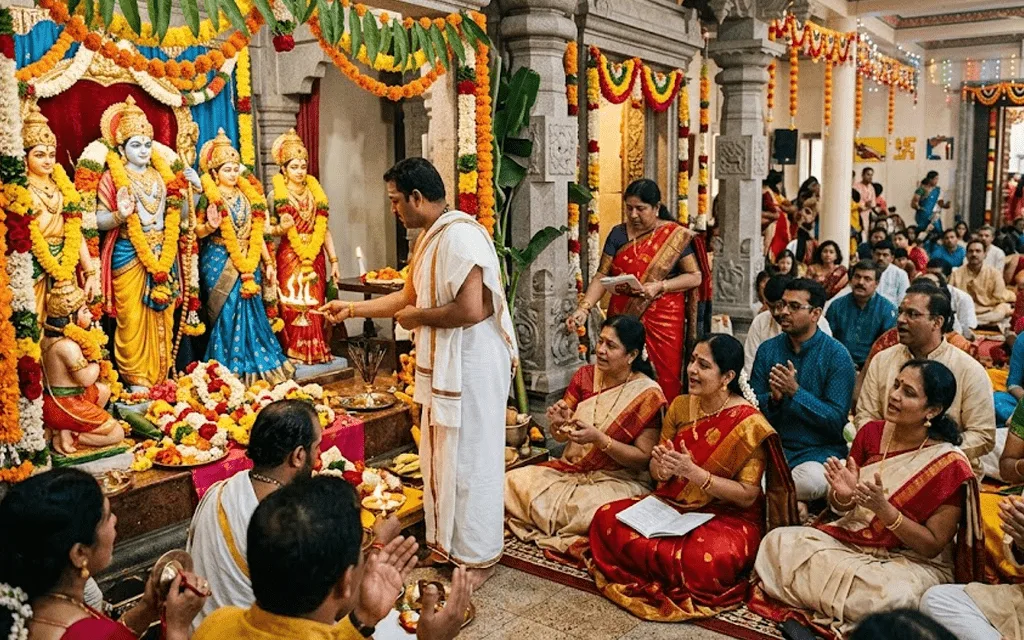
Women’s Bhakti in Chaitra Masam 2026: Navratri & Rama Navami
Women's Bhakti in Chaitra Masam 2026: Leading Navratri & Rama Navami Rituals in Parabhava Year The Sacred Authority of the Woman in Chaitra Masam Long before…

Women's Bhakti in Chaitra Masam 2026: Leading Navratri & Rama Navami Rituals in Parabhava Year
The Sacred Authority of the Woman in Chaitra Masam
Long before modern conversations about women's empowerment entered public discourse, the Vedic tradition quietly and firmly established something the world is still catching up to: women are the primary custodians of devotional life. In every Hindu household across Telangana, Andhra Pradesh, Karnataka, and Tamil Nadu, it is the woman of the home who lights the lamp before dawn. It is she who draws the kolam at the threshold, who keeps the kitchen ritually pure, who knows which mantra to whisper on which tithi. She does not merely support devotion — she is the living form of it.
In Parabhava Nama Samvatsara 2026, this role becomes even more luminous. A year that tests humility and demands inner strength is precisely the year when feminine bhakti — patient, fierce, sacrificial, and joyful — becomes the household's greatest protection. Chaitra Masam, the sacred first month beginning with Ugadi (March 30, 2026), is the season when women's spiritual leadership steps into full bloom.
This post is for every woman in Hyderabad's bustling apartments and quiet old-city homes, for working mothers managing deadlines and deity lamps, for college students navigating careers and family expectations, for grandmothers who have kept these fires alive for decades. Your devotion is not small. Your rituals are not side notes. You are the ritual.
Ugadi Preparations: The Woman as Architect of New Beginnings
The days before Ugadi (March 28–29, 2026) belong to the women of the house in a way no other festival does. The thoranam (mango leaf garlands) hung at the doorway, the kolam freshened with new patterns, the Ugadi Pachadi prepared with precise attention to all six tastes — these are not decorations. They are offerings. They transform the home into a temple before a single priest arrives.
The Ugadi Pachadi preparation is itself a meditative act. As you combine raw mango for surprise, neem flowers for bitterness, jaggery for sweetness, tamarind for sourness, green chili for sharpness, and salt for necessity, you are doing Vedic theology with your hands. You are teaching your children — through taste, not lecture — that life contains all of these, and that we receive them all with a grateful heart.
Practical tip for working women in Hyderabad: Prepare the Pachadi ingredients the night before (March 29) and store them separately. The blending itself takes only ten minutes on Ugadi morning and can be done after the morning lamp-lighting, before office commutes begin. Do not outsource this ritual — the intention of the hands that blend it is part of its sanctity.
Ghatasthapana / Kalash Sthapana: The Woman Who Consecrates Space
On the first day of Chaitra Navratri (March 30, 2026), the most significant act of the entire nine-day festival takes place: Kalash Sthapana — the consecration of the sacred pot that becomes the residence of Devi for the duration of Navratri. In many regional traditions, this ritual is performed specifically by the senior woman of the household, the grihalakshmi, whose own purity and intention sanctify the space.
How to perform Kalash Sthapana:
Place a clean, wide clay or copper pot on a bed of raw rice spread over red cloth. Fill it with Ganga water (or clean water with a drop of Ganga jal if available). Place mango leaves around the neck of the pot and a coconut wrapped in red cloth on top. Surround the Kalash with soil in which you plant barley or wheat seeds — by Navami, the sprouted shoots (called javara) represent Devi's blessings growing in the home.
Light the lamp, offer red flowers and kumkum, and invite Devi with this invocation:
"Om Durgayai Namaha. O Mother, enter this Kalash. Protect this home and all who live within it for these nine sacred days and all the days of this Parabhava year."
The Kalash is then tended daily — fresh flowers, fresh water, fresh lamp — by the women of the home. It is not merely decoration. It is a living altar, and you are its priestess.
Nine Nights, Nine Forms: Devi as Mirror for Women's Lives
The nine forms of Durga worshipped across Navratri are not abstract theological concepts. They are intimate portraits of strength that women embody every single day:
Shailaputri (Day 1) — the daughter of the mountain, steady and unshakeable. For the woman who holds her family together when everything trembles.
Brahmacharini (Day 2) — the ascetic who performs tapas for thousands of years. For the working woman who sacrifices sleep, comfort, and personal time in service of her dharma.
Chandraghanta (Day 3) — the warrior who wears the moon on her forehead and rides into battle. For the woman who must fight unseen battles at work, at home, in systems that underestimate her.
Kushmanda (Day 4) — she who created the universe with her smile. For every mother who knows that a smile in the right moment can change a child's entire world.
Skandamata (Day 5) — mother of Kartikeya, protecting while nurturing power. For mothers raising children who will lead.
Katyayani (Day 6) — the fierce warrior, answerer of prayers. For the woman praying for justice, for resolution, for a situation that has waited long enough.
Kalaratri (Day 7) — the terrifying, the liberating. For women releasing what needs to be released — fear, bad relationships, outdated roles.
Mahagauri (Day 8) — pure, radiant, restored. For women healing, renewing, reclaiming themselves.
Siddhidatri (Day 9) — the giver of all perfections. For the woman who has done the work and receives grace.
Reflect on which form speaks most directly to your life right now. That is the form to worship with special attention this Navratri.
Sita's Devotion: Ramayana's Lesson for Rama Navami
Chaitra Masam culminates in Rama Navami (April 6, 2026), the birth celebration of Lord Rama. But Sita is never absent from Rama's story — and her presence is not passive. Sita is the daughter of the Earth itself, born from a furrow in the ground, raised as a princess, tested by fire, and ultimately reclaimed by the mother who bore her. Her devotion to dharma never wavered, but it was always on her own terms.
For women leading Rama Navami rituals in 2026, Sita's example offers a powerful frame: devotion does not mean self-erasure. Sita stood in the forest, stood before Ravana, stood before the fire, and stood before a questioning kingdom — and in each place, she remained fully herself.
On Rama Navami, women can lead the Sitarama Kalyanam (the divine wedding reenactment) in home satsangs — assigning roles, decorating the altar, preparing the sacred swings (Rama jhula), and offering tulsi-scented water. This is women's liturgy, and it always has been.
Mantra for Rama Navami: "Shri Sita Ram Jai Sita Ram" — recite on behalf of the whole family.
Women-Led Satsangs & Mantra Groups: Community as Spiritual Power
One of the most potent remedies in Parabhava year is collective feminine prayer. A group of women chanting together in a home, apartment complex, or neighborhood creates a field of protection that no single individual can generate alone.
How to start a women's Chaitra satsang in Hyderabad:
- Identify 5–10 women in your apartment community, colony, or friend network
- Choose a fixed morning time — even 6:30–7:00 AM works for working women
- Rotate the host home each week so the blessing circulates
- Alternate between: Lalitha Sahasranama, Vishnu Sahasranama, Devi Mahatmyam readings, and Rama mantra jap
- End with shared prasad — even a small piece of fruit is sufficient
Many women in localities like Madhapur, Kondapur, Miyapur, and Uppal have found that these early morning circles become the most sustaining part of their week — not just spiritually, but emotionally. The satsang becomes a support system, a space of honesty, and an anchor through difficult seasons.
Daily Aarti: The Lamp That Belongs to Women
The practice of aarti — circumambulating a flame before the deity — is so intrinsically female in Indian devotion that in many temples, the inner sanctum lamp is tended exclusively by women during the domestic hours. In the home, this is your lamp.
A simple daily aarti routine for Chaitra Masam:
Morning (sunrise): Light a ghee lamp, ring the bell three times, offer a flower, and recite:
"Jai Mata Di. Om Dum Durgayai Namaha."
Evening (sunset): Light a sesame oil lamp for Hanuman or Vishnu, offer incense, and sing or hum a verse of the Hanuman Chalisa or Vishnu Sahasranama — even two minutes of this anchors the home in sacred sound.
For working women: The morning aarti before leaving the house functions as both prayer and protection. Even if you are rushing, the act of pausing before the lamp — truly pausing, eyes closed, thirty seconds — changes the quality of the entire day.
Fasting with Wisdom: Devotion Without Depletion
Many women observe fasts during Navratri, Ekadashi, and Rama Navami. This is beautiful — but Parabhava year asks for sustainable devotion, not performative suffering. Bhakti should strengthen you, not hollow you out.
Guidelines for wise fasting in Chaitra Masam 2026:
- Fruit and milk fasts are appropriate for working women who need sustained energy
- Ekadashi fasts (March 31 and April 15) can be observed as partial fasts (one grain-free meal)
- Avoid fasting that leads to irritability, weakness at work, or martyrdom energy — these do not serve Devi
- Stay hydrated. Coconut water, buttermilk, and sabudana are traditional fasting foods that genuinely sustain
Consult your own body with the same reverence you bring to the Goddess — because the Goddess lives there too.
A Prayer for Women Leading This Chaitra Masam
O Devi, who is the fire that does not ask permission to burn — O Sita, who is the earth that endures and endures and endures — O every grandmother who lit a lamp in the dark and did not explain herself —
Bless the women of this household. Bless the women who wake before dawn. Bless the women managing temples and toddlers and Teams meetings. Bless the women who are learning to ask for more and the women who have always given everything.
In this Parabhava year, let our devotion be our dignity. Let our ritual be our resistance. Let our lamp be our leadership.
Om Shri Durgayai Namaha. Jai Siya Ram.
Closing: The Year Bows to the Devoted Woman
Parabhava year tests ego and pride — qualities that the feminine principle, in its truest Vedic expression, has always known to hold lightly. In that sense, this Samvatsara was perhaps designed with women's wisdom in mind. The patient lamp-keeper, the dawn riser, the woman who has always known that devotion IS power — she does not fear Parabhava. She transforms it.
Lead the Ghatasthapana. Gather the satsang. Light the lamp. Sing the aarti. Tell your daughters that these are not small things. These are the things the year turns on.
Jai Mata Di. Shubh Chaitra Masam 2026.
This post honors all women across traditions who keep sacred fire alive in their homes and communities. For personalized devotional guidance, consult a trusted temple panditji or family elder.
Frequently Asked Questions
When does Chaitra Masam begin in 2026 and when is Rama Navami?
Chaitra Masam begins with Ugadi on March 30, 2026, which is also the first day of Chaitra Navratri. Rama Navami, the birth celebration of Lord Rama, falls on April 6, 2026.
How do women perform Kalash Sthapana on the first day of Navratri?
Place a clean clay or copper pot on raw rice over red cloth, fill it with Ganga water or clean water, and set mango leaves and a red-cloth-wrapped coconut on top. Plant barley or wheat in soil around it, light a lamp, offer red flowers and kumkum, and invite Devi.
What are the six tastes in Ugadi Pachadi?
Raw mango for surprise, neem flowers for bitterness, jaggery for sweetness, tamarind for sourness, green chili for sharpness and salt for necessity. Working women can prepare the ingredients the night before and blend them on Ugadi morning after the lamp-lighting.
Which forms of Durga are worshipped during the nine days of Navratri?
The nine forms are Shailaputri, Brahmacharini, Chandraghanta, Kushmanda, Skandamata, Katyayani, Kalaratri, Mahagauri and Siddhidatri, one for each day in that order. Devotees may give special attention to the form that speaks most to their own life.
How can women in Hyderabad start a Chaitra satsang?
Gather 5 to 10 women from your apartment community or friend network, fix a morning time such as 6:30 to 7:00 AM, and rotate the host home weekly. Alternate Lalitha Sahasranama, Vishnu Sahasranama, Devi Mahatmyam and Rama mantra japa, and end with shared prasad.
What simple daily aarti can women follow in Chaitra Masam?
In the morning, light a ghee lamp, ring the bell three times, offer a flower and recite "Om Dum Durgayai Namaha". In the evening, light a sesame oil lamp for Hanuman or Vishnu, offer incense and sing a verse of the Hanuman Chalisa or Vishnu Sahasranama.
Share this with family and friends
Send it on WhatsApp, post it, or copy the link.
More from Sri Ram Navami
- Sita Rama Kalyanam: The Divine Union – Eternal Love, Dharma & Bhakti
- Sri Rama Navami 2026 in New Zealand: Devotional Celebrations, Temple Events & Jai Shri Ram Spirit in Aotearoa
- Sri Rama Navami 2026: How India is Celebrating Lord Rama’s Birth with Divine Devotion, Grand Temple Processions & Sita Rama Kalyanam
- Ram Navami 2026 in USA: Date, Puja Timings, Significance & Simple Home Ritual Guide
- Ram Navami 2026 in the USA: Date, Puja Timings & Simple Home Ritual Guide
You might also like
Navratri 2026: Complete Guide to the Nine Days of Worship, Dates, Colors, Goddesses & Rituals

Dussehra 2026 (Vijayadashami) in New York, USA f

How Hindus Should Celebrate Dussehra and Diwali 2026