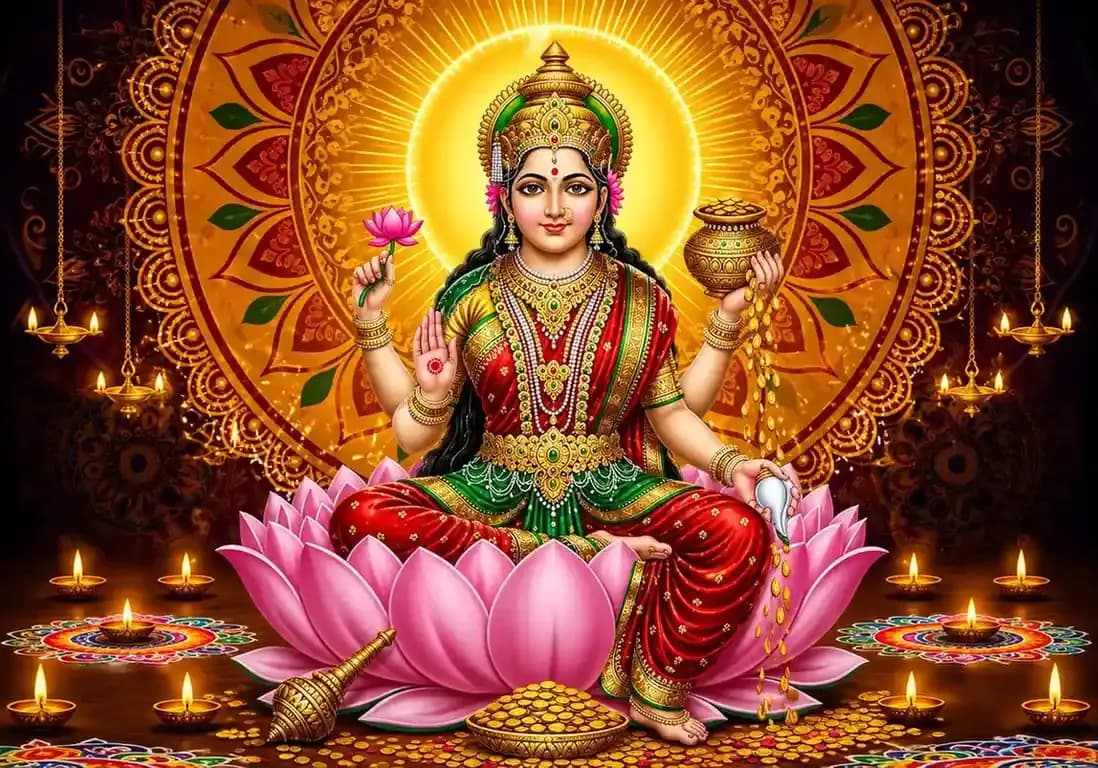
Varalakshmi Vratam 2026 Europe: Date, Puja Timings and Country-by-Country Guide
When is Varalakshmi Vratam 2026 in Europe and how do you keep it across Germany, France, the Netherlands and the Nordics? A practical, date-honest, apartment-friendly guide.

When is Varalakshmi Vratam 2026 in Europe and how do you keep it across Germany, France, the Netherlands and the Nordics? A practical, date-honest, apartment-friendly guide.
Quick answer: Varalakshmi Vratam 2026 falls on Friday 21 August 2026 in most Telugu, Tamil and Kannada panchangs, while some panchangs mark Friday 28 August 2026. Both are valid Shravana Fridays; follow your family, kula or local-temple tradition. In Europe, always compute the muhurat in local CEST or GMT using a drik panchang.
Varalakshmi Vratam is one of the most beloved Shravana-month vows for Lakshmi, the goddess of prosperity and auspiciousness. For families across Europe — from Frankfurt and Paris to Amsterdam, Zurich, Dublin and the Nordics — the vratam is a way to carry a warm Telugu, Tamil and Kannada household tradition into a very different climate and calendar. This hub explains the 2026 date honestly, how to read a European muhurat, and how to source everything you need country by country.
Before anything else: two dates are in circulation for 2026, and this guide treats both as legitimate. Which one your family keeps depends on the panchang lineage you follow, not on being right or wrong.
- Festival: Varalakshmi Vratam (Sri Varalakshmi Vratham)
- Primary date 2026: Friday, 21 August 2026 (most Telugu/Tamil/Kannada panchangs)
- Alternate date 2026: Friday, 28 August 2026 (some panchangs)
- Month: Shravana (Shukla paksha Friday)
- Deity: Goddess Lakshmi as Varalakshmi
- Region in Europe: Germany, France, Netherlands, Switzerland, Ireland, Nordics + rest
- Time reference: Local CEST / GMT — never assume IST
Which date is correct for 2026?
Both dates are correct within their own tradition. Most Telugu, Tamil and Kannada panchangs place Varalakshmi Vratam on the Friday before the Shravana Purnima, which in 2026 is Friday 21 August. Some panchangs — and some family customs — observe it on Friday 28 August. Neither is wrong. The vratam is fundamentally a Shravana-Friday vow, and more than one Friday qualifies depending on how the paksha and tithi are counted.
The safest approach is simple: follow your family, kula or local-temple tradition. If your temple in Europe announces a date, that resolves it for your community. For the full reasoning and the tithi window, see our date explainer, and if you are unsure which panchang to trust abroad, read which panchang NRIs should follow.
Reading a European muhurat: local time vs IST
The single biggest mistake European NRIs make is copying an Indian muhurat clock time. A muhurat published for Chennai or Hyderabad is computed for Indian Standard Time and Indian sunrise. Central Europe (CEST, UTC+2 in August) is three and a half hours behind IST; Ireland and the UK on GMT/IST-summer are four and a half hours behind. Sunrise, sunset and lagna windows all shift accordingly.
Rather than printing any clock time here, we name the traditional lagna windows and ask you to derive the actual local times from a drik panchang set to your city.
- Simha lagna — a favoured morning window many families use before work.
- Vrishchika lagna — a strong daytime option, often mid-to-late morning in Europe.
- Kumbha lagna — an afternoon window, useful when the morning is impossible.
- Vrishabha lagna — the classic evening sthira-lagna window, ideal for working households.
Choose the lagna your family traditionally uses, then look it up in a local drik panchang app or site configured to your European city and to CEST/GMT. Do not reuse an Indian time. Our puja vidhi guide walks through the ritual order once you have your window.
Three observance versions
Not every European household can take a full festival day off. Pick the version that fits your life; the intention (sankalpa) matters more than scale.
- 30-minutes-before-work version: a small kalasha or a framed Lakshmi image, a lamp, one flower, turmeric-kumkum, and a short Varalakshmi ashtottara or a few names of the goddess. Offer a simple naivedyam and resolve to complete a fuller puja in the evening or on the weekend.
- Full version: the traditional kalasha with coconut, mango leaves (or a substitute), new cloth, the Varalakshmi face or coin, nine-thread toram tied on the wrist, ashtottara, and a proper naivedyam of sweet rice or payasam. Best done in a chosen lagna window.
- Evening version: for working households, set up after the workday in the Vrishabha (evening) window, do the full kalasha puja calmly, and invite a few friends for the toram and prasadam. This is the most realistic option across Europe.
Germany
Germany has the largest and most organised Hindu infrastructure in continental Europe, largely built by the Sri Lankan Tamil community. The Sri Kamadchi Ampal temple in Hamm is the best-known hub, and there are active communities in Frankfurt, Munich, Hamburg, Stuttgart and Cologne. Telugu and Tamil associations in these cities typically hold or coordinate collective observances. German-Indian grocery stores (organiser-type: Asian/Indian supermarkets and Tamil-run shops) reliably stock turmeric, kumkum, coconuts and often fresh flowers; mango leaves appear seasonally.
France
France's Hindu life centres on Paris, especially the La Chapelle area (around Rue du Faubourg-Saint-Denis), a dense Sri Lankan Tamil quarter with temples and shops that make sourcing genuinely easy. Lyon, Toulouse and Marseille have smaller communities. For Varalakshmi Vratam you will find kalasha materials, coconuts, flowers and pooja items in the Tamil shops of La Chapelle; ask about a local temple's announced date, as many Paris families align to it.
Netherlands
The Netherlands has two distinct Hindu populations: recent South-Indian tech-and-student arrivals in Amsterdam, Eindhoven, Rotterdam and Utrecht, and the long-established Surinamese-Hindustani community whose roots trace to indentured migration. The Surinamese-Hindustani community has its own mandirs and a mature Hindu retail presence, which makes pooja sourcing easier than the population size alone would suggest. Telugu families can usually find kalasha items and coconuts in Surinamese toko shops even where South-Indian specifics are scarce.
Switzerland
Switzerland hosts a well-organised Sri Lankan Tamil Hindu network with temples serving Zurich, Geneva, Basel, Bern and the surrounding cantons. Indian and Sri Lankan grocery shops in the larger cities stock the essentials. Prices run high, and fresh mango leaves can be hard to find outside temple supply, so plan a substitute in advance.
Ireland
Ireland's Hindu community is concentrated in Dublin, with smaller clusters in Cork, Limerick and Galway. It is a younger, largely professional migration, so organised temple infrastructure is thinner than in Germany or France, but Indian grocery stores in Dublin stock most pooja items. Ireland is on IST-summer (GMT+1) — remember this is Irish Summer Time, not Indian Standard Time — so compute your muhurat on a Dublin-set drik panchang, not an Indian one.
The Nordics (Sweden, Denmark, Norway, Finland)
The Nordics have a real Sri Lankan Tamil temple presence — Norway in particular has established Hindu temples serving Oslo and other cities — alongside growing South-Indian tech communities in Stockholm, Copenhagen, Gothenburg and Helsinki. The challenge here is the far north: fresh mango leaves are genuinely difficult to source, and daylight patterns are extreme. Lean on temple networks for community observance and plan substitutes early. Compute muhurat locally; the Nordics are on CEST in August (Finland on EEST, one hour ahead).
Europe-wide comparison
| Country | Main cities | Time zone (Aug) | Community context | Sourcing difficulty |
|---|---|---|---|---|
| Belgium | Brussels, Antwerp | CEST | Tamil + South-Indian mix, some temples | Moderate |
| Italy | Rome, Milan | CEST | Growing South-Indian + Tamil, few temples | Moderate to hard |
| Spain | Madrid, Barcelona | CEST | Smaller South-Indian community | Moderate to hard |
| Austria | Vienna | CEST | Small but active Hindu community | Moderate |
| Poland | Warsaw, Krakow | CEST | Newer tech migration, limited temples | Hard |
Sourcing table: item, where in-country, substitute
| Item | Where in Europe | Substitute |
|---|---|---|
| Coconut | Any Indian/Asian/Turkish grocery | Whole coconut is widely available; use a fresh one |
| Mango leaves | Tamil/South-Indian shops seasonally; temples | Betel/paan leaves, fresh curry leaves, or clean ashvattha/peepal-style green leaves; even fresh bay or beech twigs as a respectful stand-in in the far north |
| Turmeric & kumkum | Every Indian grocery | Turmeric powder for haldi; sindoor/kumkum widely stocked |
| Flowers | Supermarkets + florists | Any fresh, unfaded flowers; local roses/marigold alternatives are fine |
| Toram thread | Indian shops; make your own | Nine strands of clean cotton/yellow thread turmeric-smeared |
| Naivedyam items | Indian grocery | Rice, jaggery, ghee for payasam; any home sweet is acceptable |
Apartment realities
Most European NRIs live in flats with smoke detectors, shared stairwells and strict tenancy rules. This is entirely compatible with the vratam. Use a small deepa with limited camphor rather than a large flame; keep a window cracked; place a bowl of water nearby; and avoid heavy dhoop near detectors. A framed Lakshmi image with a kalasha works beautifully in a corner shelf or a repurposed side table — no permanent altar is needed. Cleanliness, bhakti and a steady lamp matter more than a large setup.
For a deeper, step-by-step abroad-specific walkthrough including toram tying and the ashtottara, see our NRI guide, and the main Varalakshmi Vratam 2026 pillar for the full festival context.
Related reading
- Varalakshmi Vratam 2026 date: 21 or 28 August?
- Which panchang should NRIs follow?
- Varalakshmi Vratam 2026 (main pillar)
- Varalakshmi Vratam 2026 puja vidhi
- Varalakshmi Vratam 2026 NRI guide
Frequently Asked Questions
When is Varalakshmi Vratam 2026 in Europe?
Varalakshmi Vratam 2026 falls on Friday 21 August 2026 in most Telugu, Tamil and Kannada panchangs, and on Friday 28 August 2026 in some panchangs. Both are valid Shravana Fridays. Follow your family, kula or local-temple tradition, and compute the muhurat in your local European time using a drik panchang set to your city.
Should I use the Indian muhurat time in Europe?
No. Indian muhurat times are computed for Indian Standard Time and Indian sunrise. Central Europe is about three and a half hours behind IST in August, and Ireland is further behind. Use a local drik panchang set to your city and time zone, then observe the vratam in your chosen lagna window rather than reusing an Indian clock time.
Which lagna windows are used for the puja?
Traditionally four sthira and favourable lagna windows are used: Simha (a morning option before work), Vrishchika (mid-to-late morning), Kumbha (afternoon) and Vrishabha (the classic evening window ideal for working households). Choose the one your family follows and look up its exact local time in a drik panchang configured for your European city.
What can I use if I cannot find mango leaves in northern Europe?
Fresh mango leaves are seasonal and hard to source in the far north. Respectful substitutes include betel or paan leaves, fresh curry leaves, or clean green leaves such as peepal-style, bay or beech twigs. The kalasha and your bhakti carry the observance; a genuine, clean-leaf substitute is fully acceptable when mango leaves are unavailable.
Can I do Varalakshmi Vratam in a small apartment?
Yes. A framed Lakshmi image or a small kalasha on a corner shelf is enough. Use a small deepa with limited camphor, keep a window slightly open, place water nearby, and avoid heavy incense near smoke detectors. No permanent altar is required. Cleanliness, a steady lamp and sincere sankalpa matter far more than the size of the setup.
Where do Europe's organised Hindu temples come from?
Much of Europe's organised Hindu infrastructure was built by the Sri Lankan Tamil community — for example the temple network around Hamm in Germany, La Chapelle in Paris, communities across Switzerland, and established temples in Norway. In the Netherlands, the long-settled Surinamese-Hindustani community adds mandirs and mature Hindu retail, making pooja sourcing easier.
What is a quick 30-minute version of the vratam?
Set up a small kalasha or a framed Lakshmi image with a lamp, one flower, turmeric and kumkum. Offer a simple naivedyam, recite a short Varalakshmi ashtottara or a few names of the goddess, and make a sankalpa to complete a fuller puja in the evening or at the weekend. Intention matters more than scale.
Do all European countries observe on the same date?
Not necessarily. The date depends on the panchang lineage and on what your local temple announces, not on the country. Many families in Paris, Frankfurt or Zurich align to their temple's declared Friday. Whether your community keeps 21 or 28 August 2026, both are valid; follow your family, kula or local-temple tradition rather than assuming a single European date.
Related guides you may find helpful
You might also like

Rama Ekadashi 2026: Date, Vrat Katha, Puja Vidhi & Significance

Champa Shashthi 2026: Date, Khandoba Worship & Jejuri's Golden Festival

Kati Bihu 2026: Date, Rituals & Assam's Festival of Earthen Lamps