Why Kavady Devotees Wear Yellow?
Origins of the Kavady Festival The ancient tribes of India began the Kavady festival by worshipping the rising sun.
Origins of the Kavady Festival
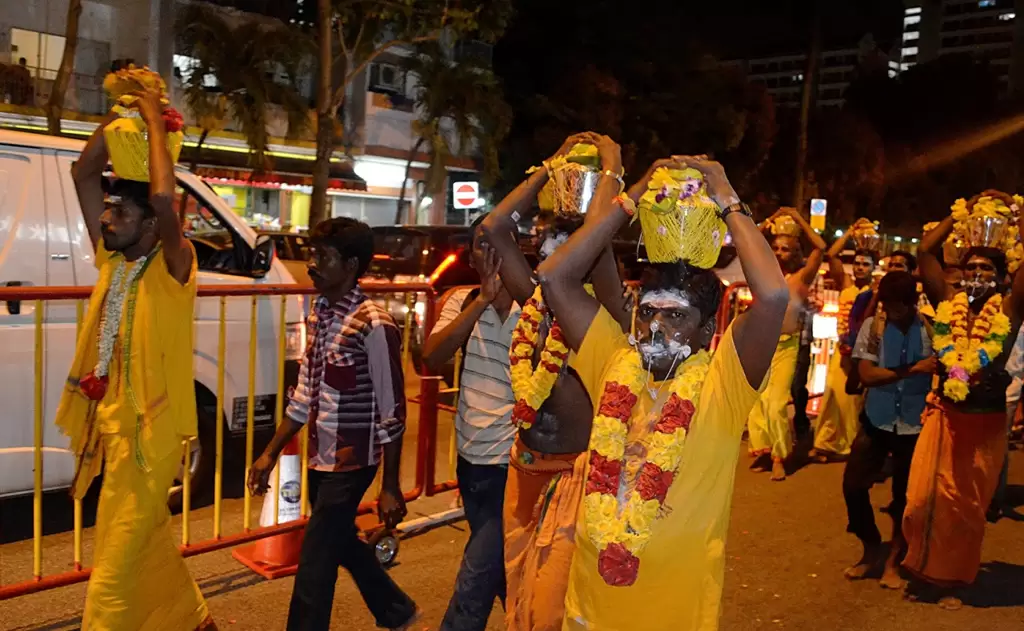
The ancient tribes of India began the Kavady festival by worshipping the rising sun. They believed that the sun not only provided heat and light but also had the power to burn away sins and redeem devotees. Over time, they recognized the sun as Lord Muruga.
The sun was perceived as yellow, and this color eventually became associated with the Kavady festival. As a result, devotees wear yellow when participating in Kavady rituals. This color represents purity, auspiciousness, and spiritual enlightenment.
Lord Subramanya (Muruga) – The Divine Warrior
Subramanya, also known as Kartikeya, is the son of Lord Shiva and Goddess Parvati. He is revered by many names, including Muruga, Kumara, Skandha, Shanmuga, and Guha.
Created from six divine sparks emerging from Lord Shiva’s third eye, Kartikeya was born with the purpose of defeating the demon Soorapadma. He is depicted with six faces, adorned with red vermilion, and riding a divine peacock.
Symbolism of Lord Muruga
- Known for his intelligence and leadership as the commander of the Deva (divine) army.
- His weapon, the Vel (spear), symbolizes the source of all knowledge and dispels ignorance.
- Worshipped as the curer of all diseases.
Kartikeya and the Significance of "OM"
According to legend, Kartikeya once explained the esoteric meaning of "OM", the Pranava Mantra, to his father, Lord Shiva. This made Krithika and Sashti especially auspicious days dedicated to him.
Festivals Celebrated in Honor of Lord Muruga
- Thai Poosam
- Panguni Uthiram
- Vaikasi Visakam
- Kandha Shashti
Lord Subramanya’s Consorts
Lord Subramanya has two consorts:
- Devasena – The celestial princess and daughter of Indra.
- Valli – The daughter of Nambirajan, a hunter king.
His major shrines are known as the Aaru Padai Veedu (Six Sacred Abodes), which include:
- Palani
- Swami Malai
- Thiruthani
- Thiruchendur
- Pazhamudircholai
- Thiruparankundram
Yellow in the Kavady Festival
During the Kavady festival, devotees wear yellow due to its connection to the sun and association with Lord Muruga. The color symbolizes:
- Purity
- Auspiciousness
- Spiritual growth
Wearing yellow during the festival has become a sacred tradition, signifying a devotee's dedication, spiritual awakening, and connection to divine energy.
What does the colour yellow signify in Vedic and Agamic tradition?
In the Vedic colour symbolism, yellow — known in Sanskrit as Pita — is closely associated with Surya (the Sun), Agni (sacred fire), and Vishnu, whose iconic pitambara (yellow silk garment) represents divine radiance and the dissolution of spiritual ignorance. The Rigveda repeatedly invokes the sun's golden rays as a purifying force, and this ancient association flows directly into the Kavady tradition, where devotees don yellow clothing to align themselves with solar and divine energy before approaching Lord Muruga.
The Shaiva Agamas, which govern the ritual worship at Muruga's Aaru Padai Veedu temples, prescribe specific colours for different modes of devotion. Yellow is classified as a sattvic colour — one that calms the mind, elevates consciousness, and prepares the devotee for darshan. Wearing yellow during Kavady is therefore not merely customary; it is a deliberate ritual act (kriya) that signals the devotee's vow of purity and single-pointed devotion to Skanda throughout the period of the festival.
Turmeric, the natural source of bright yellow pigment, also holds deep ritual significance. Applied to the body as a paste (manjal) before the procession, it is considered both purifying and auspicious, echoing the use of haridra described in various Grihya Sutras for rites of passage and votive worship.
What is the mythological origin of the Kavady itself as a physical offering?
The most widely cited Puranic account of the Kavady's origin centres on the sage Agastya and his disciple Idumban. After the churning of the cosmic ocean, two hills — Sivagiri and Saktigiri — were to be transported to Palani at the command of Lord Shiva. Agastya entrusted Idumban to carry them. Idumban fashioned a yoke (kavadu) of wood, suspended each hill at either end with a serpent serving as the rope, and set off. When he stopped to rest near Palani, he found he could not lift the hills again. Atop the smaller hill stood a young boy — Lord Muruga himself — who refused to yield the hill. After a fierce contest and the eventual recognition of the divine presence, Idumban surrendered and sought a boon: that anyone who carries a kavadu in his name may be blessed by Muruga.
This legend is the reason the Kavady (kavadu) traditionally takes the form of two arched wooden or metal frames balanced on the shoulders, mirroring Idumban's original yoke carrying the two hills. Devotees who pierce their bodies with vel (spear-shaped skewers) during the procession symbolically re-enact the transformation of Idumban — from adversary to ardent devotee — demonstrating that ego and pain must be transcended before the Lord's grace is received.
How does the Kavady festival connect to the Tamil month of Thai Poosam?
The most prominent Kavady observance occurs on Thai Poosam, which falls in the Tamil month of Thai (January–February) when the full moon aligns with the Poosam (Pushya) nakshatra. According to the Skanda Purana, it was on this day that Goddess Parvati presented Lord Muruga with his divine vel (spear) so that he could vanquish the asura Soorapadma. The vel is therefore the defining symbol of this festival, and carrying a kavady topped with a vel is the devotee's way of honouring that celestial gift.
In Tamil Nadu, Thiruparankundram and Palani — two of the six Aaru Padai Veedu — draw the largest Thai Poosam crowds, with processions stretching for several kilometres. In Malaysia and Singapore, Thai Poosam at Batu Caves and the Sri Thendayuthapani Temple has grown into one of the largest annual Hindu gatherings outside India, demonstrating how the diaspora Tamil community has preserved and amplified this tradition. Throughout all these celebrations, yellow-clad devotees carrying kavadys form the living core of the procession.
What spiritual disciplines must a Kavady devotee observe before the festival?
A devotee who undertakes the Kavady vow (viratham) traditionally observes a period of fasting and austerity lasting anywhere from three days to a full month before the festival day. During this time the devotee abstains from non-vegetarian food, sexual activity, intoxicants, and any form of conflict or falsehood — practices that map closely onto the yama and niyama disciplines described in Patanjali's Yoga Sutras and echoed in the Shaiva Siddhanta texts that govern Tamil Shaivism.
The devotee sleeps on the floor, bathes twice daily in cold water, and repeats the names of Lord Muruga — particularly the mantra 'Vel Muruga Haro Hara' — as a form of japa. This sustained sadhana is understood to progressively purify the sthula sharira (gross body) and the sukshma sharira (subtle body), so that by the time the kavady is lifted onto the shoulders, the devotee is in a heightened state of devotional consciousness. In this state, devotees who undergo vel piercing frequently report experiencing no pain, which devotees interpret as Lord Muruga's grace (arul) sustaining them through the ordeal.
How is Lord Muruga's vel understood as a symbol of jnana (knowledge)?
The Vel, Muruga's primary weapon, is described in Tamil Shaiva literature — particularly the Kanda Puranam composed by Kachiyappa Sivachariyar — not merely as a physical spear but as the embodiment of Jnana Shakti, the power of supreme knowledge. Its pointed tip represents the penetrating quality of wisdom that cuts through avidya (ignorance), while its broad base represents the all-encompassing nature of divine consciousness. This is why temples dedicated to Muruga often inscribe 'Vel, Vel, Vettri Vel' as a mantra — invoking victory through knowledge rather than brute force.
The incident in which the young Kartikeya explains the deeper meaning of the Pranava mantra 'OM' to his father Shiva — so thoroughly that Shiva must accept him as guru — appears in several Tamil devotional texts and gives rise to one of Muruga's celebrated epithets: Swaminatha, 'he who became the teacher of his own father.' This motif underscores the Shaiva philosophical principle that the divine can be encountered in any form, even that of a child, and that true knowledge transcends age, lineage, or social status.
For Kavady devotees, carrying the vel-topped frame is therefore an act of seeking that same liberating knowledge. The physical weight of the kavady is consciously understood as the weight of karma and worldly attachment; completing the procession to the temple represents the soul's journey toward Muruga's feet — and toward jnana.
Frequently Asked Questions
Why do Kavady devotees wear yellow?
Yellow is linked to the sun, which ancient tribes worshipped and later recognized as Lord Muruga. The color represents purity, auspiciousness and spiritual growth.
What is the origin of the Kavady as a physical offering?
As commonly told, the sage Agastya asked his disciple Idumban to carry the hills Sivagiri and Saktigiri to Palani on a wooden yoke. Idumban surrendered to Lord Muruga there and asked that anyone carrying a kavadu in his name be blessed.
What vows does a Kavady devotee observe before the festival?
Devotees fast and keep austerity from three days to a full month. They avoid non-vegetarian food, intoxicants, conflict and falsehood, sleep on the floor, bathe twice daily in cold water and chant Muruga's names.
What is the significance of turmeric in Kavady rituals?
Turmeric is the natural source of bright yellow pigment. Applied as a paste (manjal) on the body before the procession, it is considered purifying and auspicious.
Which festivals are celebrated for Lord Muruga?
These include Thai Poosam, Panguni Uthiram, Vaikasi Visakam and Kandha Shashti. His major shrines are the six Aaru Padai Veedu, including Palani, Thiruchendur and Thiruparankundram.
Where is Thai Poosam celebrated by the diaspora?
In Malaysia and Singapore, Thai Poosam at Batu Caves and the Sri Thendayuthapani Temple is among the largest annual Hindu gatherings outside India. Yellow-clad devotees carrying kavadys form the heart of the procession.
Share this with family and friends
Send it on WhatsApp, post it, or copy the link.
More from Festivals
- Dev Deepawali 2026 Varanasi: Date, Purnima Time, Ganga Aarti, Story, Puja Vidhi and Deep Daan
- Kartik Purnima 2026: Date, Purnima Time, Snan, Deep Daan, Puja Vidhi and Significance
- Raas Purnima 2026 in Assam: Date, Majuli Raas Mahotsav, Story and Celebrations
- Tulsi Vivah 2026: Date, Puja Vidhi, Samagri, Katha and Significance
- Dussehra 2026 Date, Puja Muhurat, Significance and Celebrations Around the World
You might also like
Must-Perform Rituals in Karthika Masam 2026: Complete State-Wise Guide for Devotees Across India
Vasant Panchami 2027 (Saraswati Puja, Basant Panchami, Sri Panchami): Date, Panchami Tithi, Puja Muhurat by City, Vidhi and Story
Holi 2027: Date, Holika Dahan Muhurat City-Wise, Bhadra Timings, Puja Vidhi and Holi Abroad