Why Do Married Hindu Women Perform Varalakshmi Vratam?
Discover why married women (sumangali) traditionally keep Varalakshmi Vratam for family wellbeing and prosperity, the Charumathi story behind it, and how many families and temples today welcome unmarried women and all devotees.
Discover why married women (sumangali) traditionally keep Varalakshmi Vratam for family wellbeing and prosperity, the Charumathi story behind it, and how many families and temples today welcome unmarried women and all devotees.
Quick answer: Married Hindu women traditionally perform Varalakshmi Vratam as sumangalis, inviting Goddess Lakshmi into the home to bless the family with health, harmony and prosperity. The custom draws on the Charumathi story from the Skanda Purana. Today many families and temples warmly welcome unmarried women, widows and all devotees too.
Varalakshmi Vratam is one of the most cherished observances in South Indian households, kept on the Friday before the full moon in the month of Shravana. In most Telugu, Tamil and Kannada panchangs, Varalakshmi Vratam 2026 falls on Friday 21 August 2026, while some panchangs place it on Friday 28 August 2026. Neither is wrong; the difference comes from how the lunar month is reckoned, so please follow your family, kula or local-temple tradition.
A question devotees often ask is why the vratam is so strongly associated with married women. The short answer lies in tradition and symbolism, not in exclusion. The married woman, or sumangali, is honoured as a living embodiment of Lakshmi's grace within the household, and she keeps the vow chiefly for the wellbeing of her family. Yet the deeper spirit of the vratam is welcoming and generous, and today many homes and temples happily include unmarried women, widows and every sincere devotee.
The sumangali tradition and its meaning
The word sumangali refers to a woman whose husband is living, and in classical custom she is regarded as auspicious, a bearer of mangalam or wellbeing. Because Goddess Lakshmi herself is the eternal consort of Vishnu and the very form of auspiciousness, the sumangali is seen as her earthly reflection. When such a woman invites Lakshmi into her home through the vratam, tradition holds that she is welcoming prosperity, harmony and grace on behalf of the entire family.
This is why the vratam is often described as a prayer offered not for oneself alone but for one's husband, children, elders and household. The married woman becomes, for that day, the hostess who receives the Goddess. It is an act of devotion woven into the fabric of family life, which is one reason the custom has been carried lovingly from one generation of women to the next.
Symbolism of inviting Lakshmi home
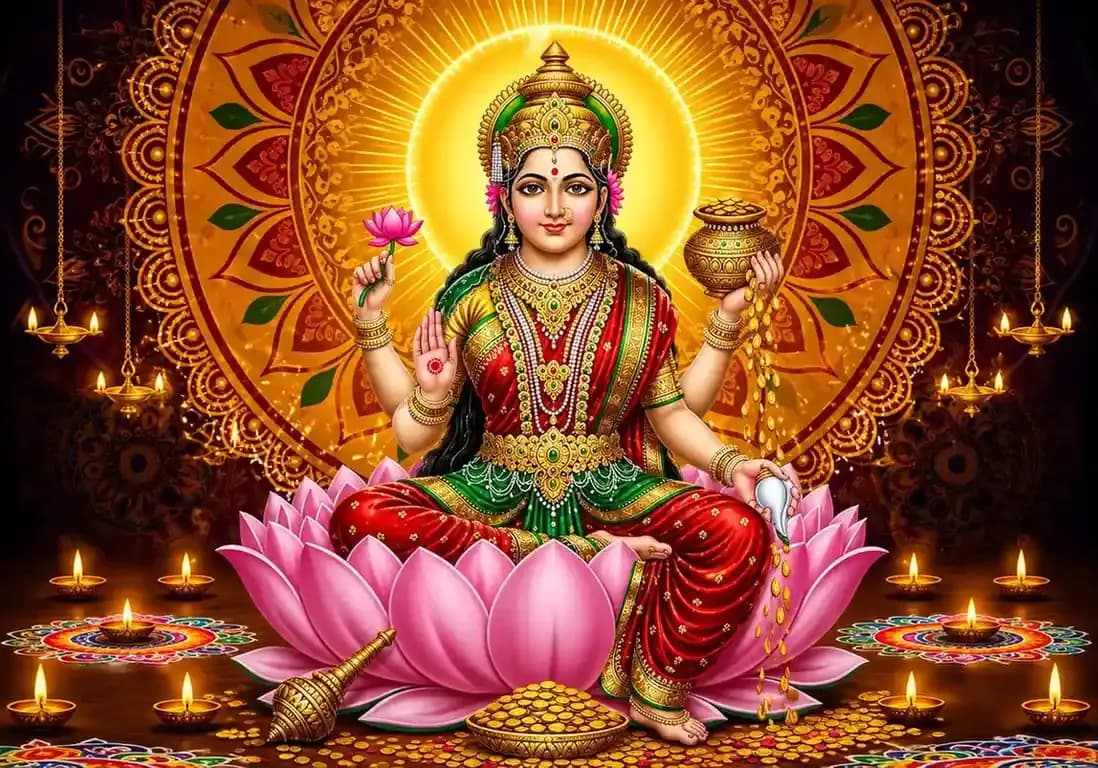
The heart of Varalakshmi Vratam is the belief that Lakshmi, the giver of boons (vara), can be honoured in the home just as she is in the temple. The kalasam or sacred pot, adorned as the Goddess with a face, ornaments and a sari, symbolises her presence. The married woman decorating and worshipping this form enacts a beautiful idea: that the home itself is a shrine, and the woman who tends it is its priestess for the day.
- The sumangali is honoured as a living reflection of Lakshmi's auspiciousness.
- The kalasam represents the Goddess invited to reside in the home.
- The vow is kept chiefly for family wellbeing, not personal gain.
- Turmeric, kumkum and flowers signify mangalam and abundance.
- Sharing tamboolam with other women extends the blessing outward.
The Charumathi story behind the vratam
The traditional origin of Varalakshmi Vratam is told in the Skanda Purana. According to the account, Goddess Parvati asked Lord Shiva which single vow a woman could keep to secure prosperity and happiness for her family. Shiva narrated the story of Charumathi, a devout and virtuous woman of Kundinapura who was deeply devoted to her husband and household.
Pleased by her devotion, Goddess Lakshmi is said to have appeared to Charumathi in a dream and instructed her to perform the vratam on the Friday before the Shravana full moon. Charumathi gathered the other women of her town and worshipped the Goddess together. Tradition relates that their homes were blessed with prosperity and wellbeing, and the observance spread from there. The story explains both why the vratam is linked to married women and why it has always been a shared, community-minded celebration among women.
| Element | What it represents |
|---|---|
| Sumangali | A married woman honoured as a form of Lakshmi's auspiciousness |
| Kalasam | The sacred pot in which the Goddess is invited to reside |
| Charumathi story | The Skanda Purana account that anchors the tradition |
| Friday in Shravana | The auspicious day for inviting Varalakshmi home |
| Tamboolam sharing | Extending blessings and goodwill to other women |
Who performs the vratam today?
While the classical association is with married women, the living tradition is far more welcoming than a strict rule. Practice varies by region, family and temple, and it is best understood as a range rather than a single requirement. Many households today invite unmarried daughters, widowed elders and even devotees of any background to join the worship, on the reasoning that Lakshmi's grace is for all who seek it sincerely.
- Married women (sumangalis) keep the vratam for family wellbeing, the most widespread custom.
- Unmarried women in many families now perform or join the puja, praying for prosperity and a good future.
- Widowed and elderly women are increasingly welcomed to worship, especially at community and temple events.
- Whole families, including husbands and children, often participate in the puja and aarti together.
- Temples frequently host congregational Varalakshmi pujas open to all devotees.
If your family has always reserved the main vow for a married woman, that is a valid and beautiful tradition. If your family or temple welcomes everyone, that too is valid and beautiful. The vratam has never been about excluding anyone from Lakshmi's blessings, and no devotee should feel shamed for their circumstances. For a fuller discussion, see the guide on who may perform the vratam, linked below.
How the tradition is kept in practice
Whoever performs it, the vratam follows a broadly similar shape. The woman or family cleans the home, prepares the kalasam, and worships Varalakshmi with flowers, turmeric, kumkum, lamps and offerings. A sacred thread is often tied on the wrist. Fasting is common through the day, with the meal taken after the puja. For step-by-step guidance, our puja vidhi article walks through the sequence, and there is also a practical option for those who observe the vow without a formal kalasam.
For families living abroad, the essence travels well even when materials or timing differ. Devotion, cleanliness and sincerity matter more than elaborate arrangements. NRIs balancing work and time zones may find our NRI guide helpful for adapting the observance while keeping its heart intact.
Related reading
- When does Varalakshmi Vratam 2026 fall — 21 or 28 August?
- Complete Varalakshmi Vratam 2026 guide
- Step-by-step Varalakshmi Vratam puja vidhi
- Who can perform Varalakshmi Vratam?
- How to observe the vratam without a kalasam
- Varalakshmi Vratam NRI guide
Frequently Asked Questions
Why do married women perform Varalakshmi Vratam?
Married women, honoured as sumangalis, are traditionally seen as living reflections of Goddess Lakshmi's auspiciousness. They keep the vratam chiefly to invite prosperity, health and harmony into the home for the whole family. The custom draws on the Charumathi story from the Skanda Purana, where a devout married woman was blessed for her sincere devotion.
What is a sumangali in this context?
A sumangali is a married woman whose husband is living, regarded in classical custom as auspicious and a bearer of mangalam, or wellbeing. Because Lakshmi is the very form of auspiciousness and Vishnu's consort, the sumangali is seen as her earthly reflection, which is why she has traditionally been the one to invite the Goddess into the home.
Can unmarried women perform Varalakshmi Vratam?
Yes, in many families and temples today unmarried women perform or join the vratam, praying for prosperity and a good future. While the classical association is with married women, the living tradition is welcoming. Practice varies by region and family, so follow your own family, kula or local-temple custom, and know that Lakshmi's grace is for all sincere devotees.
What is the Charumathi story?
The Skanda Purana relates that Parvati asked Shiva which vow secures a family's prosperity, and he told of Charumathi, a devout woman of Kundinapura. Lakshmi appeared to her in a dream and asked her to perform the vratam on the Friday before the Shravana full moon. Charumathi and the town's women worshipped together and their homes were blessed.
When is Varalakshmi Vratam in 2026?
In most Telugu, Tamil and Kannada panchangs, Varalakshmi Vratam 2026 falls on Friday 21 August 2026, while some panchangs place it on Friday 28 August 2026. Neither date is wrong; the difference comes from how the lunar month is reckoned. Please follow your family, kula or local-temple tradition when choosing your date.
Do widows perform Varalakshmi Vratam?
Traditionally the main vow was kept by sumangalis, but practice today is far more inclusive. Widowed and elderly women are increasingly welcomed to worship Varalakshmi, especially at community and temple events, on the reasoning that the Goddess's grace is for everyone. No devotee should feel excluded or shamed; follow the custom your family and temple observe.
Is the vratam performed for the woman herself?
Not primarily. The married woman keeps the vratam chiefly on behalf of her family, praying for the wellbeing of her husband, children and elders. For that day she becomes the hostess who receives the Goddess into the home. This family-centred spirit is a defining feature of the observance and one reason it has been lovingly passed down through generations.
Can the whole family take part in the puja?
Yes. Although a woman traditionally leads the vratam, whole families including husbands and children often participate in the puja and aarti together, and temples host congregational Varalakshmi pujas open to all. The vratam has never been about excluding anyone from Lakshmi's blessings, so families are free to worship together in whatever way suits their tradition.
You might also like
Bathukamma 2026 in Malaysia: Dates, Kuala Lumpur Celebration & Vijayadasami Guide
Bathukamma & Dasara 2026 in Canada: Dates, Telangana Association Celebrations & City-by-City Guide
Bathukamma and Dasara 2026 in Australia: Dates, Telangana Association Celebrations, Muhurat and City-by-City Guide