
Hanuman Jayanti 2026: The Complete Devotional Guide — Date, Significance, Pooja Rituals, Mantras & Celebration
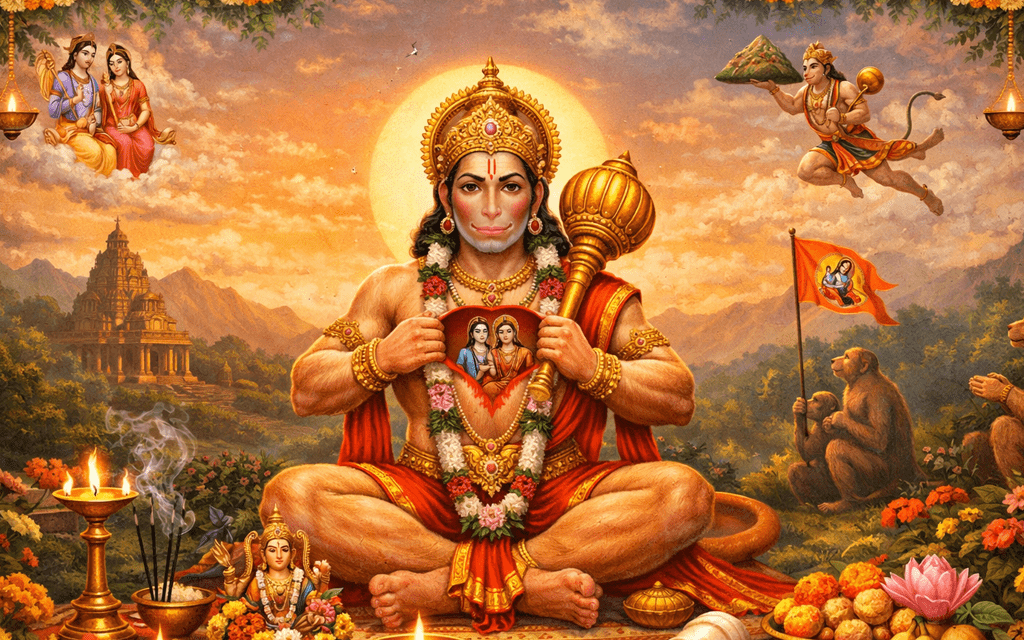
"Where the name of Rama is sung with devotion, there Hanuman is always present — unseen, yet unmistakably felt.
"Where the name of Rama is sung with devotion, there Hanuman is always present — unseen, yet unmistakably felt."
Hanuman Jayanti 2026 — Date & Tithi at a Glance
Regional Note: Dates vary by state. In Andhra Pradesh & Telangana, the 41-day Anjaneya Jayanthi begins on April 1 (Chaitra Purnima) and concludes in Vaishakha. In Karnataka, it falls on Margashirsha Trayodashi. In Tamil Nadu & Kerala, it is observed during the Margali (Dhanu) month (December–January). Always consult your local Panchang for precise timings.
The Sacred Sunrise Birth — Why Hanuman Jayanti Begins at Dawn
<cite index="7-1">Celebrations begin early in the morning, even before sunrise, as devotees awaken to purify their bodies and minds.</cite> This is not mere tradition — it is rooted in sacred scripture. <cite index="5-1">Since Lord Hanuman is believed to have taken birth at sunrise, celebrations in Hanuman temples start before sunrise and continue for the entire day, until after sunset.</cite>
On Hanuman Jayanti 2026, rise before dawn. Bathe, wear fresh clothes, and sit in prayer as the first golden light touches the sky. In that luminous moment between night and morning — that precise threshold of light — Anjana Devi's divine son was born. You are not merely watching a sunrise. You are witnessing a cosmic re-enactment of the most auspicious birth in Hindu memory.
Who Is Lord Hanuman? — The Divine Portrait of Bajrangbali
<cite index="3-1">Hanuman Janmotsav is a Hindu festival celebrating the birth of the Hindu deity Hanuman, one of the protagonists of the Ramayana and its many versions. Hanuman is regarded to be an ardent devotee of Rama, and is widely known for his unflinching devotion. He is revered as a symbol of strength.</cite>
<cite index="3-1">Hanuman is a vanara, born to Kesari and Anjana. He is also known as the celestial son of Vayu, the wind-god. His mother, Anjana, was an apsara who was born on earth due to a curse. She was redeemed from this curse upon giving birth to a son.</cite>
Lord Hanuman is not simply a mythological hero. To hundreds of millions of devotees, He is a living divine presence — the eternal servant of Lord Rama, the destroyer of obstacles, the remover of fear, and the bestower of strength, courage, and devotion. He is simultaneously:
- Anjaneya — son of Anjana
- Pavanputra / Vayuputra — son of the Wind God Vayu
- Bajrangbali — one with a body as strong as lightning (Bajra = thunderbolt, Anga = body)
- Sankat Mochan — the reliever of all distress
- Mahavira — the great hero
- Kesari Nandana — son of Kesari
- Chiranjeevi — the immortal one, believed to be living till this very day
<cite index="5-1">Lord Hanuman is the symbol of loyalty and devotion. He possesses unmatched strength and great intellect. He teaches us devotion; how to master the five senses of smell, taste, sight, touch and hearing; how to be faithful; humility with power; helping those in distress; overcoming difficulties of life. Lord Hanuman also signifies integrity, valor, intelligence, strength, patience and wisdom.</cite>
The Divine Birth Story of Lord Hanuman
The story of Hanuman's birth is a miracle woven from tapas (penance), divine grace, and cosmic love.
<cite index="7-1">Hanuman is described as the son of Anjana and Kesari, blessed by Vayu, the Wind God. According to traditional stories, Anjana was once a celestial being, an apsara, who was cursed to be born on earth. To end her curse, she performed intense penance (tapas) to Lord Shiva, seeking a divine child.</cite>
According to the Valmiki Ramayana, as Anjana performed deep penance, King Dasharatha of Ayodhya was simultaneously performing the Putrakameshti Yajna under Rishi Rishyashringa to beget children. <cite index="3-1">By divine ordinance, a kite (bird) snatched a fragment of that sacred pudding (payasam) and dropped it while flying over the forest where Anjana was engaged in worship. Vayu, the wind god, delivered the falling pudding to the outstretched hands of Anjana, who consumed it. Hanuman was born to her as a result.</cite>
<cite index="3-1">The Varaha Purana and Brahmanda Purana mention that shortly after the birth of Hanuman, he leapt toward the Sun, mistaking it for a fruit.</cite> Lord Indra struck the infant with his thunderbolt (Vajra), injuring his jaw (hanu) — giving Him the name Hanuman (one with a broken jaw). But Vayu, in grief and fury, withdrew all air from the universe until the gods descended and bestowed extraordinary boons upon the child — gifts of immortality, indestructibility, wisdom, and unmatched strength.
That child — born of divine penance, blessed by every god, carrying the breath of the universe within Him — is our eternal Bajrangbali.
The Profound Significance of Hanuman Jayanti
<cite index="4-1">Hanuman Jayanti, also known as Hanuman Janmotsav, is a sacred Hindu festival that marks the birth of Bhagwan Hanuman, the embodiment of strength, devotion, and unwavering service. It is observed with great reverence across India, where devotees engage in fasting, temple visits, and chanting of the Hanuman Chalisa to seek his blessings for courage, wisdom, and protection from obstacles.</cite>
Spiritual Significance
Hanuman Jayanti is not merely a birthday celebration — it is a day of spiritual initiation. Hanuman represents the highest ideal of Bhakti (devotion) — complete surrender to the Divine with no ego, no personal agenda, and no reward sought. His entire life was an act of selfless service to Lord Rama.
By celebrating Hanuman Jayanti, we are not just honouring a deity. We are aspiring to embody what He represents:
- Bhakti — pure, egoless devotion
- Jnana — profound knowledge and wisdom (He is described as the wisest of the wise — Bhudhimatam Varishtham)
- Shakti — divine strength that flows from surrender, not pride
- Vairagya — detachment and freedom from fear
- Seva — tireless, joyful service to the Divine
Astrological Significance
<cite index="4-1">The Hanuman Jayanti date in 2026 is especially significant as it falls on a Wednesday, a day dedicated to Lord Ganesha and Mercury — and Hanuman is also considered a powerful protector against negative planetary influences, especially Shani Dosh (malefic Saturn effects). Devotees believe that observing fasts, visiting temples, and chanting the Hanuman Chalisa on this occasion can remove obstacles, grant inner strength, and bring divine blessings.</cite>
Tuesdays and Saturdays are traditionally Hanuman's days. When Hanuman Jayanti falls on or near these days, its potency is multiplied manifold. Devotees with Shani Sade Sati (7.5-year Saturn transit), Mangal Dosha, or any planetary affliction particularly benefit from sincere Hanuman worship on this day.
How Hanuman Jayanti Is Celebrated Across India
<cite index="9-1">Hanuman Jayanti is celebrated on different dates across India: on Chaitra Purnima in most northern states, the 10th day of Shukla Paksha in Vaishakha month in Telugu-speaking states, the 13th day of Shukla Paksha in either Margashirsha or Vaishakha month in Karnataka, during the Dhanu month (Margazhi in Tamil) in Kerala and Tamil Nadu, and on Pana Sankranti, marking the Odia New Year, in Odisha.</cite>
<cite index="7-1">In major temples such as Hanuman Garhi in Ayodhya, Sankat Mochan Hanuman Temple, and prominent shrines in Tamil Nadu, Karnataka, and Maharashtra, the day begins with abhisheka, the sacred bathing of Hanuman's idol. The ritual includes Panchamrita — a mixture of milk, curd, ghee, honey, and sugar — along with holy water from rivers or temple tanks, tulsi leaves, and sandalwood paste.</cite>
Hanuman Jayanti Puja Vidhi — Complete Step-by-Step Ritual Guide
Performing Hanuman Puja on His Jayanti with sincere devotion is one of the most meritorious acts in the Hindu calendar. Here is the complete puja vidhi:
Step 1 — Brahma Muhurta Snan (Pre-Dawn Bath)
Wake before sunrise. Bathe with water infused with a few drops of sesame oil or a sprig of tulsi. This mangala snan (auspicious bath) purifies the body and prepares the devotee to receive Hanuman's divine energy. As you bathe, chant:
"Om Anjaneyaya Namah" — I bow to the son of Anjana.
Step 2 — Puja Sthapana (Altar Preparation)
- Place a photo or idol of Lord Hanuman on a clean, elevated platform covered with red cloth (red is Hanuman's sacred colour).
- Alongside Hanuman, place images of Lord Rama, Sita Mata, and Lakshmana — for Hanuman is never complete without his beloved Rama.
- Light a ghee lamp on the right side and an incense stick on the left.
- Place fresh flowers — red hibiscus (Jasond/Gurhal), marigolds, and tulsi leaves — before the deity.
Step 3 — Panchamrita Abhishek (Sacred Bath of the Deity)
<cite index="7-1">The ritual includes Panchamrita — a mixture of milk, curd, ghee, honey, and sugar — along with holy water, tulsi leaves, and sandalwood paste.</cite>
If you have a small Hanuman idol, bathe it with Panchamrita while chanting:
"Om Hanumate Namah"
Then bathe with clean water and wipe gently with a red cloth. Apply sindoor (vermilion) mixed with pure ghee on Hanuman's entire form. This practice is rooted in the beautiful story of Sita Mata applying sindoor for Lord Rama's longevity — and Hanuman covering his entire body in sindoor to express his boundless love for Rama.
Step 4 — Shodashopachara (Sixteen Sacred Offerings)
Offer the sixteen traditional upachāras to Lord Hanuman:
- Avahana — Invitation: "Om Hanumate Namah, Avahayami"
- Asana — Offer a seat (symbolically)
- Padya — Water for His feet
- Arghya — Water for His hands
- Achamana — Water for sipping
- Snan — Abhishek (ritual bath)
- Vastra — Offer a red thread or new cloth
- Yajnopavita — Sacred thread
- Gandha — Sandalwood paste; apply to Hanuman's forehead
- Pushpa — Flowers (red hibiscus most preferred)
- Dhupa — Incense sticks
- Deepa — Ghee lamp
- Naivedya — Food offering: besan ke laddu, boondi prasad, bananas, and panchamrita
- Tambula — Betel leaf and areca nut
- Dakshina — Coins (symbolic offering)
- Visarjana — Respectful farewell at puja's end
[image: 🔸] Step 5 — Hanuman Chalisa Paath (Recitation)
<cite index="4-1">It is a day marked by grand recitations of the Hanuman Chalisa, elaborate pujas, abhishekas, and yajnas (sacred fire offerings) in temples and homes alike.</cite>
Recite the Hanuman Chalisa at minimum three times (for those observing the fast — seven or eleven times is ideal). If possible, gather the family and recite together. The Chalisa's 40 verses contain the essence of Hanuman's qualities, deeds, and blessings. Each verse is a doorway into His divine presence.
Step 6 — Sundarkand Path (The Most Sacred Scripture)
The Sundarkand — the fifth chapter of Valmiki Ramayana narrating Hanuman's journey to Lanka to find Sita Mata — is Hanuman's own chapter. Reading or listening to a complete Sundarkand Path on Hanuman Jayanti is considered among the highest acts of devotion. Many families invite a pandit to conduct a Sundarkand Path throughout the night.
[image: 🔸] Step 7 — Aarti (The Song of Divine Light)
Conclude the puja with Hanuman Aarti — "Aarti Kije Hanuman Lala Ki, Dusht Dalan Raghunath Kala Ki." Wave the ghee lamp clockwise before Hanuman's image while the aarti is sung. Ring the bell with each rotation. This act of aarti is the heart of devotion — offering your attention, your light, and your love entirely to the Divine.
Step 8 — Prasad Distribution
Distribute besan ke laddu, boondi, and bananas as prasad. Hanuman is particularly pleased with besan ke laddu (gram flour sweets) and coconuts. Offer prasad to every person present — for in Hanuman's presence, all are equally blessed.
Powerful Hanuman Mantras for Jayanti 2026
Mantras are living vibrations. Chanted with sincerity, they transform the atmosphere of your home into a temple of Hanuman's divine presence.
Hanuman Moola Mantra
ॐ हनुमते नमः
Om Hanumate Namah
Meaning: I bow to Lord Hanuman, the great one who vanquishes all obstacles. How to chant: 108 times daily; begin every puja and mantra session with this. Use a red coral bead mala for best results.
Hanuman Beej Mantra
ॐ ऐं भ्रीम हनुमते
श्री राम दूताय नमः
Om Aim Bhreem Hanumate
Shri Rama Dootaya Namah
Meaning: O Hanuman, the messenger of Shri Rama — the one carrying the seed-sound of divine power — I bow to you. When to chant: During brahma muhurta (pre-dawn) or during the Pradosh period. Most potent on Tuesdays and Saturdays and, above all, on Hanuman Jayanti.
Hanuman Gayatri Mantra
ॐ आञ्जनेयाय विद्महे
वायुपुत्राय धीमहि।
तन्नो हनुमत् प्रचोदयात्॥

Om Aanjaneyaaya Vidmahe
Vaayuputraaya Dheemahi
Tanno Hanumat Prachodayaat
Meaning: We meditate upon the great son of Anjana, the son of Vayu the wind-god. May that Hanuman inspire and illuminate our intellect. When to chant: This Gayatri mantra is ideal for students, writers, speakers, and anyone seeking sharper intellect, wisdom, and spiritual clarity. Chant 108 times during sunrise on Hanuman Jayanti.
Sankat Mochan Mantra (For Removing All Obstacles)
ॐ नमो हनुमते रुद्रावताराय
सर्वशत्रुसंहाराय सर्वरोगहराय
सर्ववशीकरणाय रामदूताय स्वाहा॥

Om Namo Hanumate Rudraavataraaya
Sarva-Shatru-Samhaaraaya Sarva-Roga-Haraaya
Sarva-Vasheekaranaya Rama Dootaya Svaaha
Meaning: I bow to Hanuman, the avatar of Rudra, who destroys all enemies, removes all diseases, controls all negative forces, and is the sacred messenger of Lord Rama. When to chant: When facing obstacles, illness, fear, enemies, or during times of deep distress. Chant 108 times with full faith.
The Taraka Mantra of Hanuman's Beloved Rama
श्री राम जय राम जय जय राम
Shri Rama Jaya Rama Jaya Jaya Rama
The mantra Hanuman chants eternally. To chant Rama's name is to make Hanuman's heart your home. This mantra, when repeated with love, creates an invisible shield of protection around the devotee — for where Rama's name resounds, Hanuman is present.
Bajrang Baan (For Ultimate Protection)
The Bajrang Baan is among the most potent stotras dedicated to Hanuman — an uncompromising, direct invocation of His raw, fiery divine energy. Read in full on Hanuman Jayanti, especially if you are facing grave difficulties, fear, black magic, or deep life challenges. The Bajrang Baan is Hanuman's ultimate weapon placed in the devotee's hands.
"Jai Hanumaan Gyaan Gun Saagar, Jai Kapis Teehun Lok Ujaagar..." — From the Hanuman Chalisa, verse 1
Hanuman Jayanti Fasting — Vrat Rules & Guidelines
<cite index="7-1">Many people observe a fast, which may be a strict nirjala fast (without water) or a lighter phalahara fast (consisting of fruits and milk only).</cite>
Fasting Options:
Fasting Do's:
- Begin with sunrise prayer and end only after evening aarti
- Maintain complete celibacy on the fasting day
- Spend the day in chanting, reading scripture, and acts of service
- Feed Brahmins, sadhus, or the poor — Hanuman is supremely pleased by feeding the hungry
Fasting Don'ts:
- Avoid anger, gossip, or harsh speech
- Avoid entertainment, social media, and worldly distractions
- Avoid non-vegetarian food, alcohol, and tobacco (on this and ideally all Tuesdays and Saturdays)
How to Celebrate Hanuman Jayanti 2026 — A Complete Guide
Visit a Hanuman Temple at Sunrise
On the morning of April 1, 2026, visit your nearest Hanuman temple before or at sunrise. Join the morning abhishek, sit through the Hanuman Chalisa recitation, and receive the first prasad of the day. The energy in a Hanuman temple on His Jayanti is palpable — electric, warm, and deeply protective.
Famous Hanuman Temples to Visit:
- Hanuman Garhi, Ayodhya, Uttar Pradesh
- Sankat Mochan Hanuman Temple, Varanasi
- Sri Prasanna Anjaneya Swami Temple, Bengaluru
- Salasar Balaji Temple, Rajasthan
- Jakhu Temple, Shimla
- Namakkal Anjaneyar Temple, Tamil Nadu
- Sri Anjaneya Swami Temple, Khairatabad, Hyderabad
Hanuman Chalisa — Read All 40 Verses
Recite the complete Hanuman Chalisa — ideally 7, 11, or 108 times. Each recitation is a complete spiritual journey through Hanuman's divine story and qualities. Even one sincere, word-by-word recitation on Hanuman Jayanti is said to dissolve years of karmic obstacles.
Offer Sindoor Garland
Offer a garland made of sindoor (vermilion) to Lord Hanuman's idol. This practice re-enacts the beautiful moment when Hanuman smeared himself entirely with sindoor for the love of Lord Rama. With each garland offered, you are expressing the same sentiment: "I offer all that I am to You, Lord."
Light 11 Ghee Lamps
Light 11 or 21 ghee lamps before Hanuman's image at your home shrine. The number 11 is sacred to Hanuman — the 11th avatar of Lord Shiva. Let each lamp burn throughout the day.
Organize a Sundarkand Paath
Invite neighbours and family for a communal Sundarkand Path. Even listening to a recorded Sundarkand recitation reverently on this day is deeply meritorious. <cite index="4-1">Devotees immerse themselves in His divine energy through devotional chants of Jai Bajrang Bali! seeking His blessings for strength, wisdom, and protection.</cite>
Prepare & Distribute Prasad
Make besan ke laddu at home as an act of devotion. First offer them to Hanuman, then distribute to family, neighbours, and those less fortunate. Food made with love and offered to Hanuman becomes medicine for the soul.
Acts of Seva — Service as Worship
Hanuman's entire existence was Seva — selfless service. On His Jayanti, perform at least one act of genuine service: feed the hungry, donate to the poor, help a distressed person, sponsor food at a temple, or plant a tree. Hanuman is most pleased when His devotees become, even briefly, an instrument of divine service in the world.
Regional Celebrations Spotlight
Andhra Pradesh & Telangana — 41 Days of Divine Grace
<cite index="1-1">In Andhra Pradesh and Telangana, Hanuman Jayanti is celebrated for 41-days which starts on Chaitra Purnima and ends on the tenth day during Krishna Paksha in Vaishakha month.</cite>
This 41-day festival (Brahmotsavam) is unique in all of India. Devotees take a vrata deeksha (sacred vow) for 41 days — abstaining from meat, alcohol, and impure conduct while performing daily Hanuman puja. The final day (Vrata Udyaapana) is marked by a grand celebration and grand prasad distribution.
North India — Processions & Kirtans
In Ayodhya, Varanasi, Mathura, and Delhi, <cite index="7-1">Hanuman Jayanti is observed with spiritual discourses, elaborate processions, kirtans, and food offerings in major temples.</cite> Entire neighbourhoods come alive with Jai Bajrang Bali chants and kirtan programmes through the night.
Maharashtra — Community Celebrations
In Maharashtra, Hanuman Jayanti is observed on Chaitra Purnima with processions called melas, distribution of prasad, and temple programmes lasting through the night. The festival holds special importance in Nashik, Pune, and Mumbai.
Hanuman Jayanti 2026 — FAQ
Q: What is the exact date of Hanuman Jayanti 2026? Hanuman Jayanti 2026 falls on Wednesday, April 1, 2026 — the Purnima (full moon) of Chaitra month in the Hindu lunar calendar. In Andhra Pradesh and Telangana, the 41-day Anjaneya Jayanthi begins on this same date.
Q: What is the best time to perform Hanuman Puja on Jayanti 2026? The most auspicious time is at sunrise — as Lord Hanuman is believed to have been born at sunrise. Temples begin their rituals before dawn. For home puja, sunrise puja followed by an evening aarti during Pradosh Kaal are both highly auspicious.
Q: Which flowers does Lord Hanuman prefer? Lord Hanuman is most pleased with red hibiscus (jasond/gurhal), marigolds, and tulsi leaves. Sindoor (vermilion) is His most beloved offering.
Q: What food should be offered to Hanuman on Jayanti? The most beloved prasad for Hanuman includes besan ke laddu (gram flour sweets), boondi, bananas, coconut, and panchamrita. He is also pleased with jaggery and black gram (urad dal) offerings.
Q: Why is sindoor applied to Hanuman's idol? The practice traces back to a beautiful story: Hanuman once saw Sita Mata applying sindoor in the parting of her hair and asked why. She replied it was for Lord Rama's long life and well-being. Hanuman, overwhelmed with love for Rama, smeared sindoor over his entire body, reasoning that if a tiny bit of sindoor in Sita's hair ensured Rama's well-being — his entire body covered in sindoor would make Rama immortally blessed. This act of pure love is commemorated through the sindoor offering.
Q: Is Hanuman Jayanti a public holiday in India? Hanuman Jayanti is a gazetted public holiday in several Indian states including Uttar Pradesh, Himachal Pradesh, Uttarakhand, Rajasthan, and others. It is a restricted/optional holiday in many other states.
Q: Can women worship Hanuman on Jayanti? Absolutely. <cite index="7-1">Women, children, and entire families actively participate in Hanuman Jayanti celebrations.</cite> In many traditions, particularly in South India, women are among the most devoted Hanuman bhaktas. The idea that women cannot worship Hanuman is a regional custom, not a scriptural injunction.
Q: What mantra should I chant if I have Shani Dosha? Chant the Hanuman Beej Mantra and Bajrang Baan on Hanuman Jayanti with sincerity. Since Hanuman is considered the supreme protector from Saturn's malefic influences (Shani Dev himself was reportedly saved by Hanuman), His worship on His Jayanti is considered exceptionally potent for those with Shani Sade Sati or Shani Dasha.
Closing Devotion — Jai Bajrang Bali
There are gods of grandeur and gods of grace. And then there is Hanuman — the god who chose to be a servant. Who had the power to claim everything, and chose instead to give everything. Who carried mountains in one hand and held Lord Rama in every breath.
On Hanuman Jayanti 2026, as you light your lamp, chant your mantras, and offer your laddu with folded hands — know that you are not worshipping a distant deity. You are reaching toward the highest ideal of what a human being can become: devoted beyond reason, courageous beyond fear, and loving beyond all self-interest.
"Sankat kate mite sab peera, jo sumirai Hanumat balbira." "All troubles depart and all pain is erased — for those who remember the mighty Hanuman." — Hanuman Chalisa, Verse 36
May Lord Hanuman's boundless grace protect your family, ignite your courage, and illuminate your path in 2026 and always.
Jai Shri Ram! Jai Bajrang Bali!
Published by HinduTone.com — Your Sacred Companion for Hindu Festivals, Devotional Music, Puja Guides & Dharmic Living.
Tags: #HanumanJayanti2026 #BajrangBali #Anjaneya #HanumanChalisa #ChaitraPurnima #HinduFestivals #HinduTone #JaiBajrangBali #HanumanMantras #DevotionalGuide
You might also like
Major Hindu News, Events, Temple Updates, and Court Developments in April 2026: A Comprehensive Roundup for India and the USA
How India Celebrated Hanuman Jayanti 2026 — Devotion, Rituals & Grand Processions

Hanuman Jayanti 2026: Complete Birth Story of Lord Hanuman & Its Spiritual Significance