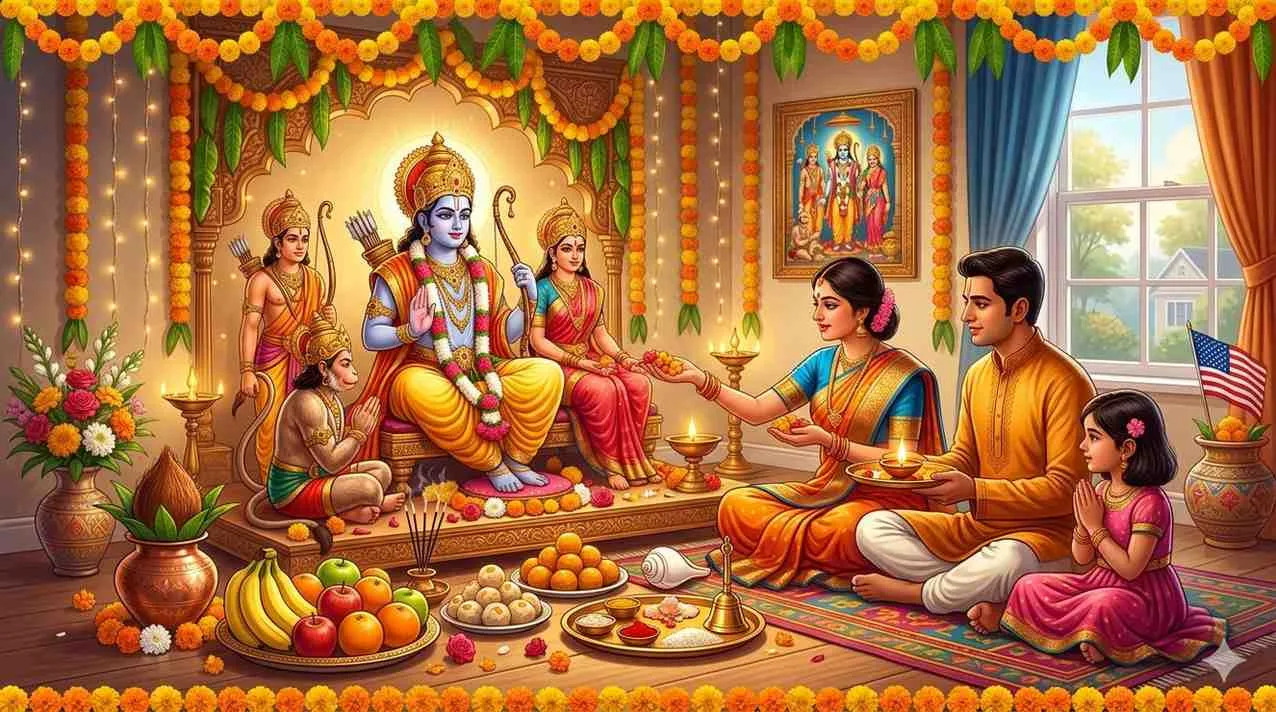
Why the Ramayana Survives Every Re-Telling
A text that has been retold in Sanskrit, Tamil, Telugu, Malayalam, Bengali, Hindi, Awadhi, Thai, Indonesian, Khmer and dozens of regional voices — and is being retold again on every streaming platform — keeps surviving. The structural reasons explain why.

A text that has been retold in Sanskrit, Tamil, Telugu, Malayalam, Bengali, Hindi, Awadhi, Thai, Indonesian, Khmer and dozens of regional voices — and is being retold again on every streaming platform — keeps surviving. The structural reasons explain why.
Every few years a new Ramayana retelling appears — a streaming series, a graphic novel, a children's book, a contemporary novel that places the characters in a modern setting. Each one provokes the same conversation in NRI households: is this faithful enough to the original? Should the children watch it? Is the regional version we grew up with being lost to the streaming-platform version? The conversation is, on its surface, about the specific adaptation in question. Underneath it is a quieter recognition that the Ramayana has been doing this for more than two thousand years, and that the survival of the story across every previous round of retelling tells us something about the structure of the text itself.
The Valmiki Ramayana in Sanskrit is the earliest extant version, but it was never the only one. The Tamil Kamba Ramayanam, the Telugu Ranganatha Ramayanamu, the Malayalam Adhyatma Ramayanam, the Bengali Krittivasi Ramayana, the Hindi Ramcharitmanas by Tulsidas, the Awadhi Ram Charita Manas — each of these is a major regional tradition with its own emphases and its own characterisation choices. The Thai Ramakien and the Indonesian Kakawin Ramayana extend the tradition beyond the Indian subcontinent entirely. The story has been continuously retold for centuries; the streaming-era adaptations are the latest layer in a deep history.
Why the text accommodates retelling
The Ramayana's structural feature that explains its survivability is that it is not a single fixed text in the way a modern novel is. It is a story that exists at several scales simultaneously: as a long-form narrative covering decades of plot, as a sequence of episodes that can be told as standalone units (the bow-breaking, the exile, the kidnapping of Sita, the bridge to Lanka, the war), and as a set of character studies (Rama, Sita, Lakshmana, Hanuman, Ravana) that can be examined independently of the plot.
Different retellings emphasise different scales. A South Indian Bharatanatyam performance may stage a single episode (often the breaking of Shiva's bow) for a forty-minute piece. A Diwali pageant in an NRI temple may abridge the full plot into a ninety-minute children's play. A novel-length retelling may zoom in on a single character's psychology. The text accommodates all of this because the underlying structure was built for it. The Valmiki Ramayana itself was a re-narration of an earlier oral tradition; every generation since has continued that re-narration.
What the retellings keep constant
Across all the variations, certain features stay constant. The four core characters — Rama, Sita, Lakshmana, Hanuman — and their adversary Ravana are recognisable in every version, with their essential dispositions intact. The major plot beats — the exile from Ayodhya, the abduction of Sita, the search and rescue, the battle with Ravana, the return — are present in every retelling. The ethical questions — what is dharma? what does Rama owe his father? what does Sita owe her husband? what does Ravana's defeat mean for the abducted but virtuous wife? — recur in every version, often with quite different answers across regional traditions.
What varies is everything else. The narrative emphasis, the characterisation of secondary figures (Bharata, Shatrughna, Vibhishana, Mandodari), the treatment of Sita's trials, the role of the female characters more broadly, the philosophical voice of the narrator, the cosmological frame, the language register — all of these change across retellings, sometimes dramatically. A reader of the Krittivasi Ramayana and a reader of the Ramcharitmanas are reading recognisably the same story, but in registers that diverge meaningfully.
The streaming-era retellings
Contemporary streaming adaptations sit in this long history without breaking it. A big-budget production of the Ramayana for a global streaming platform is, structurally, the same kind of project as a regional poet's retelling in the 14th century: take the recognised story, make decisions about emphasis and characterisation, render it in a new medium for a new audience. The medium has changed (from oral recitation to manuscript to printed book to staged drama to film to streaming), but the underlying activity has not.
Some streaming adaptations work and some do not, and the difference usually comes down to whether the production has taken the source seriously enough. Adaptations that preserve the core characters' dispositions, the major plot beats and the central ethical questions tend to land — even when they change the visual style, the language, the cosmological frame. Adaptations that treat the source as raw material to be reworked according to contemporary genre conventions tend to feel hollow, regardless of production values.
The NRI viewer's position
The NRI viewer in 2026 is in an unusual position relative to all this. The first-generation parent grew up with one or two regional versions and a specific household reading of the story. The second-generation child encounters the story through whatever versions reach them — increasingly streaming productions in English, sometimes Hindi or a regional language, sometimes a children's adaptation in an English-language book.
The conversation in NRI households about whether a new retelling is "faithful" often misses the deeper point. The Ramayana has survived two thousand years of retellings precisely because no single version is the authoritative one. Faithfulness is not the test; whether the retelling carries the core elements forward and whether it engages the next generation with the underlying story is. A streaming adaptation that captures a second-generation NRI teenager's attention and prompts them to ask about the original Sanskrit text is doing what every previous re-telling has done — pulling a new generation into the tradition through whatever medium fits them.
A reading recommendation for the household
A pattern that has worked well in NRI households is to keep one canonical version available — usually the regional version the parent grew up with, in print or in audio — and to let the children encounter contemporary retellings in whatever form they find them. The canonical version provides the reference point; the contemporary retellings provide the entry points for the child's generation. When the child asks "is this what really happens?" — and many do — the parent has a reference point to point to and a longer conversation to have about how stories travel.
The Ramayana has survived every previous retelling because the structure of the text has supported it. The 2026 retellings, on every available medium, are the latest evidence of that survival. The NRI household's contribution is to keep the conversation going across generations, not to police which version the child encounters first. The text was always going to outlast any single rendering of it.
You might also like
Divine Timing: First Glimpse of Nitesh Tiwari’s ‘Ramayana’ Unveiled on Hanuman Jayanti with Ranbir Kapoor as Lord Rama
Complete MBBS Once in Life: The Spiritual Meaning of Mahabharata, Bhagavatam, Bhagavad Gita & Ramayana
Rama Avatar — The Seventh Incarnation of Vishnu: Ramayana, Ayodhya, the Ideal Man & Eternal Dharma Lessons for 2026