

CCTV Footage Shows Deliberate Smudging of Pongal Rangoli in Tamil Nadu
CCTV Footage Shows Deliberate Smudging of Pongal Rangoli in Tamil Nadu – Sparks Outrage Over Disrespect to Tradition By HinduTone Staff Kanchipuram, Tamil Nadu…
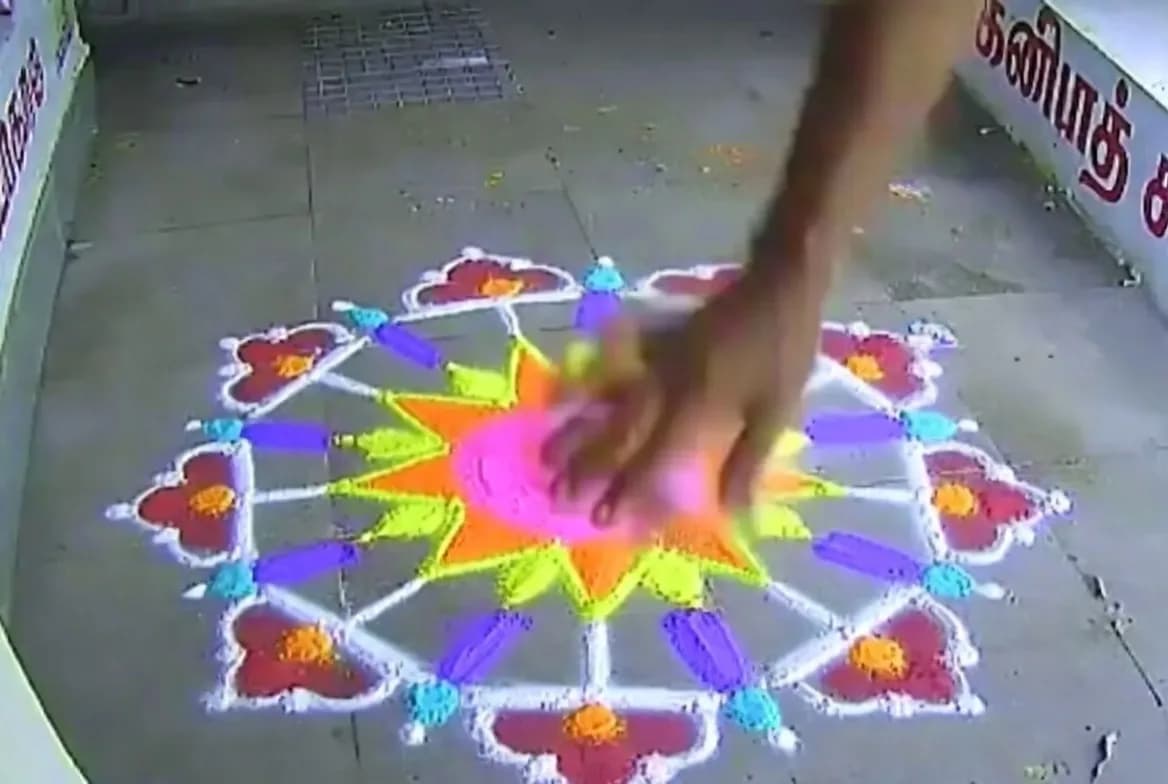
CCTV Footage Shows Deliberate Smudging of Pongal Rangoli in Tamil Nadu – Sparks Outrage Over Disrespect to Tradition By HinduTone Staff Kanchipuram, Tamil Nadu…
CCTV Footage Shows Deliberate Smudging of Pongal Rangoli in Tamil Nadu – Sparks Outrage Over Disrespect to Tradition
By HinduTone Staff Kanchipuram, Tamil Nadu | January 17, 2026
As Pongal festivities conclude across Tamil Nadu, a wave of anger has spread through social media following the circulation of multiple CCTV clips allegedly showing individuals deliberately walking over and destroying traditional rangoli (kolam) designs created for the festival.
Pongal, celebrated annually from January 14 to 17, is one of the most important harvest festivals in Tamil culture. Families prepare kolams using rice flour at entrances, courtyards, and even on public streets. These intricate patterns—often depicting flowers, birds, pots of abundance, geometric designs, and auspicious symbols—are drawn with devotion to invite prosperity, honor the Sun God, and celebrate agricultural abundance.
Several videos that have gone viral in the past few days reportedly show different incidents:
- Figures wearing abayas walking directly across freshly prepared rangoli without any attempt to step aside.
- Motorbikes riding over wet rice-flour designs, scattering the patterns.
- Men passing through kolams at night, seemingly unconcerned.
- One particularly concerning clip showing a child, in the presence of an adult, intentionally stepping on and kicking at the designs, smudging large sections.
Many viewers and netizens have described these acts as deliberate disrespect and, in some cases, as targeted attempts to insult Hindu traditions during a major religious and cultural festival. Comments on various platforms have called the behavior “cultural vandalism” and demanded police action and community awareness.
Others have offered a more neutral perspective, noting that in densely populated urban and semi-urban areas like parts of Kanchipuram, many kolams extend onto public footpaths, sidewalks, and even portions of roads. In such locations, accidental stepping or driving over the designs can occur simply due to space constraints and heavy footfall during festival days. These observers argue that without clear evidence of intent in every case, it is premature to label all incidents as malicious.
As of the evening of January 17, 2026, no official police complaints or FIRs have been publicly reported in connection with these specific videos. Local authorities in the districts where the footage originated have not issued any formal statements. The absence of an official response has itself become a point of criticism among sections of the online Hindu community, who accuse officials of reluctance to address what they see as religiously motivated incidents.
Pongal otherwise passed peacefully in most parts of the state with traditional observances: the boiling of Pongal (sweet rice dish) in new earthen pots, cattle worship, kolam competitions in many villages and towns, temple special pujas, and community feasts. The four-day festival—Bhogi, Thai Pongal, Maattu Pongal, and Kaanum Pongal—remains a cornerstone of Tamil identity and agrarian heritage.
The controversy over the rangoli-smudging videos has once again highlighted the delicate balance required when sacred or cultural symbols are placed in shared public spaces during large-scale celebrations. Some voices within the community are now calling for better planning, such as confining elaborate kolams to private compounds or clearly demarcated festival zones, to reduce the chances of both accidental and intentional damage.
HinduTone will continue to follow any official developments or statements from police and district administration regarding these incidents
What is the Sacred Significance of Kolam in Tamil Hindu Tradition?
The kolam is far more than a decorative art form. Rooted in ancient Agamic and folk traditions of Tamil Nadu, it is considered a living yantra — a sacred geometric diagram drawn at the threshold of a home to ward off negative energies and invite the goddess Lakshmi. The practice is referenced in classical Tamil literature, including the Sangam-era text Natrinai, which describes the drawing of patterns at doorways as an auspicious act tied to domestic piety and feminine virtue.
Rice flour is the traditional medium precisely because it serves a dual spiritual and ecological purpose: it feeds ants and small creatures, embodying the principle of ahimsa and compassion toward all living beings, while simultaneously purifying the entrance space. During Pongal specifically, the kolam is enlarged and elaborated to honor Surya Bhagavan, the Sun God, whose northward journey (Uttarayana) marks the start of the harvest season. The act of smudging or destroying such a design — especially deliberately — is therefore not merely aesthetic damage; it is the desecration of a consecrated threshold offering.
How Does Pongal's Religious Calendar Make This Period Especially Sensitive?
Pongal falls during the Tamil month of Thai (January–February) and spans four days: Bhogi Pongal, Surya Pongal, Mattu Pongal, and Kaanum Pongal. Of these, Surya Pongal on January 15 is the most sacred, when families cook the traditional sweet rice dish in a new clay pot, allowing it to boil over as a gesture of abundance and gratitude to the Sun. The kolam drawn on this day in particular carries the greatest ritual weight, as it forms part of the formal worship setting arranged around the cooking pot.
The timing of the incidents — reportedly captured between January 14 and 17, precisely during the active puja period — amplifies the grievance felt by devotees. In temples such as Ekambareswarar Temple in Kanchipuram and Brihadeeswara Temple in Thanjavur, elaborate kolams are drawn daily by temple staff during this period as part of official Agamic ritual. The sanctity observed in these temple settings reflects the same reverence that ordinary Tamil families bring to their home entrances, making any desecration feel like a direct affront to active religious practice.
What Does Hindu Dharmic Framework Say About Respecting Others' Sacred Spaces?
The Manusmriti (Chapter 4, verses 39–40) and several Dharmashastra texts explicitly caution against disturbing the sacred offerings, drawings, or ritual objects placed by households as part of their religious observance. More broadly, the principle of lokasangraha — maintaining the cohesion and harmony of society — found in the Bhagavad Gita (Chapter 3, verse 20) implies a duty not to disrupt the legitimate religious practices of one's neighbors and community members.
The Skanda Purana, which contains extensive lore about Tamil Shaiva traditions and the sacred geography of Tamil Nadu, describes the kolam drawn at entrances as an outward expression of inner purity (shaucha). To deliberately destroy it is, in this framework, an act of ritual pollution directed at another's household. Community elders in Tamil Nadu have traditionally treated even the accidental scuffing of a neighbor's kolam as a matter requiring a polite apology — reflecting how deeply the sanctity of this practice is embedded in the social fabric.
What Legal Protections Exist for Religious and Cultural Practices in India?
Under Indian law, Section 295 of the Indian Penal Code (now reproduced under the Bharatiya Nyaya Sanhita) addresses deliberate acts intended to outrage religious feelings or defile objects held sacred by any class of persons. If the CCTV footage is found to show intentional destruction, complainants could seek action under this provision, particularly where intent can be inferred from the nature and repetition of the acts captured.
Additionally, Article 25 of the Constitution of India guarantees the freedom to practice and propagate religion. Legal scholars have argued that this protection extends to the cultural expressions inseparable from religious observance — such as the drawing of kolams during a festival — not merely to formal temple worship. Community organizations in Kanchipuram and other districts have in past years successfully petitioned local district administrations to issue public advisories requesting pedestrians and motorists to be mindful of festival kolams on footpaths, under provisions of the Tamil Nadu District Municipalities Act.
How Have Tamil Communities Historically Responded to Threats Against Their Cultural Heritage?
Tamil cultural identity is unusually strongly tied to religious practice, with the Bhakti movement poets of the Nalayira Divya Prabandham — the 4,000 hymns of the Alvar saints — and the Shaiva Tevaram tradition forming the living backbone of everyday Tamil Hindu life. When elements of this culture have been threatened historically, communities have responded through both spiritual renewal and organized social action. The 20th-century movement to protect temple lands under the Hindu Religious and Charitable Endowments Act of Tamil Nadu is one example of how Tamil Hindus have mobilized institutionally to defend their traditions.
In the specific context of kolam preservation, organizations such as the Tamil Nadu Kolam Artists Association have in recent years documented thousands of traditional kolam patterns at risk of being forgotten, and several district municipalities have held competitive kolam festivals during Pongal as a way of reinforcing public awareness of the art form's sanctity. The outrage generated by the current CCTV footage follows a pattern seen in previous years in which viral incidents of rangoli destruction during Diwali or Pongal have led to brief but genuine civic conversations about inter-community respect and the protection of Hindu festival expressions in shared public spaces.
Frequently Asked Questions
When is CCTV Footage Shows Deliberate Smudging of Pongal?
CCTV Footage Shows Deliberate Smudging of Pongal falls on January 17, 2026.
What is the significance of CCTV Footage Shows Deliberate Smudging of Pongal?
CCTV Footage Shows Deliberate Smudging of Pongal Rangoli in Tamil Nadu – Sparks Outrage Over Disrespect to Tradition By HinduTone Staff Kanchipuram, Tamil Nadu | January 17, 2026 As Pongal festivities conclude across Tamil Nadu, a wave of anger has spread through social media following the circulation of multiple CCTV clips allegedly showing individuals deli
How is CCTV Footage Shows Deliberate Smudging of Pongal celebrated?
Devotees observe it with puja, fasting or special offerings, visiting temples, chanting mantras, and gathering with family. Customs vary by region and tradition.
What should devotees do on CCTV Footage Shows Deliberate Smudging of Pongal?
Take a sacred bath, perform the day's puja and charity (dana), observe any prescribed fast, and chant mantras with sincere devotion.
You might also like
June 2026 Hindu Festival Calendar — Complete Dates, Vrat & Puja Guide for NRIs
Shani Deva Temples Worldwide & Must-Performed Rituals — Complete Devotee's Guide
The Resolve of a Monk – A Divine Incident Showcasing Kanchi Paramacharya’s Compassion
