How Second-Generation Hindus Are Redefining Dharma Abroad
A new generation is weaving ancient wisdom into modern life, creating a vibrant, evolving expression of Hindu identity across the globe.
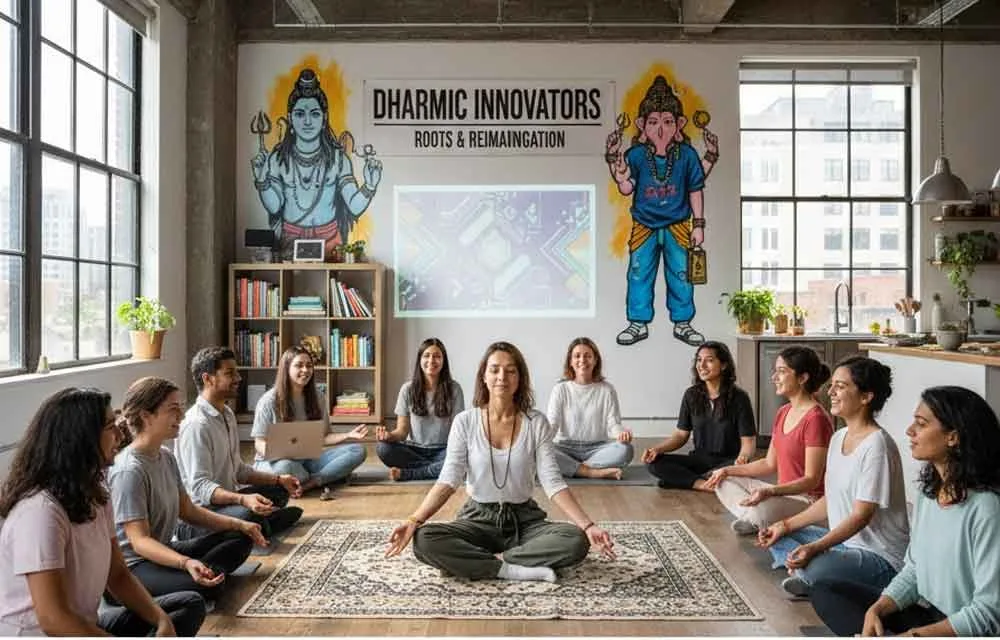
A new generation is weaving ancient wisdom into modern life, creating a vibrant, evolving expression of Hindu identity across the globe.
By HinduTone Correspondent
Twenty-seven-year-old Priya Sharma logs into a Zoom satsang from her London apartment every Sunday morning. Born and raised in the UK, she's never lived in India, yet she begins her day with pranayama, keeps a small puja corner in her flat, and actively participates in online discussions about the Bhagavad Gita. "My parents practiced Hinduism out of tradition," she explains. "I practice it out of choice."
Priya represents a growing phenomenon: second-generation Hindus abroad who are reimagining what it means to live dharma in the 21st century. Unlike their immigrant parents who brought Hinduism with them as cultural baggage, these young people are actively curating their spiritual identity, blending ancient traditions with contemporary sensibilities in ways that are reshaping Hindu practice across the diaspora.
The Digital Temple: Spirituality Meets Technology
The transformation is perhaps most visible in how technology has become the new mandap. Virtual satsangs, YouTube channels dedicated to Vedic philosophy, and Instagram accounts offering daily mantras have created what some call a "digital ashram" — a borderless space where young Hindus connect with their heritage.
Rohan Patel, a 24-year-old software engineer in Silicon Valley, learned Sanskrit through an app and now follows three different spiritual teachers on social media. "I can attend a lecture by a swami in Rishikesh during my lunch break, join a meditation session led by someone in Toronto in the evening, and discuss the Upanishads with people from five different countries before bed," he says. "My grandparents had one guru in one village. I have access to wisdom from everywhere."
This democratization of spiritual knowledge has created a more questioning, intellectually engaged generation. They're not satisfied with ritual alone; they want to understand the philosophy behind it. Online forums buzz with young people debating interpretations of sacred texts, discussing the relevance of ancient practices in modern contexts, and yes, even respectfully challenging outdated social norms while maintaining core spiritual values.
Yoga Beyond Asanas: Reclaiming the Eight Limbs
While yoga studios have proliferated across Western cities, second-generation Hindus are pushing back against the commercialized, fitness-focused version of yoga that dominates mainstream culture. They're reclaiming it as a holistic spiritual practice rooted in Hindu philosophy.
"When I walk into most yoga studios here in Melbourne, there's no mention of Patanjali, no understanding of yoga as one of the six orthodox schools of Hindu philosophy," says Asha Krishnan, a 29-year-old teacher who runs workshops on classical yoga philosophy. "For us, it's not just about physical postures. It's about yamas and niyamas, about dharana and dhyana — the entire eight-limbed path."
This generation is bringing meditation back to its dharmic roots as well. Mindfulness may be the buzzword in corporate wellness programs, but young Hindus are exploring dhyana as it's been practiced for millennia, often combining ancient techniques with modern psychological understanding. Meditation apps created by Hindu youth don't just offer generic relaxation — they incorporate mantras, explain chakra systems, and connect practices to their scriptural foundations.
The Evolving Temple Experience
Physical temples remain vital, but their role is changing. Second-generation Hindus are transforming these spaces from purely ritual centers into community hubs that address contemporary needs while preserving tradition.
At a temple in New Jersey, young professionals have created a lecture series that explores how Vedantic philosophy applies to modern challenges — workplace ethics, environmental responsibility, mental health. At a Toronto mandir, a youth group organizes both traditional festivals and social justice initiatives, viewing seva (service) as an essential expression of dharma.
"We don't see a contradiction between being progressive and being devout," explains Vikram Desai, who helps organize programs at his local temple in Texas. "Hinduism has always evolved. The question isn't whether to change, but how to honor our core values while addressing the realities of our lives here."
Many temples are adapting too, offering programs in English, creating spaces for philosophical discussion alongside traditional worship, and recognizing that second-generation devotees may express their faith differently than their parents. Some have introduced contemporary music in bhajans, while others have created discussion groups that tackle tough questions about caste, gender equality, and social reform within a dharmic framework.
Navigating Two Worlds: The Creative Synthesis
Perhaps the most striking aspect of this generation's approach is their refusal to see their dual identity as a conflict. They're not trying to be either Western or Hindu — they're creating something entirely new.
Maya Iyer, a 26-year-old lawyer in London who writes about contemporary Hindu identity, puts it this way: "I wear a bindi to court, I quote both Supreme Court rulings and the Mahabharata, I'm passionate about LGBTQ+ rights and equally passionate about preserving Sanskrit. These aren't contradictions to me — they're all part of who I am."
This synthesis appears in countless ways: environmental activism rooted in the Hindu concept of Prakriti as sacred; social justice work inspired by Vasudhaiva Kutumbakam (the world is one family); professional ethics grounded in karma yoga; and relationship advice drawn from both modern psychology and ancient texts.
Food, fashion, and festivals are being reimagined too. Vegan versions of traditional prasad, contemporary fusion music at Diwali celebrations, and eco-friendly ganesh idols reflect a generation that honors tradition while living their modern values.
The Challenge of Authenticity
This reimagining isn't without tension. Some elders worry that the tradition is being diluted. Critics within the community sometimes accuse young people of "cafeteria Hinduism" — picking and choosing what suits them while discarding what doesn't.
But second-generation Hindus push back against this criticism. "Hinduism has always had room for multiple paths, multiple interpretations," argues Arjun Mehta, a doctoral student studying religion in Boston. "The Rig Veda itself says truth is one but the wise call it by many names. We're not abandoning dharma — we're living it in a way that's authentic to our context."
They point out that every generation has adapted practices to their time and place. The Hinduism practiced in Indonesia differs from that in Nepal, which differs from that in Trinidad. The diaspora experience is creating new, legitimate expressions of an ancient tradition.
Building Community Across Borders
One unexpected outcome of this digital, globalized approach is a new form of community — one that transcends geography and even specific traditions within Hinduism.
Online platforms have connected young Hindus who might never meet physically: a Bengali Vaishnava in Canada discussing philosophy with a Tamil Shaivite in Singapore, a Gujarati in Australia collaborating with a Punjabi in the UK on a podcast about Hindu environmentalism. These connections are creating a more pan-Hindu identity, one that recognizes diversity while finding common ground in core principles.
"My parents' Hinduism was very specific to their region in India," says Neha Gupta, who runs a popular podcast on contemporary Hindu life from her home in Sydney. "Mine is more expansive. I learn Carnatic devotional songs, read Bengali poetry, attend lectures on Kashmiri Shaivism, and study with teachers from different lineages. The diaspora has actually allowed me to experience the breadth of Hindu tradition in a way I might not have in India."
The Future of Dharma: Ancient Roots, New Branches
As this generation comes of age, they're not just inheriting their parents' faith — they're actively shaping its future expression. They're creating content, establishing organizations, writing books, and building platforms that will influence generations to come.
Some are pursuing formal religious education, becoming pundits and scholars who can bridge traditional learning and contemporary context. Others are creating art, music, and literature that explores Hindu themes through modern mediums. Still others are entering academia, ensuring that Hindu perspectives are represented in broader scholarly conversations.
What unites them is a deep love for their tradition combined with an unwillingness to practice it uncritically. They're asking hard questions: How do we reconcile ancient social structures with modern egalitarian values? How do we preserve Sanskrit while making wisdom accessible? How do we honor our parents' sacrifices while living authentically?
The answers they're developing may not satisfy everyone, but they're creating a dynamic, evolving form of Hinduism that's both rooted and relevant — one that future generations of diaspora Hindus can inherit with pride.
As Priya Sharma puts it, wrapping up her Sunday morning satsang in London: "My grandmother preserved our tradition by holding tight to it. I preserve it by understanding it deeply enough to adapt it. Both are acts of devotion. Both are dharma."
In living rooms and temple halls, on meditation cushions and Zoom calls, through yoga mats and Instagram posts, second-generation Hindus are writing a new chapter in an ancient story — proving that dharma, like water, takes the shape of its container without losing its essential nature.
For more stories on contemporary Hindu life and spirituality, visit www.hindutone.com
Frequently Asked Questions
How are second-generation Hindus using technology to practise dharma?
They join virtual satsangs, follow YouTube channels on Vedic philosophy and Instagram accounts offering daily mantras, forming a borderless "digital ashram". Some learn Sanskrit through apps and follow teachers across several countries.
How do second-generation Hindus approach yoga differently?
They push back against fitness-only yoga and reclaim it as a spiritual practice rooted in Hindu philosophy, including Patanjali's eight limbs, the yamas and niyamas, dharana and dhyana.
How are Hindu temples abroad changing for younger devotees?
Many are becoming community hubs, with programs in English, philosophy lectures and discussion groups, youth-led seva, and contemporary music in bhajans, while keeping traditional festivals and worship.
What is "cafeteria Hinduism" and how do young Hindus respond to the charge?
It is a criticism that young people pick and choose what suits them. They answer that Hinduism has always had room for multiple paths, and that they are living dharma in a way that fits their context.
How are Hindu youth in the UK, USA, Canada and Australia connecting with each other?
Online platforms link them across borders, such as a Bengali Vaishnava in Canada with a Tamil Shaivite in Singapore, or a Gujarati in Australia with a Punjabi in the UK, building a more pan-Hindu identity.
How do second-generation Hindus bring dharma into environmental and social work?
They draw on Prakriti as sacred for environmental activism, Vasudhaiva Kutumbakam for social justice, and karma yoga for professional ethics. They also make vegan prasad and eco-friendly ganesh idols.
Share this with family and friends
Send it on WhatsApp, post it, or copy the link.
More from Hinduism
- Can a Robot Perform Puja? Robot Aarti, AI in Rituals and What Hindu Tradition Says
- GitaGPT and AI Bhagavad Gita Chatbots: How Accurate Are They, and What Does Hindu Tradition Say?
- Robotic Elephants and AI in Hindu Temples: Kerala's Mechanical Tuskers, Tirumala's AI Command Centre and the Debate
- Madhava of Sangamagrama and the Kerala School: The Infinite Series for Pi, Sine and Arctangent, Worked Out Step by Step
- Vedic Mathematics: Myth vs Fact. Bharati Krishna Tirtha's 16 Sutras, Where They Come From, and What Still Works
You might also like
Quantum Computing Explained for Hindus: Qubits, Superposition and Entanglement, with Vedanta Analogies (Not Equivalences)

Usha Chilukuri: From Humble Beginnings(Active Member of RSS) to the Second Lady of the United States – A Journey Rooted in Values

Uttarakhand: Kedarnath Dham Witnesses Second Snowfall of Winter 2026