Hindu Beliefs on the Soul and Rebirth: A Devotional Journey Through Atman, Karma, and the Eternal Cycle
Table of Contents A Devotional Invocation Introduction: The Soul That Never Dies Atman: The Eternal Soul in Hindu Thought The Atman and Brahman: The River and…
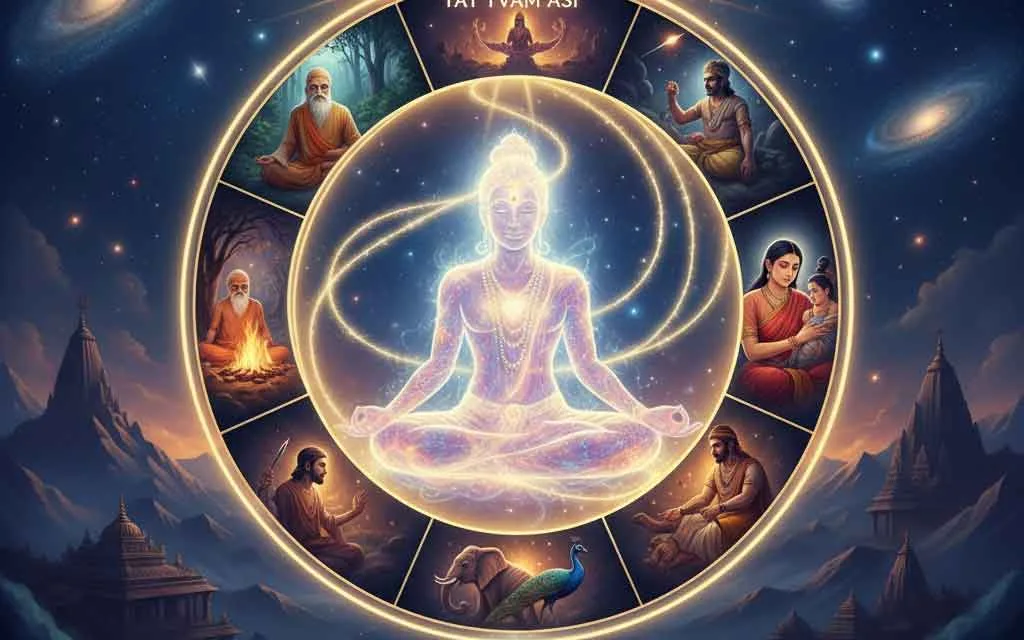
Table of Contents A Devotional Invocation Introduction: The Soul That Never Dies Atman: The Eternal Soul in Hindu Thought The Atman and Brahman: The River and…
Table of Contents
- A Devotional Invocation
- Introduction: The Soul That Never Dies
- Atman: The Eternal Soul in Hindu Thought
- The Atman and Brahman: The River and the Ocean
- The Three Bodies and Five Sheaths of the Soul
- What Is Samsara? The Cycle of Birth, Death, and Rebirth
- Karma: The Cosmic Law That Drives Rebirth
- The Journey of the Soul After Death
- How Rebirth Is Determined: The Role of Vasanas and Samskaras
- Reincarnation Across Species: Can the Soul Become an Animal?
- Different Schools of Hindu Thought on the Soul
- Evidence of Past Lives in Hindu Tradition
- Moksha: Liberation from the Cycle of Rebirth
- The Four Paths to Moksha
- The Soul in the Bhagavad Gita: Krishna's Eternal Teaching
- The Soul in the Upanishads: Whispers of the Infinite
- Reincarnation in Hindu Sacred Stories
- Frequently Asked Questions
- A Devotional Closing: You Are the Deathless One
1. A Devotional Invocation {#invocation}
Aum. Asato ma sadgamaya. Tamaso ma jyotirgamaya. Mrityor ma amritam gamaya. Aum Shanti. Shanti. Shanti.
Lead me from the unreal to the Real. Lead me from darkness to Light. Lead me from death to Immortality. Aum Peace. Peace. Peace. — Brihadaranyaka Upanishad 1.3.28
This ancient prayer, chanted by sages in the forests of India thousands of years ago, is still alive today — in temples and homes, on the lips of monks and grandmothers, in the hearts of seekers everywhere. It asks for the one thing the human soul has always longed for: to move beyond the shadow of death and find what is truly, eternally real.
This prayer is the seed of everything we are about to explore.
2. Introduction: The Soul That Never Dies {#introduction}
Of all the great questions the human mind has ever asked, perhaps none is more piercing, more intimate, or more urgent than this:
What am I, truly? And what happens to me when I die?
Every tradition has wrestled with this question. But few have explored it with the depth, the daring, and the tender devotion of Hinduism.
The Hindu answer, distilled from thousands of years of direct spiritual experience, is both simple and staggering:
You do not die.
Not the real you. Not the you that is aware right now as you read these words — the silent, watching presence behind your thoughts, your feelings, your memories, your name. That awareness is not born with the body. It does not age with the body. And it does not cease when the body falls away.
The body is a garment. The soul is the wearer. When the garment wears out, the soul lays it aside — and in time, takes on another.
This is the Hindu understanding of the soul (Atman) and rebirth (punarmrityu — "repeated death," or more poetically, the soul's ongoing journey through many lives toward its ultimate homecoming).
It is a vision that transforms everything: how we see suffering, how we understand justice, how we approach death, and above all, how we live now.
Let us enter this vision together — with reverence, with wonder, and with open hearts.
3. Atman: The Eternal Soul in Hindu Thought {#atman}
The Meaning of Atman
The Sanskrit word Atman (sometimes spelled Atma) comes from the root an, meaning "to breathe" — the breath of life itself. But in Hindu philosophy, Atman means far more than the life-force. It is the innermost self — the pure, unchanging, eternal consciousness that is the true identity of every being.
The Atman is not the body. Not the mind. Not the emotions. Not the personality. Not the intellect. All of these change — they are born, they grow, they decline, they pass away. The Atman never changes. It was never born. It will never die. It simply is — the eternal witness of all that arises and passes away in the field of experience.
The Katha Upanishad describes the Atman with breathtaking poetry:
"The soul is never born, nor does it ever die. It has not come into being, does not come into being, and will not come into being. It is unborn, eternal, ever-existing, and primeval. It is not slain when the body is slain."
The Atman Is Not the Ego
One of the most important teachings of Hindu philosophy is that the Atman is not the ego — the "I" we ordinarily identify with. The ego (ahamkara, literally "I-maker") is a construction of the mind — a story we tell about ourselves made of memories, desires, fears, and social roles.
The Atman is what remains when all that story is set aside. It is the pure, clean, luminous awareness that was there before any thought arose — and will be there after every thought has gone.
To discover the Atman is to discover your true self. And the discovery of the true self is, in Hindu understanding, the discovery of God.
Qualities of the Atman
Hindu scripture describes the Atman as:
- Nitya — Eternal, without beginning or end
- Shuddha — Pure, untouched by sin, karma, or suffering
- Buddha — Ever-awakened, self-luminous consciousness
- Mukta — Ever-free, never truly bound despite appearing so
- Vibhu — All-pervading, not confined to a single body
- Achala — Immovable, unshakeable, beyond all change
- Ananda — Bliss itself, not a bliss that comes and goes but the very nature of awareness
These are not qualities the soul acquires through spiritual practice. They are its natural state — always present, always perfect. Spiritual practice is simply the process of removing what obscures this perfection from view.
4. The Atman and Brahman: The River and the Ocean {#atman-brahman}
One of the most profound and debated questions in all of Hindu philosophy is the relationship between the individual soul (Atman) and the Supreme Reality (Brahman).
Different schools of Hindu thought answer this differently. But all agree on one foundational truth: the soul and the Supreme are intimately, inseparably connected.
Advaita Vedanta: The Soul IS the Supreme
In Advaita Vedanta (non-dual philosophy), as taught by Adi Shankaracharya, the individual Atman and the universal Brahman are ultimately one and the same.
The apparent separation between the individual soul and God is a result of avidya (ignorance) — a cosmic case of mistaken identity. We take ourselves to be small, limited, mortal beings when in truth we are the infinite, immortal, all-pervading Consciousness itself.
The classic metaphor: a wave looks separate from the ocean and might believe itself to be a small, limited thing — subject to rising and falling, crashing and dissolving. But the wave is the ocean. It has always been the ocean. The appearance of separation was always an appearance only.
"Aham Brahmasmi" — "I am Brahman." (Brihadaranyaka Upanishad)
This is not arrogance. This is the most humbling recognition possible — that your true self has no personal boundaries, no private ownership, no separate agenda. You are the whole.
Vishishtadvaita: The Soul Is Part of God
Ramanujacharya's Vishishtadvaita (qualified non-dualism) teaches that the individual soul is real and distinct but is inseparably a part of God — like a cell is a distinct entity and yet belongs entirely to the body. The soul is not identical with Brahman, but neither is it truly separate. It is an amsha — a portion, a ray of divine light.
This view supports intense personal devotion (bhakti) — for there must be a real "I" to love a real "You," even if that love ultimately dissolves the distance between them.
Dvaita: The Soul and God Are Eternally Distinct
Madhvacharya's Dvaita (pure dualism) teaches that the individual soul and God are eternally, irreducibly distinct. The soul is real. God is real. The world is real. Liberation means not becoming God but dwelling in God's eternal presence — serving, loving, and rejoicing in the divine relationship forever.
For Madhva, the sweetness of divine love requires the "otherness" of the Beloved. A love letter written to yourself cannot have the same fire as one written to the Infinite Other.
5. The Three Bodies and Five Sheaths of the Soul {#three-bodies}
Hindu philosophy offers an extraordinarily detailed map of the soul's embodiment — describing not one body but three, and not one layer of experience but five.
The Three Bodies (Sharira Traya)
1. Sthula Sharira — The Gross Physical Body The physical body, made of the five elements (earth, water, fire, air, space). This is what we see in the mirror. It is born, grows, ages, and dies. When the soul departs at death, this body dissolves back into the elements.
2. Sukshma Sharira — The Subtle Body The subtle body is the non-physical body — made of the mind (manas), intellect (buddhi), ego (ahamkara), and the vital life-force (prana). This body carries the soul from one physical birth to the next. It is the vehicle of all mental and emotional experience, and it bears the accumulated impressions (samskaras) and tendencies (vasanas) from every past life. This is what survives death and takes rebirth.
3. Karana Sharira — The Causal Body The causal body is the deepest layer of individual existence — the "seed" body from which the subtle and gross bodies emerge. It consists of deep unconscious tendencies, the root ignorance (avidya) that sustains the illusion of individual separation from the Supreme. It is experienced in deep dreamless sleep. When the causal body is dissolved through final liberation, the cycle of rebirth ends.
The Five Sheaths (Pancha Kosha)
Within these three bodies, the soul is wrapped in five layers (koshas) that veil its infinite light:
The pure Atman shines beyond all five sheaths — as the Sun shines beyond the clouds that temporarily obscure it. Spiritual practice is the progressive dissolution of these veils until the radiant Atman stands revealed in its full glory.
6. What Is Samsara? The Cycle of Birth, Death, and Rebirth {#samsara}
Samsara (Sanskrit: to flow together, to wander) is the cycle of repeated birth, death, and rebirth through which all souls pass until they achieve liberation. It is perhaps the most fundamental concept in Hindu cosmology — and the one that gives Hinduism's entire ethical and spiritual framework its deepest urgency.
The Cosmic Scale of Samsara
In Hindu cosmology, samsara is not merely a human phenomenon. All beings — from the smallest microorganism to the mightiest deva (celestial being) — are subject to the cycle of birth and death. Even gods are born and die when their accumulated merit (punya) is exhausted, taking new births according to their karma.
The only beings who are truly free from samsara are those who have achieved moksha — liberation — by realizing the ultimate truth of their own nature.
Why Does Samsara Exist?
Different Hindu schools offer different explanations. In Advaita Vedanta, samsara arises from avidya — the fundamental ignorance of one's true nature. We mistake the Atman for the body-mind, and this mistaken identity drives the ongoing search for happiness in the outer world, generating karma, which generates rebirth, which generates more karma — a wheel that keeps turning under its own momentum.
In devotional traditions, samsara is understood as the Divine Mother's lila (cosmic play) — a drama of veiling and revelation through which the Supreme consciousness explores its own infinite possibilities in the forms of countless individual beings.
Either way, the message is the same: the wheel of samsara brings suffering in the long run, however much temporary pleasure it may offer. The goal of human life is to find the exit from the wheel — not through despair but through awakening.
The Rare Gift of Human Birth
Hindu tradition teaches that out of the 8.4 million species of life (chaurasi lakh yoni), human birth is the rarest and most precious. Only as a human being does the soul possess the full combination of intelligence, free will, and spiritual capacity needed to achieve liberation.
Animals and plants accrue karma but cannot deliberate on its nature or consciously choose the path of liberation. Celestial beings enjoy great bliss but may lack the urgency that comes from mortal life. The human being alone stands at the crossroads — capable of the worst and the best, of the deepest bondage and the highest freedom.
"This human body is a boat. The Guru is the navigator. The grace of God is the favorable wind. With all these, if one does not cross the ocean of samsara, it is indeed a tragedy." — Adi Shankaracharya
7. Karma: The Cosmic Law That Drives Rebirth {#karma}
No concept is more central to understanding Hindu beliefs on rebirth than karma — one of the most widely misunderstood and most profoundly significant ideas in all of human thought.
What Karma Really Means
Karma (Sanskrit: action) is the universal law of cause and effect operating across lifetimes. Every thought, word, and deed creates an energetic impression — a karmic seed (karma-bija) — that will eventually bear fruit, whether in this life or in future lives.
Karma is not punishment. It is not fate imposed from outside. It is the natural consequence of one's own actions flowing back to the actor — as inevitably and impersonally as a boomerang returns to the hand that threw it.
The Brihadaranyaka Upanishad states simply: "You are what your deep, driving desire is. As your desire is, so is your will. As your will is, so is your deed. As your deed is, so is your destiny."
The Three Types of Karma
1. Sanchita Karma — Accumulated Karma The vast reservoir of all karma accumulated across all past lives — the total balance sheet of the soul's journey. Most of this remains dormant, like seeds in a granary. It is too vast to be exhausted in a single lifetime.
2. Prarabdha Karma — Ripe Karma The portion of sanchita karma that has "ripened" and is being played out in the current lifetime. Prarabdha karma determines the broad circumstances of one's birth — family, body, general life conditions. This karma must be experienced and cannot be avoided. It is what has already been "set in motion."
3. Agami Karma — Future Karma The new karma being created right now through present thoughts, words, and actions. This is the arena of free will — where conscious choices can purify the karmic account, reduce future suffering, and gradually orient the soul toward liberation.
Karma Is Not Fatalism
A critical misunderstanding: karma does not mean "everything is fated." While prarabdha karma creates the canvas of this life, how one responds to that canvas — with wisdom or ignorance, with love or hatred, with surrender or resistance — is always a matter of free will.
Indeed, the entire point of karma theory is to inspire conscious living — to understand that we are always sowing seeds for our future, and that by purifying our actions, thoughts, and intentions, we can progressively lighten our karmic burden and accelerate toward liberation.
Good Karma, Bad Karma, and Beyond Karma
Hindu teaching recognizes:
- Punya karma — meritorious karma that leads to pleasant rebirths and spiritual progress
- Papa karma — negative karma that leads to suffering and difficult rebirths
- Nishkama karma — action without attachment to results, which does not generate new karma and is the key to liberation
The Bhagavad Gita's central teaching on karma (Karma Yoga) is precisely this: act rightly, act fully, but do not grasp at results. Offer every action to the Divine. When action is purified of self-centered desire, it ceases to bind the soul to the wheel of rebirth.
8. The Journey of the Soul After Death {#after-death}
What actually happens to the soul at the moment of death? Hindu scriptures offer detailed, nuanced, and profoundly reassuring accounts of the soul's journey beyond the body.
The Moment of Death
At death, according to Hindu understanding, the subtle body (sukshma sharira) separates from the gross physical body. The physical body — no longer animated by the life-force — begins to decompose. The subtle body, carrying all the soul's accumulated impressions, memories, and desires, embarks on its next journey.
In the Brihadaranyaka Upanishad, the dying person's vital forces (pranas) are described as gathering together and beginning to ascend. The last conscious thoughts and desires of the dying person are said to have enormous influence on the nature of the next birth — hence the Hindu emphasis on dying in a sacred state of mind, with the name of God on one's lips.
The Realm of the Dead: Pitriloka
After death, souls may temporarily reside in Pitriloka — the realm of ancestors — where the effects of their karma are processed. Ancestor worship (Pitru Tarpana) and the Shraddha ceremonies performed by the living are believed to aid the souls of departed ancestors in their onward journey.
Heaven and Hell: Not Permanent Destinations
Hinduism teaches that svarga (heaven) and naraka (hell) are real but temporary states — not eternal destinations. They are stages in the soul's ongoing journey, where the fruits of particularly meritorious or negative karma are experienced before the soul takes its next birth.
A soul that has done great good may enjoy a long sojourn in celestial realms of beauty and joy. A soul laden with dark karma may experience painful intermediate states. But eventually — because no finite cause can produce an infinite effect — both the heavenly and the hellish experiences exhaust themselves, and the soul returns to earth for another human birth.
This is profoundly different from traditions that teach eternal heaven or eternal hell. In Hinduism, no soul is ever permanently lost. Every soul, however deep in darkness, is moving — however slowly — toward its eventual homecoming in the Divine.
The Garuda Purana: A Roadmap of the Afterlife
The Garuda Purana, one of Hinduism's eighteen major Puranas, provides an extraordinarily detailed account of what the soul experiences after death — the journey through various realms, the review of one's life by the god of death (Yama), the weighing of karma, and the determination of the next birth. It is traditionally read during the thirteen days of mourning after a Hindu's death, offering both guidance for the departed soul and consolation for the bereaved.
9. How Rebirth Is Determined: The Role of Vasanas and Samskaras {#vasanas}
The nature of one's next birth is not randomly assigned. It is shaped by two deeply interconnected forces:
Vasanas: Deep Tendencies
Vasanas (Sanskrit: fragrance, perfume) are the deep unconscious tendencies, inclinations, and habitual patterns of the soul — the accumulated emotional and psychological residue of all past experience. They are the invisible perfume of all our past lives that clings to the subtle body.
If a soul has spent many lives in artistic creation, the vasana of creativity will be strong — and that soul may be born with extraordinary artistic gifts in the next life. If a soul has cultivated deep anger across many lives, the vasana of anger will arise powerfully in the new personality.
Vasanas explain why people are born with seemingly innate gifts, fears, loves, and personality traits that cannot be explained by genetics or childhood environment alone. They are the soul's autobiography written in tendencies.
Samskaras: Karmic Impressions
Samskaras (Sanskrit: impressions, refinements) are the specific mental and karmic imprints left by individual experiences and actions. Every significant experience — every strong emotion, every deliberate choice, every spiritual practice — leaves a samskara in the subtle body.
The sixteen Hindu sacraments (shodasha samskaras) — from the rite performed before conception to the funeral rites after death — are designed to consciously shape these impressions toward purity, refinement, and spiritual orientation.
The Last Thought at Death
The Bhagavad Gita states powerfully: "Whatever state of being one remembers when he quits his body at the end of life, that state he will attain without fail." (Gita 8.6)
This teaching drives the Hindu practice of nama-smarana — constant remembrance of God's name throughout life, so that at the moment of death, the mind naturally turns toward the Divine, drawing the soul upward toward liberation rather than into another cycle of worldly birth.
10. Reincarnation Across Species: Can the Soul Become an Animal? {#across-species}
Hindu scripture teaches that the soul can indeed take birth in forms other than human — in animal, plant, or even mineral forms — if the accumulated karma and vasanas are sufficiently gross or undeveloped.
The Vishnu Purana and other texts describe the soul's journey through 8.4 million species (chaurasi lakh yoni) — a vast, spiraling curriculum of experience through which consciousness progressively evolves toward fuller self-awareness.
The Ascending Journey of the Soul
The general direction of the soul's evolution is upward — from simpler to more complex forms of consciousness:
- From mineral and plant forms, consciousness awakens to sensation
- In animal forms, it develops instinct, emotion, and social bonding
- In human form, it gains full self-reflective awareness and the capacity for liberation
Downward rebirths — from human to animal — are possible but are understood as temporary corrections. Even a soul born as an animal due to heavy karma will eventually work its way back to human birth, because the direction of evolution is always ultimately upward.
Sacred Animals as Elevated Souls
This teaching partly explains the Hindu reverence for animals. Cows, elephants, serpents, and peacocks are not merely animals — they may be souls in the midst of their own sacred journey. To mistreat an animal is not only an act of violence; it is a failure of recognition — a failure to see the divine soul within.
11. Different Schools of Hindu Thought on the Soul {#schools}
The question of the soul's ultimate nature and its relationship to liberation has generated some of the world's most sophisticated philosophical debate within Hinduism.
Advaita Vedanta (Adi Shankaracharya, 8th century CE)
The individual soul (jivatman) is ultimately identical with Brahman. The appearance of individuality is due to avidya (ignorance) and maya (cosmic illusion). Liberation means the dissolution of the false sense of individuality and the recognition of one's identity as the infinite Brahman. After liberation, there is no "soul" that continues — only Brahman, which was always the only reality.
Vishishtadvaita (Ramanujacharya, 11th–12th century CE)
The individual soul is real and distinct but is a mode (prakara) of Brahman — as the body is to the soul. The soul retains its individual identity even after liberation, dwelling eternally in the blissful presence of Lord Vishnu. Liberation is not the extinction of individuality but its ultimate fulfillment in divine relationship.
Dvaita (Madhvacharya, 13th century CE)
The soul is real, individual, and eternally distinct from God. Even in liberation, the soul retains its unique identity and serves, loves, and rejoices in eternal relationship with the Lord. There is no merging — only the eternal dance of devotion between the finite soul and the infinite God.
Shaiva Siddhanta
The soul (pashu) is bound by pasha (bonds) and is led by Shiva (the Lord) toward liberation. Unlike some Advaita formulations, the liberated soul in Shaiva Siddhanta remains distinct from Shiva — purified, illumined, and in eternal loving union but not identical.
12. Evidence of Past Lives in Hindu Tradition {#past-lives}
The Stories of Jatismaras
Hindu tradition is rich with accounts of jatismara — those who remember their past lives. Such people appear throughout the Puranas, the Mahabharata, and the Ramayana. The sage Narada and the divine twins Nara-Narayana are examples of beings who carry the memory of their entire cosmic journey.
Bridha Balaka: The Child Who Remembered
The Bhagavata Purana tells stories of saints who, from birth, demonstrate knowledge and spiritual attainments that can only be explained by past-life development — most famously the boy Prahlada, who came into this life already burning with love for Lord Vishnu, unmoved by threats and violence.
The Case of Shanti Devi
In modern India, the documented case of Shanti Devi (born 1926, Delhi) became one of the most carefully investigated cases of past-life memory in the world. From childhood, she described with precise detail the family, home, and circumstances of her previous life in Mathura — details later verified by investigators including a commission appointed by Mahatma Gandhi himself. Her case has been studied by researchers worldwide as one of the strongest documented instances of reincarnation memory.
Scientific Research
Researcher Dr. Ian Stevenson of the University of Virginia spent decades systematically documenting cases of children who claimed to remember past lives — many from India, where the cultural framework of reincarnation makes such memories more openly expressed. His research, published in peer-reviewed academic literature, provides the most rigorous scientific examination of this phenomenon to date.
13. Moksha: Liberation from the Cycle of Rebirth {#moksha}
If samsara is the wheel of repeated birth and death, moksha is the breaking of that wheel. It is the supreme goal of human life in Hindu thought — the final, irreversible liberation of the soul from the cycle of rebirth.
The word moksha comes from the Sanskrit root muc, meaning "to release" or "to set free." It is synonymous with mukti (freedom), nirvana (in Buddhist usage), kaivalya (in Yoga philosophy), and videhamukti (liberation after death).
What Moksha Is Not
Moksha is not:
- A heavenly realm to which one goes after death
- A reward for good behavior
- A state of nothingness or annihilation
- Something that can be earned through merit alone
What Moksha Is
Moksha is the direct, experiential recognition of one's true nature as the eternal, infinite, blissful Atman — identical with or inseparably related to Brahman. It is not a future event but a present reality that becomes fully apparent when the veils of ignorance and karma are dissolved.
In Advaita Vedanta, moksha (jivanmukti) can be achieved while still in the body — a state in which the sage lives and acts in the world but is inwardly established in the unshakeable recognition of their identity with the Infinite. The body continues until the fruits of prarabdha karma are exhausted — at which point videhamukti (liberation without the body) is attained, and the soul never returns to the cycle of birth and death.
Moksha in Devotional Traditions
In Vaishnava traditions, moksha means eternal residence in the divine realm — Vaikuntha (the realm of Vishnu) or Goloka Vrindavan (the eternal home of Krishna) — where the liberated soul serves and loves the Supreme Lord in an eternal relationship of bliss.
In Shaiva traditions, moksha means eternal union with Shiva — not the loss of self but the dissolution of all that is not Shiva, leaving only the pure, luminous consciousness that was Shiva all along.
14. The Four Paths to Moksha {#four-paths}
The Hindu tradition recognizes that different souls have different temperaments, and offers four primary paths to liberation — each suited to a different type of seeker:
Jnana Yoga — The Path of Knowledge
The path of Jnana (wisdom) is the direct inquiry into the nature of the self. Through deep study of scripture, reflection (manana), and sustained meditation (nididhyasana), the seeker dismantles every false identification — "I am the body," "I am the mind," "I am my story" — until only the pure, self-luminous Atman remains.
This is the path of the philosopher, the sage, the one who will not rest until they have touched the bedrock of reality. Adi Shankaracharya is its supreme exemplar.
Bhakti Yoga — The Path of Devotion
The path of Bhakti (love and devotion) is the direct surrender of the heart to the Supreme. The devotee pours their love into God through prayer, chanting, worship, service, and the constant remembrance of the Divine. In the fire of love, the ego — the primary obstacle to liberation — is gradually consumed.
This is the path of the lover, the poet, the mystic who finds God not in philosophy but in tears and songs and the ache of longing. Mirabai, Tukaram, and Chaitanya Mahaprabhu walked this path.
Karma Yoga — The Path of Selfless Action
The path of Karma Yoga is the art of acting in the world without attachment to results — offering every action as a sacrifice to the Divine. When actions are purified of self-centered desire, they generate no new karma. The karmic account is gradually cleared, and the soul moves toward liberation through the very activities of daily life.
This is the path of the servant, the warrior, the parent, the leader — anyone who gives themselves fully to their duty without grasping at reward. Mahatma Gandhi saw his life's work as an expression of karma yoga.
Raja Yoga — The Path of Meditation
The path of Raja Yoga (royal yoga), systematized by the sage Patanjali in the Yoga Sutras, is the science of the mind — the systematic training of attention through ethical discipline (yamas and niyamas), posture (asana), breath control (pranayama), sense withdrawal (pratyahara), concentration (dharana), meditation (dhyana), and finally the direct absorption of consciousness into its source (samadhi).
In samadhi, the boundary between the meditator, the act of meditation, and the object of meditation dissolves — and the Atman shines in its own pure light, free from all veiling.
15. The Soul in the Bhagavad Gita: Krishna's Eternal Teaching {#bhagavad-gita}
The second chapter of the Bhagavad Gita contains perhaps the most celebrated and comprehensive teaching on the soul in all of world literature. When Arjuna breaks down on the battlefield, paralyzed by grief at the prospect of fighting and killing his own family, Lord Krishna responds not with comfort but with truth — the deepest truth about what the soul is.
"The soul is never born nor dies at any time. It has not come into being, does not come into being, and will not come into being. It is unborn, eternal, ever-existing, and primeval. It is not slain when the body is slain." — Bhagavad Gita 2.20
"For the soul there is never birth nor death at any time. It is not born, and it does not die. It is not slain when the body is slain." — Bhagavad Gita 2.19
"Just as a person puts on new garments, giving up old ones, the soul accepts new material bodies, giving up the old and useless ones." — Bhagavad Gita 2.22
"The soul can never be cut into pieces by any weapon, nor can it be burned by fire, nor moistened by water, nor withered by the wind." — Bhagavad Gita 2.23
These words, spoken by God himself on a battlefield two or three thousand years ago, remain as alive and as urgently relevant as the moment they were first uttered. They are not merely philosophy. They are a sword that cuts through the greatest of all human fears — the fear of annihilation — and reveals the deathless, radiant, imperishable nature of the self.
16. The Soul in the Upanishads: Whispers of the Infinite {#upanishads}
The Katha Upanishad: Nachiketa and the God of Death
One of the most beloved and profound stories in all of Hindu scripture is that of young Nachiketa in the Katha Upanishad. A boy of extraordinary courage, Nachiketa journeys to the realm of Yama — the god of death — and demands to know the secret of what lies beyond death.
Yama, impressed by the boy's fearlessness, offers him worldly treasures, pleasure, and power — anything to avoid answering. Nachiketa refuses them all. He wants only one thing: the truth about the soul.
Finally, Yama relents and reveals the supreme secret:
"The knowing Self is not born; it does not die. It has not sprung from anything; nothing has sprung from it. Unborn, eternal, everlasting, and ancient, it is not slain when the body is slain."
"Finer than the finest, greater than the greatest, the Self is hidden in the heart of each and every creature. The person who is free from desire sees the glory of the Self through the grace of the Creator."
This story teaches that the knowledge of the soul is not an intellectual achievement — it is a grace, granted to those who desire truth above all else.
The Chandogya Upanishad: The Invisible Thread
The Chandogya Upanishad contains a series of teachings given by the sage Uddalaka Aruni to his son Shvetaketu. Again and again, through beautiful analogies — the salt dissolved in water, the fig and its seed, the flowing rivers that lose their names in the ocean — the father points to the one inescapable truth:
"Tat Tvam Asi" — "That Thou Art."
You are not separate from the Supreme. The Atman within you and the Brahman that sustains all existence are one and the same. This is the ground from which you have never moved, however far your dream of separation may have taken you.
17. Reincarnation in Hindu Sacred Stories {#sacred-stories}
The Story of King Bharata
The Bhagavata Purana tells the story of the great King Bharata — a just and spiritually advanced ruler who renounced his kingdom to seek God in a forest hermitage. But there he made a fatal error: he became deeply attached to a baby deer he had rescued, and at the moment of his death, his last thought was of the deer rather than of God.
As a result, Bharata was reborn as a deer — retaining some memory of his human life, feeling the sorrow of his spiritual regression. In the next life, having learned this lesson, he was born as a human sage of such total inner freedom (Jadabharata — the "inert one") that he appeared utterly indifferent to the world, living as a beggar, speaking to no one. But when questioned, he revealed wisdom so vast and luminous that it consumed all who heard it.
This story illustrates with heartbreaking tenderness how powerful and subtle the vasanas of attachment are — and how the soul, through patient lifetimes, finds its way home.
The Story of Jada Bharata
The same sage Jadabharata (King Bharata reborn) is once press-ganged as a litter-bearer for a king. When the king, irritated by the uneven gait, asks why he walks so haltingly, Jadabharata answers with a teaching on the soul so profound and spacious that the king leaps from his litter, bows at the sage's feet, and receives liberation.
The soul's journey is never wasted. Every experience — even apparent regression — serves the ultimate purpose of awakening.
18. Frequently Asked Questions {#faq}
Q: Do Hindus believe in reincarnation? Yes. Reincarnation — the rebirth of the soul in successive bodies — is one of the most fundamental beliefs in Hinduism. It is supported by the Upanishads, the Bhagavad Gita, the Puranas, and virtually every major school of Hindu philosophy.
Q: What determines what you are reborn as in Hinduism? Your next birth is shaped by accumulated karma (the sum total of your past actions and their consequences), vasanas (deep unconscious tendencies), and the quality of consciousness at the moment of death. Those who die in a state of God-remembrance or spiritual clarity tend toward higher births. Those whose minds are dominated by strong worldly desires or negative tendencies may be drawn to births that provide opportunities to work those tendencies through.
Q: Can you be reborn as an animal in Hinduism? Yes, Hindu scripture teaches that the soul can take animal or even lower forms if the accumulated karma and tendencies are sufficiently gross. However, the overall direction of the soul's evolution is upward, and such rebirths are understood as temporary rather than permanent.
Q: What happens to the soul between deaths? After death, the subtle body (carrying the soul's karmic impressions) may pass through intermediate realms — including temporary experiences of heaven or hell — before taking on a new physical birth. The duration and nature of this intermediate state varies with the soul's karma and level of spiritual development.
Q: Is moksha (liberation) permanent? Yes. In most Hindu schools, moksha — once genuinely attained — is permanent and irreversible. The fully liberated soul (jivanmukta) does not return to the cycle of birth and death. In Advaita Vedanta, there is no "return" because the illusion of individual identity has been completely dissolved, and only Brahman remains.
Q: Do Hindus believe bad people go to hell forever? No. In Hinduism, even the worst karma produces only a temporary experience of hellish states. Because no finite cause can produce an infinite effect, every experience of hell or heaven eventually exhausts itself, and the soul continues its journey. No soul is ever permanently condemned.
Q: Can you remember your past lives? Most people do not consciously remember past lives because the transition between bodies involves a natural "veil of forgetting" — necessary for full engagement with the new life. However, those with highly developed spiritual consciousness, or in exceptional circumstances, may retain memories. There are well-documented cases — including those studied by researchers like Dr. Ian Stevenson — of children spontaneously remembering past lives.
Q: What is the difference between karma in Hinduism and in popular culture? In popular culture, karma is often reduced to "what goes around comes around" — a simple tit-for-tat. In Hindu philosophy, karma is far more nuanced: it operates across lifetimes, involves intentions as well as actions, encompasses the accumulated karmas of all past lives, and can be transcended entirely through spiritual practice, divine grace, and nishkama karma (action without attachment to results).
19. A Devotional Closing: You Are the Deathless One {#closing}
We have walked together through the vast, luminous landscape of the Hindu understanding of the soul — from the eternal Atman to the turbulent wheel of samsara, from the intricate mechanics of karma to the blazing freedom of moksha.
And perhaps this is the deepest gift that Hindu wisdom offers the world:
You are not your body. You are not your story. You are not your fears, your failures, or your fading pleasures.
You are the deathless, birthless, infinite awareness in which all of this arises like a dream — vivid while it lasts, but leaving no permanent stain on the pure mirror of the soul.
Every loss you have suffered, every grief you have carried, every prayer you have whispered in the dark — all of it is part of a journey so vast and so purposeful that no single lifetime can contain its meaning. You are a soul of extraordinary antiquity. You have loved and lost and learned and loved again, lifetime after lifetime. You have been a king and a beggar, a saint and a sinner, a poet and a warrior.
And through all of it, something in you has never moved. Something has watched every scene of every life with perfect, compassionate clarity — never diminished, never destroyed, never truly separate from the ocean of infinite love from which it came.
That is the Atman. That is you. That is the Supreme.
"The soul that is immersed in the Divine does not die. It only changes garments — eternally, gracefully, moving always toward the light."
Aum Tat Sat. Aum — That alone is Truth.
Aum Shanti. Shanti. Shanti.
This article is a devotional offering from the heart of HinduTone to all seekers on the eternal path.
Tags: Hindu beliefs on soul and rebirth, Atman in Hinduism, reincarnation in Hinduism, karma and rebirth, samsara cycle of rebirth, moksha liberation, Hindu afterlife, what happens after death in Hinduism, Bhagavad Gita soul, Upanishads Atman, Hindu concept of soul, five sheaths kosha, three bodies Hindu, jnana yoga bhakti yoga karma yoga, punarmrityu, vasanas samskaras, Hindu philosophy soul
Related Articles on HinduTone:
- Hindu Beliefs on the Supreme God: Brahman, Ishvara & the Divine
- What Is Moksha? The Four Paths to Liberation in Hinduism
- Karma Explained: The Hindu Law of Cause and Effect
- The Bhagavad Gita: Chapter 2 — The Eternal Soul
- Hindu Funeral Rites: The Sacred Journey After Death
- Navratri: Nine Nights of the Divine Mother
Published on HinduTone.com — Your devotional home for Hindu spirituality, culture, and sacred wisdom. © HinduTone | www.hindutone.com
You might also like
Purushottam Maas 2026: Lord Vishnu's Sacred Gift of Spiritual Multiplication & Divine Grace
Shani Jayanti 2026: Date, Significance, Rituals & Powerful Mantras
Hindu Priest Jobs New Zealand 2026 — Auckland, Wellington, Christchurch Vacancies & NZ Religious Worker Visa Guide