Kumbh Mela 1881 vs. 2025: A Journey Through Time and Transformation
Kumbh Mela, one of the largest spiritual gatherings in the world, has been a cornerstone of Hindu culture for centuries.
Kumbh Mela, one of the largest spiritual gatherings in the world, has been a cornerstone of Hindu culture for centuries.
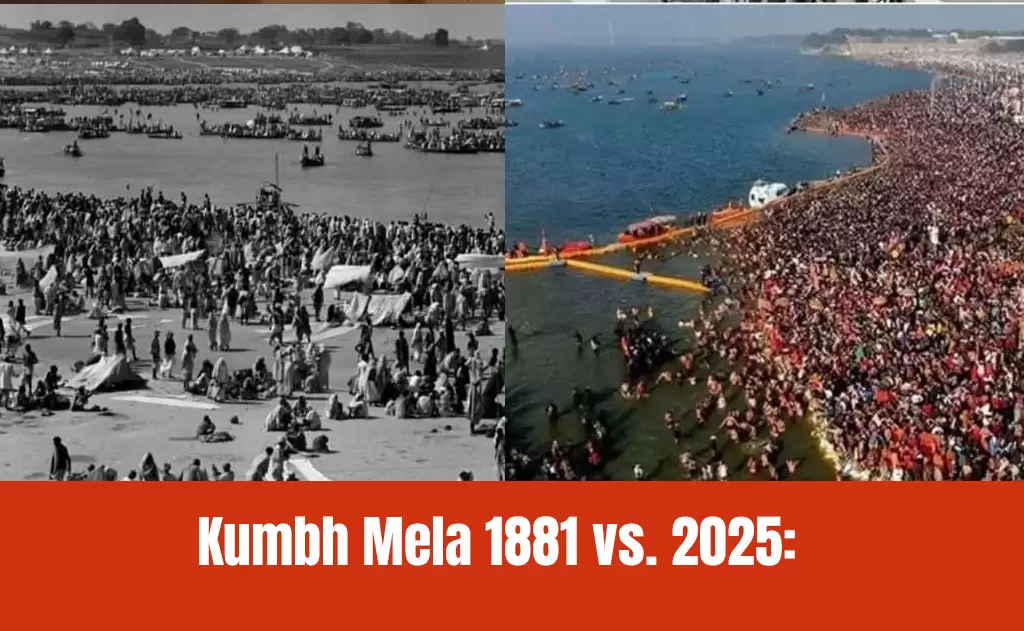
Kumbh Mela, one of the largest spiritual gatherings in the world, has been a cornerstone of Hindu culture for centuries. While its essence remains deeply rooted in faith and devotion, the event has undergone tremendous changes over the years. Comparing the Kumbh Mela of 1881 with that of 2025 highlights how technology, governance, and societal evolution have transformed this grand festival.
- Scale of Participation:
1881: The Kumbh Mela was a massive event even in 1881, but the participation was limited by transportation and communication challenges. Devotees primarily traveled by foot, bullock carts, or boats.
2025: Advanced transportation systems, including trains, buses, and even air travel, enable millions from around the globe to attend. The 2025 event expects over 100 million participants, a significant leap in scale. - Infrastructure and Planning:
1881: Minimal infrastructure existed, with temporary camps and makeshift arrangements for the pilgrims. Sanitation and crowd management were rudimentary.
2025: The festival boasts state-of-the-art facilities, including bio-toilets, AI-driven crowd monitoring, water purification plants, and well-organized tent cities with Wi-Fi connectivity. - Communication:
1881: News of the Kumbh Mela spread through word of mouth, posters, and announcements at temples. Pilgrims relied on local guides and maps for navigation.
2025: Social media, mobile apps, and real-time updates through official websites ensure seamless communication. Pilgrims can access virtual maps, safety alerts, and even live streams. - Role of Technology:
1881: The festival was entirely reliant on traditional methods for rituals, timekeeping, and logistics.
2025: Drones monitor crowds, AI predicts footfall, and digital payments ensure cashless transactions. Virtual reality (VR) also enables global devotees to participate from their homes.
- Spiritual and Cultural Practices:
1881: Practices were deeply traditional, with minimal outside influences. The emphasis was on simplicity and austerity.
2025: While the core rituals remain unchanged, cultural programs now include modern elements like laser shows, documentaries, and global participation of Hindu diaspora communities.
- Health and Safety:
1881: Limited medical facilities were available, and epidemics were a significant concern due to lack of sanitation.
2025: Comprehensive health camps, vaccination drives, and medical teams equipped with modern technology ensure safety. Pandemic protocols, if required, are seamlessly implemented.
- Environmental Awareness:
1881: Environmental impact was negligible due to organic practices and fewer participants.
2025: With a massive crowd, eco-friendly measures like waste segregation, biodegradable materials, and Ganga cleanup drives are emphasized to protect the environment.
- Governance and Security:
1881: Managed by local authorities and spiritual leaders with limited resources for law enforcement.
2025: The government deploys thousands of security personnel, advanced surveillance systems, and disaster management teams to ensure a safe and orderly event.
Conclusion: +The Kumbh Mela of 1881 and 2025, though separated by centuries, share the same spiritual essence while reflecting the evolution of society, technology, and governance. This comparison showcases how tradition and modernity coexist in one of Hinduism's most sacred celebrations, ensuring its relevance for generations to come.
What is the scriptural foundation that has kept Kumbh Mela unchanged at its core across centuries?
The theological anchor of Kumbh Mela is the Samudra Manthan narrative recorded in the Bhagavata Purana (Book VIII) and the Vishnu Purana. When the gods and asuras churned the cosmic ocean, the physician of the gods, Dhanvantari, emerged bearing the Kumbha — the pot of amrita, the nectar of immortality. Drops of that nectar are believed to have fallen at four tirtha-kshetras: Prayagraj (at the Triveni Sangam of the Ganga, Yamuna, and the invisible Saraswati), Haridwar on the Ganga, Nashik on the Godavari, and Ujjain on the Shipra. This cosmic geography has determined the rotation of the Maha Kumbh cycle for as long as written records exist.
The choice of dates is governed by a precise astronomical alignment — a Jupiterian reckoning called Brihaspati-yoga. When Jupiter (Brihaspati) enters Vrishabha (Taurus) and the Sun and Moon are in Makara (Capricorn) at Prayagraj, the waters of the Sangam are held to become amrita-tulya, equivalent to the nectar of immortality. This astronomical calculus was the same in 1881 as it is in 2025; no authority has altered it. The Shahi Snan dates — the royal bathing days for the Akharas — are still fixed by the same Panchanga calculations that medieval astrologers used.
Who are the Akharas and how has their role evolved from 1881 to 2025?
The Akharas are the monastic orders that give Kumbh its institutional backbone. Adi Shankaracharya is traditionally credited with organising these warrior-ascetic brotherhoods in the 8th century CE to protect Sanatana Dharma. The thirteen recognised Akharas — seven Shaiva, three Vaishnava, and three Udasina-Sikh — have the hereditary right to lead the Amrit Snan procession in a strict order of precedence. In 1881, the procession order was fiercely contested; the colonial-era administration of the North-Western Provinces had to negotiate with Akhara leaders to prevent the violent clashes that had marred earlier Kumbh gatherings.
By 2025, the Akhara Parishad — the apex council of all thirteen Akharas — works in structured coordination with the Uttar Pradesh Mela Authority. Naga Sadhus, the naked ash-smeared ascetics of the Shaiva Akharas, remain the most visually iconic participants, emerging from their Himalayan retreats for the Shahi Snan. What has changed is the reach: in 1881, a Naga Sadhu's initiation (diksha) ceremony was witnessed only by those physically present; in 2025, such ceremonies are livestreamed to tens of millions worldwide, bringing the living tradition of sannyasa into the global public eye without altering its ritual structure.
How did colonial administration in 1881 shape the Kumbh Mela, and what does sovereign Indian governance look like in 2025?
In 1881, the Kumbh Mela at Haridwar and the Magh Mela cycle at Prayagraj were administered under the British North-Western Provinces government. Colonial officials issued detailed Mela reports — some preserved in the India Office Records — that treated the gathering primarily as a public-health and crowd-control challenge. A pilgrim tax was levied at various points, and foreign missionaries used the festival as an opportunity for proselytisation, drawing documented protests from Hindu leaders of the time.
The 2025 Maha Kumbh at Prayagraj is organised under a dedicated Mela Authority constituted by the Government of Uttar Pradesh, with a full-time Mela Adhikari (Officer) heading a multi-department task force. The planning horizon now spans three years before the event. Over 40,000 police personnel, an Integrated Command and Control Centre with AI-enabled camera surveillance covering the entire mela ground, and a network of 25 hospitals and 100 health centres have been deployed. The shift from colonial extraction to sovereign service-delivery reflects a fundamental transformation in how the Indian state relates to this pilgrimage.
What ecological and environmental considerations distinguish the 2025 Mela from its 1881 counterpart?
In 1881, the Ganga and Yamuna at Prayagraj were substantially free of industrial pollution; the ecological footprint of the Mela was measured mainly in firewood consumption and organic waste. Devotees drank directly from the river, and the seasonal flood cycle naturally cleansed the mela grounds after each gathering. The Triveni Sangam's water quality was not a matter of public debate or administrative policy.
By the late twentieth century, industrial effluents, sewage discharge, and encroachment had severely degraded both rivers. For the 2025 Maha Kumbh, the National Mission for Clean Ganga (Namami Gange programme) has coordinated with the Mela Authority to ensure zero untreated sewage discharge into the Sangam during the festival period. Real-time water-quality sensors are placed at multiple ghats, and their readings are publicly displayed. The deployment of over 10,000 'Swachhagrahis' — sanitation volunteers — and a ban on single-use plastics within the mela perimeter represent a conscious effort to marry ancient reverence for the sacred river with contemporary environmental responsibility.
How has the participation of women and marginalised communities changed between 1881 and 2025?
In 1881, women's participation in Kumbh was shaped by strict social constraints. Widows, considered inauspicious in many communities of that era, were discouraged or barred from attending. Women of lower castes faced additional restrictions on access to prominent ghats. The few written accounts that survive from women pilgrims of the nineteenth century describe navigation of elaborate social hierarchies alongside the physical rigours of the journey.
The 2025 Maha Kumbh presents a markedly different picture. Women Naga Sadhus from the Kinnar Akhara — a body formally recognised by the Akhara Parishad in 2019 — march in the Shahi Snan procession, a phenomenon that would have been unimaginable in 1881. Women-only designated bathing ghats, female police battalions for security, and dedicated rest areas for mothers and children reflect institutional acknowledgement of women as full participants. Pilgrims from Dalit and Adivasi communities now have unhindered access to all principal ghats under constitutional guarantees, though lived experience continues to vary. This evolution does not erase historical inequalities, but it does mark a directional change grounded in both legal reform and shifting social consciousness.
What role does Prayagraj's sacred geography — the Triveni Sangam — play in the Mela's spiritual significance across both eras?
Prayagraj, ancient Prayaga, holds the title 'Tirtha-raja' — king of all pilgrimage sites — in texts including the Matsya Purana and the Padma Purana. The Triveni Sangam, the confluence of the visible Ganga and Yamuna with the mythically subterranean Saraswati, is described in these texts as a place where a single bath during auspicious conjunctions yields the accumulated merit of countless lifetimes of tapas (austerity). This doctrinal claim has drawn pilgrims since at least the Gupta period (4th–6th centuries CE) and is the reason the site was already receiving hundreds of thousands in 1881.
The act of snan (sacred bathing) at the Sangam is not mere ritual washing; it is understood as a moment of moksha-sadhana — active pursuit of liberation. The Rigveda (X.75) praises the Sindhu river system in terms that later commentators extended to all sacred confluences, and the concept of tirtha as a 'crossing place' — from the mundane to the divine — runs through all subsequent Sanskrit literature on pilgrimage. In 2025, floating pontoon bridges stretch across the same waters that nineteenth-century pilgrims waded through, but the whispered mantra at the moment of immersion, the cupped hands lifting the sacred water toward the sun, and the inner orientation of the devotee remain threads of continuity that no infrastructure transformation has severed.
Frequently Asked Questions
What is Kumbh Mela 1881 vs.?
Kumbh Mela, one of the largest spiritual gatherings in the world, has been a cornerstone of Hindu culture for centuries. While its essence remains deeply rooted in faith and devotion, the event has undergone tremendous changes over the years.
What are the key points about Kumbh Mela 1881 vs.?
Comparing the Kumbh Mela of 1881 with that of 2025 highlights how technology, governance, and societal evolution have transformed this grand festival. Scale of Participation: 1881: The Kumbh Mela was a massive event even in 1881, but the participation was limited by transportation and communication challenges.
Why does Kumbh Mela 1881 vs. matter in Hinduism?
It reflects core values of Sanatana Dharma and offers practical and spiritual guidance that remains relevant across generations.
How can devotees apply Kumbh Mela 1881 vs. in daily life?
By reflecting on its teaching, incorporating the related practices or observances into daily routine, and approaching it with sincere devotion and understanding.
You might also like
Maha Kumbh 2025 Legacy — 13 Months Later: Records, Spiritual Impact, NRI Pilgrim Stories & Next Ardh Kumbh 2027 Preview
Hindu Dharma Worldwide: Complete NRI Diaspora Guide to Festivals, Temples, Mantras & Traditions (USA, UK, Canada, Australia, UAE & Europe — 2026)
Hindu Temples & Festivals in Europe — Complete NRI Guide to Sanatana Dharma Across the Continent (2026)