The Significance of Vasant Panchami and Its Connection to Kumbh Mela
Vasant Panchami, also known as Saraswati Puja, is a vibrant and auspicious festival that marks the arrival of spring and celebrates the goddess of wisdom,…
Vasant Panchami, also known as Saraswati Puja, is a vibrant and auspicious festival that marks the arrival of spring and celebrates the goddess of wisdom,…
Vasant Panchami, also known as Saraswati Puja, is a vibrant and auspicious festival that marks the arrival of spring and celebrates the goddess of wisdom, knowledge, and learning, Maa Saraswati. This day is not just a celebration of nature’s beauty but also a spiritual awakening that aligns deeply with Sanatana Dharma’s core principles.
At www.hindutone.com, we explore the relevance of festivals like Vasant Panchami in modern life and their timeless connection to our Dharmic heritage.
Why is Vasant Panchami Important?
Honoring Maa Saraswati: Vasant Panchami is dedicated to Goddess Saraswati, the epitome of wisdom, learning, and creativity. Devotees pray for enlightenment, clarity of thought, and artistic inspiration.
The Transition to Spring: The festival symbolizes the end of winter and the onset of spring (Vasant Ritu). It marks a season of renewal, optimism, and prosperity in both nature and life.
Spiritual Awakening at Kumbh Mela: During Kumbh Mela, Vasant Panchami holds special significance as it aligns with the sacred confluence (Triveni Sangam) of Ganga, Yamuna, and Saraswati rivers. Devotees take holy dips at this time, seeking spiritual purification and divine blessings.
Promoting Sanatana Dharma: Vasant Panchami reminds us of the eternal values of knowledge and harmony with nature. Observing this day strengthens our connection with our roots and ensures the continuity of Dharmic traditions in a fast-changing world.
How to Perform Poojas on Vasant Panchami
Performing pooja on Vasant Panchami is simple yet profound. Here’s a step-by-step guide:
Prepare the Altar:
Place an idol or picture of Maa Saraswati. Decorate the altar with yellow flowers, as yellow symbolizes energy, prosperity, and knowledge.
Offerings to Maa Saraswati:
Light a ghee diya and offer yellow-colored sweets like kesar halwa or boondi ladoos. Place a few books, pens, or musical instruments near the idol for her blessings.
Recite Saraswati Vandana: Chant mantras like: “Om Saraswati Namah” or the powerful: “Saraswati Mahabhage Vidye Kamalalochane, Vidyarupe Vishalakshi Vidyam Dehi Namostute.”
Perform Aarti: Sing the Saraswati aarti with devotion and gratitude.
Seek Knowledge and Wisdom: Meditate or read sacred texts to absorb the essence of knowledge and clarity Maa Saraswati embodies.
Vasant Panchami and Kumbh Mela: A Spiritual Synergy
The alignment of Vasant Panchami with Kumbh Mela amplifies the spiritual significance of this day. Millions gather at the sacred Triveni Sangam to take holy dips, participate in Satsangs, and embrace the eternal values of Sanatana Dharma. The energy of the collective devotion creates a powerful spiritual aura that inspires people to live a Dharmic life.
Celebrating Sanatana Dharma with www.hindutone.com
At Hindutone, we are committed to promoting the relevance of Sanatana Dharma in modern life. Vasant Panchami is a perfect reminder of how our traditions can guide us toward a harmonious and enlightened existence. Explore more about Hindu festivals, rituals, and their timeless wisdom on our portal: www.hindutone.com.
Keywords: Vasant Panchami, Saraswati Puja, Kumbh Mela, Sanatana Dharma, how to perform Vasant Panchami pooja, Hindu festivals, spiritual significance, Triveni Sangam, promoting Sanatana Dharma, www.hindutone.com.
What do the Vedas and Puranas say about Goddess Saraswati and Vasant Panchami?
Goddess Saraswati is first invoked in the Rigveda (Mandala VI, hymn 61) as 'Ambitame, Naditame, Devitame Saraswati' — best of mothers, best of rivers, best of goddesses. This triple identity as a cosmic river, a divine mother, and the sovereign of speech (Vak) establishes her as far more than a patron of the arts; she is the very force through which consciousness finds expression in the world.
The Brahma Vaivarta Purana narrates that Brahma fashioned the universe but found it silent and formless until Saraswati emerged from his lips, instantly filling creation with melody, language, and wisdom. Vasant Panchami commemorates this primordial moment of Vak Srishti — the creation through sacred speech — making the day not merely a cultural observance but a re-enactment of the universe's first awakening.
The Devi Bhagavata Purana further describes Saraswati as inseparable from Vasant Ritu, the season that itself embodies sattvic renewal. Performing Saraswati Puja on the Shukla Panchami tithi of the month of Magha is therefore considered the most auspicious moment to initiate a child into learning, a practice known as Vidyarambha Samskara.
Why is Vasant Panchami one of the most sacred Shahi Snan dates at Kumbh Mela?
Among the several Shahi Snan (royal bathing) dates observed during Maha Kumbh Mela at Prayagraj, Vasant Panchami stands out because it carries a dual sanctity — the astronomical power of the Magha Shukla Panchami tithi combined with the devotional energy of Saraswati Puja. Ancient texts classify this as an Amrit Yoga, a rare celestial alignment when a bath at the Triveni Sangam is said to yield the merit of a thousand ordinary tirthas.
During the Maha Kumbh Mela, Vasant Panchami Shahi Snan traditionally sees the procession of the Niranjani Akhara and other monastic orders into the Sangam waters at dawn, a sight that draws millions of pilgrims from across the country. The Akharas, draped in saffron and accompanied by elephants, chariots, and the sound of Vedic chanting, create a living tableau of Sanatana Dharma's unbroken monastic lineage.
The hidden — or 'Antarvahini' — Saraswati river is believed by tradition to flow beneath the surface at Triveni Sangam, making Vasant Panchami, the day devoted to Saraswati, especially potent at this spot. Pilgrims who take the sacred dip on this tithi believe they receive not only physical purification through the Ganga and Yamuna but also the blessing of divine knowledge that the invisible Saraswati bestows.
How does the colour yellow unify cosmology, nature, and devotion on Vasant Panchami?
Yellow — called Pitambara in Sanskrit — is the presiding colour of Vasant Panchami and carries layered symbolic meaning. In Vedic cosmology, yellow is associated with Brihaspati (Jupiter), the guru of the gods and the celestial lord of wisdom and dharma. Wearing yellow garments and offering yellow flowers such as mustard blossoms, marigolds, and yellow roses to Maa Saraswati is therefore an act of aligning oneself with the sattvic, knowledge-conferring energy that Jupiter represents.
From a natural standpoint, the mustard fields of North India burst into brilliant yellow exactly around Vasant Panchami, creating a seamless link between agricultural abundance and the divine. The Bhagavata Purana compares the onset of Vasant Ritu to the smile of Vishnu — nature itself becomes a form of prasad at this time of year.
In regional traditions across Varanasi, Mathura, and Nadia in West Bengal, children who begin formal schooling on Vasant Panchami are dressed in yellow and handed a slate smeared with saffron paste to write their first letters. This Vidyarambha ritual embeds the colour's symbolism into the child's first conscious encounter with learning, creating a lifelong association between the golden hue and the pursuit of knowledge.
Which temples and pilgrimage centres celebrate Vasant Panchami with special grandeur?
The Shri Saraswati Temple at Basar (also spelled Basara) in Telangana, situated on the banks of the Godavari river, is one of the most significant Saraswati shrines in peninsular India. Thousands of families travel to Basar specifically on Vasant Panchami to perform the Akshara Abhyasam ceremony, placing their young children's fingers in the presiding priest's hand to trace the first letters of the Telugu alphabet in a plate of rice — a tradition that has continued for many centuries.
In North India, the Saraswati Ghat in Varanasi and the Saraswati Koop — the sacred well said to tap the underground Saraswati stream — at Prayagraj are especially thronged on this day. The Kashi Vidvat Parishad (the council of learned pandits in Varanasi) customarily convenes on Vasant Panchami to honour distinguished scholars, maintaining the city's ancient identity as a living centre of Vaidika learning.
In the eastern regions, the Dakshineswar Kali Temple complex near Kolkata and numerous pandals across West Bengal and Odisha install elaborate clay images of Saraswati, complete with her vahana (mount) the white swan, symbolising the discrimination between the real and the transient. Students place their textbooks and musical instruments before the goddess, refraining from using them until formal puja is complete — a community-wide pause in favour of devotion.
What is the deeper philosophical meaning of Saraswati's association with music, speech, and liberation?
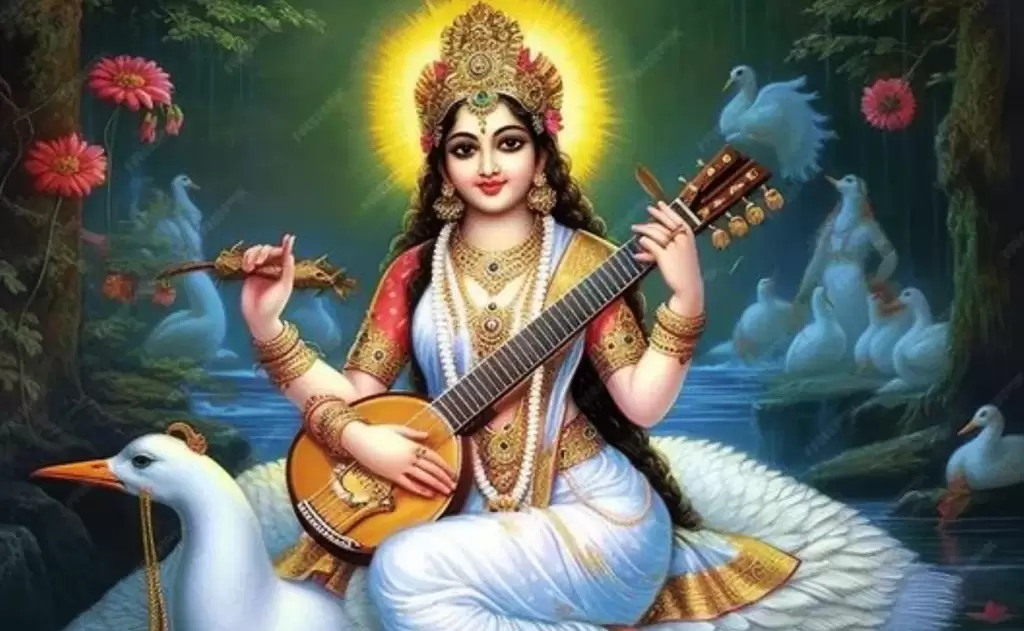
Maa Saraswati holds the veena in two of her four hands, and the Naradiya Shiksha — an ancillary Vedic text on phonetics — explains that musical notes (svaras) are not human inventions but cosmic vibrations that sustain the order of the universe (Rta). The veena in Saraswati's hands is therefore a symbol of Nada Brahman, the primordial sound from which all creation unfolds, connecting music directly to the metaphysical foundation of existence.
Her other attributes — the pustaka (sacred book) and the akshamala (rosary) — represent Jnana (knowledge) and Dhyana (meditation) respectively. Together, these four objects illustrate the fourfold path to wisdom: sound, scripture, contemplation, and the grace that emerges when the other three are perfected. The swan (Hamsa), her vahana, exemplifies Viveka — the faculty of discrimination that separates milk from water — reminding the devotee that true learning must be accompanied by discernment.
The Yogic tradition, particularly the school of Tantra Shastra, identifies Saraswati with the Vishudda chakra located at the throat — the energy centre governing pure, truthful, and enlightened speech. Worshipping her on Vasant Panchami is therefore seen as an activation of this chakra, enabling the practitioner to move from mere information to genuine understanding, and ultimately toward Moksha through the liberated word.
How can modern devotees meaningfully observe Vasant Panchami beyond the formal puja?
The spirit of Vasant Panchami extends naturally into actions that honour knowledge in everyday life. Beginning a new course of study, picking up a musical instrument, starting a journal in one's mother tongue, or making a commitment to read one sacred text — the Bhagavad Gita, the Ramacharitmanas, or even a regional classic — are all ways of honouring Saraswati that align with the festival's inner meaning without requiring elaborate ritual equipment.
Community observance deepens the festival's impact considerably. Organising a Saraswati Vandana recitation in schools, sponsoring books for underprivileged children, or hosting a kavi sammelan (poetry gathering) in one's neighbourhood translates the goddess's blessings into living dharmic action. Several spiritual organisations in India mark Vasant Panchami by launching annual scholarship funds and free tutoring programmes, recognising that the best offering to Saraswati is the gift of learning to those who lack access to it.
For those unable to travel to Prayagraj for the Kumbh Mela Shahi Snan, a sunrise bath in any river or body of water, accompanied by the chanting of the Saraswati Stotram from the Skanda Purana and a yellow flower offering, is considered spiritually meritorious. The essential principle, as stated in the Devi Bhagavata Purana, is Bhava — the sincerity of feeling — which transforms even a simple act of devotion into a profound moment of connection with the divine.
Frequently Asked Questions
What is The Significance of Vasant Panchami and Its?
Vasant Panchami , also known as Saraswati Puja, is a vibrant and auspicious festival that marks the arrival of spring and celebrates the goddess of wisdom, knowledge, and learning, Maa Saraswati. This day is not just a celebration of nature’s beauty but also a spiritual awakening that aligns deeply with Sanatana Dharma’s core principles.
What are the key points about The Significance of Vasant Panchami and Its?
At www.hindutone.com, we explore the relevance of festivals like Vasant Panchami in modern life and their timeless connection to our Dharmic heritage. Why is Vasant Panchami Important?
Why does The Significance of Vasant Panchami and Its matter in Hinduism?
It reflects core values of Sanatana Dharma and offers practical and spiritual guidance that remains relevant across generations.
How can devotees apply The Significance of Vasant Panchami and Its in daily life?
By reflecting on its teaching, incorporating the related practices or observances into daily routine, and approaching it with sincere devotion and understanding.
You might also like
Maha Kumbh 2025 Legacy — 13 Months Later: Records, Spiritual Impact, NRI Pilgrim Stories & Next Ardh Kumbh 2027 Preview
Saraswati and the Knowledge Tradition: Why NRI Students Light a Lamp Before Exams
Benefits of Pradakshina by Number | Spiritual Significance of 1 to 108 Circumambulations