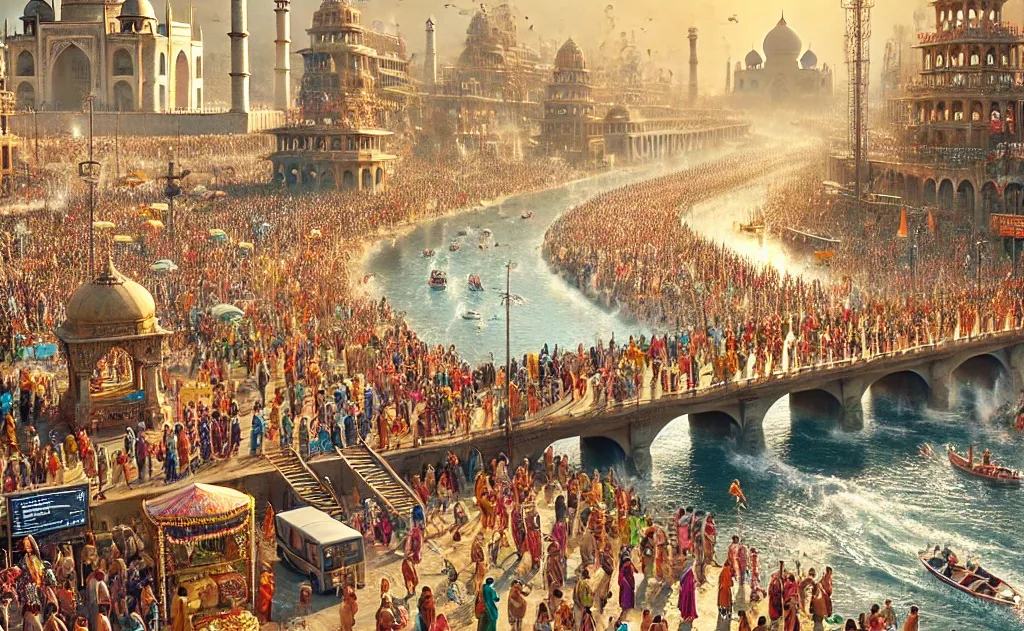
Last night, there was a lighting show in Prayagraj.
On the night of February 4, 2025, during the Maha Kumbh Mela in Prayagraj, a spectacular drone light show illuminated the skies above the Sangam Nose area.
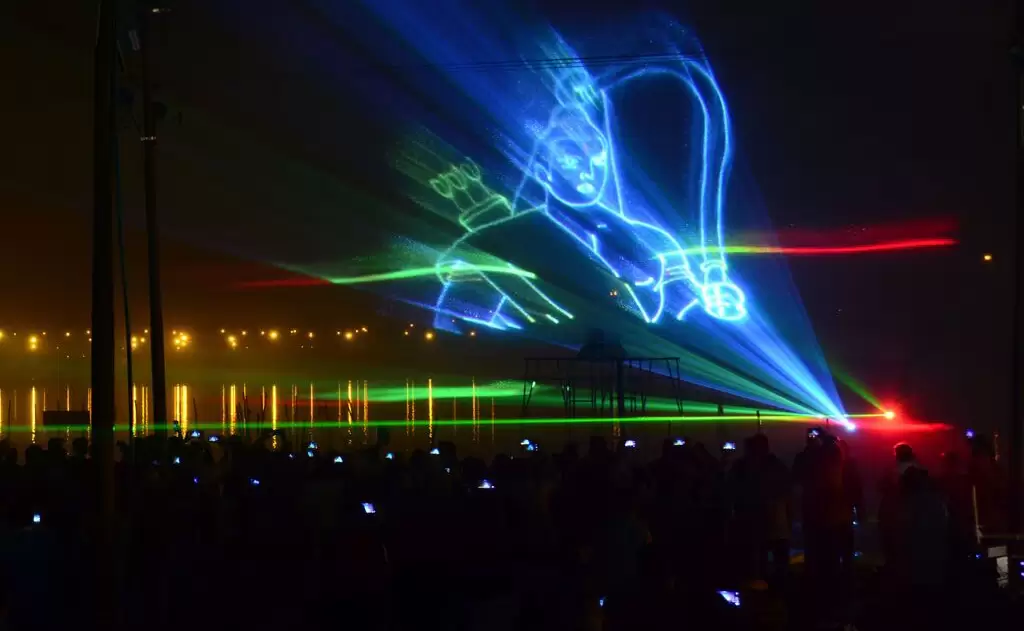
On the night of February 4, 2025, during the Maha Kumbh Mela in Prayagraj, a spectacular drone light show illuminated the skies above the Sangam Nose area.
On the night of February 4, 2025, during the Maha Kumbh Mela in Prayagraj, a spectacular drone light show illuminated the skies above the Sangam Nose area. This first-of-its-kind event featured 2,000 illuminated drones working in unison to depict mythological tales, including a magnificent representation of Lord Shiva. The show seamlessly blended technology with tradition, offering attendees a unique visual experience. The Maha Kumbh Mela, held from January 13 to February 26, 2025, is renowned for its spiritual significance, and this drone show added a modern touch to the age-old festival.
Why was the Sangam Nose chosen as the stage for this historic drone show?
The Sangam Nose — the precise tip of land where the Ganga, Yamuna, and the invisible Saraswati meet at Prayagraj — is considered the most sacred geographical point of the entire Maha Kumbh. Ancient texts including the Matsya Purana describe the Triveni Sangam as a tirtha capable of dissolving accumulated karma across multiple lifetimes. Staging the drone show directly above this confluence ensured that the mythological imagery was projected over the holiest coordinates of the festival.
The choice also carried practical significance. The open sky above the Sangam Nose is unobstructed by tall structures, giving the 2,000 drones maximum vertical and lateral space to form large-scale formations. Pilgrims gathered on the ghats on both the Ganga and Yamuna banks could witness the display simultaneously, amplifying its communal impact across a vast crowd estimated in the millions.
What mythological narratives did the 2,000 drones depict in the night sky?
The centerpiece formation was a luminous depiction of Lord Shiva — specifically understood by viewers as Mahakala, the lord of time — whose cosmic significance is inseparable from the Kumbh tradition. According to the Bhagavata Purana's account of the Samudra Manthan (churning of the cosmic ocean), it was Shiva who consumed the Halahala poison to protect creation, an act of supreme sacrifice closely associated with the spiritual gravity of Kumbh bathing.
Beyond the Shiva tableau, the drones are reported to have illustrated scenes connected to the origin of the Kumbh itself — the flight of Garuda carrying the pot (kumbha) of amrita, the divine nectar of immortality, as celestial beings pursued him across the heavens. Drops of amrita are believed by tradition to have fallen at Prayagraj, Haridwar, Nashik on the Godavari, and Ujjain on the Shipra — the four cities that rotate as hosts of the Maha Kumbh and Ardha Kumbh cycles.
How does drone technology meet the ancient tradition of illuminating sacred festivals?
Light has long been a devotional language in Sanatana Dharma. The Skanda Purana describes the Kartik Deepotsava — the festival of lamps — as a means of welcoming divine presence and purifying space. Maha Aarti ceremonies performed nightly at the Triveni Ghat in Rishikesh and the Dashashwamedh Ghat in Varanasi use synchronized fire lamps to weave a moving visual prayer. The Prayagraj drone show stands as a technological evolution of this same impulse: coordinated light as collective worship.
Each programmable drone functions as a single pixel in an enormous aerial canvas. Engineers pre-map GPS coordinates for every drone to trace specific iconographic outlines with centimeter-level precision, ensuring that a deity's form is rendered faithfully rather than abstractly. The synchronization required — 2,000 units holding formation against wind and atmospheric variables — mirrors, in a modern register, the disciplined coordination of thousands of priests performing a Mahayajna.
What is the deeper spiritual context of Maha Kumbh 2025 that gave this event its meaning?
Maha Kumbh occurs once every twelve years at Prayagraj when Jupiter (Brihaspati) enters Aries and the Sun and Moon align in Capricorn — a planetary configuration described in Jyotisha texts as creating a window of heightened cosmic receptivity. The 2025 gathering is additionally designated a Maha Kumbh rather than a standard Purna Kumbh because it falls after the completion of twelve full Purna Kumbh cycles at Prayagraj, an alignment that recurs only once every 144 years, making it exceptionally rare in living memory.
Within this context, the February 4 drone show fell between two of the most auspicious snan (bathing) dates of the calendar — Mauni Amavasya (January 29) and Basant Panchami (February 3) — both of which drew tens of millions of pilgrims to the Sangam. The light show on the night of February 4 therefore served as a collective celebration in the immediate afterglow of the festival's peak sacred period, connecting devotees through shared spectacle at a moment of heightened religious emotion.
How has Prayagraj prepared its infrastructure to host events of this scale during Maha Kumbh 2025?
Prayagraj, known historically as Prayaga and later as Allahabad, underwent one of the largest temporary urban expansions in recent Indian history to accommodate Maha Kumbh 2025. The Mela authority constructed over 150,000 tents across more than 4,000 hectares of the Sangam flood plains — a temporary city known as the Kumbh Nagari — equipped with water supply, sanitation, medical facilities, and high-speed connectivity.
Dedicated air-traffic coordination protocols were established to permit drone performances above the Sangam, a logistically sensitive airspace given the volume of state and security aircraft monitoring the gathering. The February 4 show required clearance from civil aviation authorities and real-time coordination with ground security forces, underscoring how the administration balanced modern event production with the safety of an audience numbering in the hundreds of thousands gathered along the river banks that evening.
What legacy might this event leave for future Kumbh celebrations and Hindu festival culture?
The Prayagraj drone show represents a precedent — the first time large-scale drone iconography has been deployed at a Kumbh Mela — and its reception among pilgrims and organizers is likely to influence how future Ardha Kumbh and Maha Kumbh events are designed. Festival organizers in Haridwar, Nashik, and Ujjain may look to similar technology for their respective Kumbh cycles as a way to make sacred narratives visible to enormous, dispersed crowds who cannot access traditional close-range ritual performances.
Critically, the success of the show rests on its fidelity to the iconographic and narrative content of the tradition rather than spectacle for its own sake. When technology is used to render the Samudra Manthan or the form of Mahakala above the Triveni Sangam, it functions as a form of visual Katha — sacred storytelling — that the Bhagavata and Vishnu Puranas have long valorized as a legitimate path of spiritual engagement. The challenge for future events will be ensuring that artistic and technological choices remain anchored in scriptural accuracy and the aesthetic sensibilities of the tradition they serve.
Frequently Asked Questions
When was the drone light show held at Maha Kumbh 2025?
The drone show took place on the night of February 4, 2025, during the Maha Kumbh Mela in Prayagraj. The Mela itself ran from January 13 to February 26, 2025.
How many drones were used in the Prayagraj Maha Kumbh show?
The show used 2,000 illuminated drones flying in unison. It was described as a first-of-its-kind event, with the drones tracing mythological tales over the Sangam Nose area.
What did the drones depict over the Sangam?
The centerpiece was a luminous depiction of Lord Shiva, understood by viewers as Mahakala. The drones are also reported to have shown the Kumbh origin legend of Garuda carrying the pot of amrita.
Why was the Sangam Nose chosen for the drone show?
The Sangam Nose is the tip of land where the Ganga, Yamuna and the invisible Saraswati meet, considered the most sacred point of the Maha Kumbh. Its open, unobstructed sky also gave the drones space to form large formations visible from the ghats.
Which snan dates came just before the drone show?
Mauni Amavasya on January 29 and Basant Panchami on February 3 were two of the most auspicious bathing dates, and both drew tens of millions of pilgrims. The drone show followed them on February 4.
You might also like
Hinduism’s Global Stage: How Maha Kumbh 2025 Redefined Spiritual Tourism
Kumbh Mela 2025: End Date, Holy Dip Opportunities, and Key Shahi Snan Dates

Maha Kumbh Mela 2025: Shri #PawanKalyan’s Holy Dip & Aarti at Triveni Sangam