Asantosha
Asantosha (असन्तोष) is a Sanskrit-origin Hindu boy-name meaning “Beyond all contentment; the ever-unsatisfied with evil”. Find pronunciation, origin, deity association, popularity and similar Hindu baby names.
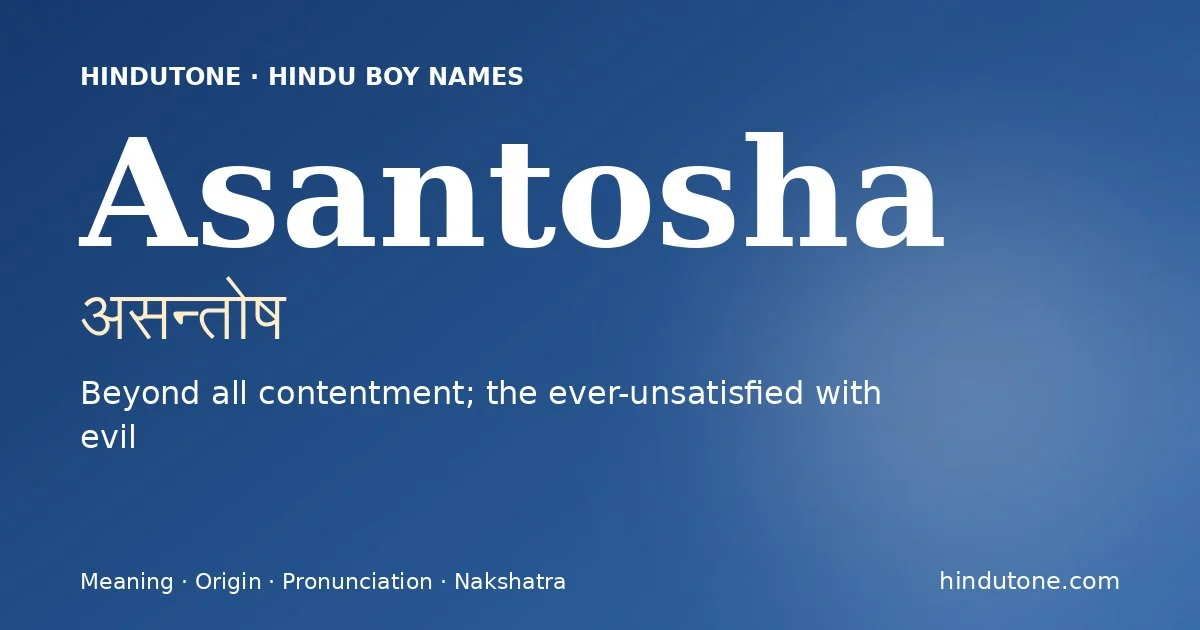
Asantosha (असन्तोष) is a Sanskrit-origin Hindu boy-name meaning “Beyond all contentment; the ever-unsatisfied with evil”. Find pronunciation, origin, deity association, popularity and similar Hindu baby names.
Asantosha (असन्तोष, IAST: Asantoṣa) is an Sanskrit-origin Hindu boy-name meaning “Beyond all contentment; the ever-unsatisfied with evil”. From a- (negation) and santoṣa (contentment/satisfaction), this name in the context of the Vishnu Sahasranāma suggests the Lord's divine discontentment with adharma—he is never at peace so long as unrighteousness persists, ever moved to act for his devotees.
Meaning, etymology & significance
While santoṣa (contentment) is a virtue for spiritual aspirants, when applied to the Supreme Lord in the negated form asantoṣa, it signifies his inexhaustible compassion and zeal for the welfare of all beings. He is never 'satisfied' by witnessing suffering or injustice—his divine restlessness is the very engine of his descents (avatāras). Some commentators also read this as indicating that his glory is beyond any measure of contentment—he transcends the very concept of sufficiency.
This philosophically nuanced epithet appears in the Sahasranāma with a devotional meaning contrary to its surface appearance; it is pronounced a-san-to-sha and needsReview is flagged given its seemingly negative form.
Scriptural source
Asantosha appears in the Vishnu Sahasranama, among the sacred names of Vishnu.
Astrology — nakshatra, rashi & numerology
By the standard Vedic correspondence between a name’s first syllable and the lunar mansion, Asantosha aligns with the Krittika nakshatra, under the Mesha rashi (Moon sign). Its Chaldean name-number is 3.
Asantosha — Name Facts
- Meaning
- Beyond all contentment; the ever-unsatisfied with evil
- Gender
- Hindu boy name
- Nakshatra
- Krittika
- Rashi
- Mesha (Aries)
- Numerology
- 3
Frequently asked questions
What does the name Asantosha mean?
Asantosha is a Sanskrit-origin Hindu boy name meaning “Beyond all contentment; the ever-unsatisfied with evil”.
Is Asantosha a boy or girl name?
Asantosha is traditionally a Hindu boy name.
Which nakshatra and rashi suit the name Asantosha?
By the first-syllable rule of Vedic naming, Asantosha aligns with the Krittika nakshatra, under the Mesha (Aries) rashi.
What is the numerology number of Asantosha?
The Chaldean name number of Asantosha is 3.
Explore more: Krittika nakshatra names · Mesha rashi names · Hindu boy names with A · All Hindu names A–Z