Jagannatha
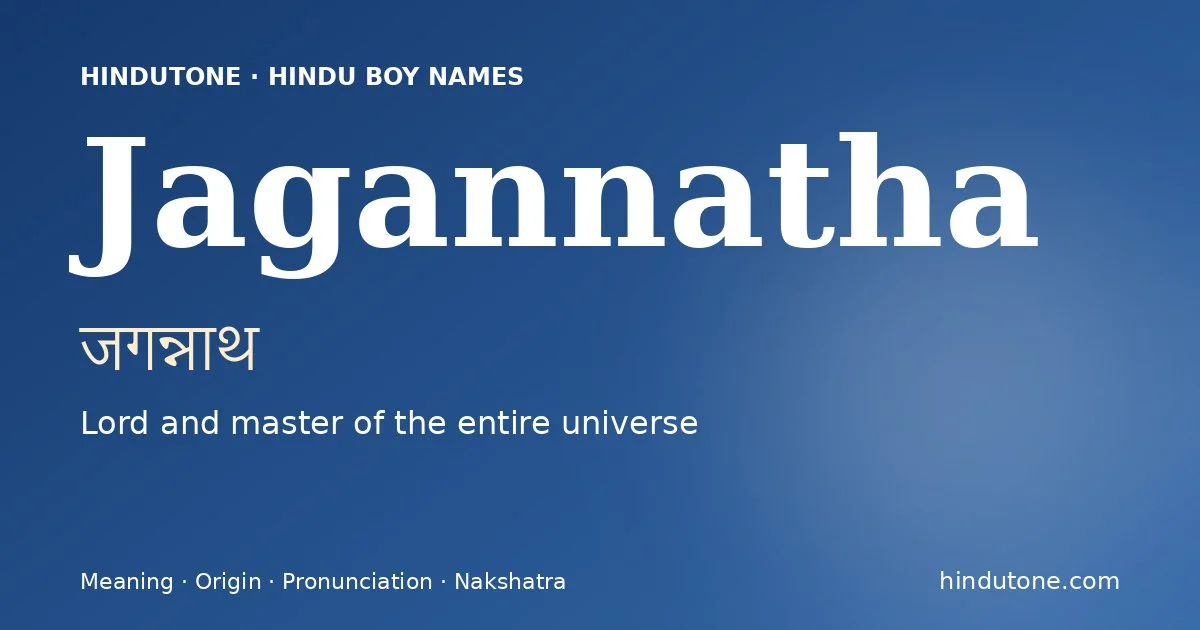
Jagannatha (जगन्नाथ) is a Sanskrit-origin Hindu boy-name meaning “Lord and master of the entire universe”. Find pronunciation, origin, deity association, popularity and similar Hindu baby names.
Jagannatha (जगन्नाथ) is a Sanskrit-origin Hindu boy-name meaning “Lord and master of the entire universe”. Find pronunciation, origin, deity association, popularity and similar Hindu baby names.
Jagannatha (जगन्नाथ, IAST: Jagannātha) is a Sanskrit-origin Hindu boy-name meaning “Lord and master of the entire universe”. Jagannātha, from 'jagat' (the universe in perpetual motion) and 'nātha' (lord, protector), declares Vishnu-Kṛṣṇa as the sovereign guardian of all that exists, moves, and breathes.
Meaning, etymology & significance
The root 'jagat' comes from the verbal root 'gam' (to go), signifying a cosmos always in motion, while 'nātha' derives from 'nāth' (to protect, to be master of), together forming a name of total divine sovereignty. The form is especially sacred in Odisha, where Jagannātha is the presiding deity of the great Puri temple, one of the four holy dhāmas of India. His annual Ratha Yātrā draws millions, embodying the democratic love of a lord who comes out to meet all his people.
Jagannātha is venerated across all sampradāyas of Hinduism and is used as a given name for boys, particularly in Odisha and Bengal; it is pronounced 'ja-gan-NAA-tha.'
Scriptural source
Jagannatha appears in the Vishnu Sahasranama, among the sacred names of Vishnu.
Astrology — nakshatra, rashi & numerology
By the standard Vedic correspondence between a name’s first syllable and the lunar mansion, Jagannatha aligns with the Uttara ashadha nakshatra, under the Makara rashi (Moon sign). Its Chaldean name-number is 9.
Jagannatha — Name Facts
- Meaning
- Lord and master of the entire universe
- Gender
- Hindu boy name
- Nakshatra
- Uttara Ashadha
- Rashi
- Makara (Capricorn)
- Numerology
- 9
Frequently asked questions
What does the name Jagannatha mean?
Jagannatha is a Sanskrit-origin Hindu boy name meaning “Lord and master of the entire universe”.
Is Jagannatha a boy or girl name?
Jagannatha is traditionally a Hindu boy name.
Which nakshatra and rashi suit the name Jagannatha?
By the first-syllable rule of Vedic naming, Jagannatha aligns with the Uttara Ashadha nakshatra, under the Makara (Capricorn) rashi.
What is the numerology number of Jagannatha?
The Chaldean name number of Jagannatha is 9.
Explore more: Uttara Ashadha nakshatra names · Makara rashi names · Hindu boy names with J · All Hindu names A–Z