Keshighna
Keshighna (केशिघ्न) is a Sanskrit-origin Hindu boy-name meaning “Slayer of the horse-demon Keśī”. Find pronunciation, origin, deity association, popularity and similar Hindu baby names.
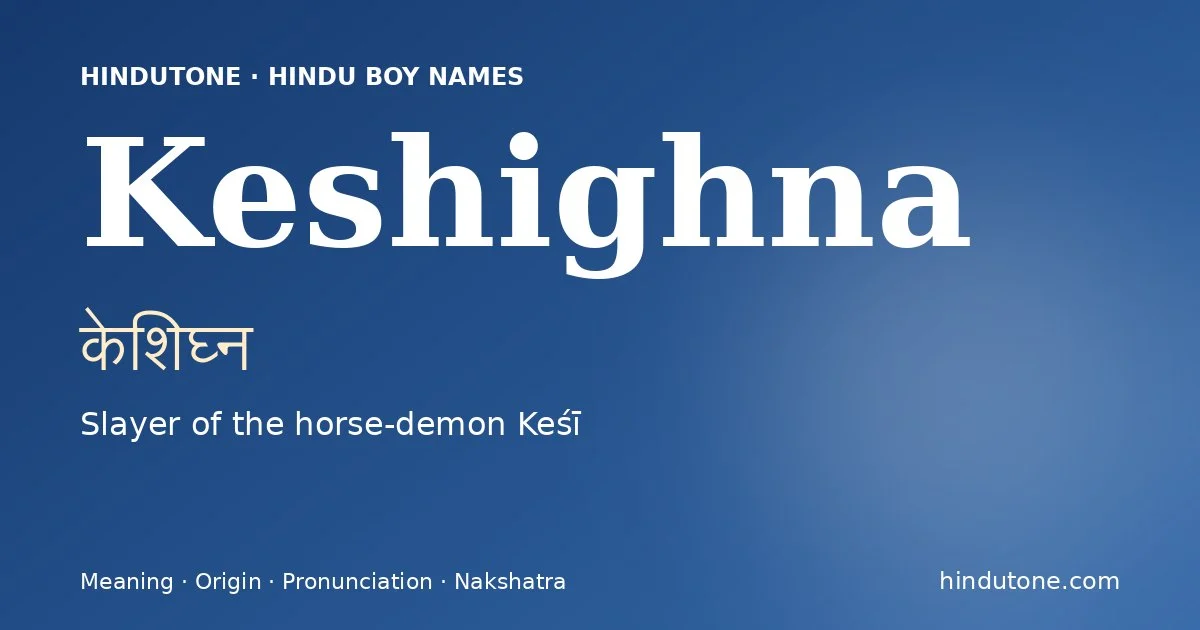
Keshighna (केशिघ्न) is a Sanskrit-origin Hindu boy-name meaning “Slayer of the horse-demon Keśī”. Find pronunciation, origin, deity association, popularity and similar Hindu baby names.
Keshighna (केशिघ्न, IAST: Keśighna) is a Sanskrit-origin Hindu boy-name meaning “Slayer of the horse-demon Keśī”. From Keśī (the demon who attacked in the form of a monstrous horse) and ghna (slayer), this epithet honours the Lord's fearless conquest of a demon whose very name evokes wild, flowing force.
Meaning, etymology & significance
Keśī, whose name may derive from keśa (hair, mane), appeared as an enormous, terrifying stallion sent by Kaṃsa to destroy Krishna. The Lord caught the demon's jaws and expanded His arm within them, slaying Keśī with sovereign ease. Ghna, rooted in han (to strike down), here denotes not mere killing but the liberation of the world from a source of terror. The episode is celebrated in the Bhāgavata Purāṇa and gave rise to one of Krishna's most cherished epithets, Keśava.
Vishnu is addressed as Keśighna to celebrate His protection of the Vraja community from supernatural threats. This name carries the same devotional warmth as Keśava and is suitable as a boy's name. Pronounced ke-shi-ghna.
Scriptural source
Keshighna appears in the Vishnu Sahasranama, among the sacred names of Vishnu.
Astrology — nakshatra, rashi & numerology
By the standard Vedic correspondence between a name’s first syllable and the lunar mansion, Keshighna aligns with the Punarvasu nakshatra, under the Mithuna rashi (Moon sign). Its Chaldean name-number is 3.
Keshighna — Name Facts
- Meaning
- Slayer of the horse-demon Keśī
- Gender
- Hindu boy name
- Nakshatra
- Punarvasu
- Rashi
- Mithuna (Gemini)
- Numerology
- 3
Frequently asked questions
What does the name Keshighna mean?
Keshighna is a Sanskrit-origin Hindu boy name meaning “Slayer of the horse-demon Keśī”.
Is Keshighna a boy or girl name?
Keshighna is traditionally a Hindu boy name.
Which nakshatra and rashi suit the name Keshighna?
By the first-syllable rule of Vedic naming, Keshighna aligns with the Punarvasu nakshatra, under the Mithuna (Gemini) rashi.
What is the numerology number of Keshighna?
The Chaldean name number of Keshighna is 3.
Explore more: Punarvasu nakshatra names · Mithuna rashi names · Hindu boy names with K · All Hindu names A–Z