Samastapātakadhvaṃsin
Samastapātakadhvaṃsin (समस्तपातकध्वंसिन्) is a Sanskrit-origin Hindu boy-name meaning “Destroyer of all sins and transgressions entirely”. Find pronunciation, origin, deity association, popularity and similar Hindu baby names.
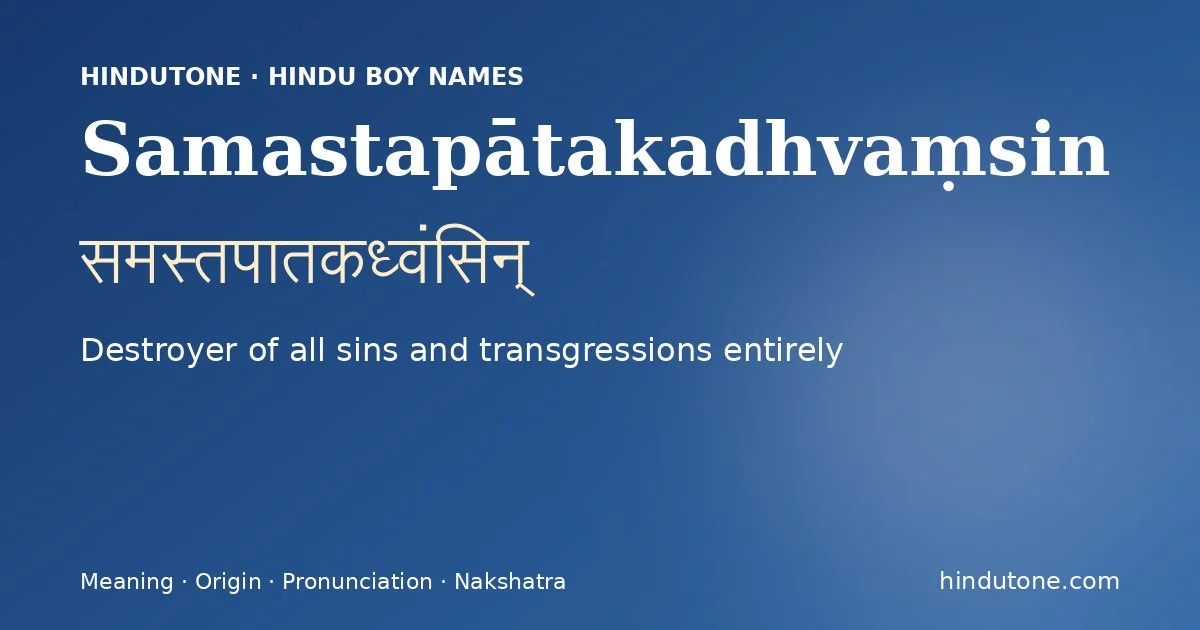
Samastapātakadhvaṃsin (समस्तपातकध्वंसिन्) is a Sanskrit-origin Hindu boy-name meaning “Destroyer of all sins and transgressions entirely”. Find pronunciation, origin, deity association, popularity and similar Hindu baby names.
Samastapātakadhvaṃsin (समस्तपातकध्वंसिन्, IAST: samastapātakadhvaṃsin) is a Sanskrit-origin Hindu boy-name meaning “Destroyer of all sins and transgressions entirely”. From samasta (all, entire), pātaka (sin, transgression — from pat, to fall), and dhvaṃsin (destroyer, one who causes collapse — from dhvaṃs, to crumble/destroy), this name offers the most comprehensive assurance of divine mercy: no sin of any category survives the Lord's purifying grace.
Meaning, etymology & significance
Pātaka literally means 'that which causes one to fall,' capturing the traditional understanding of sin as a force that pulls the soul downward from its dharmic and spiritual station. Dhvaṃsin implies not a gentle cleansing but a structural demolition — the entire architecture of past transgression is brought to ruin. Samasta ensures total scope: no pātaka, whether mahāpātaka (great sin) or upapātaka (minor transgression), is exempted from this annihilating grace.
This epithet is especially beloved in prāyaścitta (atonement) liturgies and in Vaiṣṇava prayers for liberation from karmic burdens. The compound is too elaborate for everyday use as a given name, but Dhvaṃsin alone is occasionally found as a Vaiṣṇava epithet.
Scriptural source
Samastapātakadhvaṃsin appears in the Vishnu Sahasranama, among the sacred names of Vishnu.
Astrology — nakshatra, rashi & numerology
By the standard Vedic correspondence between a name’s first syllable and the lunar mansion, Samastapātakadhvaṃsin aligns with the Shatabhisha nakshatra, under the Kumbha rashi (Moon sign). Its Chaldean name-number is 4.
Samastapātakadhvaṃsin — Name Facts
- Meaning
- Destroyer of all sins and transgressions entirely
- Gender
- Hindu boy name
- Nakshatra
- Shatabhisha
- Rashi
- Kumbha (Aquarius)
- Numerology
- 9
Frequently asked questions
What does the name Samastapātakadhvaṃsin mean?
Samastapātakadhvaṃsin is a Sanskrit-origin Hindu boy name meaning “Destroyer of all sins and transgressions entirely”.
Is Samastapātakadhvaṃsin a boy or girl name?
Samastapātakadhvaṃsin is traditionally a Hindu boy name.
Which nakshatra and rashi suit the name Samastapātakadhvaṃsin?
By the first-syllable rule of Vedic naming, Samastapātakadhvaṃsin aligns with the Shatabhisha nakshatra, under the Kumbha (Aquarius) rashi.
What is the numerology number of Samastapātakadhvaṃsin?
The Chaldean name number of Samastapātakadhvaṃsin is 9.
Explore more: Shatabhisha nakshatra names · Kumbha rashi names · Hindu boy names with S · All Hindu names A–Z