Chintamanigrihanastha
Chintamanigrihanastha (चिन्तामणिगृहान्तस्था) is a Sanskrit-origin Hindu girl-name meaning “She who dwells within the palace of the wish-fulfilling gem”. Find pronunciation, origin, deity association, popularity and similar Hindu baby names.
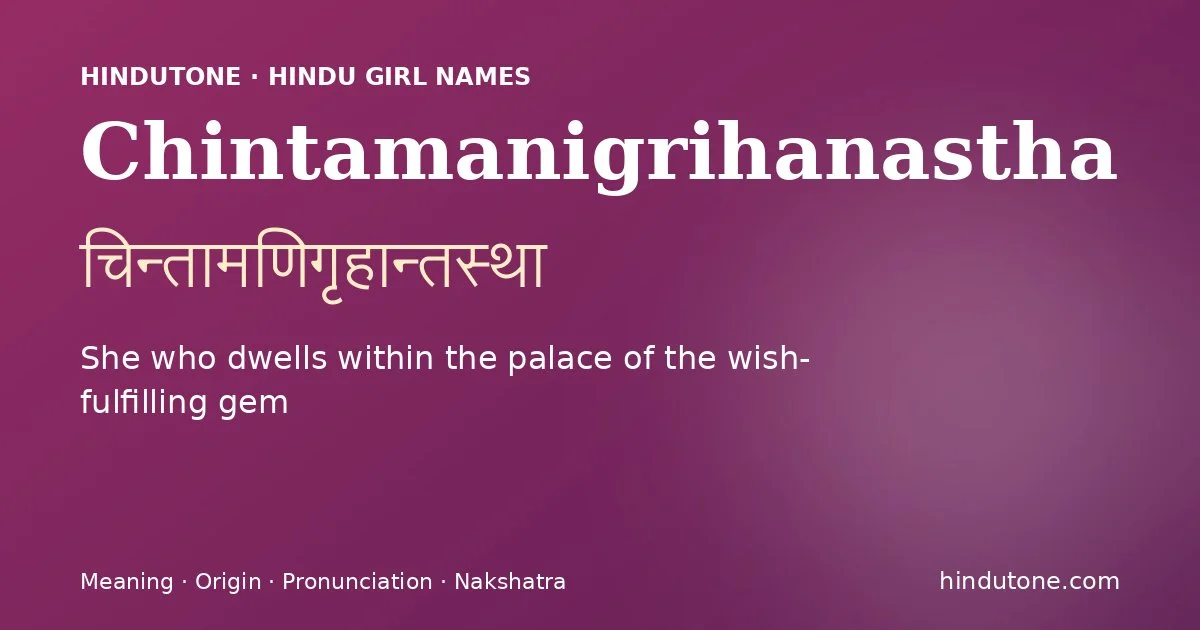
Chintamanigrihanastha (चिन्तामणिगृहान्तस्था) is a Sanskrit-origin Hindu girl-name meaning “She who dwells within the palace of the wish-fulfilling gem”. Find pronunciation, origin, deity association, popularity and similar Hindu baby names.
Chintamanigrihanastha (चिन्तामणिगृहान्तस्था, IAST: Cintāmaṇigṛhāntasthā) is a Sanskrit-origin Hindu girl-name meaning “She who dwells within the palace of the wish-fulfilling gem”. From cintāmaṇi (the wish-fulfilling jewel), gṛha (house, abode), anta (within, interior), and sthā (one who abides), this name situates Lalitā within the innermost sacred palace built entirely of the divine wish-granting gem.
Meaning, etymology & significance
The Cintāmaṇi is the legendary jewel of Hindu and Buddhist lore that grants every wish of the one who possesses it — a potent symbol of divine grace that fulfills all desires of devotees. In the cosmology of the Lalitā Sahasranāma, the Goddess's innermost palace in Śrī Nagara is described as built from this miraculous gem, so that Her very dwelling place is itself the source of all blessings. Residing within it, She becomes the living Cintāmaṇi — the wish-fulfilling presence — for all who approach Her with devotion.
This deeply symbolic epithet of Lalitā Mahātripurasundarī is more cosmological than personal and is not conventionally used as a standalone given name. However, Cintāmaṇi by itself is a traditional and meaningful girl's name used in several Indian communities, particularly in Maharashtra.
Scriptural source
Chintamanigrihanastha appears in the Lalitha Sahasranama, among the sacred names of Lalitha.
Astrology — nakshatra, rashi & numerology
By the standard Vedic correspondence between a name’s first syllable and the lunar mansion, Chintamanigrihanastha aligns with the Revati nakshatra, under the Meena rashi (Moon sign). Its Chaldean name-number is 7.
Chintamanigrihanastha — Name Facts
- Meaning
- She who dwells within the palace of the wish-fulfilling gem
- Gender
- Hindu girl name
- Nakshatra
- Revati
- Rashi
- Meena (Pisces)
- Numerology
- 7
Frequently asked questions
What does the name Chintamanigrihanastha mean?
Chintamanigrihanastha is a Sanskrit-origin Hindu girl name meaning “She who dwells within the palace of the wish-fulfilling gem”.
Is Chintamanigrihanastha a boy or girl name?
Chintamanigrihanastha is traditionally a Hindu girl name.
Which nakshatra and rashi suit the name Chintamanigrihanastha?
By the first-syllable rule of Vedic naming, Chintamanigrihanastha aligns with the Revati nakshatra, under the Meena (Pisces) rashi.
What is the numerology number of Chintamanigrihanastha?
The Chaldean name number of Chintamanigrihanastha is 7.
Explore more: Revati nakshatra names · Meena rashi names · Hindu girl names with C · All Hindu names A–Z