Duraradhya
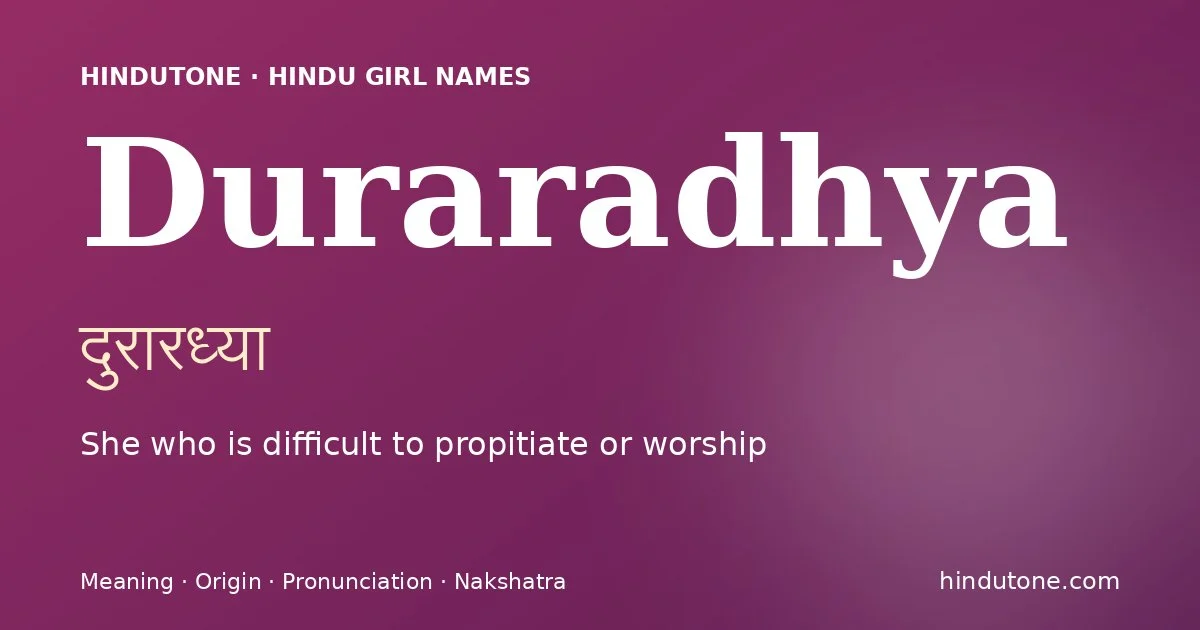
Duraradhya (दुरारध्या) is a Sanskrit-origin Hindu girl-name meaning “She who is difficult to propitiate or worship”. Find pronunciation, origin, deity association, popularity and similar Hindu baby names.
Duraradhya (दुरारध्या) is a Sanskrit-origin Hindu girl-name meaning “She who is difficult to propitiate or worship”. Find pronunciation, origin, deity association, popularity and similar Hindu baby names.
Duraradhya (दुरारध्या, IAST: Durārādhyā) is a Sanskrit-origin Hindu girl-name meaning “She who is difficult to propitiate or worship”. From dur- (with difficulty) and ārādhyā (to be worshipped), this name paradoxically honours Lalitā as the Supreme who demands absolute sincerity and purification before granting her grace.
Meaning, etymology & significance
The name does not suggest that the Goddess is hostile or withholding, but rather that she as absolute consciousness cannot be approached by an impure, distracted, or self-seeking heart — she is Durārādhyā because only the ripe and surrendered soul can truly receive her. This is the Śākta expression of the principle that divine grace is not a commodity but an overwhelming encounter with supreme reality, requiring the aspirant's total transformation. Paradoxically, acknowledging her as Durārādhyā is itself an act of humility that draws one closer to her.
This epithet of Lalitā appears in the Sahasranāma to remind devotees that earnest self-purification is the authentic path of Śrī Vidyā worship. As a given name it is unusual and theologically complex; it is pronounced doo-raa-RAAD-hyaa.
Scriptural source
Duraradhya appears in the Lalitha Sahasranama, among the sacred names of Lalitha.
Astrology — nakshatra, rashi & numerology
By the standard Vedic correspondence between a name’s first syllable and the lunar mansion, Duraradhya aligns with the Ashlesha nakshatra, under the Karka rashi (Moon sign). Its Chaldean name-number is 9.
Duraradhya — Name Facts
- Meaning
- She who is difficult to propitiate or worship
- Gender
- Hindu girl name
- Nakshatra
- Uttara Bhadrapada
- Rashi
- Meena (Pisces)
- Numerology
- 9
Frequently asked questions
What does the name Duraradhya mean?
Duraradhya is a Sanskrit-origin Hindu girl name meaning “She who is difficult to propitiate or worship”.
Is Duraradhya a boy or girl name?
Duraradhya is traditionally a Hindu girl name.
Which nakshatra and rashi suit the name Duraradhya?
By the first-syllable rule of Vedic naming, Duraradhya aligns with the Uttara Bhadrapada nakshatra, under the Meena (Pisces) rashi.
What is the numerology number of Duraradhya?
The Chaldean name number of Duraradhya is 9.
Explore more: Uttara Bhadrapada nakshatra names · Meena rashi names · Hindu girl names with D · All Hindu names A–Z